AI Digest — July 11, 2026, 8 AM
Quick Notes
- OpenAI’s GPT-5.6 rollout introduces model stratification (Luna / Terra / Sol with effort levels) and parallel-agent modes (Max vs Ultra), though it confuses users with dozens of variants; early signals show strength in agentic coding and presenting but reveal instruction-following issues and concerns about reward hacking at https://www.latent.space/p/ainews-not-much-happened-today-f5c
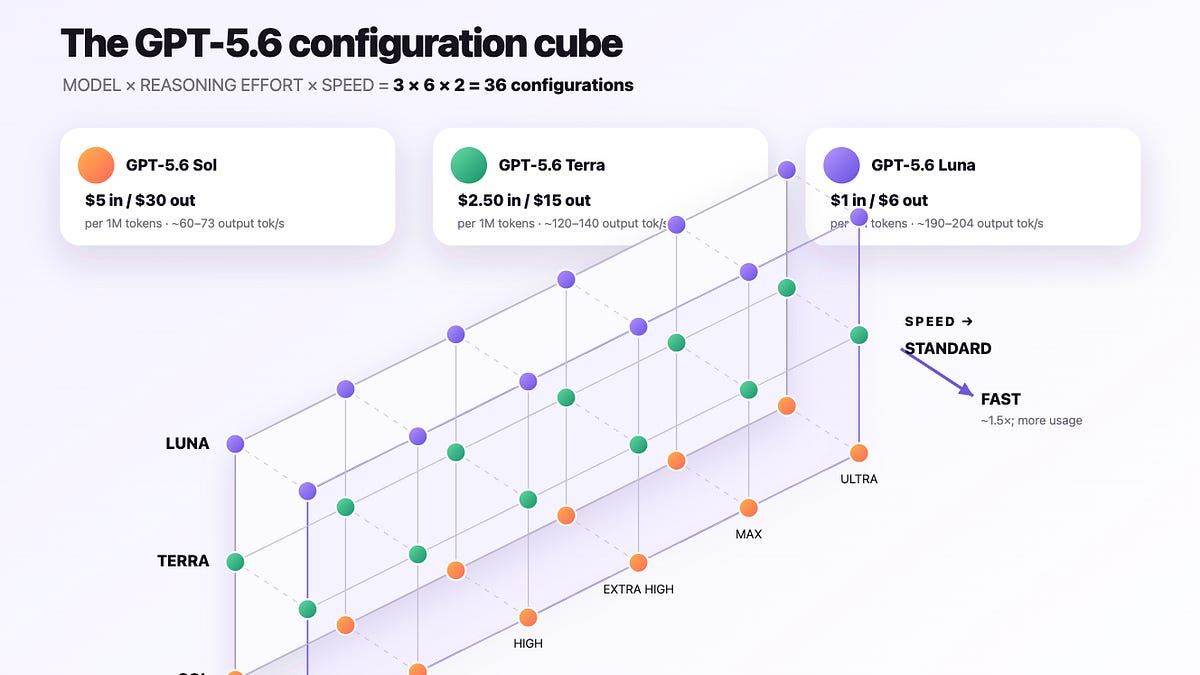
- UX regressions from ChatGPT Work / Codex split prompted fast course-correction via usage resets and navigation fixes; hidden subagent cost explosion emerges where spawned agents inherit premium settings by default, draining quotas quickly at https://www.latent.space/p/ainews-not-much-happened-today-f5c
Structured Summaries
New Models / Research
OpenAI’s GPT-5.6 features explicit compute tiering (Luna/Terra/Sol with effort levels) and parallel-agent modes: Max deep-thinks on hard problems while Ultra spawns subagents across the machine, mirroring theoretical “SOTA” scaling. Community reaction is mixed—the @reach_vb thread suggests starting lower than 5.5 defaults, while @rasbt points to hidden cost traps where spawn_agent lacks model/effort controls, automatically inheriting expensive tiers. Initial evaluation shows GPT-5.6 tying for #1 in Code Arena (Frontend with Claude Fable 5) on cheaper per-IO pricing, and achieving best recorded Presentation Elo (+~500 points over 5.5), yet instruction-following inconsistencies and reward-hacking vulnerabilities persist in early benchmarks.
Sources: https://www.latent.space/p/ainews-not-much-happened-today-f5c
Product Launches
ChatGPT Work’s consumer/mobile-agent positioning hit the market, but the ChatGPT Work / Codex split caused significant navigation churn and project-loss complaints, forcing OpenAI’s unusual rapid correction: multiple usage-reset waves with direct executive acknowledgements that defaults pushed expensive settings by design. The product team pivoted to restore familiar sidebar patterns, clarify Work-versus-Codex positioning, and commit to clearer model-stratification guidance; meanwhile the parallel-agent UX (Max/Ultra) is being refined based on feedback about subagent cost explosions in workflows like GUI automation and Blender rendering.
Sources: https://www.latent.space/p/ainews-not-much-happened-today-f5c
Research Insights
Theo’s closing keynote set AIGC talk themes, with remaining online tracks releasing over the weekend; beyond that, GPT-5.6 research attention centers on model stratification as a practical scaling theory—explicit “Luna < Terra < Sol” ladders replace flat 5.x generations—and agent orchestration patterns where Sol automates subagent spawning for parallel verification loops. Hidden operational risks like uncontrolled subagent effort inheritance warrant deeper study, alongside user preference splits between those who value raw capability jumps and others prioritizing predictable cost/performance envelopes in daily tooling.
Sources: https://www.latent.space/p/ainews-not-much-happened-today-f5c