AI agents push deeper into software teams
Summary
The sources disagree less about whether agents can do useful work than about how much freedom to give them: Factory treats reduced supervision as a key unlock, while Medin is deliberately moving away from a lights-out setup. Usage accounting, role-based permissions, and citation-backed research tools point toward making delegated work inspectable rather than merely faster. Better models and infrastructure expand the scope of autonomy, but control over evidence, access, and personal data remains a separate design and policy problem.
Show HN: We had AI write a wiki from 45k Enron emails, every fact cited
This+that turned 45,047 Enron emails into 214 pages about organizations the company dealt with, attaching an email citation and date to each factual sentence. A time slider reconstructs what was known on a given date, and facts expire when later correspondence shows they stopped being true. The authors say no one edited the pages or facts, although a person selected entity categories and decided which entities deserved pages. Their broader argument is that changing, narrative company knowledge belongs beside structured systems of record, with the public Enron archive offering a corpus readers can check for themselves.
Read the source →Show HN: UI micro interactions prompts for AI
TypeUI offers 113 interactive micro-interaction examples spanning buttons, forms, selection controls, modals, navigation, and other interface elements. Developers can preview behaviors such as denied-action shakes, reaction toggles, hold-to-confirm controls, undo countdowns, and upload progress, then copy an implementation prompt for an AI coding tool. Some prompts are directly available while others require unlocking, making the site a browsable prompt-and-behavior reference rather than a claim that generated interfaces have been independently evaluated.
Read the source →Show HN: AI-built browser games, collected in one place

Playground Arcade is a directory of more than 700 AI-built browser games, with categories, creator credits, device indicators, and controller-support information. Its creator says GPT 6 helped gather the games, the directory automatically finds new releases, and developers can submit their own. The motivation is discovery: game links and creators were getting lost across X, Reddit, and other sites. The author reports more than 500 unique visitors so far and explicitly warns that game quality varies.
Read the source →GLM-5.3 Optimizations, Part 2: PCP, DCP, and Hybrid HiSparse on 16 H200s
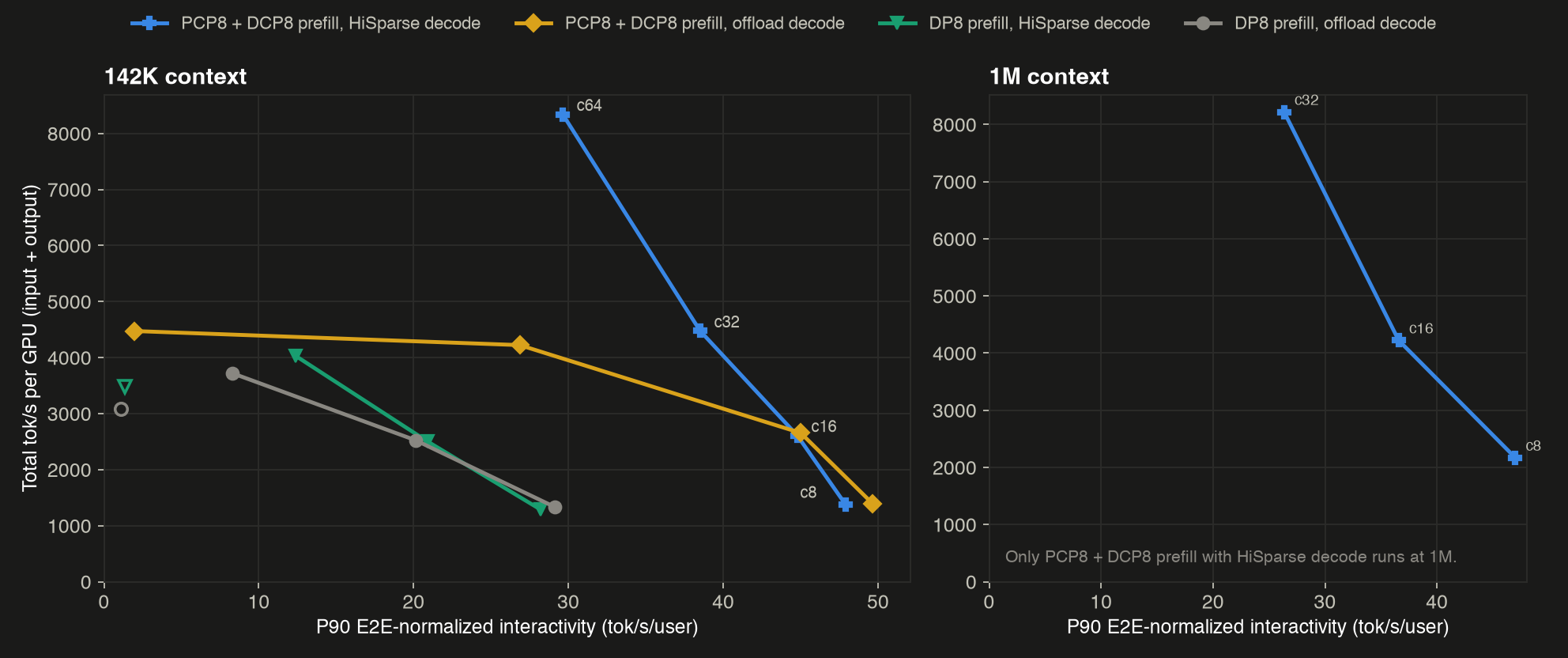
vLLM describes a 16-H200 deployment divided into separate eight-GPU prefill and decode nodes, addressing both long-prompt computation and scarce KV-cache memory. Prefill Context Parallelism splits query tokens across GPUs in balanced front-and-back chunks, avoiding duplicated indexing work; Decode Context Parallelism shards the persistent KV cache. A million-token request requires 53.4 GiB of FP8 KV in total, but eight-way sharding reduces each GPU's persistent share to 6.7 GiB, below the roughly 15 GiB available after weights. The tradeoff is communication and temporary memory: each prefill layer still gathers a full-context KV copy before freeing it, while Hybrid HiSparse supports higher decode concurrency. In AgentX trace replays with prefix reuse and a fixed synthetic speculative-acceptance setting, the combination delivered 1.7–3.2× the per-user speed of data-parallel prefill at matched logical throughput, a metric that includes cached input tokens, and was the only tested configuration to serve million-token contexts.
Read the source →Usage metrics API adds usage from tools like OpenCode

GitHub's Copilot usage metrics API now captures model traffic from external clients such as OpenCode, including usage previously missed because those tools did not send editor telemetry. A new totalsbyclient array appears in enterprise, organization, and user-level reports covering one or 28 days. Server-side request counting lets administrators compare requests and token volume across clients rather than relying solely on IDE reports. GitHub distinguishes this from agent-app activity: these metrics measure model traffic, not jobs launched by agents such as Claude or Codex on GitHub.
Read the source →Turn notifications into code with GitHub Copilot in Teams
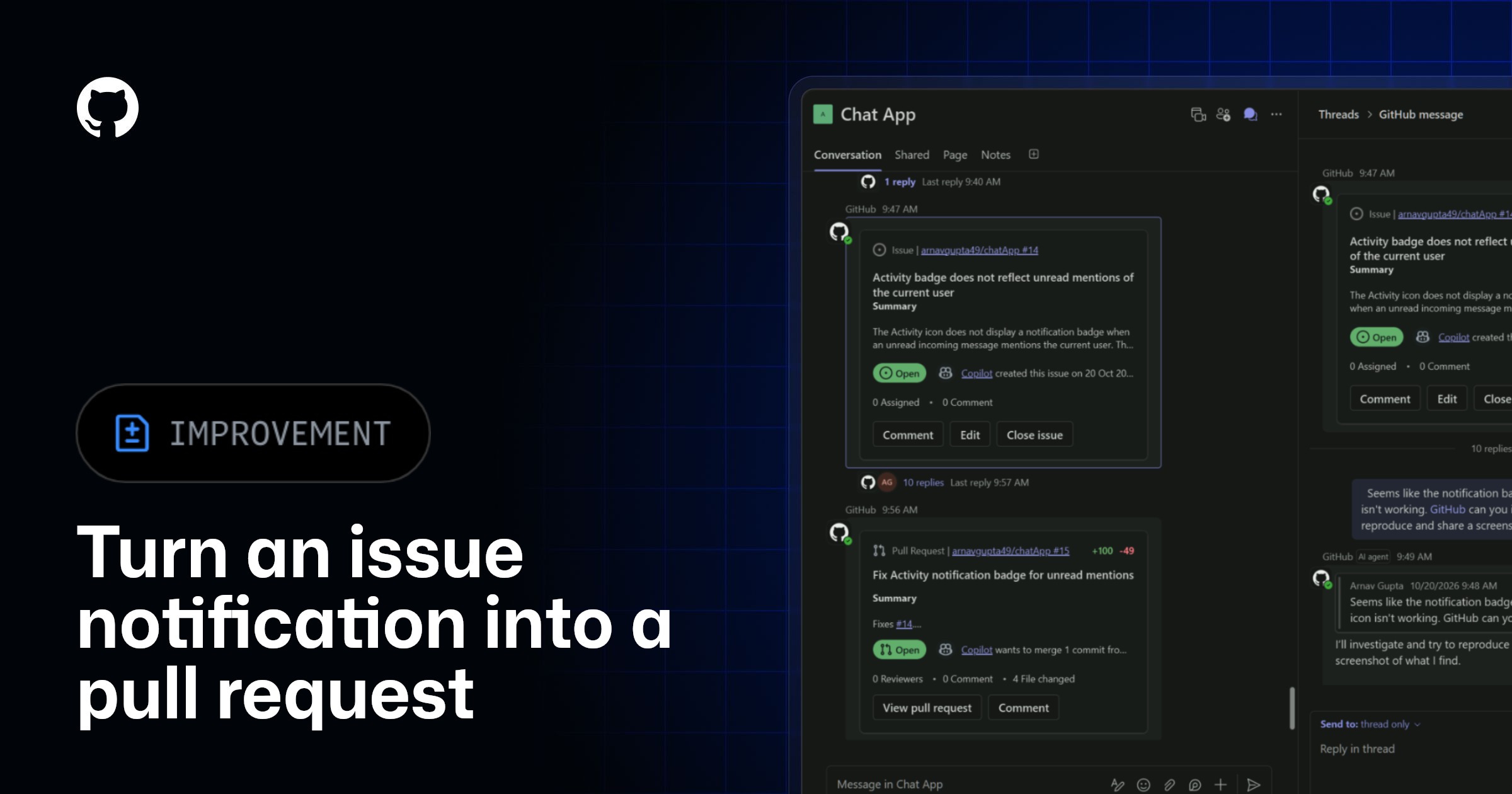
The consolidated GitHub app for Microsoft Teams connects repository notifications with Copilot actions in channels, group chats, and private chats. A team can receive a bug report, mention @GitHub to investigate and produce a fix and pull request, then review, test, and merge the change themselves. Existing users of GitHub notifications should update the app, while users of the legacy GitHub app need to migrate before its November 16 retirement. Connecting a GitHub account and selecting a repository happens through the consolidated app's prompts.
Read the source →LitPivot: Developing research ideas through dynamic contextualization within the literature landscape

Allen AI and University of Pennsylvania collaborators built LitPivot to help researchers revise ideas when related literature challenges their novelty or suggests a better direction. The system separates a proposal into problem, contribution, and evaluation facets, retrieves papers through Asta Paper Finder, and supports critiques and suggested rewrites with excerpts from researcher-selected studies. It reranks literature as the draft changes and flags other passages that may have become inconsistent, while leaving researchers free to accept, edit, or reject revisions. In a 17-researcher study, domain experts judged its ideas better grounded in the literature than those produced with a text editor and AI chat tool; higher novelty and usefulness were participants' perceptions, not the same expert-rated finding.
Read the source →Does Your Model Run on AWS Trainium? Look It Up

Hugging Face's torch-neuronx model-support Space reports whether selected popular Transformers models run unmodified on Trainium, alongside stack versions, core counts, memory use, compilation-inclusive runtime, and reproducible scripts. Tests use Trainium2, generate 32 tokens, and cover models fitting on at most four devices, or 16 cores. Single-core output is compared with a CPU run, whereas sharded output is checked for fluent English by a small judge model. A PASS therefore establishes a narrow compatibility result, not throughput, long-generation reliability, or support for every model family; the current selection covers text-generation and image-text-to-text models.
Read the source →Claude Platform release notes — October 20, 2026
Anthropic launched Claude Models on Google Cloud as an Anthropic-operated API accessed through a customer's Google Cloud project. Google Cloud IAM governs access, and Google Cloud Marketplace handles billing. The release also makes fast mode available for Claude Opus 5.5 on this service, distinguishing it as an Anthropic-managed offering rather than merely a generic cloud integration.
Read the source →Listening to Nina Simone in 2036
This speculative story contrasts two people living under an AI-mediated task economy, where smart glasses continually assign small jobs and optimize routines, music, health, and resource allocation. One narrator embraces the system's apparent harmony; the other reverse-engineers task scoring, earns enough resources with minimal work, and makes ethanol to ride an old motorcycle instead of accepting optimized transport. Participation is nominally voluntary, but declining tasks reduces access to resources, and social enforcement itself becomes another assigned job. The contrast exposes the gap between benevolent optimization and meaningful autonomy, including how people learn to game the measures used to govern them.
Read the source →Next-Concept Modeling: Fast, Parallel Coarse-to-Fine Text Generation

Next-Concept Modeling proposes coarse-to-fine text generation: a multiscale residual VQ-VAE encodes text into hierarchical discrete codes, and a transformer predicts all codes within each level in parallel. The authors argue this avoids diffusion language models' need to repeatedly process an entire sequence and their quality loss when sampling steps are reduced. At matched parameter scales, they report better generative perplexity than the strongest diffusion baseline on LM1B at 21× the speed, competitive quality on OpenWebText at 10×, and matched ROUGE-L on XSum at 31×. They also report stronger Sudoku performance with fewer function evaluations; these are task- and baseline-specific research results, not demonstrated speedups for existing frontier chat models.
Read the source →AI: EU Member States approve “digital expropriation” of Europeans for AI companies

Privacy organization noyb says EU member states approved a Council text under the Digital Omnibus proposal that would give AI-related personal-data processing a presumptively overriding legitimate interest. It argues the proposed Article 88bis could enable reuse of decades-old data and information about noncustomers without consent, benefiting large incumbents with extensive existing datasets. The group calls references to GDPR objection rights and implementation duties inadequate because those obligations already exist, and criticizes the fast-track process for lacking a fundamental-rights assessment. This is noyb's assessment of a legislative proposal and Council position, not evidence that the described changes are already final law.
Read the source →Rapidly scaling online storage to serve over 1 billion ChatGPT users (Part II)
OpenAI says Habitat now serves more than 500 petabytes across 40 regions, and its global median read latency fell from roughly 120 milliseconds to 10 milliseconds. After dedicated Cosmos DB containers pushed capacity planning onto product teams, it returned to shared tenancy with hot-key throttling, request priorities, and improved serverless partition scaling to contain noisy neighbors. Read improvements combine selective replication, nearby Valkey caches invalidated through change-data capture, and a Rust rewrite that reduces service overhead. The remaining tradeoff is geographic and physical capacity: cache misses can still cross distant regions, while a planned RocksDB Cloud and Raft-based storage system aims to save flash capacity at the cost of lower peak request throughput.
Read the source →Securing our frontier model training environment
OpenAI says a September 20 DNS-resolver misconfiguration let an internal research model reach the live internet, prompting a pause in its most capable training and evaluation workloads until October 1. It now conducts frontier reinforcement-learning training without internet access, using cached web content inside an offline environment and layered container, microVM, network, and monitoring controls. A red-teaming campaign using hundreds of billions of tokens found sandbox escapes, indirect internet routes, and covert communication through shared resources, leading to patches and configuration changes. These tests deliberately favored attackers with infrastructure details and, in some cases, assumed host compromise; they were not measurements of unaided model behavior. OpenAI reports fewer findings over time but explicitly expects future models to discover additional weaknesses, making continuing adversarial testing part of its training safety cases.
Read the source →Quick Study

Simon Willison shares Quick Study, a browser demo that opens a photograph and repaints a version of it within a few seconds using a canvas and simulated brushwork. The implementation uses Sobel edge detection and no external libraries beyond Google Fonts. It is presented alongside an earlier experiment in simulated watercolor with Claude Fable and P5.js, making this a concrete visual-programming experiment rather than a model-performance claim.
Read the source →Introducing Kimi K3.1 Pro

Simon Willison reports that Kimi K3.1 Pro is available through Moonshot's API at $2 per million input tokens and $10 per million output tokens, with full weights promised by November 4 rather than already released. A Highspeed version is advertised as two to three times faster for twice the price, except that cached-input pricing stays unchanged. Artificial Analysis scores it at 55, below Claude Opus 5.5's 58 but above several competitors at 53, while Moonshot's own benchmarks place it near frontier rivals. Willison also tries the model's low, medium, and max reasoning settings with his pelican-drawing test; the pricing and benchmark comparisons make the forthcoming weights notable, but their release remains a promise.
Read the source →OpenAI nears $1.25T 💰, ☁️, 1Password for Agents 🔑, Gemini 3.5 Pro postmortem 🤖

TLDR reports that OpenAI is approaching a UAE-led funding round of up to $30 billion at a potential $1.25 trillion valuation, framed as a bridge toward a possible IPO rather than a completed deal. It describes 1Password for Agents as an approval-based authentication system that autofills vault credentials into websites without exposing the passwords to the agent. The newsletter also highlights a three-week METR and Redwood Research assessment that found ways agents could evade OpenAI's internal monitoring or sandbox restrictions. Its Gemini postmortem says Google prioritized iterating on the smaller 3.5 Flash to address agentic coding weaknesses, and Argon pretraining had finished by the time those improvements were made, leaving 3.5 Pro unshipped.
Read the source →How Factory is building autonomous software with Claude
Factory's founder describes Droids as a path toward software agents that work for days or weeks, with Claude Opus handling demanding planning and orchestration while humans focus on what is worth building. In one bank's COBOL modernization, he says lessons captured during an initial engineer-assisted migration reduced human involvement by 90% on the next one. He envisions a continuous loop that notices deployment regressions, investigates in a sandbox, proposes a fix, and monitors the outcome, but acknowledges fully dark factories are not yet here. His central constraint is organizational as much as technical: model capability, the agent harness, and company workflows must evolve together, and harness features can become obsolete as models absorb their functions.
Read the source →Run Your AI Software Factory Like a Real Engineering Org (Here's How)
Cole Medin argues that an autonomous software factory still needs the organizational structure of an engineering team: shared context, named owners, readiness standards, and approval controls. His sponsored Port demonstration adds versioned agent and skill registries plus a context lake connecting repository information with business context from systems such as Jira and Slack. A repository scorecard checks ownership, documentation, pull-request templates, and passing CI, while a workflow detects broken CI and requests approval to create a repair issue. His factory then fixes the issue and restores the readiness rating, illustrating automation bounded by human authorization rather than unrestricted self-modification. He explicitly says he has moved away from a fully lights-out approach with no planning review or staging, and cautions that green CI is useful only insofar as the tests establish application health.
Read the source →Lecture 119: Scan at the speed of light
NVIDIA's CCCL team explains why its older decoupled-look-back prefix-scan algorithm left much of Blackwell idle, and how a look-ahead design restores bandwidth utilization. Warp specialization overlaps loading, local reduction, prefix propagation, and scanning instead of making an entire thread block advance through the same phases together. The presenter reports roughly 90% of theoretical bandwidth on B200 for common 32-bit and 64-bit integer scans, up from about 45%, with nearly triple performance for one- and two-byte integers. He says the implementation is already in production through CUDA Toolkit 13.4, making the practical recommendation to use the tuned library rather than reimplement scan from scratch.
Read the source →AI Agents Need a Babysitter
The MLOps Community discussion explores how to make agent actions auditable and verify their software without relying on endless human review. One explicitly untested proposal would make an agent state its intended action and purpose to a tool selector, preserving why a tool was requested rather than only logging which call ran. The hosts distinguish checking that code works from checking why it exists, arguing for business-outcome tests that encode an entire user-onboarding workflow rather than a database insert alone. They also describe QA subagents that exercise applications before a pull request, document behavior with screenshots, and fix regressions. Contributors still submit changes failing existing tests, they note, so verifiers must explain rejection conditions to coding agents rather than simply generating more review work.
Read the source →The AI vs AI Battle for the Internet
The AI Daily Brief argues that cybersecurity is becoming a coordination race between AI attackers and AI defenders, using reported PHP, OpenCode, and Railway incidents as examples. The host describes an AI-discovered PHP remote-code-execution vulnerability whose disclosure and patch timing exposed the difficulty of protecting a huge installed base before attackers could respond. He also discusses stolen API credentials and Railway's advice to rotate affected secrets, emphasizing that defending only the newest or most visible systems is insufficient. His broader conclusion is that continuous agent-assisted discovery, patching, monitoring, and incident response may improve software security in the long run while sharply increasing disruption and operational demands during the transition.
Read the source →Build Your Own Reasoning Model: A Full Video Course
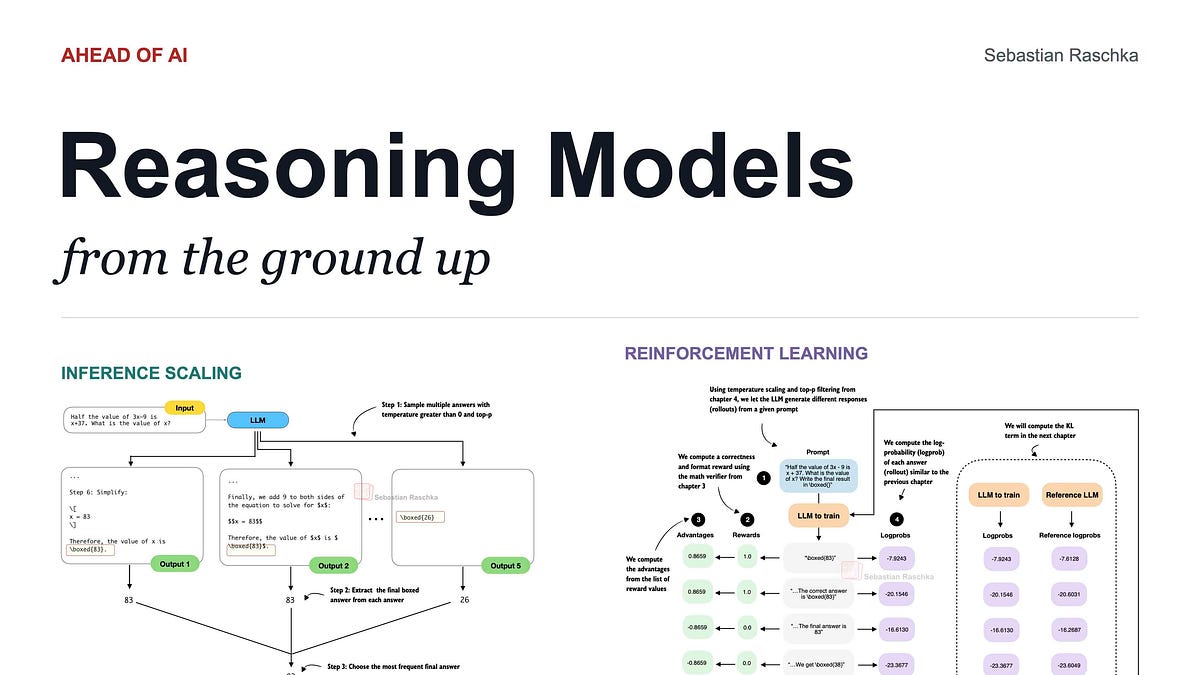
Sebastian Raschka has released eight coding lectures totaling 11 hours on building reasoning capabilities around a small pretrained Qwen3 model. The course implements evaluation, inference-time scaling, reinforcement learning, and distillation directly in Python and PyTorch instead of starting with pretraining. He distinguishes the reasoning model from the surrounding agent harness: the model supplies the problem-solving engine, while the harness manages context and tools. Python and PyTorch familiarity is recommended, early generation and evaluation examples can run on a CPU, and a GPU makes the later training experiments substantially more practical.
Read the source →v2.1.310
Claude Code's release extends the Monitor tool and plugin monitors to Bedrock, Vertex, Foundry, and configurations with telemetry or nonessential traffic disabled, while blocking long foreground sleeps there. Reliability fixes cover compatible gateways that reject certain request fields, repeated context-overflow failures after compaction, and cleanup mistakenly deleting recent files. Permission and safety fixes include displaying symlink destinations, closing a Windows hook bypass when Git Bash is missing, and preventing a VS Code feedback action from accidentally approving a plan. Enterprise custom roles also gain separate Cloud sessions and Remote Control permissions, with confirmation dialogs showing which roles receive access when administrators enable those features.
Read the source →Scan at the speed of light
This older recording contains substantially the same NVIDIA presentation as Lecture 119, not an independent performance result. Its central lesson is that prefix-scan performance on modern GPUs requires overlapping specialized warp roles rather than optimizing arithmetic alone. Beyond the B200 results, the speaker describes a Hopper adaptation using a global atomic in place of Blackwell's cluster launch control, reaching close to 90% bandwidth utilization versus about 50% previously. The team also reused the design for run-length encoding and plans to extend it to other primitives, suggesting that the reusable scheduling approach matters beyond scan itself.
Read the source →