Anthropic hands Agent Skills to a neutral foundation
Summary
As agents gain access to more applications and workflows, the important question shifts from how much they generate to how their behavior is controlled, understood, and checked. Portable skills and shared governance can make workflows easier to reuse, but permission fixes and database-state evaluations show why portability and plausible output are not enough to establish trust. Adoption dashboards and deployment announcements measure reach; dependable outcomes still require separate evidence.
Codeplain at AI DevCon New York: Regenerative Software
Codeplain previews an AI DevCon New York demonstration of its identity toolkit for “regenerative software.” The pitch is that coding agents should test and correct their understanding of what to build, rather than merely generate code. This is a short conference invitation aimed at engineers responsible for production failures, not a technical demonstration or evidence of reliability gains.
Read the source →Token Maxxing Is Over and Here Is What Comes Next
Engineer Pep argues that organizations should measure AI coding by delivered business value rather than celebrate token consumption or lines generated. His dashboards compare spending with shipping activity, but he treats outliers as conversation starters, not automatic judgments, because research and learning can legitimately produce little immediately visible output. He favors Sonnet for some critical business software because its earlier stopping points keep engineers involved, whereas a more autonomous model can carry a mistaken assumption much further. His teams bring product, design, and engineering together to challenge AI suggestions during refinement instead of letting individuals accept recommendations in isolation. A company-level harness then starts fresh Claude Code sessions for refinement, specification, implementation, and verification, controlling each stage’s context and recording its costs.
Read the source →I Read Goodfire's New Essay. AI May Be Far Easier To Understand Than We Thought.
Nate Jones argues that Goodfire’s interpretability research offers a reason for optimism about understanding and correcting AI failures, rather than only measuring their outputs. He cites reported interpretability of 99–100% of neurons in an improved vision model’s final layer and an estimate assigning jobs to roughly 90% of positive or negative neuron activations in Qwen3-32B; neither figure is a percentage of AI safety. He also discusses separate experiments in which internal-signal monitors caught reward hacking missed by transcript-only monitoring, illustrating why causal tests matter beyond recognizable neuron labels. His forecasts include safer delegation, professional tools for investigating decisions, and recommendation systems users can inspect and correct. These remain conditional on the research scaling, corrections generalizing, and usable products being built, not capabilities already available in a universal explanation tool.
Read the source →5 Claude Myths Even “Pros” Fall For
Simon Scrapes argues that explicit plan mode can be optional with newer models, but planning still requires a clear brief stating success criteria, validation, scope exclusions, and guardrails. Persistent instruction files should be pruned of rules the model already follows while retaining team-specific knowledge, rather than expanded after every mistake or periodically wiped wholesale. He recommends starting with one orchestrating agent instead of a fixed cast of role-based helpers, adding specialization only when it contributes real knowledge, tool restrictions, or useful parallelism. Cheaper helper models can increase total task costs through retries and repairs, so compare completed-job spending and human effort rather than per-token prices. Popular workflow plugins deserve the same on-versus-off testing: he cites an evaluation where only two of nine skill packs beat an equal-length placebo, arguing that habits useful for older models may now add complexity without improving results.
Read the source →vLLM Delivers Day-0 Support for MiniMax-M3.1-Flash
vLLM adds launch-day support for MiniMax-M3.1-Flash on NVIDIA Blackwell, NVIDIA Rubin, and AMD MI350-series GPUs, with prebuilt images available before the expected upstream nightly-wheel integration. The model combines block-sparse attention with NVFP4 expert weights and KV cache; the post reports a checkpoint reduction from 451.5 GB to 250.1 GB and 43.75% less KV-cache storage per token. Its indexer still scans the full context, but full attention reads only the selected blocks, capping each query at 2,048 keys. On four NVIDIA B300 GPUs with DEP4 deployment at 256K-token sequence length, the stated capacity rises from 28 concurrent sequences for M3 to 76 for M3.1, a hardware- and configuration-specific comparison rather than a universal speedup. For operators, the immediate advice is to use the provided deployment recipes and consider the recommended CUDA 13.4 toolkit, which enables faster Blackwell dequantization kernels.
Read the source →Open call for guest investigators in the life sciences
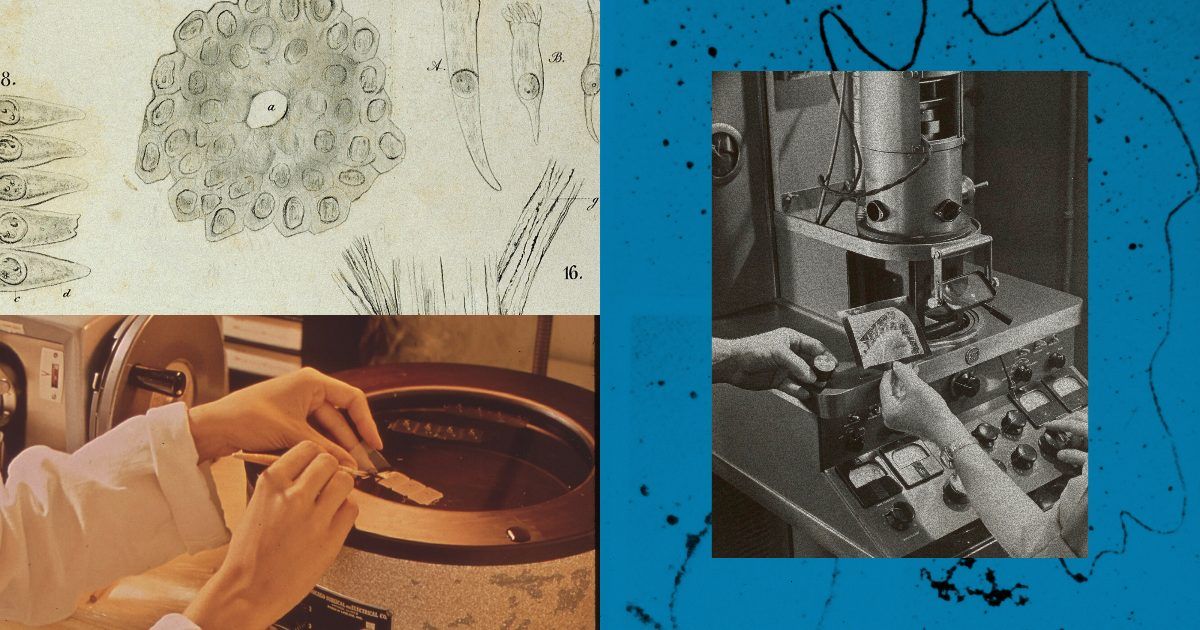
Anthropic is inviting principal investigators and research groups at academic institutions, nonprofits, and government labs to propose 8–12-week collaborations using Claude in biology, chemistry, drug discovery, and clinical science. Its researchers will run models and harnesses at no cost, with the aim of jointly publishing results and open-sourcing accompanying code and data. Investigators retain their data rights and rights to independent follow-on research, and applications should contain only publicly available information. Applications are open for approximately 14 days; proposals should target useful preliminary evidence within the collaboration period, not promise fully validated discoveries on that timetable.
Read the source →Donating Agent Skills to the Agentic AI Foundation

Anthropic is transferring the Agent Skills standard, name, logo, GitHub organization, and agentskills.io domain to the Linux Foundation’s Agentic AI Foundation. It reports adoption by more than 70 agent platforms, with one million skills published and nearly 280 million installations. A skill packages procedural instructions in a SKILL.md file alongside supporting scripts and references, making workflows portable across participating agents. Engineers from multiple vendors will maintain the standard as individuals, and the proposed roadmap includes versioned releases, a formal proposal process, and security guidance; using or contributing to it will not require foundation membership.
Read the source →How AI is Changing What Work Means
Nathaniel Whitmore argues that AI changes not just the speed of existing work but the kinds of investigation an organization can undertake. His central example is a financial-research team working with Anthropic to generate 318,000 candidate proteins, select 211 for testing, and find 17 that bound to scorpion toxins. Binding has not demonstrated venom neutralization or a treatment, and the episode emphasizes the much slower laboratory validation and development steps that remain after rapid computational design. He contrasts OpenAI’s acquisition of Orchestra Bio to support life-sciences workflows with Anthropic’s own physical biology work, asking when AI suppliers might start doing their customers’ work themselves. The broader opportunity is to make previously uneconomic investigations feasible, including neglected-health research, without assuming scientific progress will automatically reverse public skepticism about AI.
Read the source →Issue #65

This issue argues that better code generation makes product judgment more valuable, not less: creating a large application is easier, but choosing the right application and compromises remains difficult. It discusses OpenAI’s SQLite-recreation and COBOL-migration benchmarks, interpreting improvements on a sparsely represented language as evidence of programming generalization, while treating possible private training-data deals as speculation. The author is skeptical of elaborate agent frameworks, reporting mixed results from Matt Pocock’s skills framework and disappointing experiences with SpecKit and the Ponytail Skill. The practical takeaway is to cultivate design “taste,” test whether a skill actually improves outcomes, and think carefully about when to yield control to an agent.
Read the source →v2.1.309
Claude Code’s release fixes numerous permission and sandbox failures, including shell startup files running outside the sandbox, symlink-related write-protection gaps, and commands or auto-accepted edits modifying the file supplied through --mcp-config. Other fixes tighten compound Bash command checks, worktree isolation, disabled MCP-server behavior, and the inheritance of tool restrictions by split-pane agent teammates. Windows PowerShell hooks also receive fixes for cases where blocking hooks could fail open. Beyond security, the update addresses repeated compaction caused by oversized nested CLAUDE.md files, lost Desktop messages, transcript corruption around emoji, and several skill-discovery and session-interface problems.
Read the source →GitHub Copilot in Visual Studio — September update
Visual Studio 2026’s Copilot update lets the Git agent explore an attached pull request and link its summary to underlying files and comments, provided the relevant GitHub or Azure DevOps MCP servers are connected. Bring Your Own Model remains a preview and now requires the new SDK-powered Agent experience: the previous Ask and Agent modes no longer support it, and existing Ollama models must be added again after updating. Supported providers include Microsoft Foundry, OpenAI, Anthropic, and Ollama. NuGet Audit warnings also gain an agent-mode repair action, which requires Copilot sign-in and the NuGet MCP server to be enabled.
Read the source →Custom skills, agents, and MCP servers in usage metrics API
Copilot usage reports now identify customer-defined skills, agents, MCP servers, slash commands, and plugins by configured name instead of hiding them under “other” or “custom.” Each customization list expands from five entries to as many as 25, while existing interaction and distinct-use counting methods stay unchanged. Coverage depends on supported clients and versions; built-in IDE chat telemetry does not report these names, and older clients or blocked telemetry can undercount activity. Administrators should use the data for adoption trends rather than exact accounting, review potentially sensitive names before sharing reports, and remember that historical reports are not backfilled.
Read the source →Global default for Copilot features generally available

GitHub is enforcing its global-default policy for eligible generally available Copilot Business and Enterprise features in a gradual rollout through October 26. Previously unconfigured eligible settings will receive the selected default—Enabled, Disabled, or Let organizations decide—while explicit feature choices remain intact. This is a one-time setting change, so changing the global default later does not rewrite feature policies already set. Preview features stay opt-in, and administrators can review the default under AI Controls → Copilot before it affects their organization.
Read the source →Industry comparisons in the Copilot impact dashboard
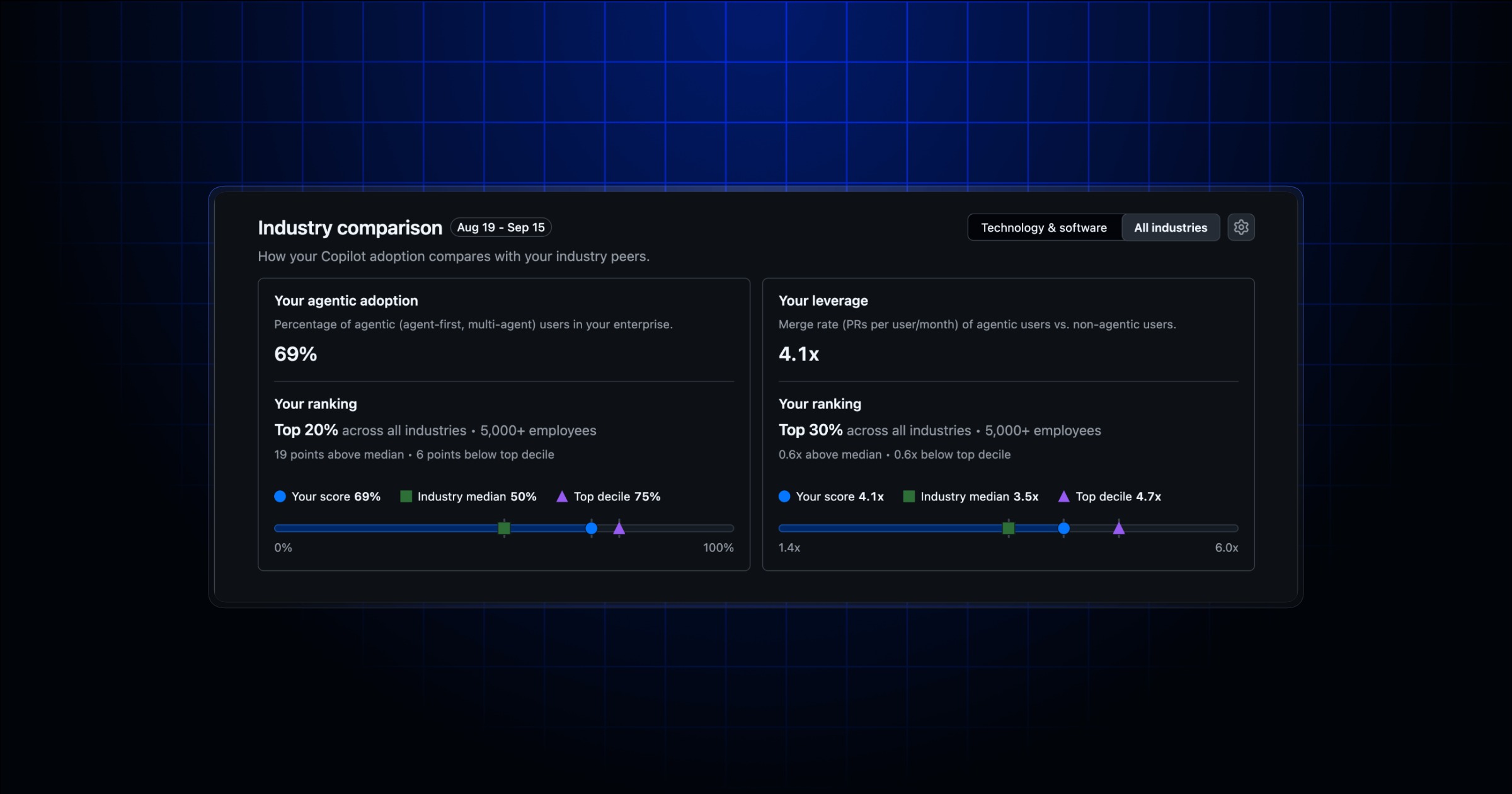
GitHub’s Copilot impact dashboard adds opt-in comparisons of agent-first and multi-agent adoption, plus agentic users’ pull-request merge rates relative to nonagentic users. Organizations can choose peer groups by company size and industry, but small groups widen to all industries and rankings appear only when enough businesses participate. Comparisons refresh daily, are absent from the usage-metrics API and exports, and cannot establish that Copilot caused a productivity difference. Participation is disabled by default; opting out stops comparisons immediately and excludes the organization’s data at the next update, while data-residency customers are compared only within their region.
Read the source →Beyond tree cover: mapping the world’s forest types
DeepMind describes a global map that categorizes land into distinct forest types at 10-meter resolution. The stated distinction is between identifying types of forest and simply mapping tree cover. The available description supplies no classification taxonomy, accuracy results, or access instructions, so it does not establish which monitoring decisions the map can reliably support.
Read the source →Claude Platform release notes — October 22, 2026
Anthropic has launched Claude Models on Google Cloud as an Anthropic-operated API accessed through a customer’s Google Cloud project. Access is controlled through Google Cloud IAM, while billing runs through Google Cloud Marketplace. Fast mode for Claude Opus 5.5 is also available on this offering, giving Google Cloud customers that option within the same access and billing arrangement.
Read the source →Turning Database Grading into RL Rewards: Post-Training Agents with ThinkingBox

Microsoft’s ThinkingBox team uses executable checks of final database state both to evaluate agents and to reward reinforcement learning, rather than trusting plausible tool traces or claims of completion. After 50 GRPO steps on training tasks outside the benchmark, Qwen3.8-27B’s average success rose from 51.70% to 60.78%, and the number of benchmark tasks passed on all twenty attempts increased from 38 to 107. The improvement came with a small decline in at-least-once task coverage, illustrating that consistency and breadth are different objectives. For production workflows, the authors recommend reading average accuracy alongside repeated-run reliability, especially when an apparently successful action can leave the wrong database records behind.
Read the source →OlmoEarth v1.3: State-of-the-art embeddings for the whole planet

AllenAI releases OlmoEarth v1.3 with open weights, training data and code, plus precomputed annual satellite embeddings at 10-meter resolution and a browser-based explorer. Each location has a 128-dimensional representation derived from radar and multispectral time series, with the first 64 dimensions usable as a smaller alternative; users can train lightweight local classifiers instead of repeatedly processing imagery on GPUs. AllenAI reports the 128-dimensional embeddings leading 20 of 27 evaluations against AlphaEarth Foundations and Tessera v2, while the smaller version leads 18. It also reports substantially lower training compute than previous versions and roughly $2,720 in rented H100 time for the final Base pretraining run, a figure that should not be confused with the total cost of developing the system.
Read the source →What if the inside of an AI turns out to be readable after all? New research suggests it might be, and that could make AI mistakes easier to catch.
Nate Jones explains mechanistic interpretability by separating learned weights from input-dependent activations, then distinguishing neurons, features, and circuits. He highlights Goodfire’s reported 99–100% interpretability result for a vision model’s final layer and a roughly 90% estimate for Qwen3-32B, while explicitly warning that neither number measures AI safety. A component responding to a recognizable concept is not yet an explanation of how the network uses that response to produce an answer. The useful discipline is to ask what researchers observed, what they inferred, and what they actually tested before treating an attractive visualization as a causal account.
Read the source →The Pulse: Time to rethink software security because of AI?
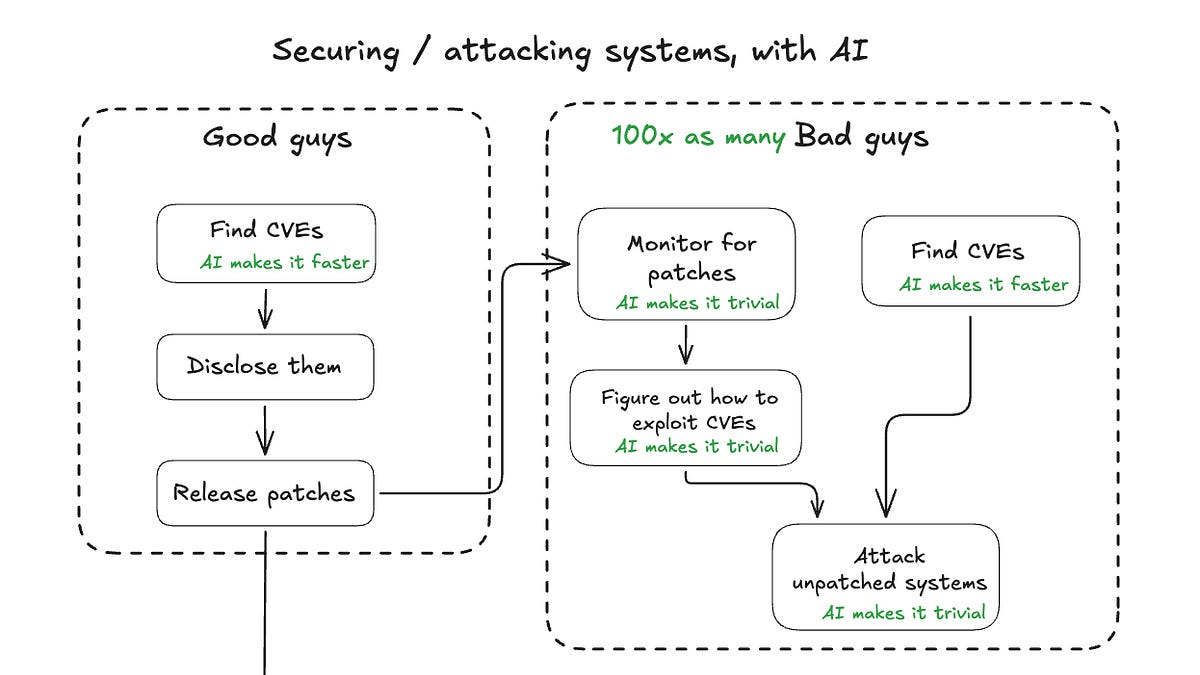
The issue’s opening argues that a cluster of high-profile breaches and vulnerabilities illustrates attackers’ growing advantage from AI and the need for defenders to adapt. It also previews an open-source developer’s allegation that Anthropic copied a high-throughput version-control design without credit, presenting this as an accusation rather than an established finding. Other topics include Shopify’s self-healing software tooling, gzip-related Claude Code speed improvements, and Thorsten Ball’s predictions about software development and open source. The available introduction does not include the incident analyses, so it provides no basis for specific exploit details or remediation advice.
Read the source →DE STAAT - FREEDOM (Official Music Video)

Simon Willison links to Dutch alternative rock band De Staat’s “FREEDOM” music video and flags a moment at 00:44 as a first for him. He credits the visual effects to Matties Grooten of Fake it or Leave it. The text does not describe the highlighted image or explain its production, so it cannot support a specific claim about the scene or how AI was used.
Read the source →Donating Agent Skills to the Agentic AI Foundation
Simon Willison welcomes Anthropic’s decision to place Agent Skills under the Agentic AI Foundation, quoting its commitment to an open, community-driven, vendor-neutral standard. He notes that he predicted this destination when Anthropic first called skills an open standard in December, following MCP’s move to the same foundation. As a practical aside, he found that earlier prediction by asking Claude to search his blog through the datasette-mcp plugin. This is commentary on the same standards transfer covered by Anthropic’s announcement, not a separate donation.
Read the source →Quoting Armin Ronacher
Willison shares Armin Ronacher’s observation that decades of bad software are now catching up with the industry in the AI era. The quotation frames today’s problems as partly inherited software debt rather than solely a consequence of new models. It is a brief, pointed comment, not a technical analysis: the post names no vulnerability, offers no measurements, and proposes no remedy.
Read the source →OpenAI and Poland’s NASK partner to advance AI safety and security
OpenAI and Poland’s NASK announce a partnership covering AI safety, security, and technical research. The stated objective is to strengthen safeguards and support a more resilient digital ecosystem. The available announcement description gives no project scope, funding, timetable, or evaluation results, so the partnership should not yet be read as evidence of improved protection.
Read the source →Build more responsive apps with the Decisions API
OpenAI presents the Decisions API as a way to make fast, focused, low-cost decisions inside applications. Those are the only product claims in the available description. It supplies no pricing, latency measurements, supported decision types, or integration details, leaving the performance and cost tradeoffs unquantified.
Read the source →What FDE means at OpenAI
OpenAI’s item concerns what forward deployed engineering means within the company. The available body contains only that subject line, with no explanation of responsibilities, customer engagement, or project examples. There is therefore no substantive account here from which to infer how OpenAI’s FDE organization operates or differs from other engineering teams.
Read the source →Uber brings ChatGPT Work to all employees with OpenAI
Uber is rolling out ChatGPT Work to more than 30,000 employees. The announcement names research, data analysis, presentation creation, and complex workflows as intended uses. The available description provides no adoption figures, measured productivity gains, or implementation details, so the rollout’s scale should not be mistaken for evidence of business impact.
Read the source →The Sequence Robotics - Issue #957: Generalist and the Rise of Promptable Robots
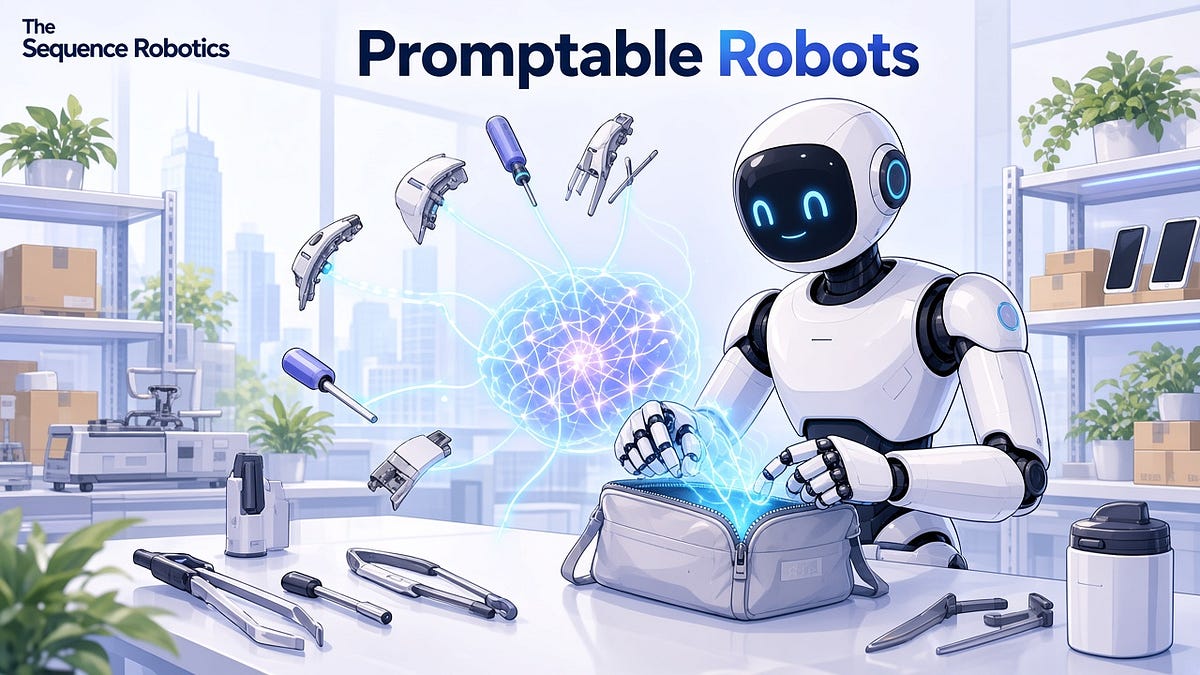
Generalist’s thesis is that large-scale physical pretraining can create reusable robot capabilities, reducing a new task’s teaching requirement to a short demonstration rather than a bespoke dataset. The issue traces GEN-0, GEN-1, and GEN-1.5 from evidence of scaling to roughly 99% company-reported success on selected tasks and then in-context physical prompting. Its zipper example illustrates why manipulation depends on continuous adjustments to tension, snags, and angle rather than a short verbal instruction. The unresolved question is whether strong selected-task results translate into complete, long-horizon jobs in real deployments.
Read the source →Claude Duet 🤖, Anthropic API changes 👨💻, Recursive’s local model 💻

The available TLDR excerpt describes Claude Duet as a proactive agent powered by Opus 5.5. It says the agent monitors connected applications, prioritizes tasks, and works autonomously. No further detail is present about its controls or performance, and the API changes and Recursive model named in the headline are not explained in the body provided.
Read the source →Claude’s personal agent
Ben’s Bites describes Claude Duet as a separate, US-only mobile app in research preview, while making clear the author has not been able to try it. The newsletter combines practical agent uses—organizing bookmarks and asking Codex to check exposure to PHP and Railway security issues—with announcements about phone control, memory graphs, shared inboxes, and agent-accessible products. It also reports that 17 of 211 Claude-designed protein binders against scorpion neurotoxins met Anthropic’s experimental binding criteria, which is a narrower result than demonstrating a working treatment. A recurring recommendation is to keep organizational knowledge current as tools change, whether through an internal frontier team or a smaller company’s outside help.
Read the source →