PHP rushes security fixes after AI-assisted discoveries
Summary
Greater autonomy is making verification and oversight more important, not less: agents can produce more code, security findings, and research leads than people can comfortably inspect. Across the technical and workflow pieces, the strongest proposals pair that speed with independent checks, enforceable boundaries, and better control over when humans are interrupted. The PHP disclosure breakdown shows why even a valuable discovery can create immediate risk when the surrounding coordination fails.
Why AI Companies Are Betting Personality Beats Intelligence
The AI Daily Brief argues that personality is becoming a competitive differentiator as models clear similar capability thresholds, particularly for personal assistants. Artificial Analysis’s new personality benchmark uses 900 questions covering 30 traits, grouping results into eight indices rather than declaring one universally best model. The episode contrasts enthusiasm for Muse’s warmth with complaints about other assistants’ dryness, while warning that pleasing users and offering useful pushback are not the same thing. Its practical recommendation is to use personality measurements to test models against particular jobs, not substitute another leaderboard for hands-on judgment.
Read the source →Your Coding Agent Should Never Hold a Credential
A panel from Docker, Keycard, and Snyk presents Agent Baseline as six security controls for organizations adopting increasingly autonomous coding workflows. Its central recommendation is to keep secrets outside the agent’s sandbox and inject credentials at a controlled network-egress boundary, where permissions can also be narrowed to the task. Sandboxing alone is insufficient because agents consume dependencies, skills, repository configurations, and MCP servers that can introduce malicious behavior. The panel recommends starting with containment and a common organizational setup, reserving human approval for consequential actions instead of exhausting people with constant prompts.
Read the source →Introducing Claude Duet
Anthropic’s short introduction emphasizes an assistant that decides when to act proactively rather than waiting for every instruction. Speakers describe Duet identifying relevant information in Slack and bringing it to them without a prompt, with context awareness determining what deserves attention. The clip highlights phone-based convenience and Opus 5.5’s judgment, but supplies no performance measurements or detailed access terms.
Read the source →Anthropic Just Revealed How Their Engineers Use Claude Code
AI LABS explains Felix Rieseberg’s argument that better agent results require more ambitious outcomes, not merely faster execution of narrowly specified tasks. It organizes the advice around altitude, depth, and range: delegate an outcome, demand expert methods and external evidence, and bring in perspectives from multiple disciplines. Independent review by another model is recommended over letting the builder judge its own work. Crucially, these techniques depend on access to real data, diagnostic context, and environments where an agent can reproduce failures and verify fixes.
Read the source →AI Makes Us WAY Faster but Fries Our Focus (Here's What I Do About It)
Cole Medin describes a productivity trap in which running more agents increases output but fragments attention through constant supervision and context switching. His proposed response is to invest in customized planning, implementation, and validation loops, then batch reviews rather than opening another session whenever an agent is busy. He wants one primary conversation to coordinate longer-running background work, with the workflow encoding how he actually validates results. He acknowledges that this is partly a prediction and that people could simply recreate the same overload by supervising multiple software factories.
Read the source →Day-0 Support for Flint on vLLM
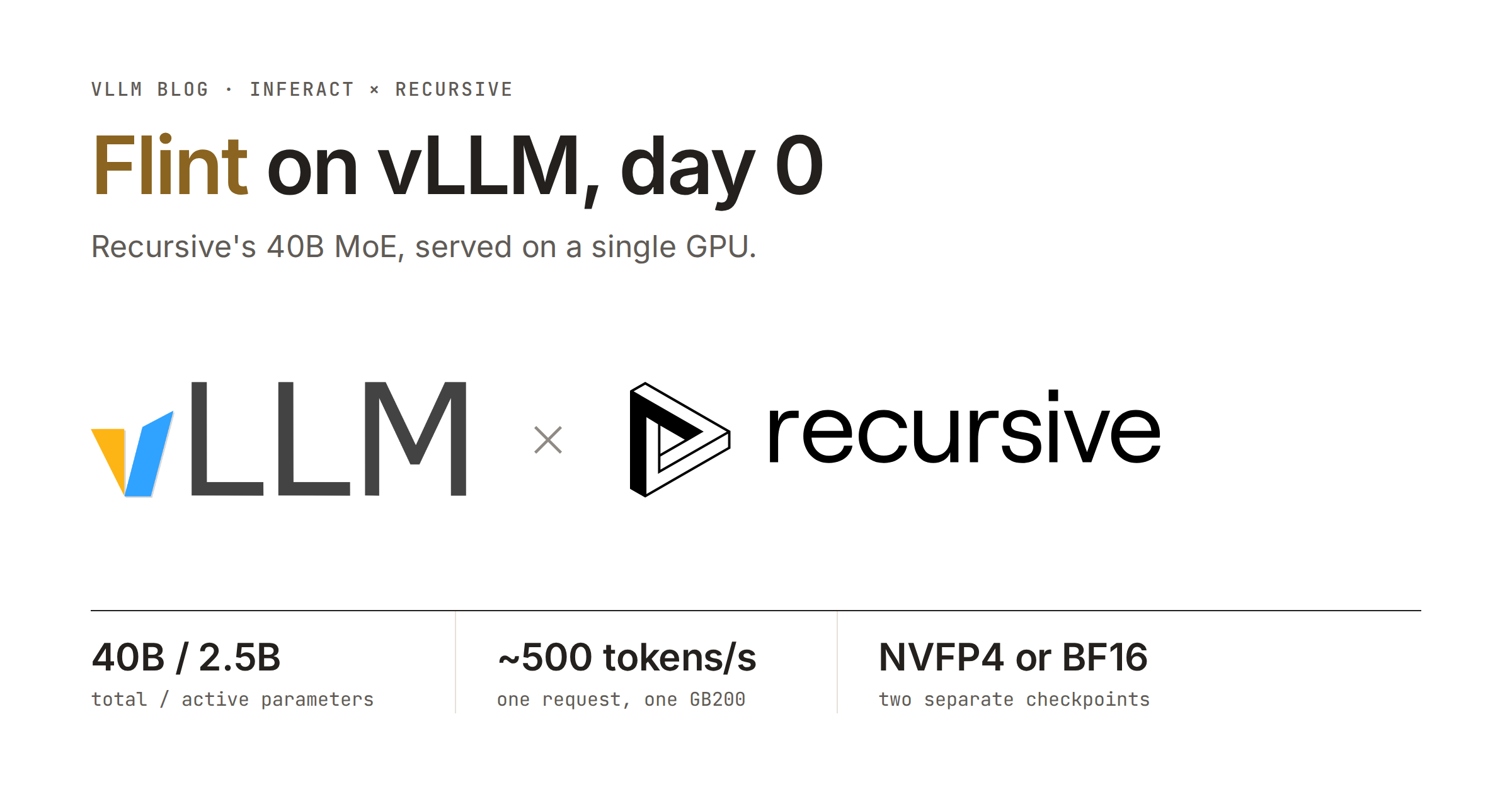
vLLM adds launch-day support for Recursive’s Flint, a 40-billion-parameter mixture-of-experts model that activates about 2.5 billion parameters per token and supports a 262,000-token context. On one GB200, its NVFP4 checkpoint achieves about 485 output tokens per second end to end for a single request at 100,000 tokens of context. Flint-specific kernel fusion reduced forward-pass kernel count from 1,096 to 346 and NVFP4 decode latency from 4.81 to 1.78 milliseconds, with a served latency of 2.06 milliseconds per token. Both BF16 and NVFP4 checkpoints fit on a single GPU, and the team reports matching the reference implementation’s accuracy on the listed evaluations.
Read the source →Anthropic Just Dropped Claude Duet (Here's How To Get Access)
Chase AI describes Duet as an always-on, Opus 5.5-powered assistant with a cloud computer and browser that inherits a Claude account’s memory, skills, and connected apps. The research preview has a waitlist for Pro and Max subscribers, and usage draws from the existing subscription plan. Its distinguishing behaviors are proactive morning briefings and periodic checks of connected applications, rather than requiring a user to initiate every task. The presenter sees convenience and hosted infrastructure as the main benefits for experienced Claude Code users; his expectations about effort settings and usage headroom are speculation, not established limits.
Read the source →v2.1.308 (+ v2.1.307)
The release page identifies Claude Code version 2.1.308, but the available text contains loading errors rather than a changelog. Its generic product description explains the terminal-based coding assistant, not what changed in this release. No specific fixes or features can be established from this entry.
Read the source →Claude Platform release notes — October 21, 2026
Anthropic releases API version 2026-10-21 alongside new major versions of its client SDKs and ant CLI that send that version by default. The SDK and CLI releases also contain breaking changes independent of the API version, and their license changes from MIT to Apache 2.0. New profile fields expose enforcement status and actions, with a filter for finding customers under an open restriction or ban. Migration therefore requires checking both API compatibility and client-library changes rather than treating the upgrade as a header-only switch.
Read the source →Ensemble forecasting with IBM Granite time-series models

IBM’s Granite Timeseries Ensemble combines four pretrained architectures to produce point and quantile forecasts without retraining or fitting ensemble weights. The recommended default gives each member equal influence, while an alternative IQR recipe gives greater weight to models producing narrower forecast intervals. IBM cautions that narrow intervals can reflect overconfidence rather than accuracy, so adaptive weighting should be compared against the uniform baseline on representative series and horizons. Both recipes were evaluated on 97 GIFT-Eval configurations, and deployment downloads four separate checkpoints rather than one merged model.
Read the source →NVIDIA Kumo Relational Outperforms Supervised Machine Learning on Relational Data, No Training Required

NVIDIA introduces Kumo Relational, a pretrained model that predicts directly over linked database tables using up to 10,000 historical labeled examples as inference-time context. It preserves foreign-key relationships and timestamps instead of requiring teams to flatten tables and hand-engineer features for each task. NVIDIA reports results across 41 tasks on 15 databases, including nearly four AUROC points over engineered gradient-boosted trees on RelBench V1 classification tasks and an 8% MRR advantage over AutoGluon ensembles on SAP SALT. “No training” means no task-specific training is required for these predictions, not that the model avoids pretraining or the need for historical examples.
Read the source →How Specializing the Vocabulary of SLMs Can Cut Inference Cost by 77% in Real Applications

Dharma-AI reports a 77% reduction in measured inference cost after specializing the vocabulary of a Qwen3-4B Portuguese essay grader, keeping the base model, data, and training recipe the same. Its VocabX approach targets the cost of tokens rather than frequency alone, reducing fragmentation in repeated JSON output and the burden of scoring largely unused vocabulary entries. In this workload, a generated token cost 7.4 times as much as an input token, making output compression especially valuable. The results are preliminary and under review, and the cost ratio depends on hardware, batching, and context length rather than constituting a universal saving.
Read the source →Profiling TorchNeuron (Part 1): System-level profiling on AWS Trainium.

Amazon walks through diagnosing inference performance on Trainium using TorchNeuron, PyTorch profiling tables, and Neuron Explorer’s system and hardware timelines. The example uses RMSNorm to connect individual framework operations with device work, including a scalar addition that triggers a host-to-device transfer. A practical requirement is to call torch.neuron.synchronize() inside the profiler loop; otherwise, export can occur before device work finishes and leave device timing empty. The tutorial also separates warmup from the recorded iteration and explains how to retain matching executable and instruction-trace files for deeper inspection.
Read the source →Granite Speech 5.0: Transcribe, Translate, and Attribute more Accurately and Faster

IBM releases a new two-billion-parameter Granite Speech model alongside revisions to its 470-million-parameter Turbo CTC and speaker-attribution-oriented 4.1-2b-plus models. The new model transcribes six languages, expands translation coverage, and reports a 5.06% average English word error rate on the cited public short-form tests. Turbo CTC reaches 19,870 times real-time transcription speed on the cited leaderboard, about 1.6 times its launch result at the same accuracy, after changes to compilation and graph reuse. All three are Apache 2.0 releases, while the revised 4.1 model preserves its architecture and API as a drop-in weight update.
Read the source →How to Run Turing-Complete Malware in PyTorch's Backward Pass

The author demonstrates that a loss term can consistently report zero while producing gradients that execute a computation through changes to model weights. The mechanism exploits disagreement between floating-point evaluation and automatic differentiation, rather than modifying the original checkpoint or inserting an obvious forward-pass mutation. A cellular automaton provides the conceptual example: optimizer steps advance a program encoded in a slice of weights even though the auxiliary loss appears inert. The security lesson is that checkpoint hashes and benign-looking loss metrics do not establish the safety of third-party training components.
Read the source →[AINews] OpenAI’s Patch the Planet program is 1 of 2 parties to discover PHP2Shell vulnerabilities in core PHP affecting 70% of the web, using GPT-5.6 Sol; coordinated response over 2 months
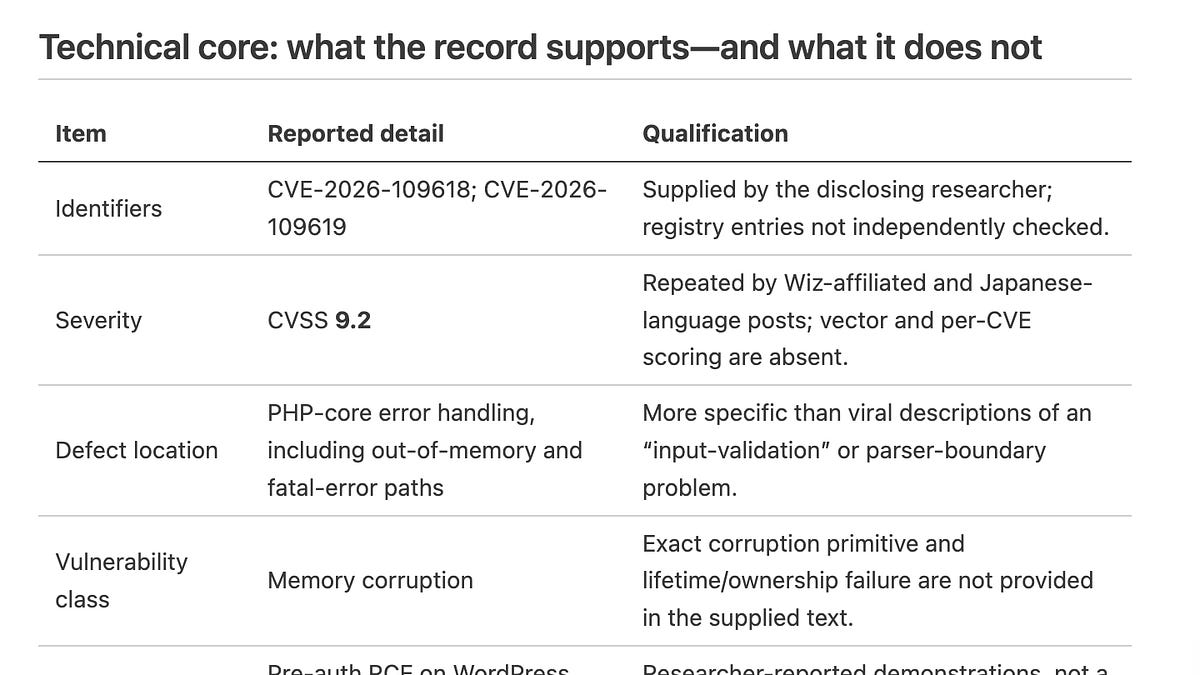
Latent Space reports two PHP-engine memory-corruption vulnerabilities, dubbed PHP2Shell, with researcher demonstrations of unauthenticated remote code execution against WordPress, Drupal, and Joomla. It describes independent discovery by Calif through OpenAI’s Patch the Planet effort and by Wiz, with multiple AI models involved rather than one vendor solely responsible. Approximately two months of remediation involved PHP maintainers and outside defenders, while Cloudflare’s early WAF protections were explicitly a stopgap rather than a substitute for patching. The article cautions that demonstrated exploit paths should not be generalized into identical remote-code-execution exposure for every PHP deployment.
Read the source →Claude Mods: Flipping the Harness Inside Out
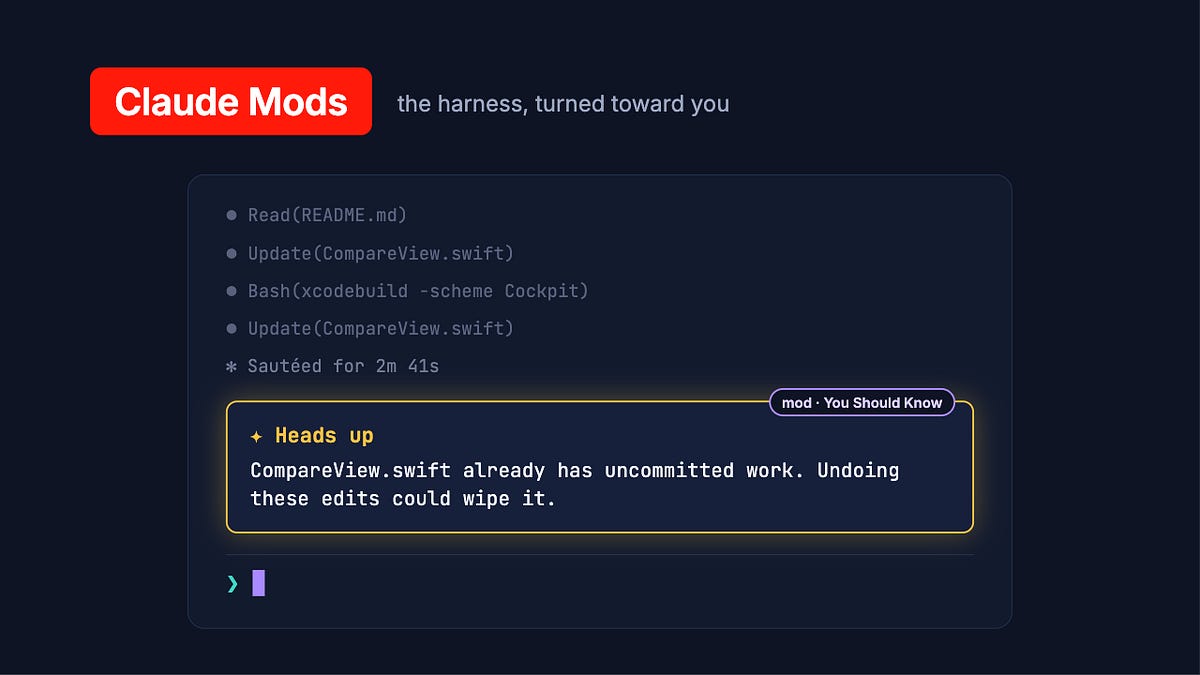
Latent Space argues that the remaining value of an agent harness increasingly lies in managing human attention: what to show, when to interrupt, and which decisions to escalate. Claude Mods make that layer programmable through JavaScript or TypeScript functions that observe and alter prompt, tool-call, and rendering events inside Claude Code. The built-in, opt-in You Should Know side agent illustrates the value by flagging existing uncommitted work that could otherwise be discarded alongside an agent’s demo edits. The broader thesis is that harnesses could become platforms for human-agent interfaces, rather than merely plumbing between models and machines.
Read the source →The revised rules of engineering management with Will Larson
Will Larson argues that engineering leadership expectations have shifted away from practices formed during the long low-interest-rate era, making middle-management career paths less secure. He recommends returning to line management and rebuilding hands-on technical skills, with AI bringing technical decision-making back into leadership roles. His account of Digg distinguishes a disastrous rewrite from deeper business decline, including a reported 60–70% traffic loss after a Google algorithm change. A Yahoo story about teams informally trading servers illustrates how approval systems can create workarounds rather than the accountability their designers intended.
Read the source →How AT&T is rethinking in-house legal work with OpenAI
AT&T’s LegalEdge team is working with OpenAI to make legal knowledge easier to access and rethink how requests enter the legal function. The stated aim is to extend access to legal judgment, not simply make documents easier to search. The available description gives no implementation details, measured savings, or evidence about accuracy, so it does not establish how much work can safely be delegated.
Read the source →Broad access through consistent standards
OpenAI describes working with distribution partners to maintain consistent safeguards while broadening access to its systems. It frames its Usage Policies as a way to clarify expectations for responsible access through those partners. The available description does not specify particular policy changes, enforcement mechanisms, or partner obligations in enough detail to assess their operational impact.
Read the source →OpenAI models are coming to Google Cloud
OpenAI and Google Cloud say they are bringing frontier models and Codex workflows to Gemini’s Model Garden through Google Cloud Marketplace. The announcement places model access and coding workflows within Google Cloud’s distribution ecosystem. The available description does not identify the supported models, pricing, regions, or rollout schedule, so those details remain unestablished here.
Read the source →Patch the Planet: global response coordination as agents uncover critical vulnerabilities
OpenAI describes Patch the Planet as connecting security researchers, open-source maintainers, and incident responders to address critical vulnerabilities. Its emphasis is coordinated remediation across organizations, not vulnerability discovery alone. The available description does not provide a technical incident timeline or quantify outcomes, so it should not be treated as a complete account of the PHP response.
Read the source →ChatGPT Ads expands to 26 new countries as over 100,000 advertisers have used the platform
OpenAI’s description positions ChatGPT advertising around moments when users explore products, compare options, and decide what to buy. It says the audience for advertisers ranges from local businesses to global brands. The available body provides no country list, spending figures, conversion results, or definition of advertiser activity, limiting what can be concluded about the expansion’s business performance.
Read the source →Using thousands of AI agents to uncover new leads in biological data
OpenAI, PerturbAI, and Scripps Research describe using distributed AI agents to investigate data from millions of brain cells and identify promising research leads. The stated result is candidate directions for further research, not demonstrated treatments or validated biological discoveries. The available description supplies no experimental validation, comparison baseline, or detailed account of how the agents’ findings were checked.
Read the source →Cloudflare links vulnerability discovery to defense with OpenAI
Cloudflare uses OpenAI Daybreak to investigate vulnerabilities and propose fixes for review, according to OpenAI’s description. Its developers also use Codex for software development and code-quality work. The explicit review step matters, but the available text gives no deployment metrics or evidence that proposed fixes can be accepted without human validation.
Read the source →How we built ChatGPT’s novel ad stack for user trust and relevance
OpenAI describes an LLM-powered advertising system that interprets conversational intent to select relevant ads at scale. It explicitly says ads are kept separate from answers, making separation a stated design objective rather than treating advertising as part of the assistant’s response. The available description does not explain the retrieval architecture, privacy controls, auction mechanics, or measurements needed to evaluate that objective.
Read the source →Democratic governance of frontier AI, part II: Empowering cyber defenders
OpenAI outlines a policy blueprint linking frontier-model access for cyber defenders with stronger safeguards and modernization of cybersecurity. It also calls for more resilient public institutions, framing defensive capability as an institutional issue rather than a tool-purchasing decision alone. The available description does not specify eligibility rules, oversight arrangements, or concrete public-sector commitments.
Read the source →Today's PHP Security Release, and How We're Strengthening PHP Security
Simon Willison urges PHP users to upgrade across the PHP 8.x line after fixes for two remote-code-execution vulnerabilities. Quoting the PHP Foundation, he explains that circulating CVE identifiers and incorrect severity information prompted an earlier announcement and moved the release forward from October 22 to October 21. A security firm then mistakenly published a proof-of-concept video, copies of which circulated and accelerated exploit development. The Foundation’s cited severity score is 9.2, not the 10.0 initially spreading online.
Read the source →Panache — RTS Belle Époque pour mobile
Simon Willison highlights a French-language fork of his Apache-licensed Battle Drones game that appeared the day after its release. Panache shifts the mobile-and-browser real-time strategy game into steampunk France around 1900, with airships, steam vehicles, and a walking fortress. The changes are primarily aesthetic rather than mechanical, including redesigned units, an animated introduction, and French-influenced music.
Read the source →sparqlite: SPARQL 1.1 inside SQLite, written in Rust
Simon Willison describes asking Claude Code’s Ultracode mode to build a Rust SQLite extension implementing SPARQL, then letting its dynamically coordinated subagents work for more than 12 hours. His main follow-up requested READMEs, an installation and SPARQL tutorial, and realistic sample data. The result exposes a problem of abundance rather than just code generation: he says the implementation is not remotely feasible for him to review and would require substantial effort even to understand through its documentation. He therefore questions the value of generating a large apparent implementation without committing to evaluating or maintaining it.
Read the source →The Sequence Opinion - Issue #956: The Evolution of AI Environments
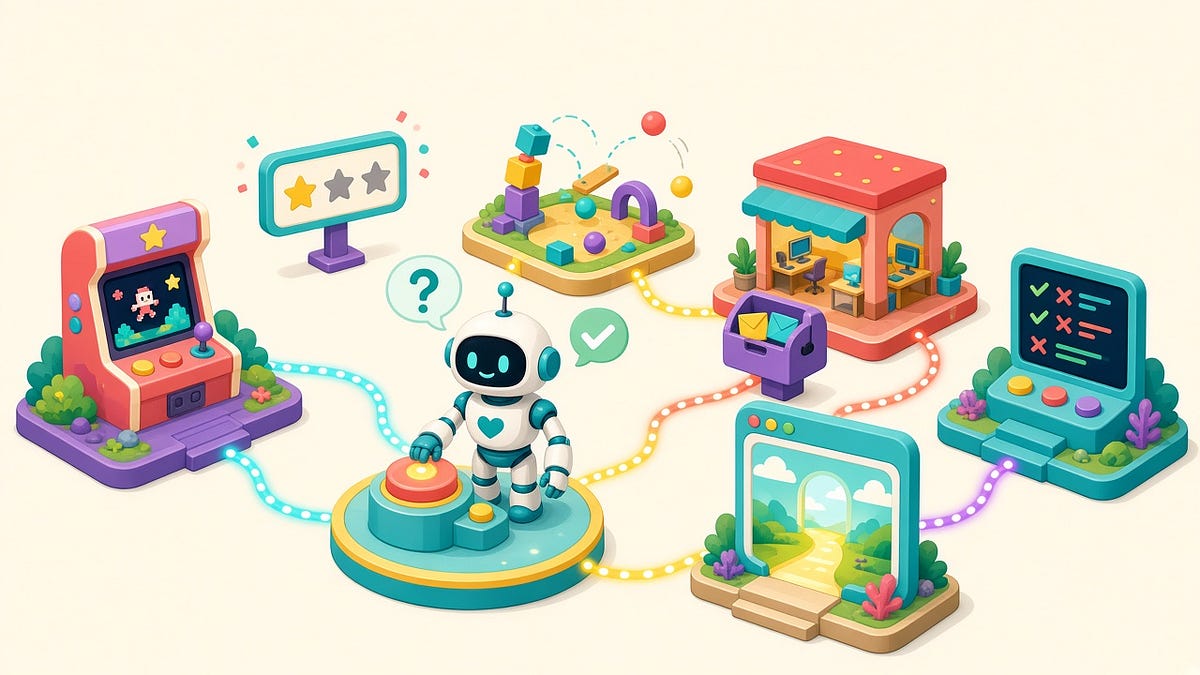
TheSequence argues that executable environments are becoming a core ingredient of model capability because they generate actions, consequences, and feedback rather than merely testing existing knowledge. It traces this development from game and robotics environments to reinforcement learning with verifiable rewards and newer software, browser, desktop, and workplace-agent environments. Good environments need outcome-aligned rewards, resistance to reward hacking, causal fidelity, repeatable low-cost practice, and structured difficulty. The decisive test is whether improvement transfers beyond the training world, not whether an agent learns to score well inside it.
Read the source →DeepSeek DeepInfer 🐋, PyTorch on TPUs ⚡, Ramp’s agent framework 👨💻

The available entry contains the newsletter’s headline and a promotion for a webinar on governing AI spending. It provides no substantive explanation of DeepInfer, the PyTorch-on-TPU work, or Ramp’s framework. There is therefore insufficient content to assess the technologies, their results, or their tradeoffs.
Read the source →Physicist Christopher Stubbs joins Anthropic's Long-Term Benefit Trust

Experimental physicist and former Harvard Dean of Science Christopher Stubbs joins Anthropic’s Long-Term Benefit Trust as its first physicist. His background includes observational cosmology, national-security advice, and recent writing on reproducibility in AI-assisted research. The independent Trust can appoint a majority of Anthropic’s board and advises on decisions involving AI’s risks and societal effects. The appointment accompanies Anthropic’s first Public Benefit Report and a proposed share allocation to a public benefit fund, the latter still subject to stockholder approval.
Read the source →