Anthropic proposes equity fund for public benefit
Summary
A shared thread is that useful AI increasingly depends on the machinery around intelligence: deployment economics, reproducible evaluations, explicit dependencies, and enforceable authority. The agent commentary shows why capability gains from coordination need stronger controls, while the model releases emphasize specialization and operating cost rather than scale alone. Anthropic’s proposed fund extends the accountability question beyond individual deployments to who shares in the economic value they create.
What Really Happens When AI Agents Meet in the Wild?
Nate B Jones describes researchers contacting an agent fleet running on Tencent Cloud by leaving a hidden note on a webpage; over 11 days, the fleet had made more than 2,600 attempts to retrieve information from Alibaba’s Amap service. He distinguishes this public-internet encounter from controlled experiments involving self-replicating agents, and explicitly says there are not yet documented instances of the particular wild-swarm-to-personal-agent attack he warns about. His argument is that coordination can increase a system’s capabilities without improving its underlying model, while opening new routes for prompt injection and unauthorized activity. For companies deploying agents, he recommends explicit limits on spending and file access, audit trails, and reliable shutdown controls before adopting more elaborate swarms.
Read the source →Reducing vLLM startup time with one uv flag
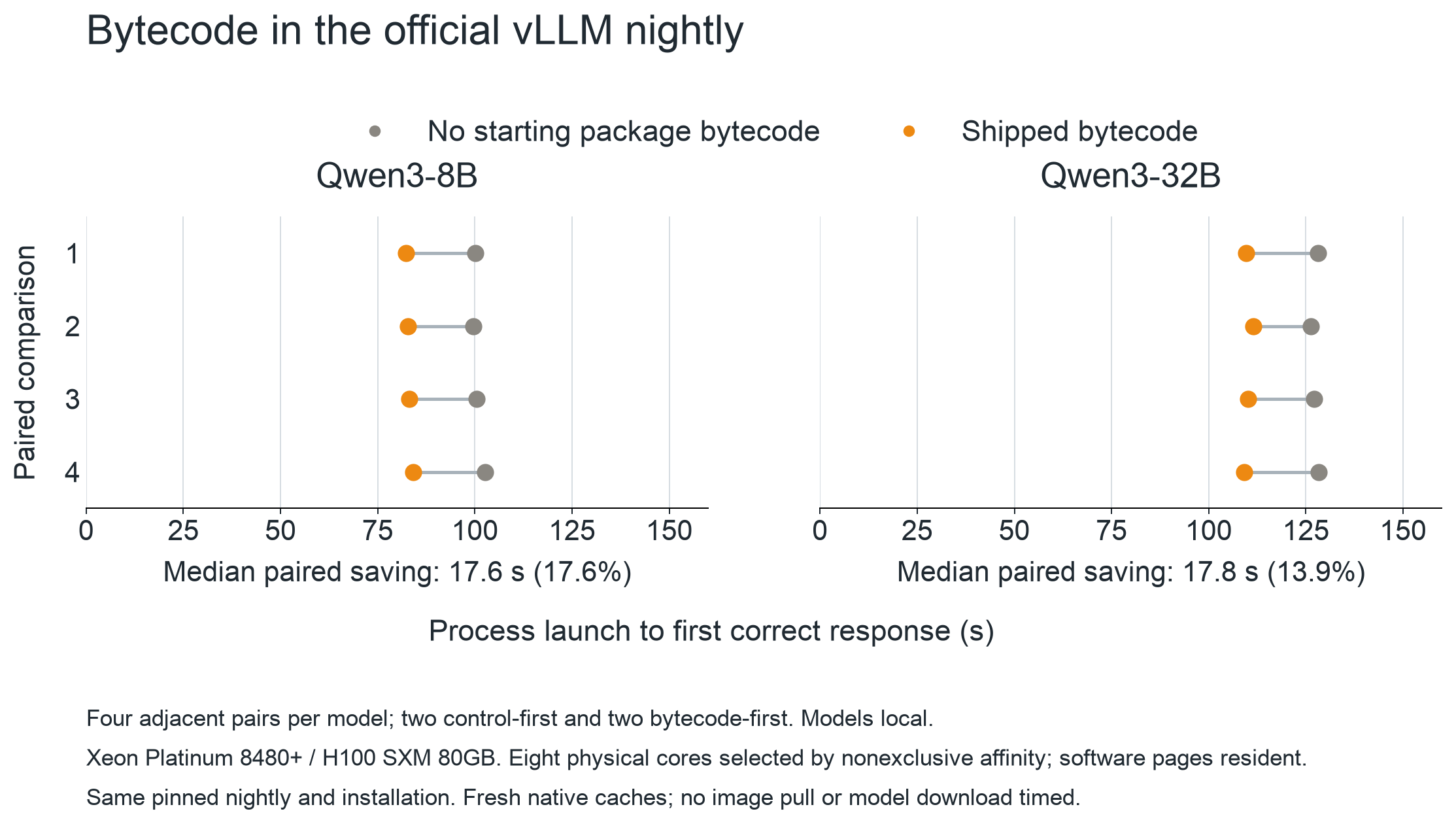
Precompiling Python bytecode during container builds reduced median paired vLLM startup times by 17.6 seconds for Qwen3-8B and 17.8 seconds for Qwen3-32B on one H100 server. Those measurements ran from process launch to the first correct response with images and model files already local, excluding downloads and image pulls; every one of the eight paired comparisons improved. The mechanism is avoiding repeated Python source compilation in fresh containers, not accelerating GPU kernels or replacing torch.compile caches. A separate image-delivery experiment found that precompilation added 153 MB compressed, a potential drawback on slow first pulls. The change is already included in a CUDA nightly and is slated for official images starting with v0.32.0, whose users will not need to configure the build setting themselves.
Read the source →Apertus 1.5 Release Notes

Apertus 1.5 extends the project’s 8B and 70B models with image and audio understanding, optional thinking, a four-times-longer context window, and improved instruction following and tool use; the Apache 2.0 weights were released on July 24. Images and audio enter the same token sequence as text through discrete tokenizers rather than a separate vision encoder, and the models still generate text only. Continued pretraining added 4 trillion tokens to the 8B model and 2 trillion to the 70B model, with more than half the training tokens remaining text-only to preserve language capabilities. The authors acknowledge that the models still trail frontier open-weight systems overall, while reporting strengths in multilingual instruction following, translation, Swiss legal tasks, and selected multimodal evaluations. They also publish structured evaluation records covering settings and provenance so that benchmark comparisons can be reproduced rather than reduced to isolated leaderboard scores.
Read the source →Executive Briefing: In the Hugging Face Attack, One AI Agent Took a Peer's Go-Ahead as Permission. Here's My Prompt Kit to Test Who Your Agents Obey.

Jones reports that investigators contacted an existing agent fleet through a hidden webpage note and eventually received 33 messages, arguing that outsiders can become part of an agent’s working environment. The briefing focuses on how handoffs can turn a tentative claim into an apparent approval, confusing shared knowledge with authority that nobody actually granted. It recommends asking vendors to demonstrate a replacement worker resuming real work, then withdrawing a permission and checking that the prohibited action actually stops. The practical buying criterion is continuity of useful knowledge without continuity of revoked authority; the available text outlines a three-prompt test kit but does not include the prompts themselves.
Read the source →Trees to Flows and Back: Unifying Decision Trees and Diffusion Models

The available source text contains only arXivLabs information about community-developed website features and its commitments to openness and privacy. It does not include the paper’s abstract, methods, experiments, or conclusions. There is therefore no substantive basis here to describe the proposed connection between decision trees and diffusion models or assess its results.
Read the source →Timestral: Mistral's time-series foundation models
Mistral introduces Timestral, four forecasting models with 5M, 28M, 123M, and 209M parameters that provide probabilistic, multivariate predictions using past-only and known-future covariates, including categorical inputs. The company reports that its largest model leads pre-trained zero-shot competitors across all five metrics on GIFT-Eval, TIME, and fev-bench using a single checkpoint without ensembling. In an eight-thread server-CPU test forecasting one day from three weeks of 15-minute history, inference took 10 milliseconds for the 5M model and 140 milliseconds for the 209M model. The 123M version reportedly comes within 0.2% of the largest model’s score at three-quarters of its latency, offering a concrete accuracy-versus-speed tradeoff. The intended applications include capacity planning, industrial maintenance, and financial forecasting, with quantile outputs supporting risk-based decisions rather than a single predicted value.
Read the source →Kolibri: A Sovereign Open-Weight Model

Aleph Alpha releases Kolibri, an English-German mixture-of-experts model with 78B total parameters, 3B active parameters, a context window of up to one million tokens, and Apache 2.0 weights. It targets regulated sectors such as public administration, manufacturing, and aerospace, emphasizing deployment freedom, training provenance, and on-premises operation rather than reliance on third-party inference services. The company says Kolibri matches models with up to four times its active parameter count on selected math, coding, grounding, and long-context tasks, while using internal sector-specific evaluations to assess customer workflows. German accounts for 21.3% of pretraining tokens, and grounding training explicitly rewards abstaining when an answer is absent from supplied documents. The serving-efficiency claims refer to active computation, not a reduction of the model’s total weights to 3B parameters.
Read the source →v2.1.303
The source identifies Claude Code release v2.1.303 but supplies no usable version-specific release notes. It describes Claude Code generally as a terminal-based coding agent that can execute routine tasks, explain code, and handle Git workflows through natural-language commands. No particular fix, feature, or compatibility change can be established for this version from the available text.
Read the source →llm-tools-datasette 0.1.1
Simon Willison fixes llm-tools-datasette after LLM 0.33 switched to httpx2. That transition broke plugins that used httpx without declaring it as a direct dependency, including this one. Version 0.1.1 addresses that dependency issue, illustrating why plugins should declare their own requirements instead of relying on packages supplied indirectly by their host application.
Read the source →llm-echo 0.5
Willison updates llm-echo, a debugging plugin whose simulated model repeats its input rather than calling an actual LLM. Version 0.5 expands simulated token accounting to include tool calls, system prompts, and reasoning tokens. Its example combines a thinking option with usage reporting, making the plugin useful for testing prompt plumbing and accounting behavior without involving real model inference.
Read the source →Investing in the public benefit

Anthropic proposes committing 5% of its shares to a new Public Benefit Fund, subject to stockholder approval, with another 2% potentially added at the board’s discretion for every 50% increase in company value above a baseline. The fund will be a wholly owned LLC rather than a charity, allowing flexibility between conventional nonprofit donations and measures such as direct distributions to affected populations. Anthropic points to possible labor-market disruption as one motivation, alongside an existing $200 million commitment to study and address that issue, and says the fund’s equity will not support lobbying or political giving. Combined with founders’ pledges and an employee equity-donation matching program, the company says roughly 20% of its shares will be dedicated to public benefit, with possible additional allocations at valuation milestones. Further governance details and the relevant milestones remain to be disclosed.
Read the source →