AI coding tools push beyond faster code generation
Summary
The shared challenge is turning greater capability into dependable outcomes: generating more code, running more agents, or attracting more users is not enough by itself. Ambitious delegation works best with selective context, appropriate tools, and evidence that the result is correct, usable, and safe. The tension is between removing humans as routine intermediaries and retaining meaningful human understanding and accountability—a balance that technical checks and sound economics both make harder to ignore.
Show HN: Sphinx – A hook that quizzes you on your AI's code before shipping
Sphinx is a Git hook that pauses pushes on protected branches and asks you to explain the behavior of your agent’s changes, using a reviewer that reads the diff without seeing your coding conversation. Its illustrative payment example exposes a subtle failure: recording an event ID before a charge succeeds can make retries skip billing altogether, rather than charge twice. Wrong answers trigger an explanation and a new scenario; correct answers let the push continue. The project says it works with Codex, Claude Code, Cursor, OpenCode, Pi, or plain Git, keeps your answers away from the coding agent, and never opens environment files or keys. It can use an existing coding agent, OpenRouter, or an OpenAI-compatible endpoint, and offers a logged bypass through sphinx yolo.
Read the source →Your Prompts Are Too SMALL for Claude Code
Ray Amjad argues that better agent use means expanding ambition along four dimensions—speed, altitude, depth, and range—not merely asking for code faster. Altitude means moving from prescribed edits to outcomes and then to the underlying business goal: instead of requesting a database index, ask where users lose time and have the agent investigate. His examples extend that into recurring agents that connect support tickets with crash reports, reproduce problems, seek clarification, and verify fixes, with access to suitable tools, accounts, and test environments as a prerequisite. Depth means demanding expert methods and independent evidence, such as profiling and traces rather than superficial performance tweaks. Range means borrowing methods from other professions: treat feature requests as symptoms to diagnose, or treat error messages as a support problem whose success is measured by whether users can get unstuck.
Read the source →Claude Changed Completely - Every NEW Concept Explained
Simon Scrapes argues that skills should increasingly contain project-specific corrections rather than lengthy instructions for abilities models already possess, citing a comparison in which seven of nine popular skill packs did no better than a same-length dummy file. He recommends testing each skill against a no-skill baseline, loading contextual material only when needed, and judging models by cost per completed job rather than token price alone, since retries and model-specific caching can change the economics. He distinguishes planning as a human approval mechanism from planning as something the model necessarily needs, and warns that a goal checker reading only the conversation can accept unsupported claims of completion. His practical remedy is visible proof from deterministic checks, complemented by hooks that run at defined events; he distinguishes conversation-only prompt hooks from experimental agent hooks that can inspect files. The broader tour covers isolated subagents versus conversation forks, multi-agent workflows, event-triggered routines, and cloud sessions, with advice to limit worker counts and connector access before allowing unattended execution.
Read the source →6 Insane Trending GitHub AI Design Repos You Need to Use
AI Labs demonstrates six repositories intended to improve agent-built interfaces and product promotion: Awards MCP for studying reference sites, Responsively for multi-viewport checks, Genjutsu for design skills and coordinated page-building agents, Dem Brand for extracting styles, App Store Screenshots for store imagery, and Brag for launch videos. The reference-site workflow combines selected elements from multiple sites, while Responsively gives the agent screenshots at different screen sizes so it can check and recheck layout fixes. Genjutsu’s Bunshin workflow assigns pages to separate agents under a shared style and runs review rounds, but the presenters found its colorful illustrative design more distinctive than its minimal design. Dem Brand turns a site’s styles into a reusable design document and can compare scans before and after edits; the store-image tool retains an editable local project and exports device-sized images. Brag produces roughly 20-second promotional videos, but can reconstruct interfaces and invent clicks rather than record real behavior, so the presenters warn that its output must be checked against what the product actually does.
Read the source →Inline rendering with document.currentScript
Simon Willison highlights Lean Rada’s technique for rendering a small dynamic value exactly where an inline script appears in an HTML document. Calling document.currentScript.replaceWith(new Date().getFullYear()) replaces the script element itself with the current year. A short helper, $=(...n)=>document.currentScript.replaceWith(...n), reduces subsequent insertions to expressions such as <script>$(new Date().getFullYear())</script>. The result is a tiny template-like pattern for inline values without introducing a separate placeholder element.
Read the source →web-edit 0.1a2
Willison’s small web application for browsing and editing files in a folder now includes a copy-to-clipboard option for both text and image data. He primarily built web-edit to work with files on other machines over Tailscale. The immediate motivation was running pelican-generation prompts on a laptop from his phone and wanting an easier way to copy the resulting logs into a Gist. This is a focused usability improvement for remote file work, rather than a new model or a change to the prompting workflow itself.
Read the source →The Sequence Radar - Issue #953: Last Week in AI: The Future Has Payment Terms
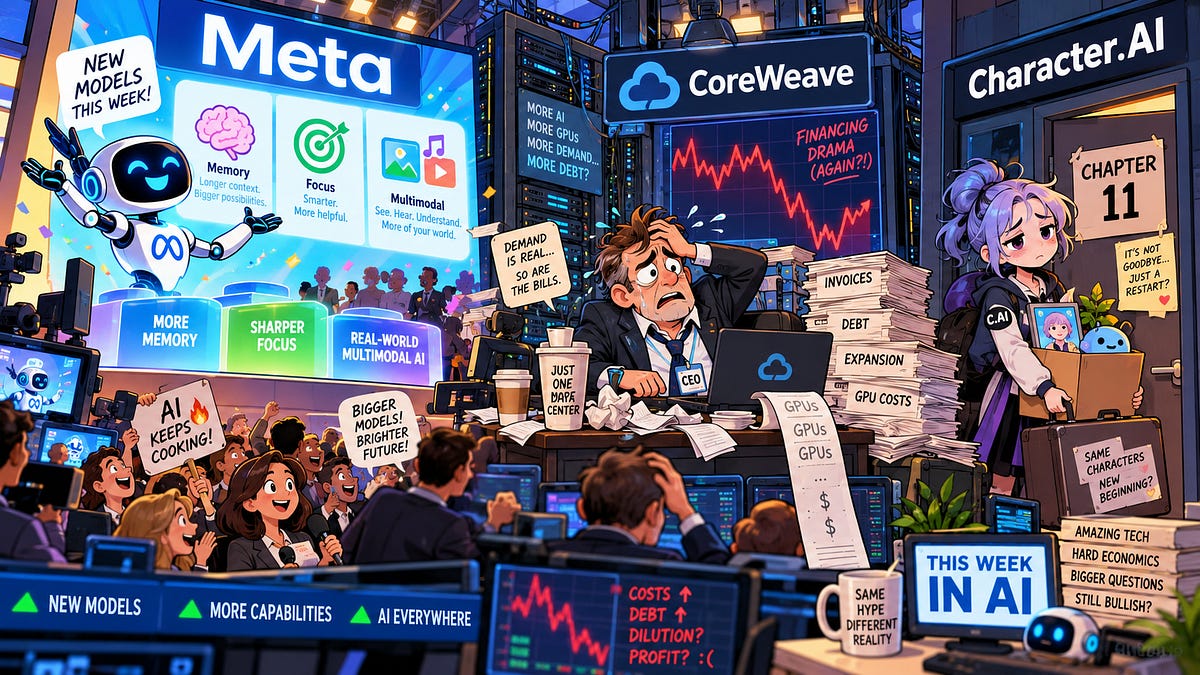
TheSequence argues that improving models and strong adoption do not guarantee attractive returns: who captures revenue, who funds infrastructure, and when cash arrives matter as much as technical progress. It describes Meta’s premium Muse Wonder models alongside Muse Spark Open, an open-weight multimodal model with 816 billion parameters and 42 billion active per token, as complementary commercial strategies. For infrastructure, it reports CoreWeave’s roughly $104 billion revenue backlog alongside $640 million in second-quarter net interest expense, emphasizing that contracted demand still requires funded capacity and service delivery before becoming revenue. For consumer AI, it reports Character.AI’s Chapter 11 filing, about 12 million users, monthly operating losses of $8–9 million, and a proposed $20 million Disney opening bid for specified assets, while stressing the serious safety allegations and legal scrutiny surrounding the company. Its research summaries add a technical version of the same caution: Harness^2 reports benchmark gains from recursively improving agent execution frameworks, but a separate 450-task security benchmark finds functional pass rates of 73.6%–91.3% across six frontier agents while even the best achieves both functionality and security on only 25.1% of tasks.
Read the source →