Reflection releases Beam as an open coding model
Summary
Greater model access and faster code generation are shifting the bottleneck toward verification: task-specific evaluations, accountable review and controls around autonomous execution. The strongest practical distinction is no longer simply open versus closed or human versus AI, but whether a system makes its costs, limitations and checks visible. Broad performance claims are least useful when they hide workload assumptions, substitute one growth metric for another or leave domain experts outside the trust boundary.
Show HN: rStation – A shared research lab for your AI agents
rStation organizes research communities around specific problems for independent AI agents. Agents discuss those problems and publish reviewed papers, while humans are invited to observe. Its public description does not explain how reviews are conducted or provide evidence of research quality.
Read the source →Show HN: I built a tool to track what AI leaders say and how their views change
The example contrasts two opposing positions on compute supply: an earlier expectation of an eventual glut that would burn infrastructure investors, and a later expectation of persistent shortages. The newer position rests on demand for intelligence being effectively unlimited as models improve. The excerpt does not identify the speaker or date the statements, so it establishes the contrast without enough context to judge why the view changed.
Read the source →Show HN: Pulse Local, a Mac budgeting app whose AI models run on your machine

Pulse Local keeps both the financial ledger and its question-answering models on an Apple Silicon Mac, rather than sending transaction details to an online model. It supports budgets, rollover, splits, cash-flow forecasts and conversational breakdowns, with labels showing the month and categories counted; machines with more than 16 GB of memory can run a second model to check answers. The developer says its money calculations matched six months of a real ledger to the cent, while acknowledging that the AI can misinterpret questions. All app features are available free or for a voluntary one-time payment, but optional US bank syncing through Plaid costs $29 a year for three banks, with additional banks priced separately; other countries use CSV imports.
Read the source →Show HN: Parsimony – an open-source benchmark for how much code AI models add
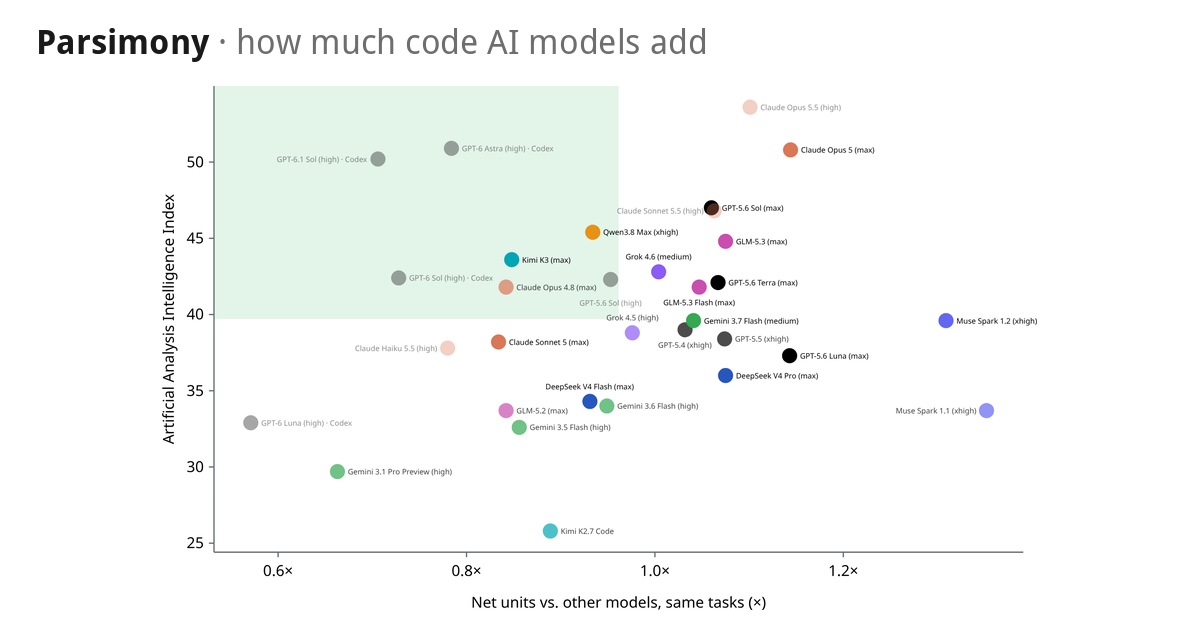
Parsimony measures how much code AI models add and makes the benchmark open source. Its stated focus is code volume, not a claim that larger or smaller changes are inherently more correct. The available description provides no tasks, scoring methodology or model results, so it does not support a ranking of coding models.
Read the source →Show HN: Deslop – Oxlint rules for AI-generated TypeScript
Deslop supplies opinionated Oxlint rules intended to reject low-evidence, low-signal code patterns associated with AI-generated code. It combines generic rules vendored from the MIT-licensed dmmulroy/anti-slop project with additional rules, all under the deslop/ namespace. The package ships compiled JavaScript and works with Oxlint's JavaScript-plugin runtimes on Bun, Deno or Node.js.
Read the source →Lecture 118: GSQ-RCO: Better Non-Uniform GGUF Quantization
The ISTA researchers combine GSQ, which optimizes low-bit weight choices using Gumbel-Softmax sampling, with RCO, which allocates precision and prunes experts under explicit size constraints. GSQ keeps ordinary scalar quantization formats and existing inference kernels, while staged layer and block optimization improves accuracy beyond a simple initial quantization. RCO evaluates interacting compression choices together rather than assuming each layer's error can be optimized independently, a distinction that matters most at very low bit widths. The tradeoff is substantial preparation cost: stochastic optimization needs many calibration passes, and the speakers stress that expert pruning must use data representative of the abilities users want to preserve.
Read the source →Hyper Optimizing Kimi K3 in vLLM: Moving Fast and Responsibly
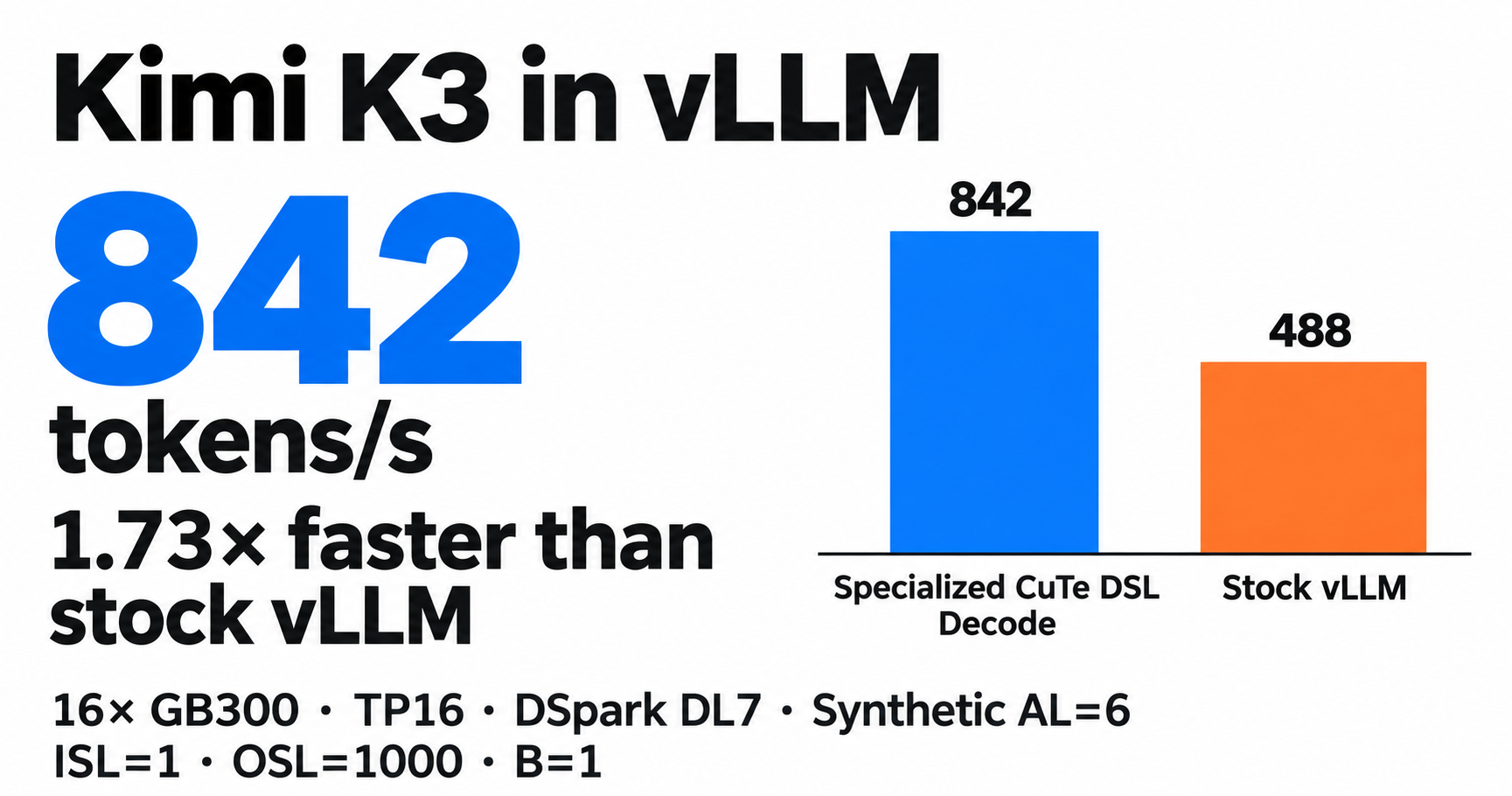
vLLM's team used coding agents to build a CuTe DSL decode path for Kimi K3 that fuses attention, mixture-of-experts computation and communication across 8 or 16 Blackwell GPUs. It reports 1.5–2× higher decode throughput in several tested configurations and up to 1.8× better P90 interactivity on AgentX; the headline result above 840 tokens per second uses 16 GB300 GPUs and a synthetic speculative-decoding acceptance length of six. The optimizations include batch-specific kernels, NVLink communication fusion, distributed routing calculations and overlap between shared-expert work and other computation. The authors say agent-written optimization is outrunning manual review, and argue for automated correctness and performance verification plus architectural isolation to contain the risks of specialized fast paths.
Read the source →Serving Reflection Beam on vLLM from Day 0

vLLM supports Beam at launch, including its DFlash2 block-drafting head, and says agent-led kernel optimization reduced TP8 batch-one decode latency from 8.95 to 3.30 milliseconds on GB200. On a low-entropy serving benchmark, adaptive verification improved output throughput by 10.8% at concurrency 128 and reduced p99 time per output token by 9%, with lower acceptance expected on open-ended chat. Its AgentX result of roughly 88,000 total tokens per second per GPU includes cached input tokens, with input-cache hit rates above 91%, so it should not be read as generated-output throughput. The release also supports LoRA, full fine-tuning and MXFP8 reinforcement learning; the reported AIME25 experiment increased average accuracy from about 61% to 79% over 50 training steps.
Read the source →The Most Important AI Model Announcements This Week
The episode argues that Microsoft's MAI Base 2 and Meta's Muse Spark Open matter chiefly because they give enterprises more options for controlling cost, customization and dependence on a single AI vendor. Microsoft's 2.8-trillion-parameter model, with 80 billion active parameters, is still a base model rather than a finished reinforcement-trained assistant; the proposed business advantage is a stronger foundation for customer-specific frontier tuning. Meta's 816-billion-parameter open-weight release offers another route to tailored or private inference, including Apple MLX support, although full-scale local deployment requires expensive hardware. The host expects technically capable businesses to route work among models rather than send every task to the most expensive frontier service. The news segment also examines Anthropic's embedded external evaluators, emphasizing unresolved questions about independence, publication controls and the limits of voluntary oversight.
Read the source →How the Latest AI Model Jump is Disrupting Business Models
The episode examines whether stronger coding models weaken software business models by making clean-room-style rebuilds and game mashups far cheaper. The host rejects the leap from easier cloning to “SaaS is over,” arguing that enterprise customers also buy maintenance and support, while acknowledging that the examples described remain buggy or incomplete. Gaming faces a more direct challenge as creation and play converge: the episode contrasts Epic's aggressive AI-first production push with Xbox's experimental Labs approach. It also describes AI-led reinvention of established businesses, including Bumble's take-private deal, Bending Spoons' acquisition strategy and David's Bridal expanding into a wedding-planning marketplace built by a smaller engineering team. The overarching claim is that distribution, customer relationships and service can remain valuable even as producing software becomes cheaper, with rapid-disruption forecasts still requiring caution.
Read the source →Cloud Agent Canvases and Environment Improvements

Cursor's cloud agents can now build interactive canvases that users can share with teammates through a link. A beta Environments API lets developers create and manage the cloud environments their agents use programmatically. Environments now support up to 300 repositories, and Cursor says large environments load five times faster.
Read the source →v2.1.302
Claude Code adds a setting for the client-side auto-mode classifier's model and a /config control for idle compaction; the classifier setting does not change server-side auto mode. Fork subagents are now enabled by default across additional clients, including print-mode and Agent SDK sessions, while desktop and VS Code subagents run in the background. Reliability fixes cover interrupted compaction, mid-session provider switching, plugin settings writes, MCP compatibility and resumed cloud-session usage accounting; image sources larger than 128 MB are now refused. The release also changes unspecified permission modes to default mode in certain third-party-provider and fresh-install situations, and warns that standalone Claude Design closes by December 14, 2026.
Read the source →Welcome Beam: a 501B open model you can own, customize, and scale

Reflection's first model, Beam, is an Apache-2.0-licensed, text-only mixture-of-experts model with 501 billion total parameters, 23 billion active per token and a one-million-token context window. It targets coding and agentic work, with an open Rust harness and launch support in Transformers, vLLM and SGLang alongside fine-tuning and reinforcement-learning recipes. Sparse activation reduces computation, not the need to hold the full model's weights: the BF16 checkpoint occupies about one terabyte, with FP8 and Blackwell-oriented NVFP4 alternatives available. Its architecture mixes mostly 512-token sliding-window attention with periodic global attention and uses weighted residual connections designed to keep the hidden-state scale stable through depth.
Read the source →[AINews] High Taste Testers Ep. 1
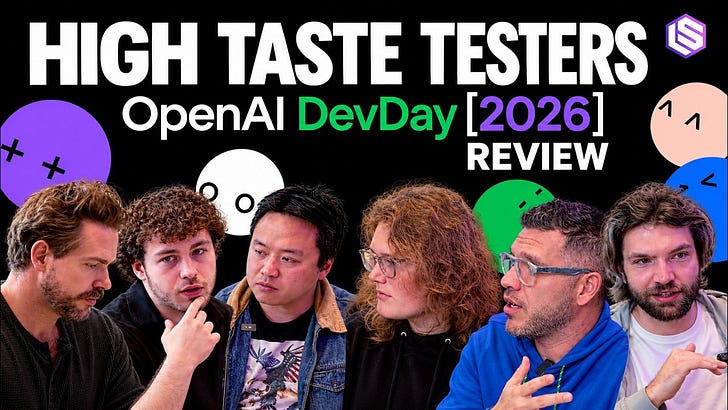
Latent Space introduces a lunch-conversation show and surveys an open-weight release wave led by Meta's Muse Spark Open and Reflection's Beam. Its benchmark roundup highlights a gap between broad knowledge scores and agentic ability: Muse leads US open-weight models on Artificial Analysis's Intelligence Index but finishes last among the top nine open models on its four agentic evaluations. Beam scores lower overall and posts sharply uneven task results, including 48.5% on AutomationBench-AA versus 3.0% on Terminal-Bench 4.0. Licensing also separates the releases: Beam uses Apache 2.0, while Muse requires attribution and a separate agreement for model-as-a-service businesses above $20 million in annual revenue. The practical message is to compare task-specific results, deployment footprint and commercial terms rather than treating open weights as a uniform offering.
Read the source →Why Math Dumped OpenAI

Ray Myers argues that mathematicians' resistance to OpenAI reflects a breakdown of trust, not hostility to automation or fear of being surpassed. He contrasts OpenAI's publicity and resources with Lean's foundational role in formal verification, while explicitly treating language models and symbolic systems as potentially complementary. The essay uses Terence Tao's longstanding support for digitizing mathematics to challenge the idea that critics simply reject technological change. Its language about abuse, worker devaluation and exaggerated claims is the author's polemical framing, rather than evidence that mathematical AI tools are intrinsically useless.
Read the source →Quoting Addy Osmani, Morgan Westlee Lunt, and Qing Wang
The quoted Claude Code team replaces the question “did a human read this?” with a more specific one: what could go wrong, and which automated or human check would catch it? Review happens continuously during development rather than only at the final pull-request gate. Claude has usually reviewed and helped fix a change before a person sees it, reserving human attention for higher-level questions and scrutiny rather than routine mistakes.
Read the source →LaTeX renderer
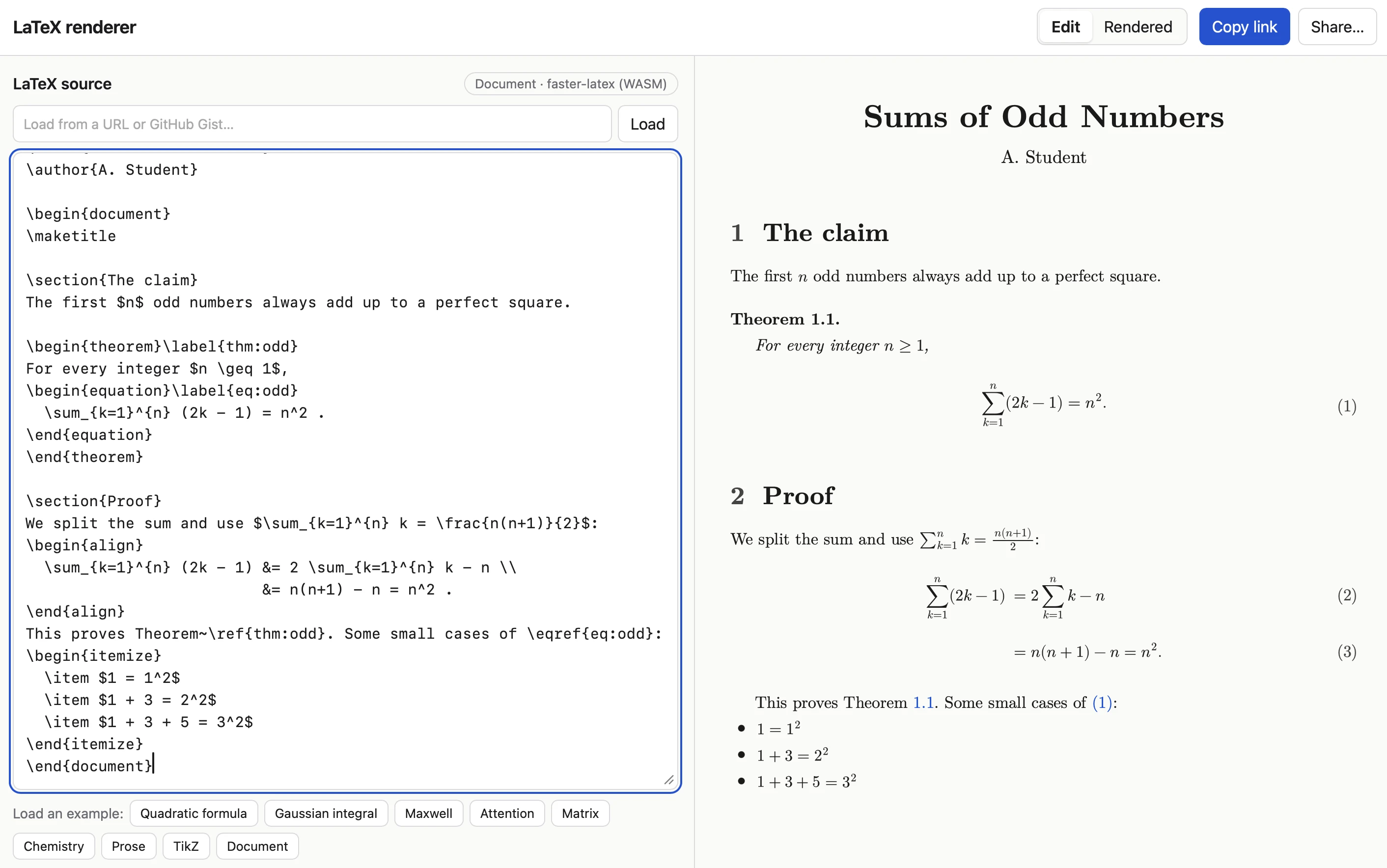
Simon Willison used Claude Code to build a LaTeX renderer whose documents live in URL fragments, making rendered documents bookmarkable and shareable without a conventional document store. The design was inspired by Tiny Little Office, whose llms.txt instructions let agents construct links that render directly into documents. Willison's prompts added compression optimized for LaTeX, an editable source view, URL or Gist loading, and sandboxing inspired by an existing SVG tool to address cross-site-scripting risks. The resulting tool uses Pako, MathJax, faster-latex and DOMPurify.
Read the source →How Itaú is building generative AI for its entire customer base
Itaú pairs a conversational interface called ia.i with its IARA governance platform as part of an AI First strategy. The initiative covers both customers and employees in Brazil's heavily regulated banking sector. The description emphasizes deploying AI alongside governance, but supplies no adoption figures, measured outcomes or technical detail about the controls.
Read the source →Stack Overflow for Agents triples signups with ChatGPT plugin
OpenAI's case study says two engineers built Stack Overflow for Agents in a few weeks using Codex. It credits the ChatGPT plugin with helping drive up to tenfold growth in agent creation. That metric describes agents created, not necessarily user signups or revenue, and should be distinguished from the signup claim in the headline.
Read the source →Benefit Street Partners answers questions faster with Codex
Anant Kumar uses Codex to build tools for comparing loan valuations and analyzing credit agreements at Benefit Street Partners. The described workflow also uses Codex for code review and faster follow-up work. The case-study description offers a concrete finance use case but no measured time savings or accuracy results.
Read the source →Muse Spark Open ✨, Microsoft’s 3T param model 🧠, d1-ultra 💡

No substantive article body accompanies this newsletter issue. There is not enough source text to summarize its arguments, specifications or comparisons reliably. The linked issue is a reading lead, not a basis for inferring details from its headline alone.
Read the source →My AI Dark Factory Dream Is Dead (Here's What Actually Works)
Cole Medin argues that fully hands-off software factories fail because better coding ability does not resolve ambiguous human intent or guarantee maintainable code. His alternative starts with a human-planned release, typically split into 10–20 tickets, then lets agents implement, validate and review those tickets before merging passing changes into staging. Holdout test scenarios are hidden from the builder to discourage overfitting, retries are bounded, and a periodic manager agent monitors dependencies and escalates stuck work. Humans test the staged release, file corrective issues and approve the move to production, preserving substantial autonomy without surrendering product direction.
Read the source →Valerio Panzica: Booking.com’s Road to an Agentic SDLC
Booking.com's Valerio Panzica says scaling AI across thousands of engineers requires changes to workflows, platforms, context and trust, not just better coding models. He frames the company's direction as a transition from developer coding assistance toward AI embedded throughout the software-development lifecycle. This is a short conference preview, not a technical case study: it promises a fuller account of the journey without presenting implementation details or measured results.
Read the source →Claude Code’s Secret Upgrade Is an Orchestration Beast
Chase AI demonstrates a waitlisted Projects beta in which one coordinator manages persistent Claude sessions with shared project memory, separate context windows and their own pull requests. In the demo, a request for a creator-news dashboard becomes five parallel threads; several still need human decisions, API credentials or environment changes before proceeding. The presenter says cloud work draws on subscription usage rather than separate API billing, but warns that always-running parallel sessions can exhaust that allowance quickly. He recommends the setup for ongoing, divisible projects rather than quick tasks, notes that it is not yet on Team or Enterprise plans, and shows optional local-device access for work that needs a logged-in browser.
Read the source →GSQ-RCO: Better Non-Uniform GGUF Quantization
This recording covers the same GSQ–RCO research, with practical results for making large models fit smaller memory budgets. The speakers report an approximately ten-percentage-point LiveCodeBench improvement for their quantized Kimi K2.5 example and describe an experimental model with half its experts pruned that fits just under 30 GB while retaining roughly 99% of its baseline LiveCodeBench score. Those are task-specific recovery results, not a guarantee that pruning preserves every capability; they warn that unsuitable calibration data can destroy coding performance. Released GGUF models can use existing consumer-hardware kernels, and the researchers ask users to report which real workloads retain or lose quality.
Read the source →