Meta releases Muse Spark Open for multimodal agents
Summary
The strongest common thread is a shift from generating plausible output to establishing what actually works: behavior-level specifications, evidence-backed explanations, repeatable evaluations, and explicit limits on agent actions. Open weights and faster inference broaden access, but the accompanying licenses, memory requirements, benchmark caveats, and billing policies determine how usable that access really is. Across software and science, the scarce resource increasingly looks like trustworthy validation and accountable deployment rather than another impressive-looking result.
Prompt tips from Anthropic

Ben’s Bites offers mixed early impressions of Gemini 4 Argon: useful for analyzing video and planning cuts, but slow and disappointing at design, with hallucinations in a finished edit. Its roundup also highlights Claude Code desktop’s multi-folder environments and child sessions, Factory’s locally hosted droids, and Ramp’s shared workspace for company memory and reusable skills. One practical suggestion is to maintain a daily chat index and a project-folder map so any file-reading agent can recover context in a fresh session. The newsletter also reports that supplying coding agents with a documentation link increased task completion from 41% to 84%, though the visible text gives no experimental details.
Read the source →Issue #64

Augmented Coding Weekly argues that programming remains a career in problem-solving and managing complexity, even when AI writes much of the code. Learning to code still matters because engineers need to understand generated software, while communication, architecture, and business knowledge become more important rather than less. The issue also warns that AI-generated contributions and automated review barriers are eroding the human connections that once made open source welcoming. It offers no easy fix for projects restricting contributions to cope with the influx.
Read the source →Your Vibe-Coded App Can Look Right And Fall Apart After Launch. REA Shows You How Real Teams Build.
Nate Jones presents Reverse Engineer Anything as a way to discover software requirements by inspecting working implementations, rather than copying their screens. Examples include Notion’s clipboard preserving structured blocks, an authenticator deriving codes from an account key and time, and Ledger Reborn using an investigation of QuickBooks to inform an independent accounting application. His central advice is to investigate one specific behavior and turn the evidence into explicit rules and checks for your own product. REA can inspect client-side code and supported local applications, but it cannot reveal a company’s private server-side implementation.
Read the source →Xiaomi Just Showed Us What Million-Dollar RL Training Looks Like
The video examines Xiaomi’s public MiMo V2.6 reinforcement-learning runs, reporting roughly $2.62 million for Pro and $854,000 for Flash across just 30 training steps. Each step involves thousands of long agent trajectories, with compute split among weight updates, generating experience, and grading solutions; group-wise grading aims to reward efficient successes instead of merely longer attempts. Partial rollouts, limits on stale trajectories, and monitoring differences between inference and training engines help keep that distributed process workable. Crucially, a late correction says an outside evaluator found solutions accessible in task Git history on about two-thirds of coding tasks, undermining confidence in the headline benchmark results despite Xiaomi’s anti-cheating measures.
Read the source →Scaling Kimi K3 on AMD Instinct MI355X: Matching NVIDIA HGX B300 Throughput per GPU on AgentX
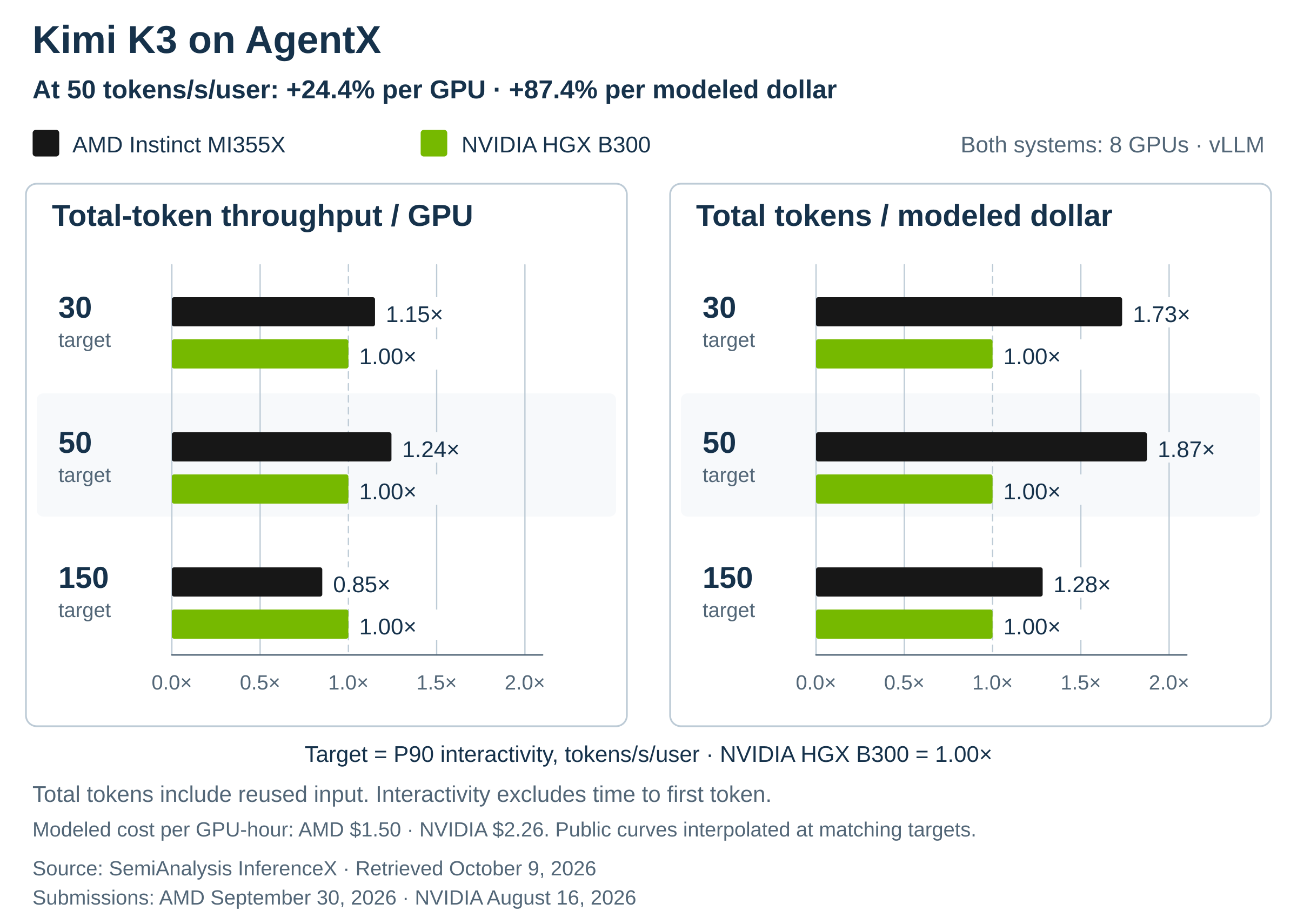
vLLM reports that an eight-GPU MI355X system serving Kimi K3 achieved 24.4% more total tokens per second per GPU than HGX B300 at a P90 interactivity target of 50 tokens per second per user. Under SemiAnalysis’s modeled ownership costs, that becomes an 87.4% tokens-per-dollar advantage. The engineering discussion emphasizes dividing attention history across GPUs and offloading reusable state to host memory, while keeping different layer types’ checkpoints aligned to avoid recomputing prefixes. These are complete-stack benchmark results using synthetic tokens and highly reusable agent-session prefixes; total tokens include reused input, and the interactivity measure excludes time to first token.
Read the source →Day 0 support for Muse Spark Open on vLLM
vLLM describes Muse Spark Open support across NVIDIA, AMD MI355X, and TPU, including quantized serving and LoRA reinforcement-learning rollouts. Its hybrid attention uses 46 sliding-window layers and 16 full-attention layers, reducing the million-token context’s KV-cache requirements to just over a quarter of an all-full-attention design. A DSpark speculator proposes up to seven tokens per pass; the team reports more than 650 tokens per second on four TPU v7 chips and 960 on eight under its stated speculative configuration. Deployment has two important caveats: the post says nightly-wheel availability depends on the support PR merging, and video audio must be extracted and sent separately if the model should process both sound and frames.
Read the source →Announcing Day 0 Support for NVIDIA Nemotron 3.5 Super VL on vLLM
Nemotron 3.5 Super VL combines text, document, image, and video understanding with reasoning and tool use in a 120-billion-parameter mixture-of-experts model with 12 billion active parameters. vLLM supports BF16 and NVFP4 deployment, an OpenAI-compatible API, and built-in multi-token prediction to reduce sequential decoding work. The post reports over 600 tokens per second on a Baseten endpoint and claims up to fivefold throughput and fourfold task-completion improvements over comparable open models in its illustrated comparisons. It explicitly warns that a separate DGX Spark chart measures the related text model, not Super VL, so those results should not be conflated.
Read the source →Scaling Indic Pretraining: 2.8 Trillion Tokens and an Open Data Generation Pipeline

NVIDIA and AI4Bharat announce an approximately 2.8-trillion-token Indic corpus, releasing soon with the GPU-accelerated recipe used to generate it. It covers all 22 constitutionally listed Indian languages in native scripts and twelve in romanized form, translating curated English material including mathematics, code, and question-answer content. Document-level translation, quality assessment, targeted repair, and preserved source identifiers are intended to make the output traceable and reusable. The authors caution that script variants can represent the same underlying content, token counts depend on the tokenizer, and synthetic translations complement rather than replace naturally authored local knowledge.
Read the source →Granite Switch 4.1: Chat, Decisions, and Speech from One Endpoint

IBM’s Granite Switch 4.1 combines chat, decision adapters, and speech recognition in 8B and 30B configurations served from one endpoint. Cache-efficient Activated LoRAs reuse the base model’s KV cache, allowing specialist classifiers alongside a general decision adapter with little additional memory cost. IBM argues that specialists can outperform generalists on targeted classifications and reports faster completion than Jev-27B in a five-step RAG demonstration. Developers can compose their own adapter combinations; a separate custom 3B Doom demonstration reportedly makes 60–100 decisions per second while retaining conversational capabilities.
Read the source →Welcome Muse Spark Open: open-weight frontier multimodal mixture-of-experts model from Meta

Hugging Face introduces Meta’s Muse Spark Open, an approximately 816B-parameter model with 42B active parameters per token and a context window of up to one million tokens. It accepts text, images, audio, and video but generates text, with training aimed at multi-file refactors, debugging, tool use, and other long-running developer workflows. Sparse activation reduces computation, not the requirement to store the full model: the BF16 checkpoint is about 1.5 TB, and the post’s Transformers recipe spans 32 H200 GPUs. An NVFP4 checkpoint targets Blackwell hardware and can run on a single B200 node, making quantization central to practical deployment.
Read the source →Welcome FLUX.3 Image Klein in Diffusers

FLUX.3 Image Klein supports text-to-image generation, multi-reference editing, and explicit layout control in Diffusers from launch. Prompts can specify named regions with bounding boxes on a normalized 0–1000 scale, while edits can map source regions to target locations and pin other elements in place. The distilled checkpoint defaults to 16 steps at 1024 × 1024, whereas the base checkpoint uses 50 steps with classifier-free guidance and is the recommended fine-tuning starting point. Reference images add substantial work—one roughly doubles generation time—and the post provides LoRA training paths plus memory-saving options such as gradient checkpointing and cached latents.
Read the source →[AINews] Agents disprove Polysemanticity; greatly improve Interpretability & Alignment
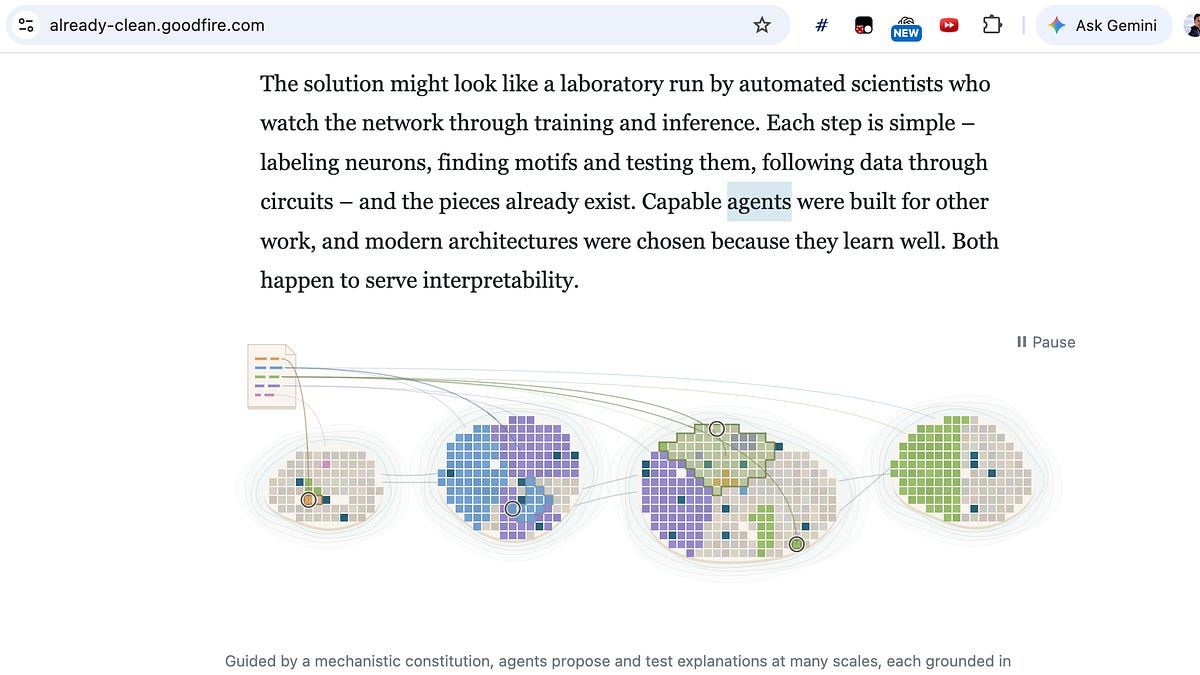
Latent Space highlights Nick Cammarata’s working theory that many canonical examples of tangled neural features yield to deeper analysis, making direct study of neurons and circuits more promising than previously assumed. Its model roundup gives a more qualified picture of Muse Spark Open than launch marketing: Artificial Analysis scores it 39, ahead of other US open-weight models but behind GLM-5.3 at 45 and Kimi K3 at 44. It reportedly uses fewer output tokens per task than the other highest-scoring open models, yet ranks last among that group on the index’s four agentic evaluations. The newsletter also flags a custom license requiring attribution and a separate agreement for Model-as-a-Service businesses above $20 million in annual revenue.
Read the source →Built an app with Claude Code or Codex that breaks once you use it? I'll walk you through setting up Reverse Engineer Anything (REA) and show you where to point it first.
This companion guide frames REA as a tool for turning an existing application’s behavior into a specification for something independently built. Its examples include Ledger Reborn’s accounting calculations and Notion’s preservation of block structure during copy and paste. The recommended starting point is a narrow question tied to a concrete decision, followed by a small inspection confirming the tools are connected and a check that can expose an incorrect explanation. The visible portion outlines the investigations and setup approach; the detailed walkthroughs are subscriber-only.
Read the source →Why are we even doing all this?

In a satirical guest post on Terence Tao’s blog, physicist Rikab Gambhir questions whether producing large volumes of potentially correct AI-generated research is the same as advancing understanding. He compares such output to Borges’s Library of Babel: a vast supply of candidate truths is not especially useful if people cannot distinguish, verify, or understand them. The criticism focuses on companies gaining publicity while outsourcing the difficult work of checking and explaining results to the academic community. Beneath the satire is a challenge to judge research by comprehension and intellectual value, not just the number of write-ups produced.
Read the source →Neural Networks Are Already Clean

Nick Cammarata argues that the classic evidence for neural superposition was often misread: apparent unrelated features can instead reflect recursive generalization, architectural problems, and weak interpretability tools. In modified InceptionV1 models, he reports that ordinary improvements made 99–100% of last-layer neurons easily interpretable without increasing model size or changing training data. Across a 300-fold model-size range, smaller networks reportedly represented broader concepts rather than arbitrarily packing unrelated ones together. He presents this as a working hypothesis favoring direct experiments on neurons and circuits, not an established proof that every modern network is fully understood.
Read the source →The Pulse: OpenAI software engineer accused of spying
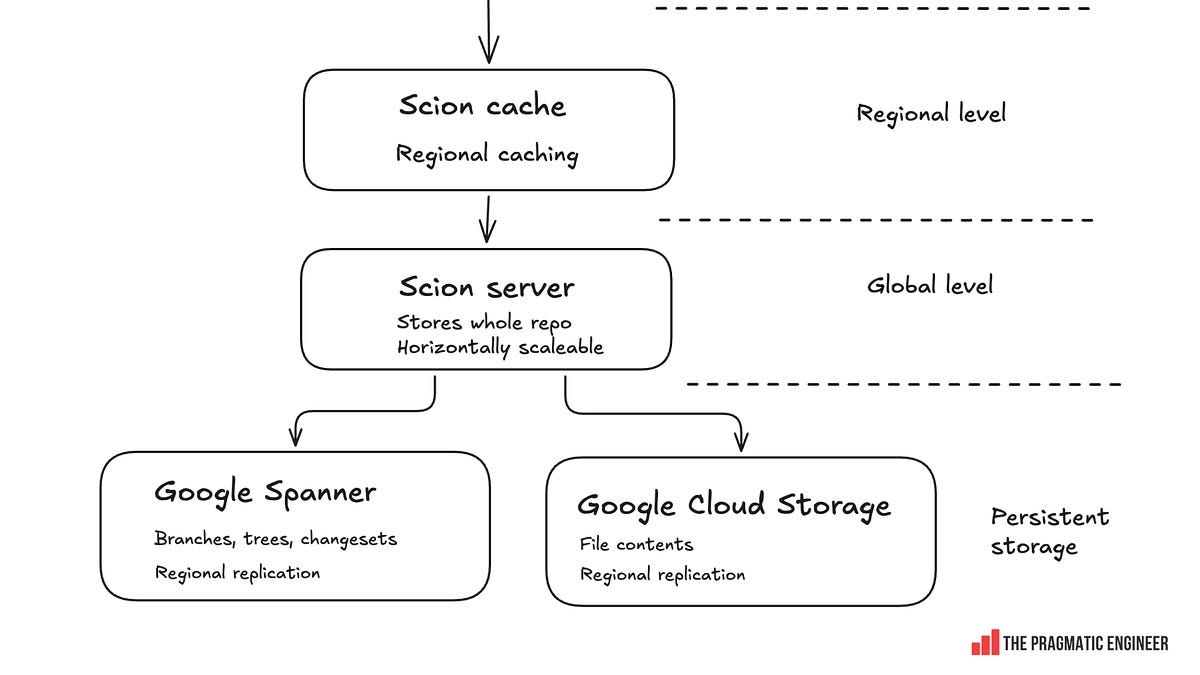
The Pragmatic Engineer reports that an OpenAI software engineer working on the Agents SDK was arrested after allegedly placing a concealed audio-recording device in a company meeting room. Its preview says the FBI and US Department of Justice are involved. The available excerpt does not provide the evidence, alleged motive, or outcome, so the allegation should not be treated as a finding of guilt.
Read the source →Bringing GPT-Rosalind to academic research labs
OpenAI introduces the Rosalind Academic Plan, offering eligible academic laboratories sponsored access to GPT-Rosalind and associated tools. The stated purpose is to support life-sciences research. The announcement text provided does not specify eligibility criteria, sponsorship limits, or application details, so it does not establish that access is available to every academic lab.
Read the source →Teaching students to think and learn through questions
OpenAI marks Teachers’ Day by highlighting AI for Educators in Brazilian Portuguese. It also presents Study Mode as a way for teachers to support active, step-by-step learning through questions. The brief announcement supplies no classroom outcome measurements or detailed lesson examples.
Read the source →Sullivan & Cromwell brings legal expertise into agreement review
Sullivan & Cromwell developed Agreement Analyzer in collaboration with OpenAI. The tool is intended to identify issues in draft agreements, applying AI to a specific legal-review task. The announcement provides no accuracy results or detail on review safeguards, so it does not establish that the tool can replace a lawyer’s judgment.
Read the source →Chirp Pong
Simon Willison reports a working experiment in two-player phone gaming using audio chirps to exchange game state. The game runs in static HTML, with nearby phones listening through the web microphone API rather than relying on a conventional network connection between players. His prompt asks for a competitive Pong-like game with additional graphical and gameplay twists, making this a small feasibility demonstration rather than a measured networking benchmark.
Read the source →Anthropic tells investors quarterly revenue up nearly 50% to $16.8bn ahead of IPO
Simon Willison highlights an FT report that Anthropic told investors quarterly revenue rose nearly 50% to $16.8 billion. A striking detail is that rival labs’ distillation activity reportedly accounted for 5–7% of revenue before Anthropic materially curtailed it in the third quarter. Willison emphasizes how much competitors may have spent training on Anthropic outputs and notes the shift toward reporting quarterly revenue rather than annualized run-rate figures. These figures come from investor communications described by people familiar with the matter, not financial statements reproduced in the post.
Read the source →The Sequence Robotics - Issue #952: One Brain, Many Bodies: Inside Skild AI's Robotics Bet
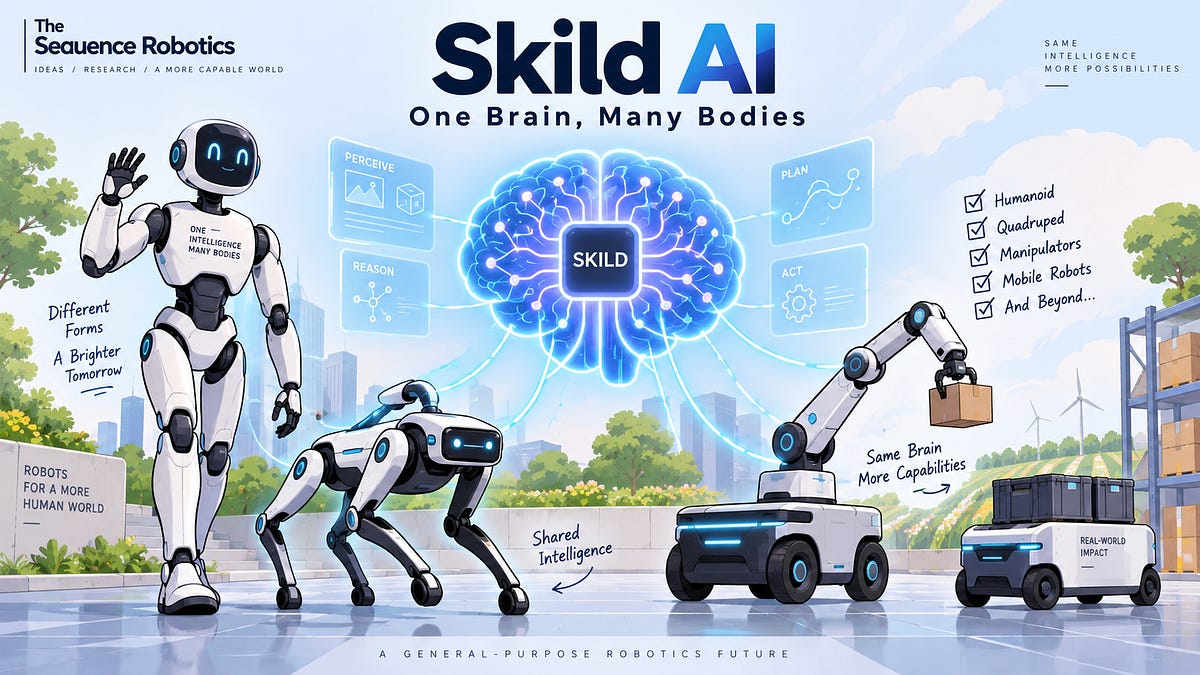
TheSequence describes Skild AI’s bet that robotic intelligence should transfer across different machines rather than require a separate rebuild for every body. Its research connects motor adaptation, learning tasks from video prompts, and self-play, treating understanding a robot’s physical configuration as something the model can learn. The key qualification is deployment: those capabilities must survive real requirements for speed, reliability, and safety. The visible introduction explains the thesis but provides no deployment results demonstrating that it has been achieved.
Read the source →Meta Muse Spark Open is live on Together AI
Together AI is offering Muse Spark Open from launch, emphasizing long-running coding tasks and combined understanding of documents, images, audio, and video. Factory and Ollama participated in early access and are making the model available to their users from day one. Published serverless pricing is $1.25 per million input tokens, $4.25 per million output tokens, and $0.15 per million cached input tokens. The post claims better first-attempt accuracy and reliable tool calling, but the supplied text does not quantify those improvements.
Read the source →Jev 1.14 ⚡, Grok Voice 3 🎙️, RSI 🔁

The available TLDR text promotes a Sentry-and-Warp workshop on automated debugging with application context. It mentions capturing agent metrics for evaluations and verifying signed deliveries. It does not include the issue’s reporting on Jev, Grok Voice, or RSI, so there is no substantive basis here for summarizing those announcements.
Read the source →GitHub's #1 Trending Skill Is Insane (5 Use Cases)
AI Labs demonstrates five REA workflows: studying features, researching competitors, testing product behavior, checking performance, and auditing security. A billing investigation found accounts whose displayed totals differed from actual charges, along with acceptance of negative seat counts and missing billing-log records. Security tests on deliberately seeded flaws found exposed API keys and a customer-data access problem. The useful discipline is evidence labeling—observed, inferred, or unknown—because REA can inspect browser-delivered behavior and code but cannot directly establish what happens inside private servers.
Read the source →An update on independent evaluators

Anthropic says six METR employees now have company hardware, office space, and internal access roughly comparable to its own risk-assessment teams. METR can publish findings without Anthropic vetoing publication, although narrowly defined confidential categories can be redacted and METR can publicly assess those redactions. Access excludes areas including customer data, privileged legal information, and model architectures, and the embedded team is siloed from other METR staff. Anthropic is also developing more limited partnerships with SecureBio, Accenture, and others, using a three-tier framework intended to expand independent access over time.
Read the source →How to Go from AI Power User to AI Leader
The AI Daily Brief argues that effective AI champions turn individual experimentation into repeatable team value, with roles ranging from peer ambassadors to embedded builders. Companies should define those responsibilities, select people colleagues already seek out, and give them protected time rather than assigning the title to the busiest or most senior employee. Sustained programs need both community and technical sponsorship, continuing education, and managers who understand the role after initial training ends. Champions should evaluate whether to reuse, buy, or build; choose the simplest adequate solution; and specify users, guardrails, human review, deployment ownership, and tests before implementation.
Read the source →v2.1.301
Claude Code adds a maximum wait setting for unattended retries at usage limits, richer OpenTelemetry permission-decision fields, matching-bracket motions in vim mode, and multiline mod inputs. Several fixes address misleading success or failure signals: failed searches now report errors instead of no matches, and workflow agents should no longer skip steps while the run still reports success. Other fixes protect worktrees that may contain unpushed commits, improve authentication refresh behavior, and prevent repeated compaction when an LLM gateway returns a different model name. For unattended and instrumented use, this release is chiefly about making execution failures visible and preventing avoidable state loss.
Read the source →Claude Platform release notes — October 15, 2026
Fast mode for Claude Opus 5.5 leaves research preview, no longer requires an access request or beta header, and gains default limits in the Start, Build, and Scale tiers. It is also available for Azure-hosted deployments in Microsoft Foundry, while Opus 5 and Opus 4.8 fast mode still require the beta header. Separately, the Enterprise Compliance API adds beta access to users’ saved Claude and Cowork global instructions. That endpoint requires an existing Compliance Access Key and the read:complianceuserdata scope.
Read the source →Multi-repo support and other improvements for GitHub Copilot in Slack and Microsoft Teams
GitHub Copilot can now work across multiple repositories within one Slack or Microsoft Teams conversation. Users can ask for pull-request summaries across projects or investigate problems spanning frontend and backend repositories without opening separate conversations. The update also allows @GitHub mentions anywhere in a message and improves repository switching and recovery from interruptions. Slack gains richer use of shared messages and threads as context, reducing the need to paste discussions manually.
Read the source →Upcoming deprecation of selected GitHub Copilot models in mid-November
GitHub says selected models will be retired across Copilot experiences on November 16, 2026, and asks users to migrate workflows beforehand. The provided text omits the model-and-replacement table, but explicitly exempts Claude Opus 4.8 for individual subscribers on annual plans so they retain an Opus option. Suggested alternatives are automatically enabled for Business and Enterprise customers under default model policies unless administrators have disabled them. Organizations that turned off global default enablement need to review and enable the replacement models themselves.
Read the source →Agentic autofix for code scanning alerts general availability
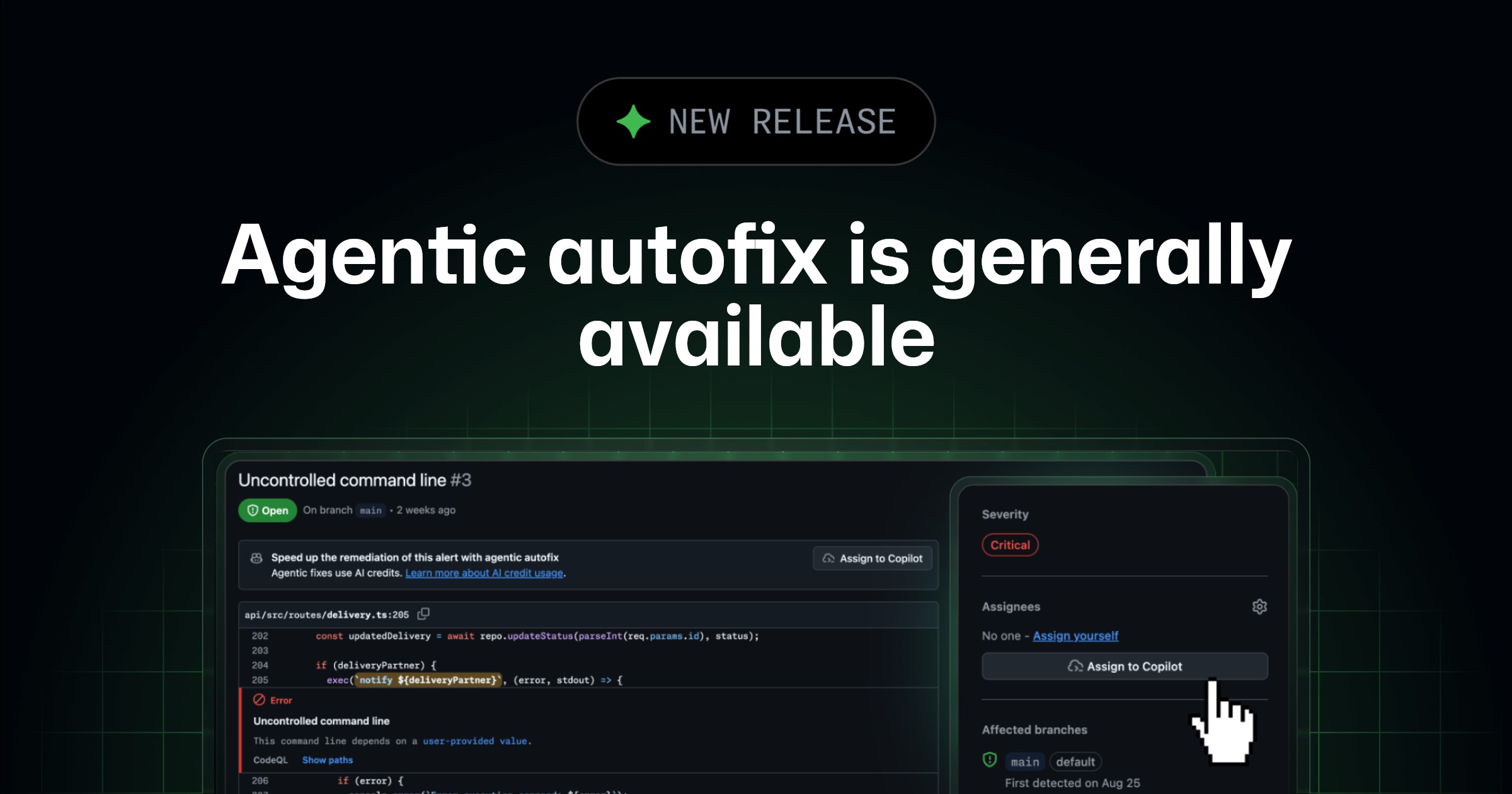
GitHub’s agentic autofix is generally available to Code Security and Advanced Security customers on Enterprise Cloud, including data-residency deployments. Assigned alerts prompt Copilot to investigate the codebase, propose a fix, rerun CodeQL, and open a pull request documenting the remediation and validation. It only supports alerts on the default branch and requires enterprise policy approval, organization or repository enablement, and a Copilot billing method. Usage consumes Code Security AI Credits and GitHub Actions minutes, and enabling it replaces the free Generate Fix option on individual alerts with Assign to Copilot.
Read the source →Accelerating the search for antimicrobial peptides with Google Antigravity
Google describes a researcher-guided Antigravity session that uses ProtNLM annotations to narrow uncharacterized UniProt proteins to a candidate antimicrobial peptide. The example identifies a 97-amino-acid Lactococcin 972-family bacteriocin, checks for matches among manually reviewed proteins, and compares its AlphaFold structure with experimentally determined structures. The researcher sets the biological questions while the agent coordinates database searches, structural analysis, and literature work. The candidate is undergoing wet-lab validation, so the walkthrough demonstrates computational prioritization rather than a confirmed new antibiotic.
Read the source →Agents Acting Safely on Our Behalf
This MLOps Community conversation argues that websites should expose explicit agent actions through WebMCP rather than depend entirely on screenshots and DOM scraping. Annotations can identify read-only operations, untrusted user-generated content, and consequential actions that should trigger user confirmation, while restrictions on sites, data, and spending add separate defensive layers. The speakers emphasize that users should be able to move between manual browsing, collaboration, and delegation instead of accepting one fixed level of autonomy. WebMCP is presented as complementary to REST, GraphQL, and MCP, with framework integration a route to adoption and DOM-based adapters only a transitional substitute for real application state.
Read the source →