AI agents get cheaper, but still need checking
Summary
Across software, robotics and scientific research, the useful gains come from matching models to narrowly defined jobs and measuring the whole workflow, not just an impressive intermediate answer. Cheaper decisions, faster inference and more parallel agents expand what can be attempted, but they also shift pressure onto verification, permissions and human judgment. The contrast between minimal prompting advice and end-to-end accountability is important: less micromanagement is not the same as less responsibility.
Show HN: Let your AI agents paint big arrows, boxes and text on your screen
Bigarrow gives coding agents a way to point at a button on a Mac instead of leaving instructions in an unseen terminal. Its Swift overlay sits above windows and full-screen apps without taking keyboard focus, and clicks near the arrowhead pass through to the target application. It supports coordinates, windows, accessibility labels and Peekaboo snapshots, with JSON output and explicit error codes for agent integration. Drawing needs no macOS permission, although some target-discovery methods do; the tool deliberately never clicks, types or captures the screen.
Read the source →Show HN: Edi Life OS – self-hosted life dashboard with an MCP server for AI
Edi Life OS combines habits, goals, Pomodoro sessions, Kanban boards, finances and notes in a single-owner, self-hosted dashboard. Its optional MCP server exposes 15 tools so an assistant can create goals, update tasks or log expenses through a bearer-token-protected HTTP API rather than accessing the database directly. The application uses PHP, MySQL and vanilla JavaScript, with Docker and conventional hosting options and no frontend build step. Some defaults are geographically specific: dates follow Asia/Tehran, and the weather card targets Qeshm Island.
Read the source →Show HN: Free open source Adobe Lightroom alternative, completely local with AI
Rembrandt is a free, GPL-licensed photo editor for macOS, Windows and Linux with on-device AI and no account or subscription requirement. It preserves originals and writes edits into standard XMP sidecars, keeping the library portable to Lightroom, darktable and other tools. A self-hosted server lets users edit photos in a browser, optionally over the local network, while the desktop application uses Tauri, GPU shaders and LibRaw compiled to WebAssembly. Releases include checksums and signed build provenance, but the desktop builds are not yet code-signed, so operating systems may display installation warnings.
Read the source →Show HN: Jevman – AI decision models play Pac-Man
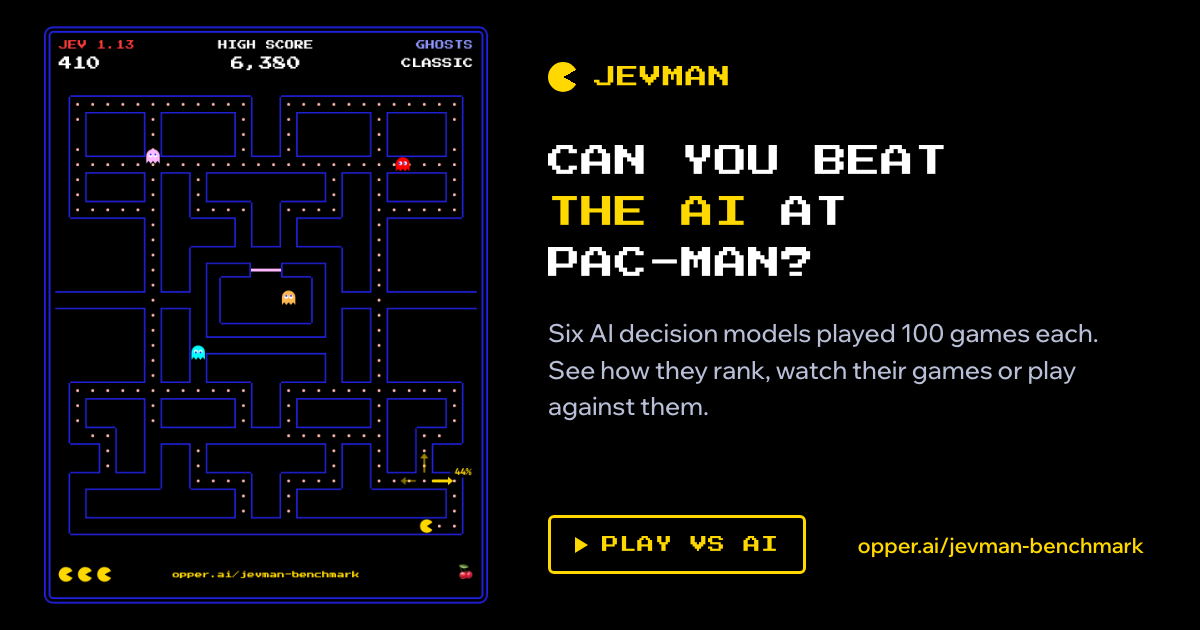
Jevman benchmarks decision models by having each play 100 real-time Pac-Man games against the classic scripted ghosts. At each junction, the model receives the maze state and must return a direction within two seconds; late answers are replaced by a backup rule, which prevented the site's Claude Haiku 5.5 run from being ranked because two-thirds of its answers arrived too late. Scores are reported with 95% margins of error, and community submissions are replayed in CI to verify scores, though their latency and cost figures are self-reported. Any model behind an HTTP endpoint can participate, making this a test of timely decisions rather than text-generation fluency.
Read the source →Show HN: I Put an AI Agent on a Nokia 110
Anup Ray reverse-engineered a Nokia 110 4G and repurposed its Calculator entry point into a native chat application that calls DeepSeek and can invoke phone functions. The prototype runs on a handset with just 48MB of memory, using a minimal agent, compressed payloads and reused buffers rather than a conventional agent framework. After loading it into RAM from a computer, it works unplugged over mobile data, but a restart requires reloading because permanent installation remains unresolved. Codex helped build the application, and the author has withheld the source because sensitive data is scattered throughout the project.
Read the source →How the Top 1% Use Claude Code Differently
Simon Scrapes argues that newer Claude models need less advance micromanagement: give them the task, guardrails and a concrete definition of done, then inspect evidence of the result. He recommends executable checks, bounded goal loops and deterministic hooks for prohibitions rather than relying on emphatic prompt language. He also advocates a short CLAUDE.md that points to task-specific references, and skills built from observed failures rather than imagined procedures. A key warning is that the goal-loop judge reads the conversation rather than independently inspecting files, so vague completion criteria can produce premature success; popular skill packs should likewise be tested against a no-skill baseline.
Read the source →DeepSeek-V4.1 Flash: The Most Insane Optimization So Far
Bycloud explains DeepSeek-V4.1 Flash as an attempt to grow model capacity while reducing the memory and compute burden of million-token agent contexts. The video reports growth from 284 billion to 552 billion model parameters, alongside a further fourfold KV-cache reduction, using compressed sparse attention that shares global memory across layers. A causal encoder processes the full prompt through the first 20 layers, while bounded replay reconstructs only the last 128 tokens through the decoder, bringing prefill close to half the usual cost. Sliding-window caches remain layer-specific, and the replay is approximate; the account also describes FP4 caching, 196 billion additional Engram memory parameters and native image support as complementary efficiency changes.
Read the source →New controls and chat improvements in Copilot for JetBrains
Copilot for JetBrains now lets enterprise administrators set the default agent model for new conversations without overriding an explicit model-picker choice. Diagnostic intention menus gain a Fix action that opens inline chat, using agent mode where available, and a new MCP setting disables automatic server startup for Copilot and Claude. The release also addresses reliability problems in provider switching, customizations, worktrees and tool-call displays. It ends support for JetBrains IDE 2025.1, so users need version 2025.2 or later.
Read the source →[Subscriber Exclusive] NYC Subscriber Meetups!
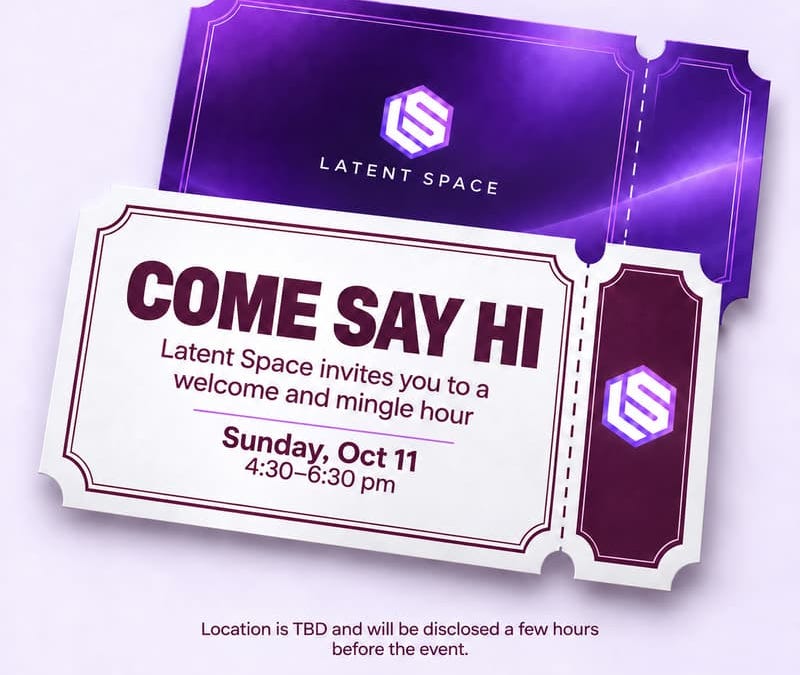
Latent Space is inviting its paid subscribers to two New York City meetups. The October 10 announcement advertises them as 'tomorrow and Tuesday' and says that readers who can see the post are invited. The public preview thanks subscribers for funding production, but venue and logistical details are behind the paywall.
Read the source →Building AI for Reliable Execution: Lessons From Industrial Robotics
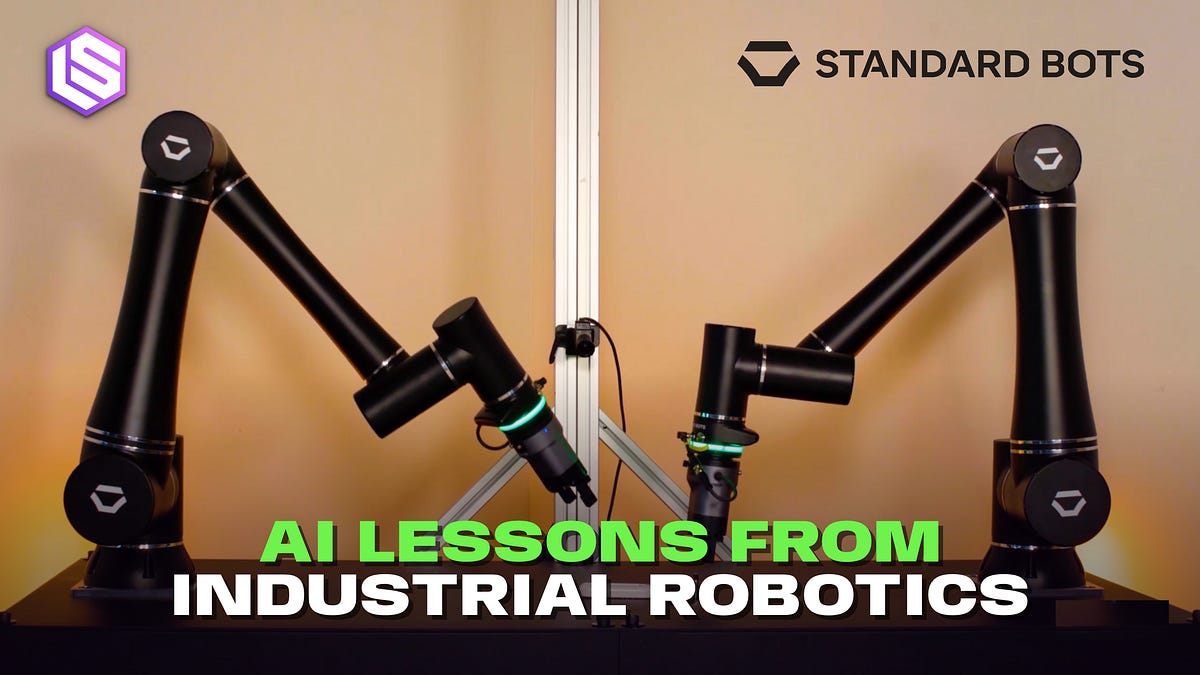
Standard Bots keeps learned behavior tightly scoped inside industrial workflows: in machine tending, a model identifies parts while conventional programming handles motion and cell logic. The company trains in the cloud but runs inference on-premises, where unreliable factory internet makes local control essential, and says a few dozen real-world corrections can address an edge case. Its full-stack ownership lets it co-optimize models, robot hardware and control policies, while air-gapped defense deployments cannot contribute data to fleet learning. The company recently raised $200 million at a $1 billion valuation, but its technical argument is that targeted demonstrations and short-horizon reliability matter more than simply building the largest model.
Read the source →Consistency is not a localized property
The author argues that consistency and exactly-once processing are end-to-end properties, not guarantees a single component can supply on its own. Kafka is the example: substantial engineering work still leaves applications responsible for not violating the guarantee, and later protocol changes were needed to close correctness holes. The practical consequence is that someone must understand the entire system and own its global behavior even when every component owner can correctly say their piece works. Handing that responsibility to machines does not eliminate the need for architectural understanding and accountability.
Read the source →Byte Language Models: Scaling, Emergent Abstractions, and Information Allocation
This paper studies ordinary, flat byte-level Transformers rather than architectures with explicit learned-tokenization stages. With token-superposition training and hash embeddings, the authors find that byte models outperform subword models as parameter counts scale, with roughly 40% relative improvement on CUTE and 20% on OCRBench. They identify emergent segmentation-like positions that aggregate local information; restricting up to 25% of intermediate layers to those representations preserves downstream performance without retraining. Uncertainty clusters around local boundaries, which the researchers exploit to obtain 3.4 times more accepted tokens in speculative decoding, although longer byte sequences still impose a substantial computational cost.
Read the source →Dwarf Fortress uses version control now
Simon Willison revisits the surprising fact that Dwarf Fortress spent years without version control despite its exceptionally complex codebase. He quotes Tarn Adams rejecting source control in 2013 and 2016, then acknowledging in a March 2023 interview that version control had become part of the development process. This is a retrospective discovery, not a claim that the project adopted version control this week, and Willison links the change to the game's Steam-era expansion.
Read the source →Python 3.15.0 added to actions/python-versions
Stable Python 3.15.0 has been added to GitHub's actions/python-versions repository. Willison says projects can now add '3.15' to their GitHub Actions test matrices to exercise the new release. He had asked ChatGPT to clone the repository and check it hourly until the stable version appeared, illustrating a narrowly defined monitoring task with a clear completion condition.
Read the source →The Sequence Radar - Issue 948: Last Week in AI: Billions in Funding, Hundreds of Papers, One Big Leap?

The Sequence frames the week as a contest over capability, inference efficiency, deployment control and behavioral verification, rather than just larger chatbots. It highlights Reflection's 501-billion-parameter Beam and Mistral's trillion-parameter Large 4, whose weights are still promised rather than already available, alongside TypeSafe's $870 million Series A at a $7.5 billion valuation. OpenAI's 722 mathematics manuscripts are treated as provisional research: the roundup reports three withdrawals and 14 revisions, and notes that outsiders cannot reproduce the work using the unreleased model. Arena's new Alignment Index extends evaluation to unauthorized actions and false completion claims, while the research roundup includes agent reinforcement learning inside real deployment harnesses and longer-context robot control.
Read the source →AI’s First Full Field-Level Disruption
The AI Daily Brief reports that an unreleased OpenAI model produced 372 novel mathematical results with 722 supporting papers, including claimed solutions to 90 problems on an AI-generated list of 500 major open problems. The episode says average compute per result was equivalent to about three hours of ChatGPT Pro thinking, but stresses that earlier Navier–Stokes work is still being checked and the new batch creates a much larger verification burden. Its central debate is whether mathematicians become proof interpreters and curators, or gain a powerful tool for new research; it distinguishes these claims from settled, independently verified breakthroughs. The episode also discusses the difference between gross and net AI-company revenue reporting, survey evidence of improving business returns, and Claude's new data-visualization features.
Read the source →Lecture 117:Building a GPU Compiler from Scratch
This GPU MODE lecture follows RMS normalization through six compiler stages, from a PyTorch graph to tensor, loop, tile and kernel representations and finally CUDA. Loop fusion removes intermediate memory traffic, while a tile-level algebra exposes choices such as register tiling, shared-memory reduction and asynchronous data movement. The compiler deliberately fuses broadly before making hardware-specific split decisions, then uses measured autotuning to choose schedules. The speaker reports about 30% better prefill performance on an end-to-end model example, but little change in decoding because that phase remains memory-bound.
Read the source →What Most People Get Wrong About Evolution | Akarsh Kumar
Akarsh Kumar argues that evolution is not equivalent to random search: selection preserves useful partial solutions, while path-dependent learning can build regularities that end-state benchmark scores miss. His artificial-life work uses foundation models to evaluate simulated worlds and search across their rules, mapping roughly 260,000 cellular-automaton configurations and identifying a small region rich in open-ended behavior. In a separate Core War experiment, LLM-generated mutations plus evolutionary selection and a verifier beat 96% of a roughly 300-program human-warrior dataset in the first round, despite poor zero-shot Redcode performance. These are experiments in emergent behavior and program search, not a demonstrated route to AGI; the interview explicitly leaves the useful abstraction from artificial life to general intelligence as an open problem.
Read the source →vLLM Support for NVIDIA Vera Rubin NVL72: 7.8x Throughput over GB200 NVL72
vLLM now runs on NVIDIA Vera Rubin NVL72 through daily CUDA 13.4 containers, with support for DeepSeek, Kimi, GLM and MiniMax models. The team reports up to 7.84 times GB200 throughput per GPU on MiniMax M3 at matched interactivity, and up to 3.7 times GB300 throughput on an MLPerf vision-language workload—different benchmarks and baselines, not one universal speedup. Rubin-specific kernels and locality-aware MoE place weight shards near the SMs reading them; preliminary small-token MoE tests show about 1.2 times faster execution, excluding communication time. The results are early, and full locality-domain enablement and several attention and communication optimizations remain on the roadmap.
Read the source →Claude Mods Are Insane... You Need To Try These Right Now
AI Labs demonstrates Claude Code mods that change the interface and intercept workflows rather than merely adding instructions or tools. Examples include a prompt enhancer that leaves the rewritten prompt for human approval, visual previews of design choices, and an assumptions panel that sends corrections back to Claude. Other mods preserve project-specific ideas, track multiple sessions and their tasks, and rewrite final explanations into clearer summaries using a Haiku-based check. The distinction is continuous behavior: these mods run as part of the interface, while temporary development versions must be installed to persist across sessions; the creators offer their refined versions through a paid community.
Read the source →Getting started with Claude Code Projects
The video transcript was unavailable.
Read the source →Agentic Apps: How Big Companies Are Actually Deploying AI Agents
Cole Medin argues that enterprise deployments should start with a business outcome and a structured application, not make a chat agent the entire product. In an Oracle-sponsored demonstration, a manager-coaching dashboard uses agents inside workflows that inject context, run code and conditionals, and let the manager review emails before sending them. He shows an HR handbook being converted into scoped, tested policy functions, contrasting that approach with probabilistic retrieval-based answers for benefits and leave rules. The practical lesson is to control tools, workflow identity and user access explicitly; generated policy code still needs validation rather than treating the presenter's reliability claims as an automatic guarantee.
Read the source →Impactful scheduling for GPU clusters

Ai2 replaced priority-based GPU scheduling with time budgets, hierarchical fair-share allocation and a time-slicing contract to direct scarce compute toward higher-impact research. Its roughly 150 researchers compete for thousands of GPUs, with outstanding demand typically two to three times available capacity. The old system encouraged idle-job squatting, inflated every workload to HIGH priority and left engineers negotiating shutdowns of non-preemptible jobs during maintenance. Dedicated GPU monopolies avoided some contention but wasted capacity when teams were between experiments, motivating transparent budgets without permanently partitioning the hardware.
Read the source →[AINews] TypeSafe/Jev at >$100M ARR, $7.5B valuation 3 weeks after launch

Latent Space reports TypeSafe's $7.5 billion valuation and a Sequoia claim of more than $100 million in ARR in its first week, while noting skepticism around the launch. The wider story is the rapid spread of decision models that return typed probabilities, selections or scores without generating long answers, with competitors appearing from OpenAI, Microsoft, Perplexity, Cloudflare and Liquid. The roundup cites LangChain's reported 64% median task-cost reduction from routing to the cheapest adequate model, but also an evaluation in which agent teams cost 1.8–5.1 times more and usually produced no significant quality gain. Its practical warning is to distinguish faster individual reasoning steps from end-to-end improvement and to measure orchestration costs instead of assuming more agents are better.
Read the source →Why AlphaFold Didn't Solve Protein Folding — Pushmeet Kohli, Google DeepMind & Sal Candido, Biohub
Pushmeet Kohli and Sal Candido argue that AlphaFold made useful progress on predicting deposited protein structures without solving protein dynamics, disorder, function or the behavior of whole biological systems. They say scaling only works after finding data with the information needed for the scientific question; readily available datasets can steer researchers away from the most consequential problems. Scientific inductive biases make models more data-efficient, but a mistaken bias can constrain learning as datasets grow. They point toward richer sources such as cryo-EM micrographs and coordinated model-building and data-generation efforts, treating a virtual cell and major drug-discovery acceleration as research goals rather than accomplished results.
Read the source →What a year

Jesse Vincent marks Superpowers' first anniversary by releasing version 7.0, whose largest change is a rebuilt brainstorming experience that helps clarify an idea but steps aside when requirements are already clear. He says the project is nearing 300,000 GitHub stars and has more than 1.1 million Claude Code installs, and that he has not personally written code since the initial release. His argument is that coding agents make many personal and small-team projects accessible to non-programmers, while good process management still improves results over unsupervised generation. He explicitly rejects the idea that agentic engineering removes the expertise or obligations required for internet-scale, safety-critical or regulated systems.
Read the source →Voxlocal: a minimal voice agent written in Rust
Voxlocal is a deliberately minimal Rust voice-agent prototype that breaks a spoken request into explicit stages rather than hiding the workflow inside a framework. It uses Whisper for transcription, predictable text cleanup, MiniLM embeddings to retrieve at most two documents, and SmolLM2 to produce a structured tool call instead of a free-form answer. Retrieval applies a similarity threshold and caps context at 320 characters, while the application parses the model's output before treating it as an action. The article uses the example of asking an automotive service price to explain the boundaries between uncertain speech recognition, retrieved evidence and executable behavior; it is an educational implementation, not a production telephony platform.
Read the source →Asana cuts model costs 76x in browser tests with GPT-6.1 Sol
OpenAI's account says Asana made its browser agent 76 times cheaper and five times faster in tests. The stated goal is to make more capable models economical to offer customers. The body attributes the result to GPT-6 Astra in Codex, not the GPT-6.1 Sol named in the headline, and supplies no benchmark setup that would resolve that discrepancy or establish production performance.
Read the source →Think Bigger: How Small Teams Win with ChatGPT
This small-business guide describes ChatGPT use across data analysis, marketing materials and budget management. It also covers meetings and decision support, positioning the product as a shared tool for several small-team functions rather than a single specialist application. The emphasis is practical everyday work, not a reported benchmark or quantified return on investment.
Read the source →A Practical Guide to Building AI Agents
OpenAI's agent-building guide covers designing, orchestrating and deploying agents. Its scope includes choosing use cases and models, designing tools, and adding guardrails. It also discusses multi-agent patterns, treating architecture and operational constraints as part of deployment rather than reducing an agent to a prompt.
Read the source →Building with the GPT-5 Model Series: A Practical Guide
This startup guide covers migration to the Responses API and the design of agents built around GPT-5 models. It includes prompt tuning and model steering alongside workflow construction. Its stated focus is reliable AI workflows, rather than a new model release or a performance comparison.
Read the source →Inside GPT-5 for Work
The guide describes GPT-5 use across marketing, engineering and finance. It also includes strategy, legal and IT workflows, making the scope broader than coding assistance. OpenAI frames the material around evaluating the model for a team's own work rather than assuming one business function represents all others.
Read the source →How OpenAI Uses Codex to Accelerate Engineering
OpenAI describes its internal use of Codex to understand unfamiliar code and refactor systems. The guide also covers performance improvement and engineering workflow acceleration. Its focus is how teams integrate assistance into existing development work, rather than a quantified claim that Codex replaces the engineering process.
Read the source →Using Codex across the software development lifecycle
The video transcript was unavailable.
Read the source →How OpenAI uses ChatGPT Atlas at work
The video transcript was unavailable.
Read the source →GPT-5: Our best model for work
The video transcript was unavailable.
Read the source →Delegate work to ChatGPT agent
The video transcript was unavailable.
Read the source →Personalize ChatGPT with custom instructions
The video transcript was unavailable.
Read the source →Collaborate and write with GPT-4o
The video transcript was unavailable.
Read the source →Create on-brand visuals with image generation
The video transcript was unavailable.
Read the source →Automate complex workflows with OpenAI o3
The video transcript was unavailable.
Read the source →Connect internal knowledge from Google Drive
The video transcript was unavailable.
Read the source →Prototyping with canvas in ChatGPT
The video transcript was unavailable.
Read the source →Market research with ChatGPT
The video transcript was unavailable.
Read the source →Creating a contextual workspace in ChatGPT
The video transcript was unavailable.
Read the source →Writing with canvas in ChatGPT
The video transcript was unavailable.
Read the source →Vision and voice in ChatGPT
The video transcript was unavailable.
Read the source →Strategic planning with ChatGPT
The video transcript was unavailable.
Read the source →Shipping code to your IDE with ChatGPT
The video transcript was unavailable.
Read the source →Put AI to work for marketing teams
The video transcript was unavailable.
Read the source →Solving complex problems with OpenAI o1 models
The video transcript was unavailable.
Read the source →Put AI to work: Automate and scale financial operations
The video transcript was unavailable.
Read the source →Put AI to work: Lessons from hundreds of successful deployments
The video transcript was unavailable.
Read the source →Fine-tuning GPT-4o webinar
The video transcript was unavailable.
Read the source →Enabling a data-driven workforce
The video transcript was unavailable.
Read the source →Quoting The New York Times
Willison quotes a New York Times report that Anthropic agents submitted 20 visa applications through a State Department website. According to two sources cited by the newspaper, all were incomplete and none was processed. Anthropic had described the agents' activity without naming the affected sites, so the passage is a report about unintended interaction with real government forms, not evidence that visas were issued.
Read the source →Deno is joining Cloudflare
Cloudflare is acquiring Deno to build on celld and make self-hosting workerd a supported way to use the Workers programming model. The Deno runtime will receive monthly bug and security fixes for one more year, after which the acquiring team plans to stop developing it, though the code remains open source. Ryan Dahl argues that Node compatibility has pulled Deno into reimplementing an existing runtime rather than solving a sufficiently different problem. Willison notes a migration tradeoff: Node now has stable permissions, but unlike Deno it cannot yet allow-list individual network hosts.
Read the source →Quoting Matthew Green
Cryptographer Matthew Green assigns his own speculative probabilities of 1% to a world where public-key encryption is impossible and 15% to a functional loss of confidence in today's public-key algorithms. Willison explains that the former scenario, Minicrypt, is Russell Impagliazzo's hypothetical cryptographic world, not a demonstrated discovery. Green's warning is about mismatched timescales: AI could produce a surprise much faster than people can replace standards, so preparation must happen before a break rather than after it.
Read the source →A new feature for my blog, built using my voice
Willison built a Django newsletter archive mostly by speaking to GPT-6 Astra High in the Codex desktop app while cooking dinner. About half an hour of voice interaction produced the model, migration, imports, archive pages and search integration, with a local browser preview letting him inspect progress. A further half hour of typed prompting and pull-request review was needed to replace a Git-subprocess import with an API-based approach, handle private-repository access and refine the pages. He sees voice as useful for multitasking rather than his daily default, because detailed corrections, pasted examples and error messages are still easier to communicate at the keyboard.
Read the source →GPT-6.1 Ultrafast ⚡, Gemini universal agent 🤖, speculative decoding 🧠
TLDR reports GPT-6.1 Sol Ultrafast rolling out across the API, Codex and ChatGPT Work, with an advertised speedup of up to eightfold and API pricing of $12 per million input tokens and $60 per million output tokens. It also describes Google's universal Gemini agent, including persistent context, orchestration, model routing and governance controls. The counterweight is Epoch's finding that frontier models handle well-defined tasks but still lack the judgment needed for its open-ended research work. A technical explainer adds that speculative decoding exploits spare compute at low batch sizes but can waste resources at high throughput, so faster generation is workload-dependent rather than free.
Read the source →v2.1.296
Claude Code 2.1.296 adds earlier auto-compaction settings for subagents, a separate model override for workflow agents and configurable maximum backoff for overloaded requests. It also introduces an allowlarge option so the Read tool can consume a large text file when context space permits. Security and policy fixes include disabled MCP servers incorrectly starting in headless sessions, incomplete secret redaction, and Bash commands involving BASHARGV0 being auto-approved when they should require permission. Further repairs cover gateway sign-in, concurrent self-hosted runner Git operations and refusing edits to non-UTF-8 files instead of corrupting their characters.
Read the source →Claude Platform release notes — October 9, 2026
Anthropic's October 9 platform update adds beta dynamic workflows to Claude Managed Agents. An agent can write a program that runs many agents in phases, combines their results and executes in the background as a workflow run, for tasks such as reviewing hundreds of documents. Developers enable workflows through the multiagent configuration and the managed-agents-2026-04-01 beta header, use the system prompt to guide when a run should start, and monitor it through workflowrun events. This is an orchestration feature for managed agents, separate from Claude Code's own release notes.
Read the source →GitHub Copilot weekly releases — October 5
GitHub's weekly Copilot release brings Claude Haiku 5.5 to paid individual and organizational tiers and makes local sandboxing generally available at no extra charge. Sandboxing can limit agents' access to files, networks and credentials across the CLI, Copilot app and supported VS Code sessions. The app now separates the account supplying a Copilot license from the account accessing repositories, while the CLI discovers models from a running local Ollama instance through /model. VS Code adds side-by-side agent sessions and a worktree-cleanup view for recovering disk space.
Read the source →Copilot code review: New organization billing options and controls
Organization owners can now charge Copilot code reviews to the organization that owns the repository instead of consuming a licensed member's personal entitlement. A separate authorization control can restrict review requests to users whose Copilot license comes from the organization or enterprise, excluding outside and personal licenses. Administrators find the billing option under Copilot policies. If the authorization restriction is enabled at organization level, repository administrators cannot disable it locally.
Read the source →Building a GPU Compiler from Scratch: Lowering PyTorch Graphs to CUDA via Multi-Level IRs
This tutorial traces RMS normalization from a high-level PyTorch operation through progressively lower representations until it becomes CUDA code. Its central design choice is to keep tensor and loop transformations hardware-independent, fuse all eligible operations, and defer decisions about splitting kernels to the tile-level scheduler. That stage exposes reduction, register-tiling and memory-staging choices that can be selected by a learned prior or measured autotuning. The speaker reports gains from eliminating intermediate memory traffic and about 30% faster prefill in an end-to-end example, while memory-bound decoding stays essentially unchanged.
Read the source →Building a GPU Compiler from Scratch: Lowering PyTorch Graphs to CUDA via Multi-Level IRs
The video transcript was unavailable.
Read the source →Building a GPU Compiler from Scratch: Lowering PyTorch Graphs to CUDA via Multi-Level IRs
The video transcript was unavailable.
Read the source →