AI shifts from chatbots to agents that act
Summary
Today’s items converge on a practical transition from models that answer questions to systems that make decisions, operate tools, generate interfaces, and affect organizations. That raises the premium on evaluation, routing, access controls, and human accountability: cheaper capable models and agent platforms broaden deployment, but the stories on work-data acquisition, safety disputes, surveillance policy, and accidental disclosure show that capability is arriving faster than settled governance.
The Haiku 5.5 Benchmarks are INSANE, So I Tested It Versus Luna
Anthropic’s Haiku 5.5 is positioned at the same price point as GPT-6 Luna and its published results show large wins on several coding, computer-use, chart-reading, and real-world-task benchmarks. The video notes exceptions: Luna leads on Automation Bench and knowledge accuracy, while the two are close on long-context reasoning and scientific coding. Its head-to-head tests argue that vendor and aggregate benchmarks should not decide a model choice alone; teams should compare models on their own prompts and workflows.
Read the source →Introducing Claude Dashboards and Claude Motion
Claude Dashboards turns warehouse data into an interactive visual dashboard, illustrated with a bike-share operator investigating why uphill docks empty each morning. Claude Motion then converts that dashboard into an animated narrative for communicating the finding to a wider team. Users can refine the output with comments, collaborate with colleagues, and export it to design tools.
Read the source →Inside Shopify's AI strategy with CTO Mikhail Parakhin
Shopify CTO Mikhail Parakhin argues that the important return from frontier models is raising the capability ceiling, not merely automating existing drudgery. He describes a system that models merchant and company actions as sequences, enabling counterfactual simulations such as testing whether a loan, faster shipping, or advertising might help a business grow. His operating advice is a barbell: spend aggressively on the best models for development, coding, testing, and research, then optimize or fine-tune cheaper models for production. He also stresses that easier building makes technical judgment and supervision more important, because models can rapidly implement a poorly framed request.
Read the source →Inside a Game Where AI Agents Never Sleep
The discussion explores using persistent AI agents as game participants rather than conventional NPCs, producing a more dynamic world but one in which agents never need to sleep. It also describes agents as companions that can learn a player’s style and potentially improve retention, citing a Tencent-affiliated presentation on AI playmates. Beyond player-facing roles, always-on agents could act as undercover testers that continuously probe a game for failures.
Read the source →Google Has More Data Than Almost Anyone. So Why Is It Bidding $10 Million On Old Emails?
Google’s reported $10 million bid for Spirit Airlines’ old work records reflects a bet that emails, Slack-style messages, calls, and documents can teach agents how knowledge work is done. The video questions whether those artifacts actually capture the judgment behind good work, especially in non-verifiable domains such as product decisions and writing. It argues workers should recognize both the value embodied in their work traces and the difficulty of attributing that value when companies resell them for AI training.
Read the source →You Should Be Using Jev’s Browser Agent, Here’s Why
The video presents Jev as a fast judgment model for browser automation: it chooses among predefined answers rather than generating prose, and returns probabilities and confidence. It supports binary, multiple-choice, and scored decisions, which the presenter says enables click-level decisions in roughly a third of a second at a quoted cost of about four cents per million input tokens. The claimed payoff is browser agents that can execute simple web tasks in seconds rather than taking longer than a person would.
Read the source →Introducing the Anthropic Cyber Mission

Anthropic launched a long-term Cyber Mission aimed at helping defenders secure critical infrastructure and open-source software as frontier models lower the cost of finding vulnerabilities. Its Critical Infrastructure Defense Program combines Claude access, engineers, and threat research with providers including Accenture, CrowdStrike, Dragos, Palo Alto Networks, and Rockwell Automation. Anthropic is also expanding its Cyber Verification Program and offering OSS Scanner, an opt-in free service that periodically provides model-generated vulnerability reports, proofs of concept, explanations, and suggested fixes to enrolled projects.
Read the source →Building on our commitment to American scientific discovery
Anthropic committed $150 million over three years to the US federal Genesis Mission, making Claude available to more than 15 participating agencies including NASA, NIH, and NSF. The company frames this as an extension of its existing DOE, national-lab, academic-seat, research-credit, and Claude Science efforts. It also points to a research preview of a Model Hardware Standard intended to let agents operate laboratory instruments safely.
Read the source →2026 Usage Policy update

Anthropic’s updated Usage Policy takes effect November 12 and primarily clarifies rules for increasingly autonomous use rather than introducing a wholesale policy shift. It consolidates bans on fake-account networks and deceptive campaigns, narrows election restrictions to deception and disruption while allowing legitimate civic uses, and explicitly covers weapon guidance software and autonomous vehicles. The revision also specifies human-review and disclosure expectations for consequential health, legal, financial, livelihood, and essential-service decisions, and more clearly prohibits surveillance and criminal-justice uses that track or recommend targets without consent.
Read the source →The model that didn't exist, so you made it yourself

A Hugging Face user used ML Intern to build a 0.8B CPU-runnable prompt rewriter as a smaller alternative to Qwen-Image 2.1’s 9B model. The project reportedly achieved 99.7% valid outputs using roughly a quarter of the teacher’s tokens, with the full labeling and training run costing $16. The post’s practical guidance is to give the agent detailed verified facts, demand a baseline and an early smoke test, specify deliverables, and impose a hard budget. In one cited example, a Qwen3.5-2B citrus-disease model improved from 14.9% to 52.8% accuracy on 335 test images for about $1.90.
Read the source →Introducing Falcon ASR

TII’s Falcon-ASR is a 1.6B-parameter speech-recognition model focused on Arabic and Emirati dialects, while also handling English, French, Spanish, and Portuguese with the same weights. It reports 20.92% average WER across six Arabic test sets, versus 23.17% for the best published comparison in its leaderboard snapshot, and 22.73% WER on its internal Emirati evaluation. The model includes word-level timestamps and was trained with dialect, noise, overlap, music, reverberation, telephony, speed, and pitch variation in mind. Its English evaluation reports a 5.74% mean WER across seven public test sets.
Read the source →Google bid $10 million for an airline's old work emails to train AI. Much of what made that work matter never showed up in an email.
Google’s pending $10 million bankruptcy-auction bid for Spirit Airlines’ emails, Teams messages, spreadsheets, and other internal records raises the question of what those traces can really teach an AI system. The essay argues that the valuable part of knowledge work is often the alignment, changed understanding, and avoided bad decisions behind a document—not the edit history alone. Rather than treating AI as a reason to defend every old task, it suggests using faster drafting and prototyping to test more ideas and make previously uneconomic projects possible.
Read the source →v2.1.295
Claude Code 2.1.295 adds a blocking failure mode for command and HTTP hooks, so hooks that fail to start, time out, or exit unexpectedly can prevent the associated action. It adds terminal status signaling through Program Status Protocol, clearer waiting output for claude -p, model filtering and time-to-first-byte controls for the Claude apps gateway, plus notification and UI improvements for mods. The release also fixes several reliability problems, including fallback when a cloud provider rejects the 1M-context beta, lost text output during background work, and unstable remote MCP reconnection behavior.
Read the source →Whistle: Speech to Text in 16.9 MB
Whistle is a 16.9 MB on-device speech-recognition model for mobile, wearable, embedded, automotive, browser, and other CPU targets, with no runtime dependencies. It uses an eight-block encoder and an eight-block decoder with gated cross-attention, five-beam decoding, keyword biasing, language tokens, and an optional depth setting that trades decoder layers for speed. The authors report stronger results than competitors on LibriSpeech, SPGISpeech, Earnings-22, and FLEURS, while Whisper base remains ahead on TED-LIUM, AMI, and MLS despite being 145.3 MB. On short clips, reported time to first token is 5.9 ms at five seconds of audio and 36.3 ms at 30 seconds.
Read the source →[AINews] not much happened today

The roundup foregrounds a dispute over OpenAI’s firing of three safety researchers who say they were dismissed after prioritizing safety and work with METR; OpenAI’s reported position is that confidential information was mishandled. It also reports GPT-6.1 Sol Ultrafast, claimed to offer near-Astra intelligence at up to eight times Sol Standard’s speed for $12/$60 per million input/output tokens, with restricted higher-tier availability. On model economics, it notes Haiku 5.5’s $0.10/$0.50 pricing and strong coding results, but also reports that its heavier reasoning can make per-task costs exceed Haiku 4.5. The issue additionally highlights ChatGPT’s Intelligent UI, lower Sonnet 5.5 cache-read pricing, and Google Cloud’s persistent, orchestrating Gemini work agent.
Read the source →Synthesis Superintelligence: from Semiconductors to Superconductors — Periodic Labs’ Liam Fedus and Ekin Dogus Cubuk

Periodic Labs argues that scientific AI must be grounded in experiments, because intelligence and simulation alone cannot resolve the noise, uncertainty, and unanticipated outcomes of the physical world. The lab’s “synthesis superintelligence” vision couples reinforcement learning, characterization, simulation, high-throughput experimentation, and autonomous instruments to learn from the whole research process—including failures. Its stated ambition is to make every lab instrument highly capable and compress materials-discovery cycles that once took decades, with potential applications in superconductors, magnets, batteries, and efficient computing.
Read the source →The Pulse: new trend of building “internal vibe-coding apps” at tech companies
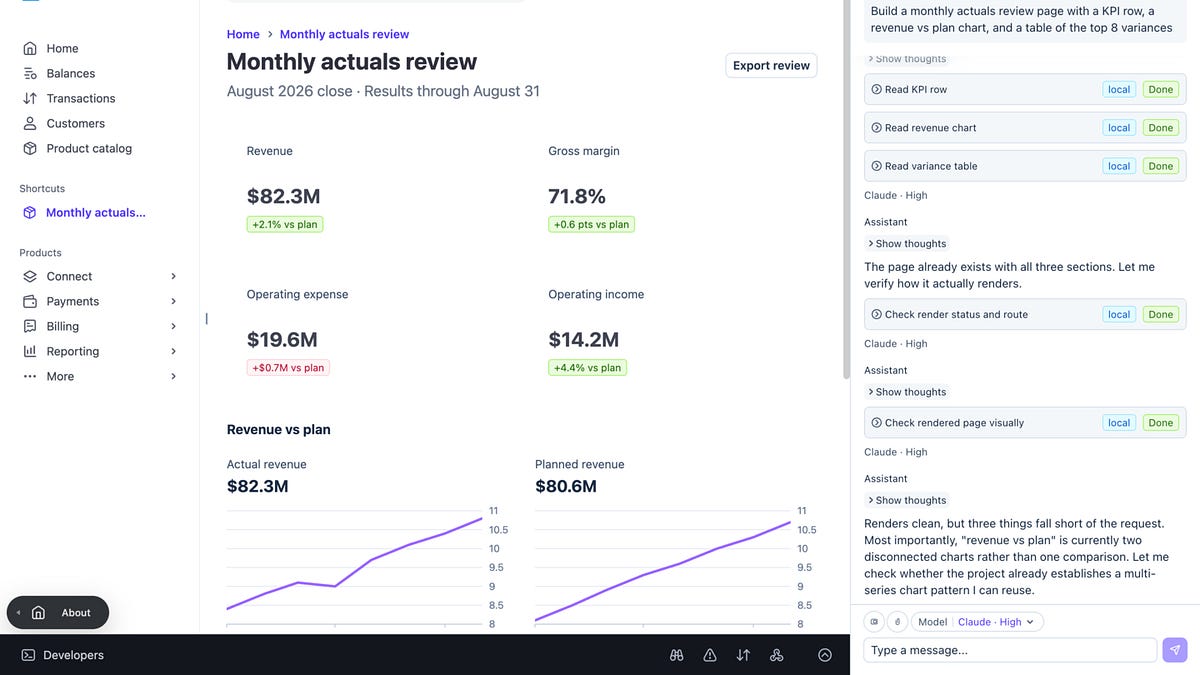
The Pulse identifies internal vibe-coding platforms as an emerging workplace pattern at mid-sized companies. Ramp and Stripe are cited as examples of companies building tools that let non-engineers create internal websites and operational applications. The central prediction is that more organizations will create similar internal platforms as adoption spreads.
Read the source →Sophos cuts threat investigation time by 96% with OpenAI Daybreak
Sophos says it uses OpenAI’s Daybreak to reduce cyber-threat investigation time by 96%. The company also reports automating 52% of managed detection and response cases. The stated operating model preserves human oversight rather than fully removing analysts from the loop.
Read the source →How Oracle turns days of work into minutes with ChatGPT and Codex
Oracle says it is applying ChatGPT Work and Codex across recruiting, engineering, and operations. The case study frames the products as a way to turn specialist knowledge into repeatable workflows. Its core claim is that this can compress tasks that formerly took days into minutes.
Read the source →Pollo AI turns creative ideas into campaigns with OpenAI
Pollo AI says it combines GPT-5.6, GPT-6 Astra, and GPT-Image-2.5 to turn creative concepts into detailed images and cinematic video advertisements. The example positions multimodal generation as a campaign-production workflow rather than a single-image tool. The claim is specifically focused on helping creators develop bold ideas into polished marketing assets.
Read the source →LegalOn halves Codex costs while maintaining development speed
LegalOn reports cutting estimated daily Codex costs by 65% without slowing development. Its approach was to route Astra, Sol, and Luna to different tasks rather than use one model uniformly. The case illustrates that model selection and budget controls can materially change agent costs while preserving throughput.
Read the source →Disrupting AI-enabled “false front” operations
OpenAI says it disrupted two influence operations that used false-front journalists and a think tank to distribute geopolitical messaging. The announcement identifies AI assistance as part of the operations. No further operational detail is provided in the extracted text.
Read the source →ttok 1.0
Simon Willison released ttok 1.0 after finding that version 0.4 defaulted to the GPT-4 tokenizer when GPT-5/GPT-6 was the more appropriate default. He cites an experiment across 31 fixtures in which seven GPT-5 and GPT-6 models all returned 44,794 tokens, suggesting their input tokenization is unchanged. The release therefore updates the default on evidence rather than a formal OpenAI confirmation.
Read the source →ttok 0.4
ttok 0.4 refreshes Simon Willison’s command-line token-counting tool, which uses OpenAI’s open-source tiktoken library. The update fixes a Click warning, refreshes CI, and adds --list-models to inspect available models. The tool can be run via uvx and used by piping text or files into it.
Read the source →Quoting Carson Gross
Carson Gross argues that programming fundamentally remains problem-solving with computers plus managing the complexity of the resulting solutions. He sees no reason those abilities should become less valuable because AI tools exist. The implication is that AI may change the mechanics of programming without eliminating the underlying engineering discipline.
Read the source →ChatGPT Intelligent UI 🧠, Claude Haiku 5.5 ⚡, Grok Bot 3rd party models 🤖

Step 5 Preview is priced at $1 per million input tokens and $2.70 per million output tokens, with a 1M-token context and benchmark results near Claude Opus 5 Medium according to Artificial Analysis’s Intelligence Index. The release is aimed at coding agents, financial analysis, and long-running work, and is available through OpenRouter and several coding-agent tools including Hermes Agent. The roundup also highlights StepAudio 3, which claims leading non-streaming ASR at 1.7% WER and strong realtime speech metrics.
Read the source →The Best New AI Products and the Key Trends They Represent
The video groups recent releases around three shifts: ChatGPT generating interactive interfaces, Anthropic competing at cheaper and faster model tiers through Haiku 5.5, and Grok Bot routing to third-party models when useful. It also highlights the rapid rise of Hermes Agent, describing its openness and fast replication of features from closed labs, alongside reported funding, installation, and token-usage figures. The broader argument is that product differentiation is moving from a single model to interfaces, agent control, distribution, and model choice.
Read the source →The Best Way To Test New AI Models
The video argues that a flood of closed and open-weight releases makes generic published benchmarks insufficient for deciding what to deploy. Instead, it recommends building a personal AI benchmark tied to the tasks, prompts, and stack that matter to an individual or organization. Such a system is meant to reveal not only which model scores best in the abstract, but whether a new release meaningfully improves a real workflow.
Read the source →Text is so 2023

Personal agents are becoming proactive and connected to more services, but the newsletter warns that broad access creates real privacy and identity risks, including a reported incident in which an agent posted bank balances to company Slack. It recommends being deliberate about which tools agents can access, while noting platforms such as Executor that centralize connections and skills. The post also surveys a shift toward interface-rich AI responses, cheaper model tiers, multimodal creative tools, cross-model agent routing, meeting assistants, and agentic software inside productivity apps. The through-line is that AI is leaving the text chat box and gaining both more useful actions and more consequential permissions.
Read the source →