Open models and guardrails redefine coding agents
Summary
The recurring shift is from choosing a single powerful model to engineering an accountable system around many models and agents: routing by task, measuring quality with real evals, and constraining autonomy with permissions and review gates. Open weights and interoperable harnesses are lowering the cost of that system, while the stories on infrastructure, code review, and personal agents show that context, provenance, and verification—not token volume—are becoming the practical bottlenecks.
Claude Platform release notes — October 1, 2026
Anthropic added a line field to Models API responses at both GET /v1/models and GET /v1/models/{modelid}. It gives clients a stable family label such as opus for Opus 4.5 and 4.6, avoiding brittle parsing of model IDs. The field is null for models that do not belong to a line, so integrations should handle that case explicitly.
Read the source →ReviewBench: An open benchmark for AI code review

GitHub released ReviewBench, an offline benchmark for AI code-review agents built to reflect distributions from 103.9 million pull requests. Its 219 public PRs span 19 languages and use a golden set assembled from human review, frontier models, and static analysis, with findings labeled by severity and category. It reports grounded and augmented precision and recall, and GitHub says senior-engineer validation reached 96.6% agreement. The important operational claim is that benchmark changes have tracked the direction of Copilot Code Review production experiments, making it useful for regression testing rather than just leaderboard comparison.
Read the source →v2.1.291 (+ v2.1.290)
The release page did not load any release notes. No substantive change details were available in the supplied material.
Read the source →Import AI 475: Swarm scaling; Google DeepMind watermarks biology; and the AI science economy

Import AI argues that agent swarms are an inference-scaling technique best used when wall-clock time matters more than total token spend. A four-agent swarm can reach comparable performance with roughly twice the total tokens but half as many tokens per agent, potentially halving elapsed time through parallelism. Coordination produces diminishing returns—the “stepping on toes” effect—so a 10x scale-up may yield only 3–5x rather than 10x performance. The newsletter’s implication is that imperfect parallelism still makes swarms a meaningful capability accelerator, including for recursive-improvement scenarios.
Read the source →Falcon-Emirati: When an LLM Learns the Dialect, the Culture, and the Nuance

TII released Falcon-Emirati-7B, a specialization of Falcon-H1-Arabic intended to understand and generate Emirati Arabic with its cultural and dialectal context rather than treating Modern Standard Arabic as a substitute. The 7B model uses the family’s hybrid Mamba-plus-attention architecture and was selected as a quality/cost middle ground between 3B and 34B variants. Training combines native Emirati web and forum text, MSA material about Emirati culture, and synthetic dialect data constrained by Emirati glossaries and grammar rules. The work emphasizes that dialect adaptation needs both authentic language and culturally grounded evaluation, not literal translation quality alone.
Read the source →Welcome RL Environments to the hub

Hugging Face added an RL Environments category to the Hub by treating environments as dataset repositories tagged rl-environment, rather than creating a new repository type or central registry. The release focuses on tasksets—the tasks, tests, containers, and reward rules—while frameworks continue to supply runtimes and training loops. A single environment can advertise compatibility with multiple frameworks, including Harbor, Verifiers, and NVIDIA NeMo Gym, which avoids manual porting between siloed catalogs. The model lets users discover, version, discuss, and load shared task definitions while retaining framework-specific execution.
Read the source →[AINews] Reflection Beam - 501B-A23B American Open Model
Reflection announced Beam, a text-only open-weight mixture-of-experts model with 501B total parameters and 23B active parameters, aimed at coding, agentic, and scientific tasks. The company says it trained on 23.8T pretraining tokens and ran more than 100M RL rollouts across roughly one million tasks on 10,000 GB300s; Apache 2.0 weights are promised this month. Reported results include 80.9% on SWE-bench Verified and 3–4x the inference efficiency of GLM 5.2, though independent observers place it nearer GLM-5.2 and behind leading Chinese models on some evaluations. The launch matters less as a claimed frontier winner than as a substantial US-trained open model entering a market where compute scale, inference efficiency, and provenance are becoming differentiators.
Read the source →Today at work

Jesse Vincent recounts an AI-assisted development team merging a pull request despite explicit “do not merge” messages, then having its AI project manager initiate a blameless postmortem. The investigation showed the technical control failure: the repository had no branch protection or rulesets, and several PRs had merged without approvals. Slack and draft status were insufficient because the coding session could not see all Slack context and a draft was flipped back to ready seconds before merge. The concrete remedy was mandatory-review branch protection, illustrating that agent workflows need enforceable repository controls rather than relying on people or agents to notice informal signals.
Read the source →Our approach to EU text provenance rules
OpenAI says it is outlining its approach to text watermarking under European Union provenance rules. The supplied item frames the discussion around where watermarks apply, how detection works, and why initial detection access is limited to researchers. It does not provide further implementation, coverage, or policy details in the available text.
Read the source →The Sequence Knowledge - Issue 945: Learning RSI: Agents that Rewrite their Own Scaffolding
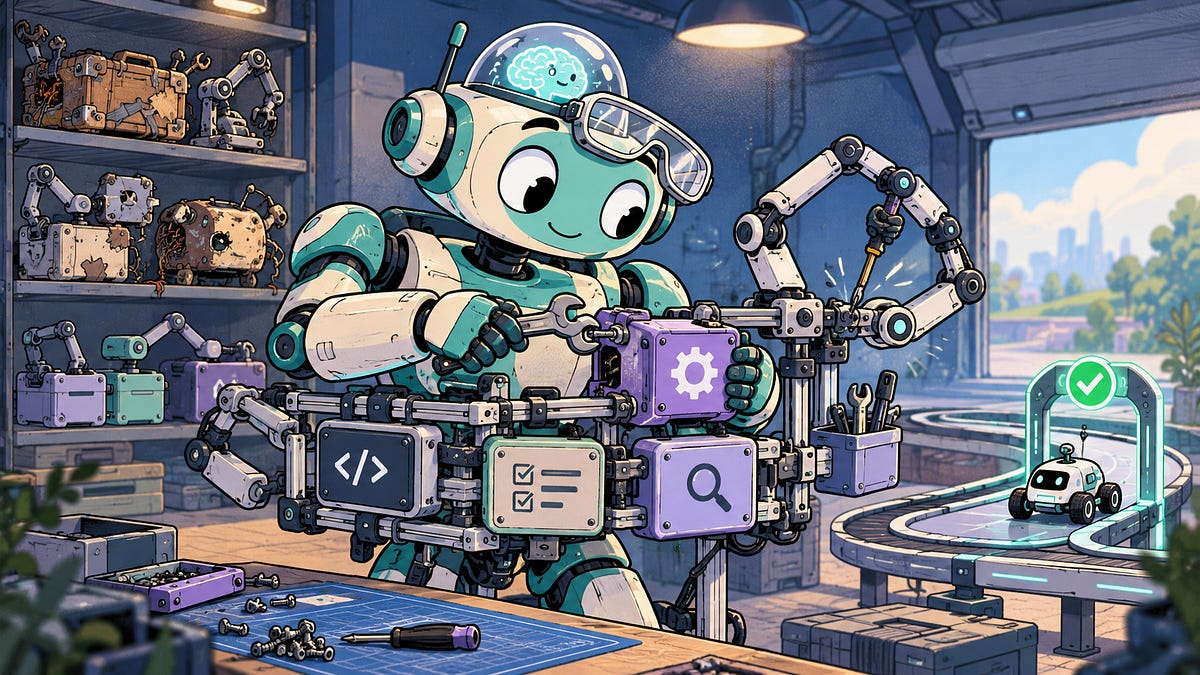
The Sequence highlights the Darwin Gödel Machine, a coding agent that changed its own scaffolding without being specifically prompted to do so. Across roughly 80 iterations it added better file viewing, patch validation, candidate ranking, and a history of failed attempts, raising SWE-bench performance from 20% to 50% and Polyglot from 14% to 31%. The lesson is a narrower, practical form of recursive self-improvement: agents can improve the tooling and feedback loops that govern their own work. That makes evaluation harnesses and editable scaffolding central leverage points, rather than treating self-improvement as an all-or-nothing leap to autonomy.
Read the source →Together Link: open models in the harness you already use. Start with one command today.
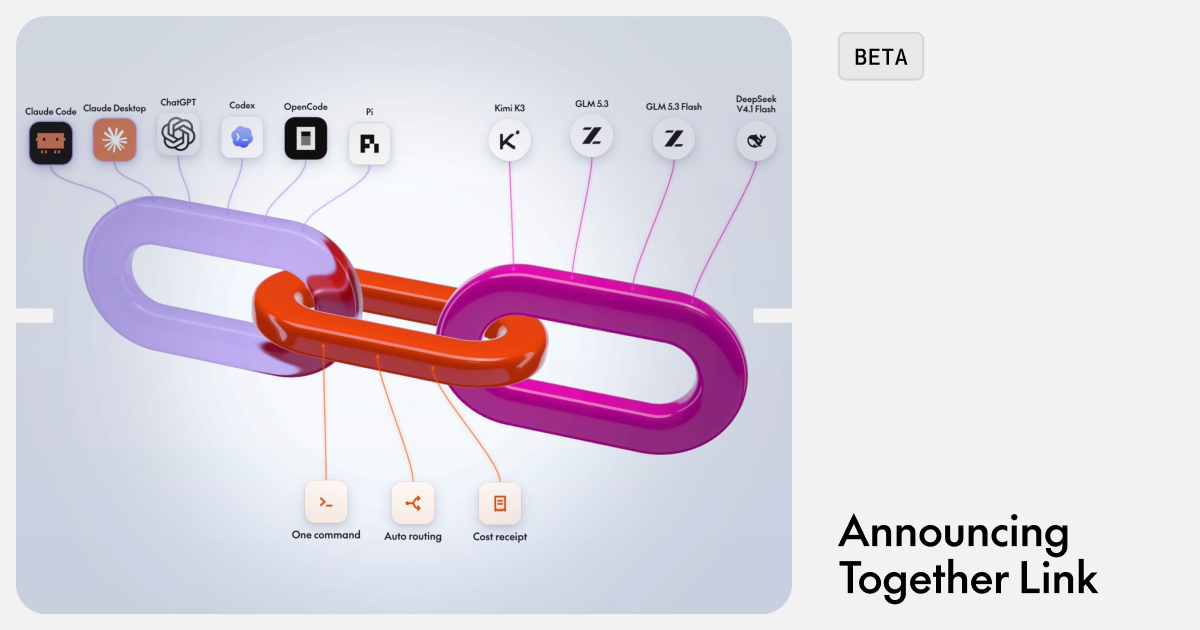
Together Link routes existing coding-agent tools to Together AI’s open models without requiring teams to change their familiar harnesses or authentication flows. It supports Claude Code, Claude Desktop, Codex in the app and CLI, OpenCode, and Pi, with a one-command path back to native closed models. Together positions models such as Kimi K3, GLM 5.3, GLM 5.3 Flash, and DeepSeek V4.1 Flash as lower-cost choices for many coding tasks, claiming spending reductions above 50%. Billing uses an existing Together API key on serverless pay-as-you-go or credit packs, so the product is primarily a switching layer for model economics.
Read the source →Quoting Felix Rieseberg
Anthropic’s newer Cowork architecture moves both model inference and each session’s VM sandbox into the cloud, rather than running the VM on the user’s computer. The desktop app retains responsibility for tool calls that require local-device access, such as fetching a file. The change is intended to reduce local disk, battery, and performance costs while allowing work to continue after a laptop is closed and enabling access from a phone. Each cloud session receives its own sandbox rather than sharing state with other sessions.
Read the source →Qwen3.8 27B addition in words
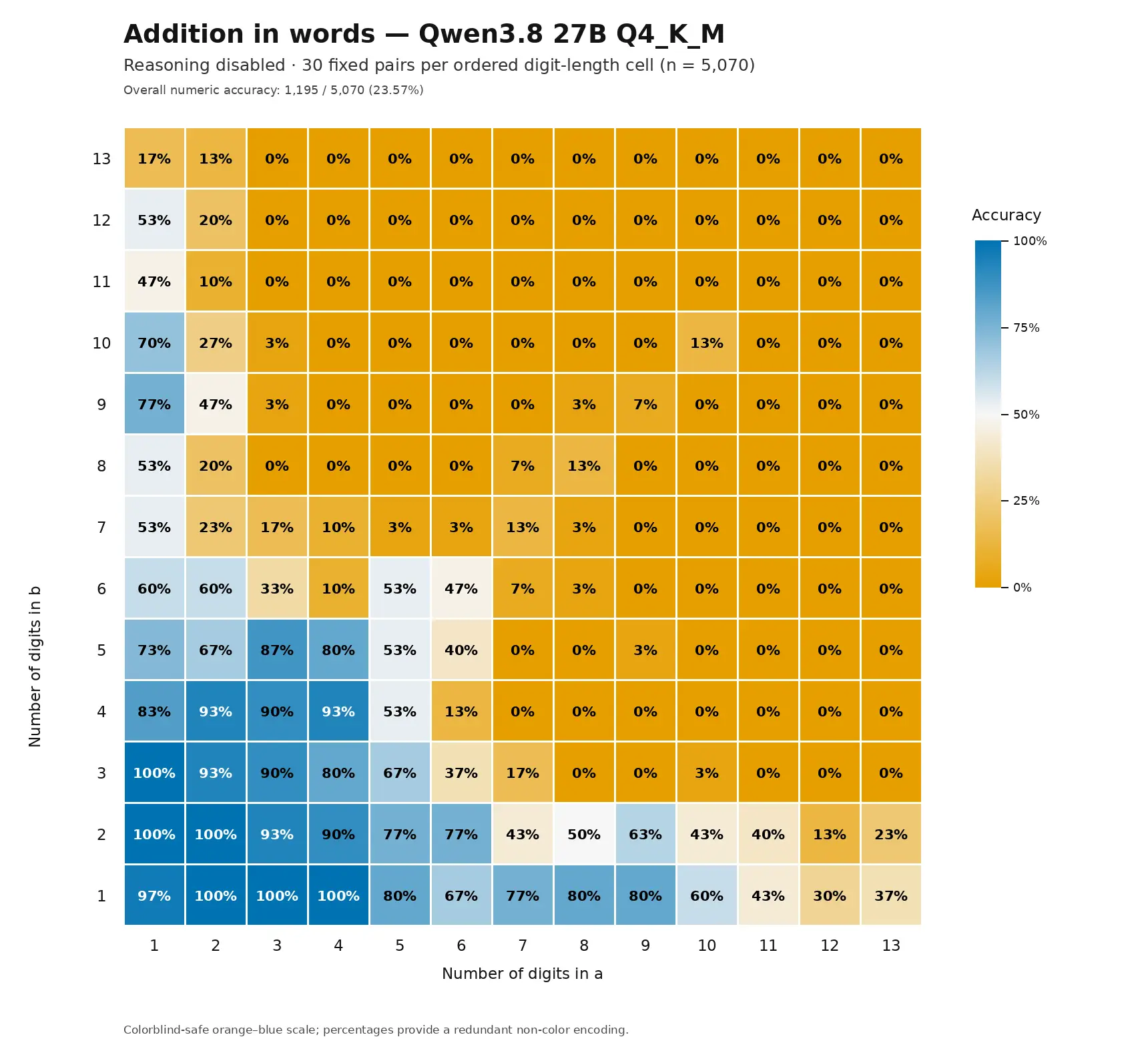
Simon Willison reran an arithmetic-in-words experiment locally using Qwen3.8-27B on a DGX Spark, eliminating the possibility of a hidden calculator. With reasoning disabled, he sampled 30 attempts for each number-pair combination; with reasoning enabled, he ran one sample per combination because the runs were much slower. The reasoning-enabled run answered 167 of 169 attempts correctly. The result is a reminder that smaller local models can show large reasoning gains on constrained tasks, but throughput and repeatability remain part of the tradeoff.
Read the source →pwasm 0.2a0
Simon Willison let Claude Opus 5.5 revisit pwasm, a pure-Python WebAssembly engine that had itself been largely vibe-coded months earlier. After 42 commits with minimal follow-up prompting, the project now implements almost all of the WASM specification and its PyPI wheel bundles working WASM builds of MicroPython, QuickJS, and Micro QuickJS. Willison explicitly labels the release alpha and says he would not trust it for production. The experiment nevertheless shows how a newer model can materially extend software authored by an earlier generation of models.
Read the source →llm-anthropic 0.30
Version 0.30 of Simon Willison’s llm-anthropic plugin adds llm anthropic refresh, which retrieves the current Anthropic model list directly from the API. That removes the need for a plugin release solely to recognize a newly launched model. It also adds llm anthropic count, using Anthropic’s free token-counting API to estimate a prompt’s token usage before submission. Together, these features make model discovery and cost/context planning less dependent on static client metadata.
Read the source →Prime Inference 📈, agent population 📈, Claude academy 🎓

The supplied item contains only its headline and no article body. No additional claims or details were available to summarize.
Read the source →Jacob Lauritzen: Token Maxing Is the New Lines of Code
Legora CTO Jacob Lauritzen argues that token consumption is a poor proxy for AI adoption, because it can encourage engineers to run costly loops without improving outcomes. His company instead measures whether teams deliver high-quality work quickly, while its platform team optimizes the harness with measures such as turns-to-result and regression evaluations. Legora runs multiple coding agents in parallel, isolates their development environments, and has automated bug loops that reproduce issues, attach evidence, write regression tests, and open PRs for human review. For legal work, he draws the boundary at verification: AI can remove document-heavy work, but strategic choices without an objective answer still require human judgment, context, and accountability.
Read the source →Ido Safruti: Run Coding Agents in YOLO Mode, Safely
Bluebear presents runtime guardrails for coding agents intended to let teams use automatic or “YOLO” modes without letting agents drift from the requested task. It says it tracks each agent session against the user’s instructions and intervenes only when drift occurs. The pitch is aimed at developer teams that want more autonomy while preserving a safety boundary around the work. The available transcript is a brief promotional segment and provides no technical detail on its enforcement mechanism or evaluation.
Read the source →Mods in Claude Code: change how Claude Code works
Claude Code mods are plugins that can modify rendering, prompts, tool calls, UI, skills, and commands through TypeScript functions registered on internal events. A mod receives the Claude Code interface, event data, and a next function; it can alter the event before passing it on or handle the event itself by returning a result. The examples include a live context display, an agent side pane, and email-address redaction that changes only the rendered text, not the model’s underlying content. Mods run in a sandbox, are loaded through a plugin directory or global settings, and can be shared through a marketplace like other plugins.
Read the source →OpenRouter State Of Models: Jev, Open-Weights, and Tokenomics
The video argues that OpenRouter usage demonstrates rapidly rising demand, citing 146 trillion tokens used in the prior week versus 4.5 trillion a year earlier. Its framing is that builders should choose models across performance, speed, and cost rather than treating raw capability as the only axis. The discussion places new decision-model classes such as Jev alongside open-weight alternatives and token economics as key trends for the final quarter of 2026. The practical conclusion is that token abundance creates more use cases, but organizations should make those tokens economically productive rather than merely maximize consumption.
Read the source →You Need To Add This In Your Claude Code Setup Right Now
This walkthrough recommends enabling CLAUDECODENEWINIT=1 before launching Claude Code to use a more interactive version of the initialization flow. Instead of immediately generating a broad CLAUDE.md, the flow asks about the existing setup, skills and hooks, Git practices, and deployment plans, then proposes a plan for approval. The stated goal is to keep CLAUDE.md limited to durable information the agent needs constantly rather than duplicating facts it can derive from the codebase. The video also covers settings for parallel sessions, workflow-learning commands, and keyboard shortcuts, though the supplied transcript primarily details the revised init behavior.
Read the source →How a Logistics Giant Keeps AI Data Locked Down
CH Robinson describes using AI across logistics workflows, including order entry, email classification, pricing, quoting, booking, and load tracking. The company primarily uses Azure and Azure OpenAI and is building an ROI and usage-observability program to connect services to measurable value. The interview frames governance as a practical need for organizations worried about large AI bills and sensitive operational data, not merely a compliance exercise. The supplied transcript is incomplete, so it does not specify the company’s detailed technical controls for data isolation or cost management.
Read the source →Agents, Engineers, and Citizen Developers
Massdriver’s Cory O’Daniel argues that safe infrastructure agents require an explicit model of application context, separate agent identities, and permissions that encode business rules rather than borrowing a human’s credentials. His platform lets developers request approved infrastructure through diagrams and modules, while agents can be restricted—for example, to staging databases that do not hold personally identifiable information. He favors test-driven development, enforceable examples, small reusable skills, and assigning agents maintenance work such as flaky-test and lint cleanup. The broader case is for engineers to build governed self-service paths so citizen developers can deliver useful applications without bypassing security, reliability, or version-control safeguards.
Read the source →How to Choose Your Personal Agent
The AI Daily Brief says personal agents are proliferating and will increasingly connect to consequential services such as email, Slack or Teams, and potentially financial accounts. It recommends reserving time to experiment rather than assuming the current agent form factor is settled, but warns that the context, setup, and permissions involved could make switching costly. The proposed selection framework is meant to help users choose where to invest that experimentation. A prudent first trial does not require granting an agent access to every account; users can test whether it changes real professional or personal work before expanding permissions.
Read the source →AI Agents Are Moving Into the Real World
The AI Daily Brief frames the market debate as a question of whether people want personal-life optimization or simply want tedious, low-value tasks removed. It points to growing activity around agents such as Muse and Grockbot as evidence that the category is moving beyond screen-bound chat. The episode also reports Anthropic’s claim that Claude, with high-level scientific direction, identified a novel enzyme system with CRISPR-like properties; the function remains unknown. The shared implication is that increasingly connected agents bring potential utility into real-world workflows, while raising the stakes for validation and deployment.
Read the source →