OpenAI pushes persistent agents into work
Summary
The day’s central shift is from evaluating AI as a chat interface to treating it as an operational actor with permissions, costs, persistent context, and measurable consequences. The agent announcements promise delegation, but the surrounding pieces emphasize the controls that determine whether delegation is viable: hard spending limits, enterprise governance, secure plugins, and tests that verify real state rather than fluent claims. The competitive question is therefore less about who has an agent and more about who can make one dependable, affordable, and accountable.
Hitting your ChatGPT limit? Try Sol before paying $300 more
Nate Jones argues that OpenAI’s meaningful DevDay releases are Dots, the persistent-agent product; Space, a shared human-and-agent workspace; and GPT-6.1 Sol, a less costly model for recurring work. A Dot runs on GPT-6 Astra with a cloud computer and selected memories, recent context, and connected-app data; it can proactively handle defined responsibilities, such as fixing a zombie weekend meeting or spotting a calendar conflict. The key buying question is not whether an agent has memory and a computer—Meta’s Muse does too—but whether it can take over a useful responsibility with enough relevant context and limited supervision. Space and Pages are intended to preserve team reasoning across handoffs, though anything placed on a shared Page is visible to collaborators even if private chats and memories are not.
Read the source →We're going to need default hard budget caps on pretty much everything
Simon Willison calls for usage-based services to make hard monthly spend caps the default: crossing the limit should stop the service and return errors, rather than merely send an alert while charges continue. He argues that coding and personal agents make it much easier to launch code that can generate API, hosting, storage, and compute costs unattended, making surprise bills a more likely operational failure. The tradeoff is downtime versus an uncapped bill, and he expects most individuals and businesses would choose the former—even for potential $10,000-plus exposure. AWS has begun offering project spend limits that pause a project at its limit for some customers, and Google Cloud introduced service-level Spend Caps in July; Willison wants agents to steer inexperienced builders toward providers with such protections.
Read the source →September sponsors-only newsletter
Simon Willison announces that his September sponsors-only newsletter is available to paying sponsors, with an August edition offered as a preview. The issue’s advertised topics include more Fable-class models, a pricing war, 3D graphics and Blender, LLMs applied to mathematics, accidental cyberattacks, Datasette security, current tools, software releases, and a year-to-date LLM review. Access is positioned as a $10-per-month sponsorship benefit that gives readers the newsletter a month before a free copy is released.
Read the source →Rex's Dino Store
Simon Willison shares a brief photo note from Brooklyn’s Grand Army Plaza subway station, where a former newsstand just before the turnstiles has been repurposed as “Rex’s Dino Store.” The post’s point is the unusually dense collection of dinosaur puns in the storefront. It is a local-art observation rather than an AI or technology report.
Read the source →The Sequence Radar - Issue 944 — Last Week in AI: Last Week in AI: OpenAI Connects the Dots, Gemini Levels Up, and Agents Cash In
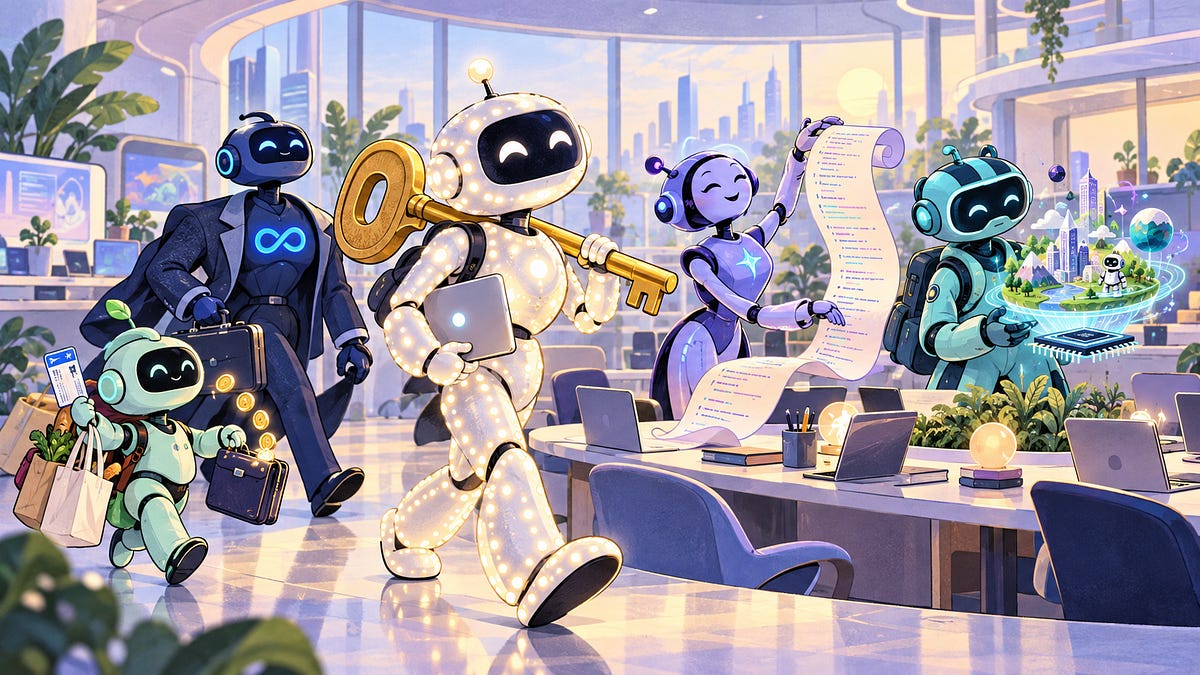
The Sequence sees the week’s releases as a push to give AI agents an “expense account”: persistent context, tools, shared workspaces, and affordable inference so they can act inside real workflows. It frames OpenAI’s Dots, Space, GPT-6.1 Sol, and Astra Ultrafast as the infrastructure for repeated delegation, while noting Google’s Gemini 4 Argon claims a one-million-token output limit and 77.9% on DeepSWE v1.1, with access initially limited to trusted cyber defenders. Meta is moving toward enterprise distribution with a new platform led by former MongoDB CEO Chirantan Desai, while AMD’s proposed $8.2 billion stock acquisition of World Labs and Instinct’s $1 billion Series C show large bets on spatial intelligence and personal agents. The article’s standard for success is practical rather than promotional: agents must complete tasks with sensible permissions, recoverable errors, and costs low enough that users stop constantly checking them.
Read the source →Joy & Curiosity #102

Thorsten Ball’s link roundup mixes product skepticism, AI capability signals, security, and cultural commentary. It highlights a reported Google Gemini 4 Argon deployment in which agents used fleet profiling telemetry to find and apply data-center memory optimizations, freeing more than 300 TiB and projecting 500 TiB to 1 PiB in total savings. The roundup also cites a cost claim that GPT-6.1 Sol achieved the same internal evaluation score for $2.72 versus Sonnet 5.5’s $7.60, and raises concern over Anthropic’s report that GLM-5.3 and Claude Mythos Preview achieved full control-flow hijacks in 4% and 6% of sampled trials, respectively. Its broader tone is that impressive capability gains coexist with mounting security risks and a tendency to mistake shipping more features for solving product problems.
Read the source →Should You Pay $100 A Month For OpenAI's Dots When Meta's Muse Has A Free Version?
The video presents OpenAI Dots as a persistent agent with a computer, memory, and the ability to continue work after the user logs off, contrasted with Meta Muse’s similar setup and free entry point. The host’s argument is that durable differentiation will come from the jobs an agent reliably performs for a person, not from those baseline features. In hands-on examples, Dots noticed and cleaned up a recurring meeting that fell on weekends and flagged a conflict between a DMV appointment and travel, illustrating the value of accumulated context handling small but neglected administrative work. The video also places Dots alongside Space and GPT-6.1 Sol as part of OpenAI’s broader effort to make context, collaboration, and lower-cost work usable in one product.
Read the source →What the Best Business AI Users Are Doing Different
This video says stronger business AI adopters are investing in a management layer: model routers, organizational and data-sovereignty strategies, and more robust AI governance. It argues that the kinds of work companies assign to AI, and the value they receive, are changing as those foundations mature. It also uses the emerging personal-agent competition to illustrate market expectations: Meta’s Muse helped drive a 27% rise in Meta stock during September and added roughly half a trillion dollars in market capitalization, though a skeptical analyst noted Meta’s historically slow monetization of new products. Muse remains free for most users, making the business model and enterprise controls as important as the agent experience itself.
Read the source →v2.1.289
Claude Code v2.1.289 is primarily a stability, security, and plugin-system maintenance release. It fixes approval and deny-rule gaps in compound shell commands and variable-prefixed commands, closes symlink-related holes in IDE Read deny rules, and prevents user-installed plugins from rewriting descriptions for organization-managed MCP sign-in tools. The release also addresses freezes and crashes from malformed or deeply nested terminal content, plugin drawing failures, stale plugin state, and sessions ending when plugin handlers throw. For multi-agent and plugin developers, it adds agent.spawn for teammates, a stable agent ID across hook events, and idle/waiting states in $.agent.list().
Read the source →The Agent Said It Was Done. The Database Disagreed.

Microsoft’s ThinkingBox benchmark evaluates agents by the actual backend state and side effects they leave behind across 507 stateful business workflows, not merely by their final text or apparently valid tool traces. In a 121,680-trial ablation across 12 models, 79,853 attempts failed executable checks; 67.24% of those failures nevertheless ended cleanly, changed state, and reported no final tool error. The benchmark repeats every task 20 times, exposing a large gap between single-run ability and consistency: Claude Opus 5.5 leads pass@1 at 67.16%, while GPT-6 Astra retains 78% of its one-shot score across repeats and Claude Opus 5/5.5 retain 71%. The post’s practical message is to test whether the required record is actually correct and whether an agent can produce that result repeatedly, because a plausible trajectory is not evidence of a correct outcome.
Read the source →