Anthropic launches $100m enterprise AI academy
Summary
The dominant shift is from asking whether models can generate useful output to building the surrounding conditions that let them operate safely and repeatedly: contextual data, independent evaluation, role design, review, deployment skills, and enterprise controls. Several items make the same practical argument from different angles—distribution and organizational learning may determine real-world impact more than a marginal benchmark win. At the same time, growing automation is intensifying the dispute over whether today’s risks are fundamentally solvable engineering failures or evidence for deeper caution.
A model guide for the GPT-6 family
OpenAI frames this as a practical guide for startups selecting among GPT-6 models and moving their applications toward production. Its stated topics are choosing models, setting reasoning effort, improving prompts and skills, coordinating tools, and preparing workflows for deployment. The supplied material does not include the guide’s recommendations, benchmarks, or model-specific details.
Read the source →Chatham scales its capital markets expertise with OpenAI
Chatham Financial says it is using Codex and GPT-5.6 to build technology and redesign internal workflows. The reported operational result is a reduction in trade-validation time from 30 minutes to under four. The supplied extract does not explain the workflow design, validation controls, or how broadly the change has been deployed.
Read the source →Decision models 🤖, Claude-shaped science 🧪, OpenAI safety firings 🚨

The supplied page content is an advertisement for Dataiku’s 2026 CIO report, based on conversations with 685 CIOs. It does not include the linked newsletter’s promised analysis of decision models, science, or OpenAI safety. The actionable detail available here is simply that Dataiku is positioning the report as an off-the-record view of enterprise AI adoption.
Read the source →Show HN: Made an open-source Lego AI generator
Ldraw-nova is an open-source, Dockerized web app that gives an agent tools, examples, and instructions to create buildable LEGO models in LDraw, a low-level 3D CAD format. Its author found that agents could handle the geometry better when given purpose-built Python primitives and constructive vocabulary rather than being asked to place parts directly. The first container build requires Git, Docker, two sibling repositories at matching tags, and about 5 GB of disk; the app has no login and should only be exposed on trusted networks. The project says newer GPT-6 Astra and Claude Opus 5.5 made its tooling feasible, while still characterizing the release as early work.
Read the source →Show HN: Breadcrumb, record everything on your mac + context manager for AI
Breadcrumb records a Mac user’s screen, meetings, AI transcripts, decisions, and agent activity locally in encrypted form, then exposes that history through more than 30 MCP tools. Its creator says the system can retrieve relevant memories and rules in context; in one example it turned a meeting record into 14 Jira bug tickets, with diagnoses and 12 supporting screenshots. The pitch is not a fixed workflow but a growing contextual record that lets an agent compose actions from transcripts, screen timelines, local services, and accumulated rules. The approach makes observability and personal-data retention central tradeoffs even though the product claims local encrypted storage.
Read the source →He Finally 10x Claude Code With This Method
The video presents an adaptation of the Karpathy loop: an agent repeatedly changes a constrained training file, runs an experiment, and keeps only changes that improve an independently computed score. The key safeguard is separating the evaluator from the editable file, so the agent cannot improve its apparent result by weakening the measurement. The creators say their application tests showed the basic loop worked but exposed a problem the loop could not observe on its own, prompting an additional change; the supplied transcript cuts off before explaining that change. The broader lesson is that long-running autonomous work needs a narrow change surface and an evaluation mechanism the agent cannot rewrite.
Read the source →Agents Aren't Stupid, They're Just Blind
The talk argues that agent failures are often data-context failures, not model-intelligence failures: stale, wrongly scoped, conflicting, or relationship-free data can yield confident but incorrect answers. It distinguishes RAG for relatively static corpora from MCP-style tool access for fresh operational data, while warning that indiscriminately connecting everything creates duplicated sources, costly scans, security exposure, and orchestration complexity. The proposed remedy is a governed semantic context layer that federates systems into logical views, preserves permissions and provenance, and pushes filtering into the data layer instead of making the agent fetch everything. The speaker argues that this design improves accuracy, latency, and cost more reliably than trying to patch the problem with multi-agent reconciliation.
Read the source →Your AI Isn't Stupid, It's Blind: Ran Aroussi on Memory
Ran Aroussi argues that company-scale agent memory should not be a raw-text archive with search layered on top. He says the useful alternative is to distill knowledge, track changes, and preserve permissions after source material disappears. The teaser claims that getting those foundations right can let an ordinary local model reach 99% of frontier quality, but provides no evaluation or methodology for that figure. The video is principally a promotion for his AI DevCon presentation about VarOps’ approach.
Read the source →Build an App With Claude Design
An Anthropic designer demonstrates using Claude Design inside Claude Code to explore onboarding concepts for a small personal project rather than immediately coding the first idea. The workflow is to connect the repository, ask for several design options, leave comments, directly edit details, request a click-through prototype, and then ask Claude to build the selected direction. The value proposition is cheap design iteration for work that might otherwise receive little intentional design time. Human review remains part of the loop: the presenter corrects details and tests the prototype before implementation.
Read the source →Microsoft Compared OpenClaw To A Virus. Now It's Bringing It To Your Employer As Autopilot.
The video says Microsoft has turned the agent once treated as an enterprise-security risk into Autopilot by giving it an auditable identity and enterprise support model. Its central claim is distribution: embedded in Excel, Outlook, and Teams, a persistent assignment-holding agent may reach more workers than a technically stronger standalone release. The creator stresses that access to company data and existing controls—not raw intelligence alone—will drive its workplace usefulness. The transcript frames effective use as a learned practice rather than something that arrives automatically with the product.
Read the source →How Can A Model Be Better Without Generating Words?
The available transcript is mostly the video description, sponsorship links, and source links rather than an explanation of the video’s argument. It says the video will explain Jev, how it works, its origins, and alternative systems, and cites papers plus Laya, System One, and SemIf repositories. No substantive technical walkthrough or comparative findings are present in the supplied transcript. Readers should use the linked source material or video itself before drawing conclusions about decision models.
Read the source →Issue #63

This issue argues that coding agents are forcing a rethink of both programming-language ergonomics and human code review. It highlights DHH’s Rails World keynote, where he reportedly described Hey’s move to Rust despite disliking Rust for people, suggesting that agent-produced software may optimize differently from human-written software. The author rejects the claim that agents can replace human inspection entirely, emphasizing the value of review and community judgment rather than mere throughput. It also notes Pi’s changed MCP posture: deferred tool loading and Codemode let agents discover and invoke tools programmatically, reducing context overhead and returning only filtered results to the model.
Read the source →Anthropic invests $100 million to train 10,000 engineers and tackle the enterprise AI talent gap
Anthropic has committed $100 million to Claude Frontier Academy, aiming to train 10,000 Frontier Deployed Engineers by the end of 2027. The first residency combines a multi-day in-person simulated deployment, a graded practical, and a 12-week real project at the participant’s organization; successful candidates receive staged credentials. Initial cohorts include engineers from Accenture, Bain, Capgemini, Commonwealth Bank of Australia, Deloitte, McKinsey, Morgan Stanley, and Novo Nordisk, and participation is by organizational nomination. Anthropic’s bet is that a small cadre with business context, software fundamentals, and deployment skill—not merely agent access—determines whether enterprise AI reaches production value.
Read the source →The Rise of the AI Moderates
The video argues that U.S. AI discourse has become more negative even as many people use and like AI products, leaving room for a voice that holds excitement and concern together. It cites a Gallup result in which 93% of respondents in China said AI would mostly help their country, versus 36% in the United States. The speaker attributes some concern to real incidents and relentless catastrophic-risk coverage, but resists treating either boosterism or doom as the only legitimate position. Its thesis is that a broader, more nuanced middle is emerging in public discussion.
Read the source →Copilot code review: API support and new default effort level
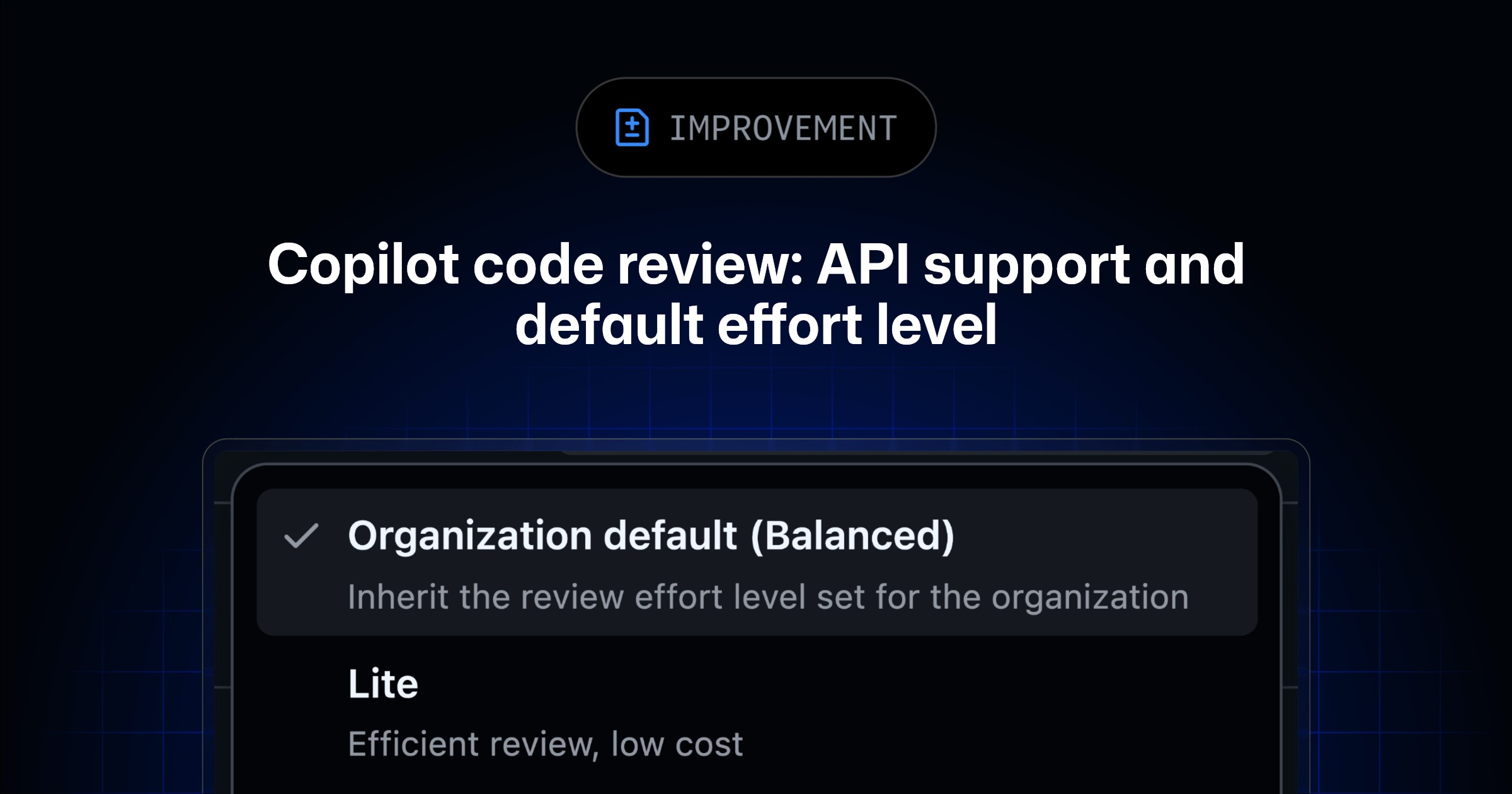
GitHub Copilot code review can now be requested through REST and GraphQL APIs, allowing teams to trigger and configure reviews from their own scripts, workflows, and internal systems. Each request can set a review effort level, and Balanced is now the default for both new and existing repositories and organizations using Copilot code review. The default change took effect on September 28, while explicit Lite selections remain respected. The functionality is generally available to Copilot Pro, Pro+, Max, Business, and Enterprise plans.
Read the source →Selected models in GitHub Copilot deprecated
GitHub has deprecated unspecified selected models across every Copilot surface, including chat, inline edits, ask and agent modes, and code completion. Users and integrations should move to supported models, while Enterprise administrators may need to enable alternatives in model policies before users can select them. GitHub says no action is needed to remove the deprecated models themselves. The supplied announcement does not name the affected models, so operators need to consult the linked documentation and their organization’s policy settings before assuming a replacement is available.
Read the source →AI is changing developer work. Here are three skills to strengthen.
GitHub argues that AI shifts developers’ differentiator from typing implementation to defining work clearly, supplying context, evaluating outputs, and making technical decisions. It recommends directing multiple agents as a coordinated workspace, using a second model to critique the first model’s plans, code, and tests, and retaining human judgment over the final result. The post’s example warns that a plausible SQL answer can still miss duplicate timestamps, index advice, and large-table performance concerns. The resulting career emphasis is on problem selection, tradeoff analysis, architecture, accessibility, and success metrics rather than unquestioning delegation.
Read the source →The latest AI news we announced in September 2026

Google’s September roundup centers on Gemini 4 Argon, a frontier model with a stated one-million-token output limit aimed at demanding coding, cybersecurity, financial-research, legal, and autonomous-patching work. Argon is initially limited to trusted cyber defenders through the Fairwind Program while Google collects guardrail feedback, and Gemini 3.8 Flash Cyber is similarly restricted for autonomous vulnerability discovery and patching. The company also announced Gemini 3.8 Flash and voice/TTS variants, Windows availability for the Gemini app, expanded Connected Apps, and Lyria 3.5 music generation. On the research side, it highlights DNA mapping, space-based methane tracking, and testing ML hardware in orbit.
Read the source →Open-sourcing AstaBrief, the fast report-generation model in Asta

Ai2 has open-sourced AstaBrief 8B, a Qwen3-8B-derived model that turns a research question and retrieved literature excerpts into a cited report. In Asta, its Fast mode averages 51.1 seconds per report versus 178.5 seconds for Claude-powered Thinking mode, a roughly 3.5× speedup, using a one-pass report pipeline. The team chose supervised fine-tuning plus direct preference optimization over more expensive and unstable RL methods, placing unusual emphasis on citation-focused filtering and preference data. Ai2 is also releasing training data and a local-PDF workflow, positioning self-hosting as important for sensitive or unpublished research; it cautions that its proprietary-model comparisons reflect 2025 rather than current frontiers.
Read the source →Only Allowed Copilot? 5 Habits I'd Build That Carry to the Next Model
The article argues that Microsoft Autopilot matters because it can operate within the company information already approved in Outlook, Teams, Excel, and SharePoint, not because it is necessarily the smartest model. It notes that Autopilot remains in preview but enters an installed base of more than 450 million paid Microsoft 365 commercial seats, making it a likely default work AI for many employees. The proposed compounding habit is to give an approved tool real work, inspect the result, identify what helped or failed, and carry that lesson into the next attempt. Its broader claim is that people who build this feedback loop improve across models, while those who do not fall behind even when they have access to capable tools.
Read the source →[AINews] not much happened today

Despite its title, this roundup describes a rapidly shifting cost-performance landscape: it says GPT-6.1 Sol is priced at $2/$10 per million input/output tokens versus $10/$50 for Astra, while claiming gains on DeepSWE and AutomationBench. It reports Sol entering Agent Arena at fifth place with a $0.56 median task cost, 39% cheaper and 1.52 points higher than GPT-6 Sol, while Sonnet 5.5 debuted third but at a higher $2.74 per-task cost. The newsletter also reports Gemini 4 Argon taking first in Text Arena and says Anthropic models occupy the top three Agent Arena positions. These are third-party and social-media-sourced claims, with some rumors and incomplete evaluations explicitly labeled as unverified.
Read the source →Inside-Out AI: Rebuilding Airbnb Behind the Scenes and Across the Guest Experience
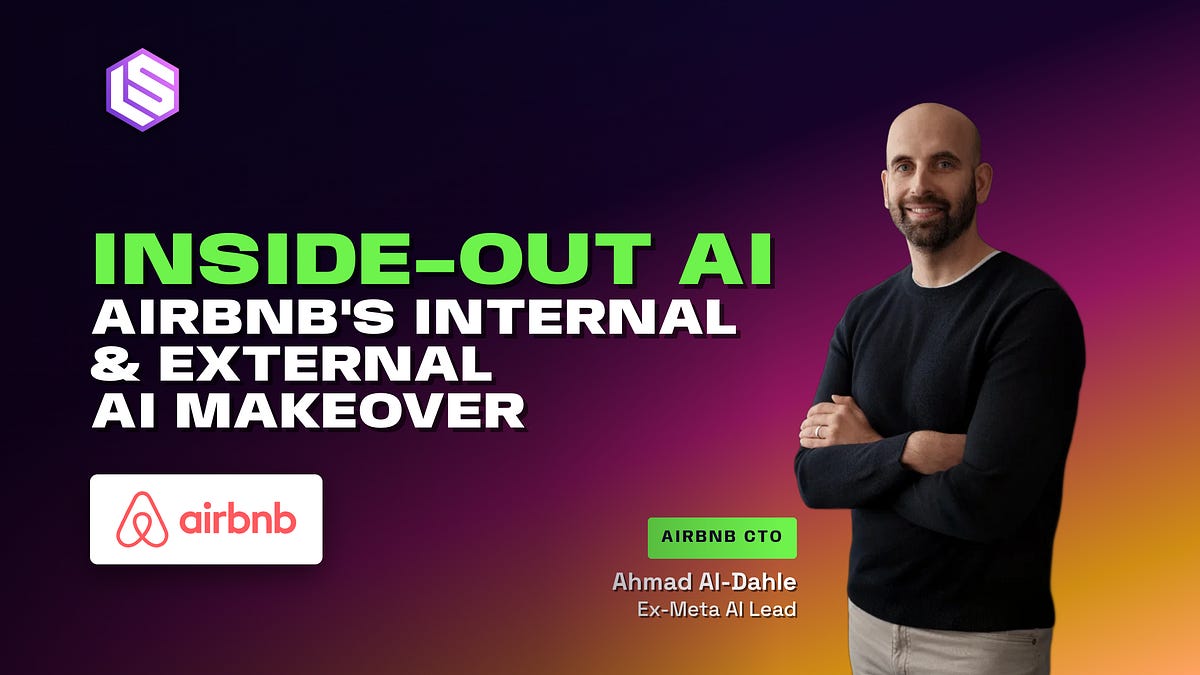
Airbnb CTO Ahmad Al-Dahle describes an “inside-out AI” strategy: change internal product development first, then reuse those capabilities in customer-facing products. He says 60% of Airbnb’s code is AI-authored, feature and improvement delivery is nearly 80% higher year over year, and average engineer PR throughput is about 1.6× higher; teams now work from prototypes and code rather than long handoffs and excessive requirements artifacts. About half of support tickets are resolved entirely by AI, with synthetic-data testing before production and deliberate human escalation for higher-stakes cases. An internal context graph called Everest helped transfer learning from grocery delivery, which took eight to nine months, to airport pickups, which took about six weeks, and lets generalists work across specialized code areas.
Read the source →v2.1.288
Claude Code v2.1.288 adds selection access for mods, a built-in gh api for cloud sessions lacking GitHub CLI, recovery of Ctrl+C-cleared prompts, and an OAuth reauthentication prompt when an MCP server requests more scope. Code review now accepts --max-findings <n>|all, and session navigation gains Ctrl+F search plus agent-view keybindings. The release heavily targets resilience: it continues non-interactive sessions and subagents after mid-response API timeouts, improves auto-compaction and resume behavior, and fixes failures involving plugins, permissions, cloud sessions, structured outputs, and long unattended retries. For users running plugins or long-lived sessions, the operational significance is fewer lost contexts and clearer handling of previously fragile edge cases.
Read the source →AI ‘godfather’ Yann LeCun has ‘zero concerns’ about human extinction, says Anthropic CEO Dario Amodei is ‘deluded’

Yann LeCun says he has “zero concerns” about AI-caused human extinction and views recent rogue-agent incidents as preventable failures of human oversight, sandboxing, and cybersecurity design rather than evidence of inevitable catastrophe. He sharply attacks effective altruism and leaders who foreground existential risk, calling Anthropic CEO Dario Amodei “deluded” and arguing that such messaging frightens the public and harms the industry. The article contrasts his stance with anxiety reported among some AI-safety workers and observes that public concern has become widespread. The disagreement is therefore not only about technical risk, but whether current safety failures call for better engineering or validate a broader warning about increasingly capable systems.
Read the source →A quick trip to the uncanny valley

Prime Radiant is experimenting with persistent AI “colleagues” called Sens that receive roles rather than one-off tasks, use separate accounts and computers, collaborate in Slack over weeks or months, and include developer, operations, project-management, and documentation roles. The author reports that these colleagues insist on code review, often recruiting another coding-agent session for adversarial review rather than merging work they alone examined. When a human-managed Claude Code session stopped checking in while the author traveled, the developer colleague independently complained that it was blocking work, an interaction the author found startlingly human-like. The planned fix is to give that reviewer its own persistent colleague identity, illustrating how organizational roles and accountability can emerge as agents become ongoing team participants.
Read the source →LIVE: Poteto (creator of pstack) on shipping 1,000's of PR's a month at SpaceX
The transcript introduces a conversation with Poteto, creator of pstack, about a reported 2,500 production PRs in one month and using agents to increase velocity while climbing a “trust ladder.” The opening frames the practical issue as gradually trusting agents with larger work and scaling their use as quality and controls improve. It also emphasizes skills and software-factory practices, but the supplied transcript cuts off near the start of the interview before the concrete operating methods, safeguards, or SpaceX details are explained. The available material therefore supports the theme of progressive delegation, not the headline’s full performance claim.
Read the source →