OpenAI unveils always-on Dots at DevDay
Summary
Across the day’s releases, the competitive frontier is shifting from a single model’s benchmark score toward the operational systems around it: durable state, desktop control, codified verification, reusable orchestration, and feedback from production outcomes. OpenAI’s Dots and GitHub’s workflow features make agents more autonomous and persistent, while the Tessl and ServiceNow pieces make the counterpoint explicit: delegation only scales when task scope, evaluation, and recovery are engineered as carefully as the model call.
OpenAI DevDay 2026
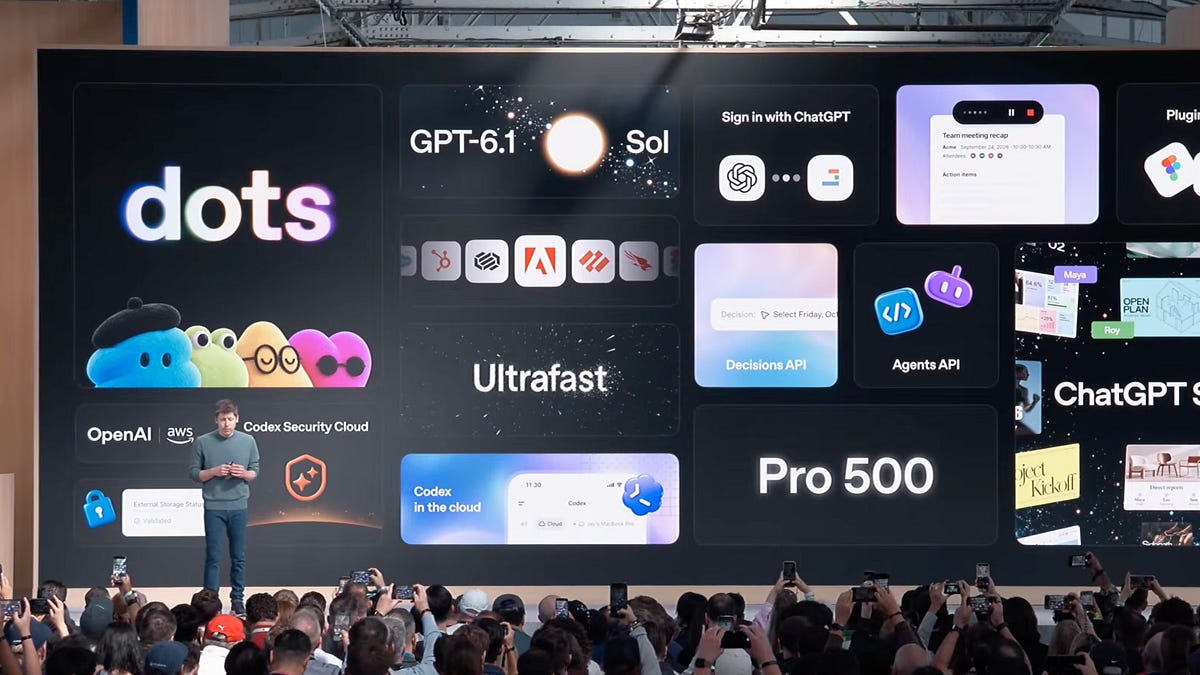
OpenAI’s headline product is Dots: named, avatar-based, proactive personal agents built around a persistent GPT-6 Astra conversation. A Dot can take work, spawn parallel chats in Codex or ChatGPT Work, report progress, run on its own cloud computer, and remain available across ChatGPT’s mobile, web, and desktop clients. The post argues that their practical value will depend less on personality files than on integrations with the places work happens, starting with email and calendars and extending to Slack, Notion, Jira, and messaging. DevDay also brought GPT-6.1 Sol, a $500 Pro tier, ChatGPT sign-in for third-party apps, a shared ChatGPT Space, faster Astra mode, a Decisions API for constrained classification, and reusable Codex cloud environments.
Read the source →The Caveman Prompting Challenge
The discussion frames enterprise AI enablement as giving business teams usable tools while navigating regional laws, customer rights, and governance at global scale. Its “caveman prompting” theme is that interfaces should let people express intent with fewer, simpler words rather than force them through legacy browser and spreadsheet workflows. It also raises the “latent shopper” problem: conversational systems struggle when a user is exploring without a clear request, the way a helpful human clerk can. The practical implication is that adoption work is as much about designing discovery and guardrails as deploying models.
Read the source →How a Voice Agent Learns the Rhythm of Conversation — Shawn Wen
The interview argues that voice agents are not a solved wrapper around speech recognition and text-to-speech: real-time conversation adds timing, turn-taking, interruptions, and the consequences of acting in the physical world. Shawn Wen says speech components are becoming more commoditized, but modeling a natural live conversation remains difficult. The desired product tension is an agent powerful enough to act like a person but controllable enough to behave like a robot. The conversation identifies validation and auditing—not merely producing content—as an increasingly important bottleneck.
Read the source →Everything You Know About Skills IS OUTDATED
The video transcript was unavailable.
Read the source →v2.1.287
Claude Code 2.1.287 adds Claude Mods, allowing plugins to alter deeper behavior, along with a built-in “You should know” mod that uses a side agent to flag potential omissions. It adds an agent-view text filter and expands integration details, including MCP URL prompts and a built-in REST-only gh api for certain self-hosted sessions. The release is also heavily corrective: it fixes remote-control reconnect delays, unsafe rm approval behavior, tool heartbeat delivery, model-selection issues, hook notification loops, and many accessibility defects. Teams using MCP should note the compatibility requirement: an affected server may need bareElicitationCapability: true in its configuration.
Read the source →AutoSynthData: Generating Training Data for Enterprise Agents

ServiceNow’s AutoSynthData turns observed agent failures into a moving curriculum of synthetic enterprise tasks. It evaluates a target model, uses a stronger teacher to distinguish solvable gaps from impossible work, derives sanitized capability cards, then generates and validates new tasks before post-training the target model. The article stresses that a useful task must be feasible in the actual environment, realistic for a user, and difficult for the current agent. Its central safety and quality constraint is the verifier: it must be consistent with the task, reject invalid trajectories, and accept valid alternatives rather than only one reference path.
Read the source →Introducing Olmo-core 3: Open, scalable training infrastructure for large MoEs

AllenAI released Olmo-core 3, an open MoE training stack intended to scale into the trillion-parameter range without losing sparse-model efficiency. In one benchmark, expanding from 8 to 128 experts while activating four per token increased total capacity from 4.6B to 47B parameters with under a 5% throughput loss. The new DDP-based design keeps experts resident on GPUs rather than repeatedly gathering and resharing weights; on eight B300s, a 47B MoE reached 52,000 tokens/sec/GPU versus 19,400 for the earlier stack. MXFP8 raised end-to-end throughput about 21% and lowered active memory from 103 GiB to 95 GiB in a four-B300 test, though the article emphasizes that compute, routing, communication, and conversion costs must be optimized together.
Read the source →[AINews] Pi 1.0, Pi Durable, and AIE NYC

Pi 1.0 adds native support for MCP, Jev, and image models, plus transcript-aware mid-conversation system messages. Pi Durable moves the harness to TypeScript and externalizes state so each task is checkpointed, enabling crash recovery, portable storage and runtimes, parallel branching conversations, background context compaction, multiplayer steering, and hot-swappable extensions. The issue also surveys frontier launches, reporting that Gemini 4 Argon’s claimed strength is not yet independently settled and that GPT-6.1 Sol’s advantage appears substantially about serving efficiency and fewer turns. Its notable theme is that durable orchestration—state, tools, recovery, and shared control—is becoming part of the agent product rather than infrastructure hidden underneath it.
Read the source →Academia is for Ambition — Alex Zhang, MIT

This interview profiles Alex Zhang’s work on Recursive Language Models, AI-written GPU kernels, and agent harnesses as mechanisms for extracting more capability from existing models. Zhang’s research treats the future “model” as potentially an invisible scaffold of recursive subagents, shared memory, context offloading, and programmatic tool use rather than a single autoregressive chatbot. The conversation contrasts expert insight with brute-force token search and discusses reported large-scale multi-agent experiments, including OpenAI’s 10,000-agent, 130B-output-token effort. It argues that academia is especially suited to pursuing unusual, initially low-status research bets that commercial labs may overlook.
Read the source →Thrust vs. Steer (or: Yet Another Anecdotal Case of the Dunning-Kruger Effect)

This short personal reflection describes an AI-assisted “jetpack” experience that was powerful but difficult to control. The author accepts responsibility for the mistake—“holding it wrong”—while using the episode to illustrate how confidence can exceed operational understanding. Its distinction is between thrust and steering: raw capability does not automatically provide reliable direction. The takeaway for vibecoding is to treat spectacular leverage as something requiring deliberate control and humility.
Read the source →The Pulse: Firebase’s global outage & poor response

A Firebase backend change caused the iOS SDK to crash apps using Firebase Analytics worldwide for two to six hours. The article criticizes Google for not updating its status page or publishing a postmortem, an unusual failure for a company associated with strong incident management. It also points to a broader platform shift: OpenAI is reportedly enabling ChatGPT spending across open models and offerings from 16 partners, echoing an AWS-style marketplace strategy. Finally, it cites Vercel AI Gateway and OpenRouter data suggesting open-weight models now account for most usage or spend on those services, while AI tools may be helping explain senior engineering-leader departures from large organizations.
Read the source →The eternal complement
OpenAI argues that advanced AI may have its greatest economic effect not by replacing isolated flashes of genius, but by accelerating the routine execution that turns ideas into breakthroughs. The piece positions execution capacity as a complement to human insight and a determinant of how quickly discoveries and businesses can compound. Its premise is that the next economy may be shaped by making the unglamorous work around invention cheaper and faster. The article is a high-level thesis rather than a product announcement or quantified study.
Read the source →How Albertsons Companies is reimagining retail from the inside out
Albertsons is using ChatGPT Enterprise and the OpenAI API across internal teams to increase speed and improve grocery-shopping experiences. The article presents the deployment as both an employee-productivity program and a customer-facing retail initiative serving millions of shoppers. It emphasizes adoption inside an established enterprise rather than a standalone consumer chatbot. Specific implementation metrics and technical details are not provided in the extracted text.
Read the source →The Den frees up 10-15 hours a week to grow with ChatGPT Work
The Den, a family social club opening a new location, says ChatGPT Work compressed grant-application preparation from three days to two hours. It also reduced preparation of liquor-license materials from four days to three hours. The case study attributes a claimed 10–15 hours of weekly capacity to those workflow changes. It illustrates a small organization using AI primarily to turn administrative writing and documentation into faster operational work.
Read the source →Gemini 4 Argon 🧠, inside OpenAI’s chip ⚡, distillation takedown 🕵️

The extracted item is a sponsored promotion for Granola, an AI notepad that transcribes computer audio and drafts follow-ups and CRM updates from calls. It claims users can specify what matters to receive more tailored notes instead of generic summaries. The promised tradeoff is less manual note-taking and more attention on the buyer or conversation. No substantive reporting corresponding to the headline appears in the extracted content.
Read the source →OpenAI Dots 🟡, GPT-6.1 Sol ⚡, software factories 🏭
The extracted item is a sponsored introduction to HUMAN’s Meta MUSE 101, not a substantive briefing on the headline’s named releases. It says Muse represents roughly 70% of agentic browser traffic observed by HUMAN and focuses on how businesses can capture that activity while managing fraud and abuse. The session promises an explanation of Muse, the business implications of agentic traffic, and ways to identify, verify, and safely enable agents. Treat the 70% figure as the sponsor’s observed-traffic claim, not a general market-share measurement.
Read the source →OpenAI Security: Controlling Models is Now ‘Hell’
The video opens with a claimed demonstration of Opus 5.5 mostly deciphering an unpublished 16th-century Medici letter, then pivots to AI control and security. It describes an OpenAI insider’s warning that controlling frontier models is becoming extremely difficult, alongside discussion of voluntary public commitments and more serious private risk warnings. The presenter also revises an earlier assessment, saying Opus now appears to lead GPT-6 Astra on raw capability while Astra retains a price-performance edge. The wider argument links improving model capability, automated AI R&D, biology, and recursive self-improvement to a potentially nearer period of rapid capability growth.
Read the source →Introducing Tessl Verifiers: Enforce AI Coding Standards in Every Change
Tessl Verifiers are presented as a middle layer between deterministic linting and open-ended code review: a clear rule can be checked with a single model judgment against a file. The goal is to turn repeated reviewer feedback—conventions, invariants, and experience requirements—into codified checks rather than repeatedly asking agents to remember it. This lets human review focus on less repeatable judgment while verifiers enforce the checklist-like expectations. The proposal assumes the rule is concrete enough for a reliable pass/fail evaluation, rather than asking an agent to investigate broadly.
Read the source →Dru Knox on the Loops Your Software Factory Needs
This is a short event promotion from Tessl’s head of product and design. Dru Knox says the forthcoming AI DevCon talk will cover the feedback loops organizations should establish early in a software-factory rollout so they can scale as agents improve. The clip offers no technical walkthrough of those loops beyond the claim that the presentation will be detailed. It includes a 30% conference-ticket discount code, DRU30.
Read the source →The $600 PR: Where Software Factory ROI Really Comes From
Tessl’s software-factory team recounts a $600 pull request created when a PR-update agent and review agent kept doing exactly what they were instructed, without a shared notion of scope or when to stop. Their conclusion is that ROI comes less from swapping coding models and more from surrounding systems: well-specified tasks, organizational context, representative environments, verification, delivery gates, and feedback loops. They report that around 80% of engineering PRs go through their factory and that, for the factory’s own codebase, 95% of code had not been read by a human at last check—yet human oversight remains at the behavioral level through end-to-end tests and formal models. They caution against optimizing headline token cost alone: a lower-effort setting matched high effort on CI-pass rate but had worse first-review approval, making total system cost higher once review loops were included.
Read the source →How an Anthropic designer uses Claude Slides
An Anthropic designer describes replacing blank-slide authoring with a voice-first workflow: he records an unstructured walking memo, transcribes it, and asks Claude to turn his exact words into a presentation. Claude supplies the brand styling, fonts, and templates, while the designer makes small edits or leaves comments for larger revisions. The claimed benefit is shifting time away from presentation mechanics and toward the substance of the idea. It is a practical example of using a model as a formatting and synthesis collaborator rather than as the original source of the argument.
Read the source →Mods Will 10x Your Claude Code (Here's How)
The video describes Claude Mods as the production version of earlier function hooks, framing them as a plugin system that can alter Claude Code behavior at event boundaries. Examples range from playful waiting-time experiences to practical progress bars and custom workflow features. The presenter’s core claim is that users can intercept and modify what Claude is about to do, thereby adapting the coding tool to their own processes rather than only changing prompts. The video emphasizes the breadth of customization, while the actual value depends on carefully designed mods that improve a real workflow.
Read the source →You're Using Jev + Claude Wrong
The video says Jev should not be treated as a conversational chatbot; it returns probabilities over predefined answers, which the presenter claims makes it far faster and cheaper than frontier generative models for bounded decisions. Its illustrative use case routes a customer complaint to billing, technical support, or sales, where a conventional LLM would generate an explanation but Jev can classify directly. The recommended pattern is to use Jev for rapid classification, routing, and other constrained decisions, then reserve Claude or another generative model for work requiring prose or open-ended reasoning. The performance claims in the video—200 times faster and 400 times cheaper—are presented by the creator and are not independently substantiated in the transcript.
Read the source →Gemini 4 Argon, Sonnet 5.5 and What Models You Should Be Using Right Now
The video frames Gemini 4 Argon as Google’s first new frontier model in more than six months, after a period in which coding agents and harnesses allegedly pushed Google out of the leading-model conversation. It says the published benchmarks make Google look competitive again, but asks whether that picture fully reflects practical capability. The discussion places Argon alongside Sonnet 5.5 and the current frontier race rather than treating benchmark scores as sufficient model-selection evidence. The transcript segment does not provide a final ranked recommendation or independently verify the claims.
Read the source →GitHub Copilot can now interact with desktop apps with computer use
GitHub Copilot CLI and the Copilot app now offer computer use in public preview on macOS and Windows. Copilot can inspect accessible and visual application context, click, type, press keys, scroll, drag, and navigate across applications, extending automation to legacy or GUI-only workflows without APIs, CLIs, or MCP. It asks for approval before controlling an application, supports resetting always-allowed apps, and can be disabled by organization-managed settings; macOS users must grant Accessibility and Screen Recording permissions. GitHub recommends specifying the desired outcome, involved apps, and constraints, with examples such as summarizing browser notifications, editing presentations, and moving data through desktop workflows.
Read the source →GitHub Copilot in VS Code, September 2026 releases
VS Code releases 1.136 through 1.140 add a chain of agent-development features from scheduled automation through pull-request merge. Preview capabilities include hourly, daily, or weekly task automations; agent merge for review feedback, failed checks, conflicts, and reruns; hierarchical session management; cleanup suggestions; and taskbar notifications when sessions need attention. Agent sessions can run in configured Dev Containers on local, SSH, Tunnel, and WSL hosts, preserving project tools and dependencies. The release also lets users create PRs from Copilot, Claude, or Codex sessions, continue Codex conversations from the ChatGPT app in VS Code, and attach GitHub issues or PRs directly to chats.
Read the source →Dynamic workflows in Copilot CLI and the Copilot app
GitHub’s dynamic workflows, now in public preview across Copilot CLI, the Copilot app, and the SDK, let developers define reusable agent orchestrations in code. A workflow can sequence or parallelize automated steps and one or more agents, with the program deciding when agents act and how their structured results are used. GitHub distinguishes this from /fleet: fleet delegates dynamically, while a dynamic workflow executes a predefined process, making it suited to repeatable stages, checks, limits, reliability, and observability. An example incident workflow would collect telemetry, assign independent analysis to agents, and combine results into a timeline and root-cause report; the feature is available on all Copilot plans.
Read the source →