Coding agents turn memory and verification into infrastructure
Summary
The common shift is from treating an AI agent as a chat interface to treating it as an operational system: its context must persist, its actions need measurable verification, and its permissions, telemetry, and costs require governance. Product releases from Claude Code and GitHub are increasingly supplying those controls, while practitioners argue that the hard work is preserving organizational learning and designing environments agents can actually observe and test. The resulting advantage appears less tied to a single model than to the quality of the feedback loops and infrastructure around it.
v2.1.283
Claude Code 2.1.283 adds gateway prompt IDs so operators can group requests belonging to one user prompt, plus stricter managed-model controls that can pin exact versions or deny named models. It expands observability by optionally placing MCP, WebFetch, and WebSearch content in OpenTelemetry spans, and adds a prompt audit for CLAUDE.md files, skills, agents, and commands written for older models. The release also introduces a signed-but-not-sent gateway load-test mode and Bedrock Mantle support. A long list of fixes targets deferred tool calls, background MCP progress, plugin validation and restoration, model selection, and configuration-write failures.
Read the source →OpenRouter: from Seed to Stripe — with OpenRouter’s Alex Atallah & AMP’s Anjney Midha

OpenRouter’s founders frame the company as neutral distribution infrastructure for a multi-model ecosystem, rather than a thin wrapper around model APIs. The discussion traces how open-model adoption, Discord deployments, and Mistral’s pricing pressure made an inference marketplace useful, and says the platform now handles more than 10 trillion tokens a day. It argues that focus—rather than building adjacent fine-tuning or memory products—was strategically important, while model fusion was shelved in 2024 and later revived under better conditions. The Stripe connection is presented as a way to bring fraud infrastructure to token flows, which the guests expect autonomous agents to attack increasingly often.
Read the source →Quoting John Gruber
Simon Willison highlights John Gruber’s warning that Meta’s Muse packages a powerful persistent cloud Linux VM for each consumer in an unusually approachable form. Gruber’s concern is not the technical achievement but whether people understand the security implications of granting such an agent access, especially on a Mac. The comparison is to a power saw: users generally recognize a physical tool’s danger, while a cute agent mascot can obscure its reach.
Read the source →Northern Gannet, Great Blue Heron, California Brown Pelican
Simon Willison shares a wildlife sighting from Monterey Bay National Marine Sanctuary featuring a Northern Gannet, Great Blue Heron, and California Brown Pelican. He says a new Canon EF 200–800mm lens produced his best photograph yet of Morris, who often stays beneath a harbor sign. The post is a brief photography note rather than an AI or software item.
Read the source →Note on 24th September 2026
Simon Willison argues that coding agents make software engineering harder even as they enable remarkable outcomes. His point is that realizing their full potential demands extraordinary discipline and knowledge. The short note offers no proposed operational remedy, only the warning against mistaking capability for reduced engineering complexity.
Read the source →Bonsai 2 27B: Near-Lossless Compression in a 9x Smaller Footprint
Simon Willison notes that Bonsai 2 27B’s GGUF files require Prism’s fork of llama.cpp rather than the standard runtime. He provides a macOS setup that downloads a roughly 5.95 GB model, serves it on port 8331 with a 32K context window, and exposes an OpenAI-compatible endpoint. On an M5 Pro he observed roughly 20 tokens per second, or 44 after a restart, but flags a Metal tensor-API warning as evidence the setup may not have been fully working.
Read the source →Joy & Curiosity #101

Thorsten Ball argues that agents, rather than languages or frameworks, are becoming the dominant developer-productivity lever. He expects syntax and hand-tool ergonomics to matter less, while runtime behavior, resource use, failure modes, observability, debugging, deployment, and rollback become crucial because an agent must be able to understand and verify them. Frameworks retain value as shared abstractions that reduce decisions, but he is pessimistic about languages that mostly offer nicer syntax and skeptical that formal methods or strong typing will receive the predicted boom. The practical selection criterion is shifting from what developers enjoy writing to what their agents can reliably operate with feedback loops.
Read the source →Proaction boosts sales 60% and saves 75+ hours with Codex
OpenAI says fleet-management company Proaction uses Codex, GPT-Live-1, and GPT-6 Astra to build, operate, and sell its product faster. The item’s stated outcomes are a 60% sales increase and more than 75 hours saved. The provided article body does not explain the measurement period, workflow details, or causal method behind those figures.
Read the source →ChatGPT Pro Max 🤖, Muse realtime avatar 🎭, DeepSeek $1B ARR 💰

The provided item contains only the newsletter headline naming ChatGPT Pro Max, Muse’s realtime avatar, and DeepSeek’s reported $1B ARR. It supplies no article text, claims, figures beyond the headline, or supporting context to evaluate those developments. No further summary can be grounded in the supplied material.
Read the source →Your Coding Agent Deletes Its Memory After 30 Days
The video argues that agent sessions and memory files are valuable organizational data that is routinely lost when session retention expires—described as 30 days for Claude Code and Codex sessions. Speakers criticize relying solely on CLAUDE.md or simple memory files: they consume context, can expose information to providers, accumulate duplicates, and may still be ignored. Their alternatives include a shared research vault, agent diaries linked to commits that preserve rationale and scoped access, and recorded parallel-agent sessions that can yield documentation, skills, and training data. The actionable thesis is to capture consequential decisions and procedures before the agent’s work disappears, rather than renting reasoning repeatedly.
Read the source →Why Your AI Agent Isn't Delivering ROI | Live in London
This is an invitation to Tesla’s September 29 event on “Agentic ROI,” available both in person and as a livestream. Rob Willoughby says the discussion will examine returns not only from models and agents but from the surrounding context, evaluations, verification, and engineering tooling that makes agent deployment effective. The framing is that organizations running agents in production need to evaluate the whole supporting system, not attribute outcomes solely to model spending.
Read the source →Building verification loops in Claude Code
The video argues that tests, type checks, and linters catch only part of the problem: agents must also prove that an application behaves as intended. Claude Code’s verify skill can run an app, exercise browser, terminal, or simulator checks, and save successful procedures into a project skill for repeated use. The example adds a Like button, captures a screenshot, traces layout shift through Chrome DevTools MCP, fixes the detected issue, and reruns the checks to produce evidence. The recommendation is to convert every recurring manual review into measurable pass/fail criteria, such as performance budgets, accessibility checks, or design-system rules.
Read the source →The Biggest AI Coding Agent Upgrade Is Already on Your Machine?!
The video proposes mining the JSONL conversation logs already stored by coding agents to improve their future work. Those logs include prompts, tool and MCP activity, and agent reasoning, but their raw volume makes them hard to use directly. The suggested approach is to extract useful material into a structured table, then identify token waste, recurring failures, and improvements to rules or skills. Its central claim is that past sessions are a largely untapped source of operational feedback for agent workflows.
Read the source →How To Use ChatGPT Work: The Complete Beginner's Guide (2026)
The guide distinguishes ordinary ChatGPT chat from ChatGPT Work, positioning Work for assignments that should finish as usable files, analyses, or application updates while the user is away. It says Codex can be used for software and non-coding work, including research, documents, cross-app tasks, recurring jobs, and file edits, without requiring programming knowledge. The video promises practical techniques such as editing a document without rewriting it, extracting data from photos, interacting with a running task, and scheduling repeated work. Its advice is to choose the workspace based on whether the request is a quick conversation or an end-to-end assignment.
Read the source →50 years of tech devices

Ben Tossell describes building an interactive timeline of 87 popular devices spanning 1976–2026 in a morning, starting with Codex and finishing in Factory; all images were generated by Astra. He had previously used Astra to create a “still works” grid of realistic forgotten devices, then asked agents to locate the source images and prompts, generate multiple timeline designs, research exact release dates, and use subagents to extend the collection after 2009. Factory’s Droid was then used to add voting and shareable personal pages, deploy the site, mount it under his existing domain, and diagnose slow image loading. The example shows agents handling design variation, research, image generation, infrastructure configuration, and performance iteration in a small consumer web project.
Read the source →How People Are Actually Using Jev
The video says Jev is attracting unusual attention because it is presented as complementary to conventional LLMs such as GPT-6 or Opus, not simply another substitute. After roughly 10 days of public use, it surveys emerging applications beyond the highly visible game and visual demos and asks whether ordinary users should include it in their AI stack. The host cites hundreds of social posts and reports that the company may be discussing a $1 billion raise at a valuation of at least $10 billion, following a $40 million seed at a $200 million valuation. The transcript excerpt does not yet provide the detailed use-case conclusions.
Read the source →Enterprise managed settings in-product validator
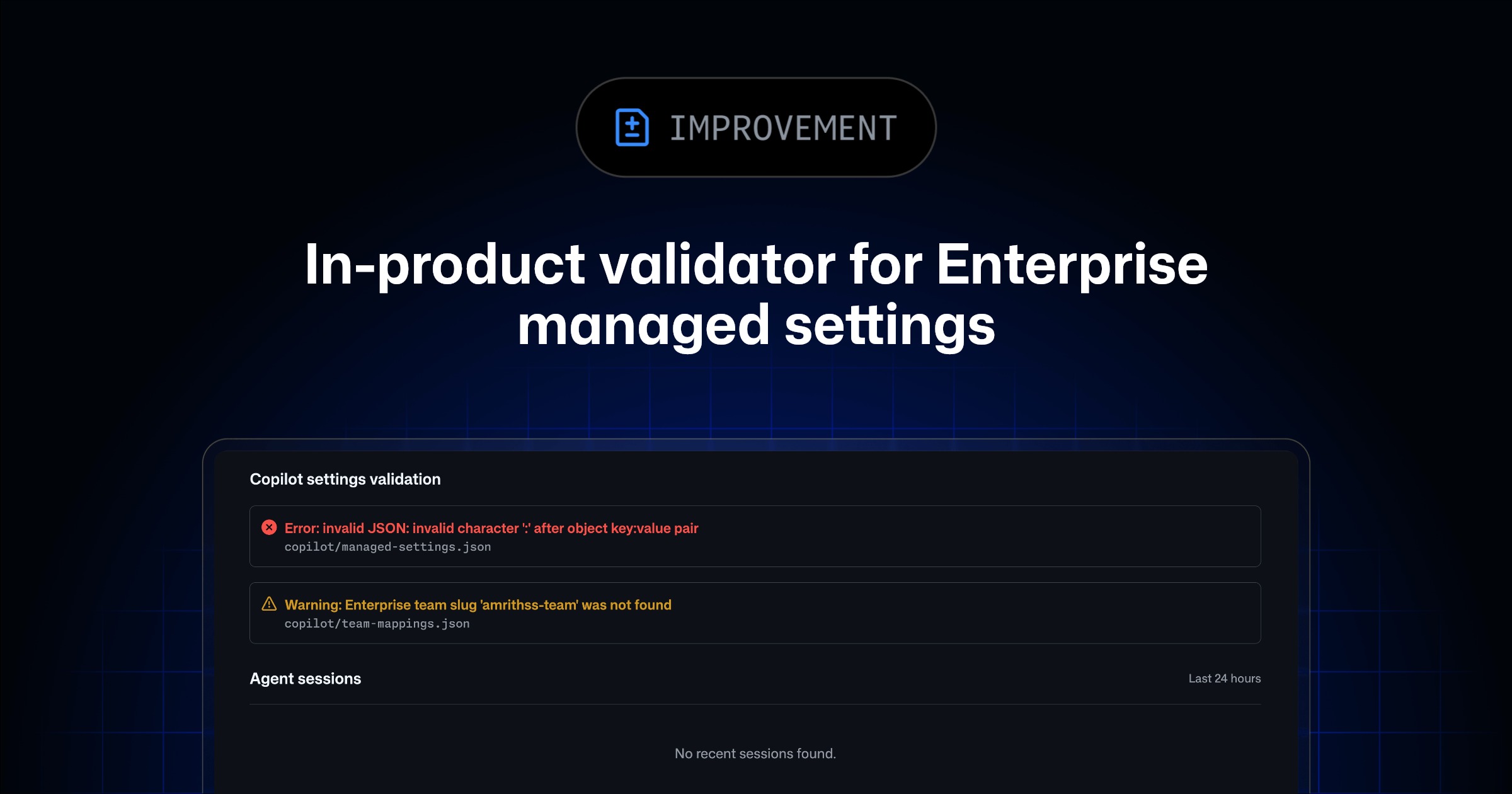
GitHub has added an in-product validator for enterprise-managed Copilot settings that detects malformed JSON, unsupported configurations, invalid team mappings, and other policy-enforcement blockers. In the enterprise AI controls page, each finding identifies the affected file and JSON path. Validation covers copilot/managed-settings.json, copilot/team-mappings.json, and referenced team-settings files. Administrators must correct issues, commit the changes to the default branch of the .github-private repository, reload Agents, and confirm the validator reports a valid configuration.
Read the source →Usage metrics API adds pull request review stages
GitHub’s repository-level Copilot usage reports now split pull-request review duration into ready-for-review to first review, first review to final review, and final review to merge. A new pullrequestreviewtimes array supplies median and 90th-percentile minutes for each stage on repos-1-day rows, attributed to the date of merge; existing pullrequests fields are unchanged. The breakdown lets teams distinguish intake delays, reviewer back-and-forth, and approved-but-unmerged work, while the 90th percentile exposes whether a few extreme cases drive the apparent slowdown.
Read the source →Agentic autofix now uses Copilot Memory
GitHub’s agentic autofix now reads existing Copilot Memory when enabled, using repository-specific context to resolve security alerts. When it creates a fix, it saves the resulting fix pattern back to memory for future alerts. GitHub says those patterns can also inform Copilot code review and the cloud agent about the repository’s own secure-development practices. Both agentic autofix and Copilot Memory remain public previews.
Read the source →GitHub Copilot weekly releases — September 21
GitHub’s weekly release adds Claude Opus 5.5, GPT-6 Sol, GPT-6 Luna, and Grok 4.7 across specified Copilot subscription tiers. The Copilot app gains public-preview local sandboxing to restrict agent access to files, networks, and credentials, along with OpenTelemetry-based activity tracking configured through enterprise settings. Slack and Teams add model selection, richer shared context, duplicate-issue detection, and improved recovery for long-running work; JetBrains adds risk-based assisted approvals, editable rewound prompts, and shared organization skills. VS Code adds agent support in Dev Containers on remote SSH, Tunnel, and WSL hosts, plus session-list and chat-layout controls.
Read the source →Updates to GitHub Copilot for Slack and Microsoft Teams
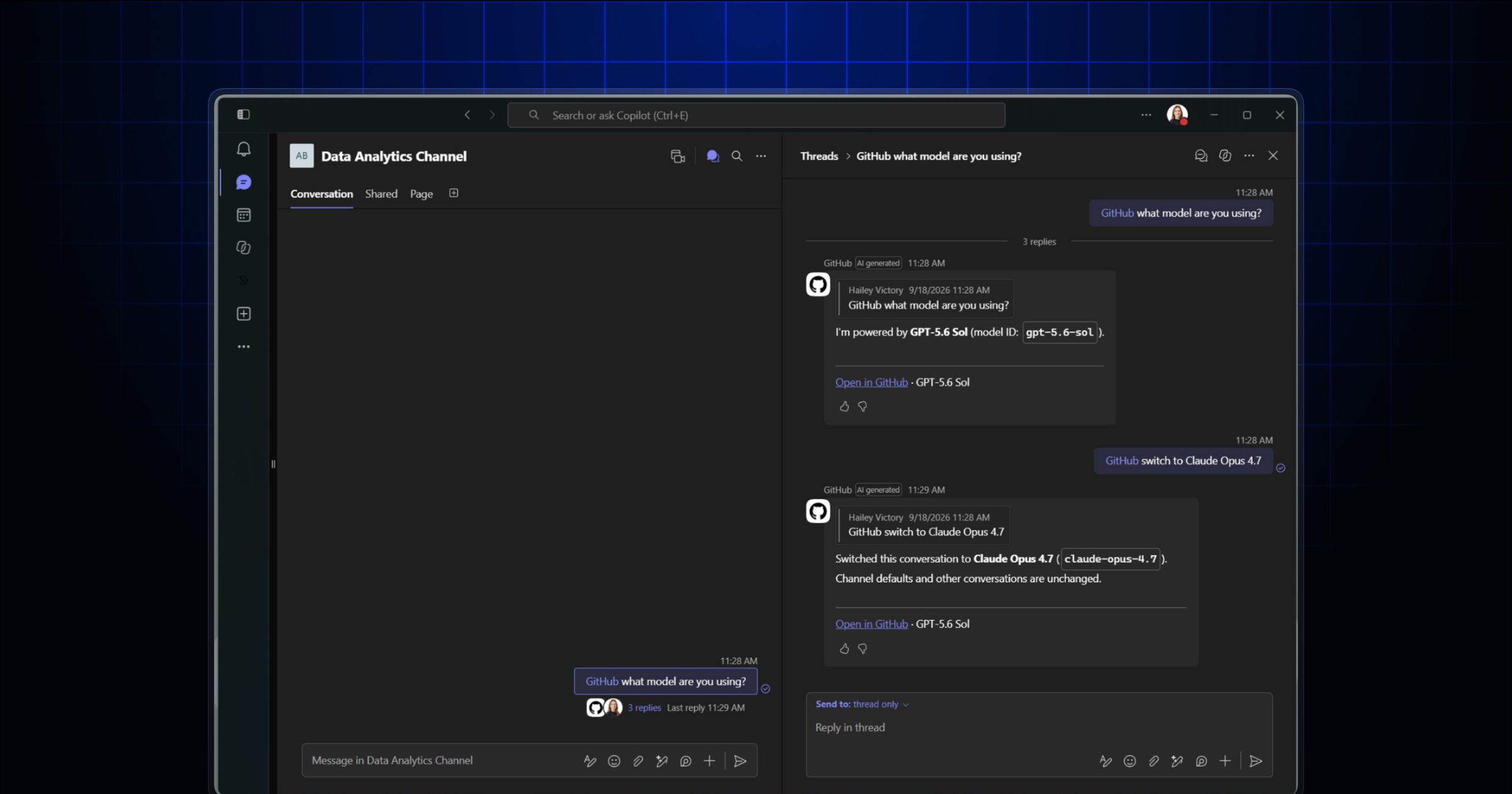
GitHub Copilot’s Slack and Teams preview now accepts more conversational context: Slack files, attachments, and links; and Teams inline images, forwarded messages, and channel or thread history. It links created GitHub work back to the original discussion, checks for similar issues before creating another, supports per-conversation model choice, and in Slack permits default owners and repositories. The release also improves long-task status, stale-reply recovery, idle reconnection, repository switching, and error messages, with Teams-specific fixes for thread history, duplicate answers, converted images, user-owned repositories, and large channels. The preview is for Copilot Business and Enterprise organizations and consumes existing entitlements and cloud-agent budgets, with some functionality rolling out gradually.
Read the source →GitHub Copilot app for Beginners: How to build custom workflows with canvases

GitHub’s Copilot app canvases are generated, shared interfaces that can take forms such as kanban boards, triage boards, release checklists, dashboards, forms, or spreadsheets. Users invoke /create-canvas and describe the workflow, the controls they need, and what the agent should update; the agent builds the UI in a side panel without manual design or file work. Canvas state is bidirectional, so users can manipulate cards and fields while the agent sees and changes the same state in real time. Resulting canvases are saved as reusable extensions that can be personal or shared with a project, and can be refined or adapted from community templates.
Read the source →Claude Platform release notes — September 24, 2026
Anthropic is resuming billing for pre-output refusals categorized as bio, frontierllm, or reasoningextraction, saying those categories have low false-positive volumes. Mid-stream refusals were already billed, while other pre-output refusal categories remain free and fallback credit is unchanged; the change applies across platforms at the running model’s normal rate. Claude for Microsoft 365 local-session Compliance API endpoints for Excel, PowerPoint, Word, and Outlook are now out of beta. Separately, the Compliance API Activity Feed will no longer return filenames, project-document names, or artifact titles; users need a Compliance Access Key with read:complianceuserdata to resolve those names via IDs.
Read the source →