Opus 5.5 resets the race for AI coding agents
Summary
The day’s strongest pattern is not simply faster frontier models but the surrounding machinery needed to use them safely: routing, task decomposition, custom interfaces, durable skills, verification loops, CI, observability, and permission boundaries. The most credible adoption stories pair aggressive agent use with hard controls—Stripe’s deployment barriers, Shopify’s checkpoints, and GitHub’s staged fuzzing architecture—rather than assuming a stronger model alone makes autonomous work dependable. In parallel, world models and AI-for-science work show the same constraint outside software: intelligence can make planning cheap, but real-time simulation and physical experimentation still set the pace.
Watermarking in vLLM
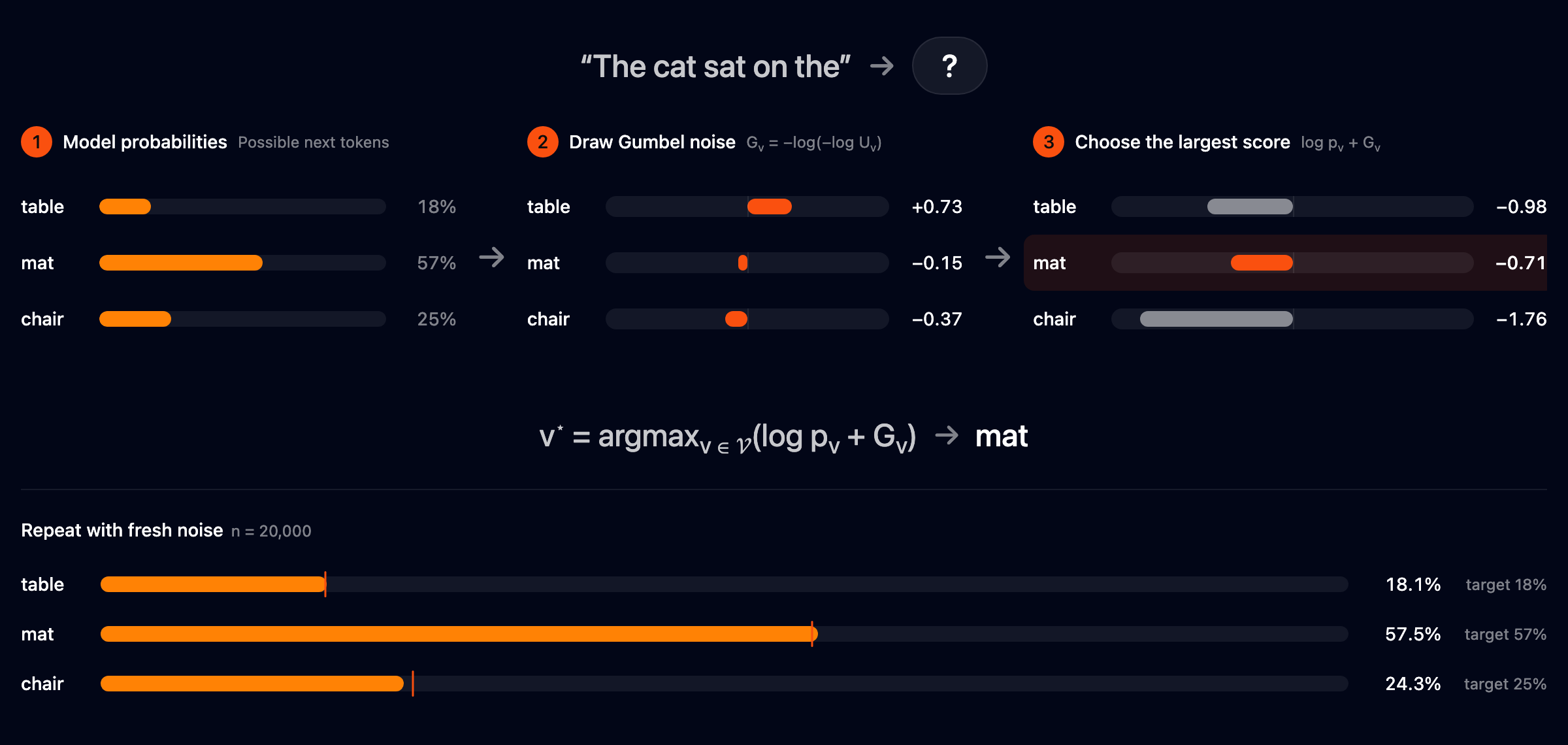
vLLM has added a text-watermarking approach that changes the sampling process rather than visibly altering generated text. It uses a secret-keyed pseudorandom function over recent context and candidate tokens, then applies Gumbel-max sampling so output remains distributed like ordinary sampling in expectation. A detector with the key can reconstruct the signal from the finished text, while an observer without it sees normal-looking stochastic output. The design targets a difficult balance: provenance that survives editing, little serving overhead, and detection without needing the original prompt or model metadata.
Read the source →Default Enablement of Copilot Features for Copilot Business and Enterprise
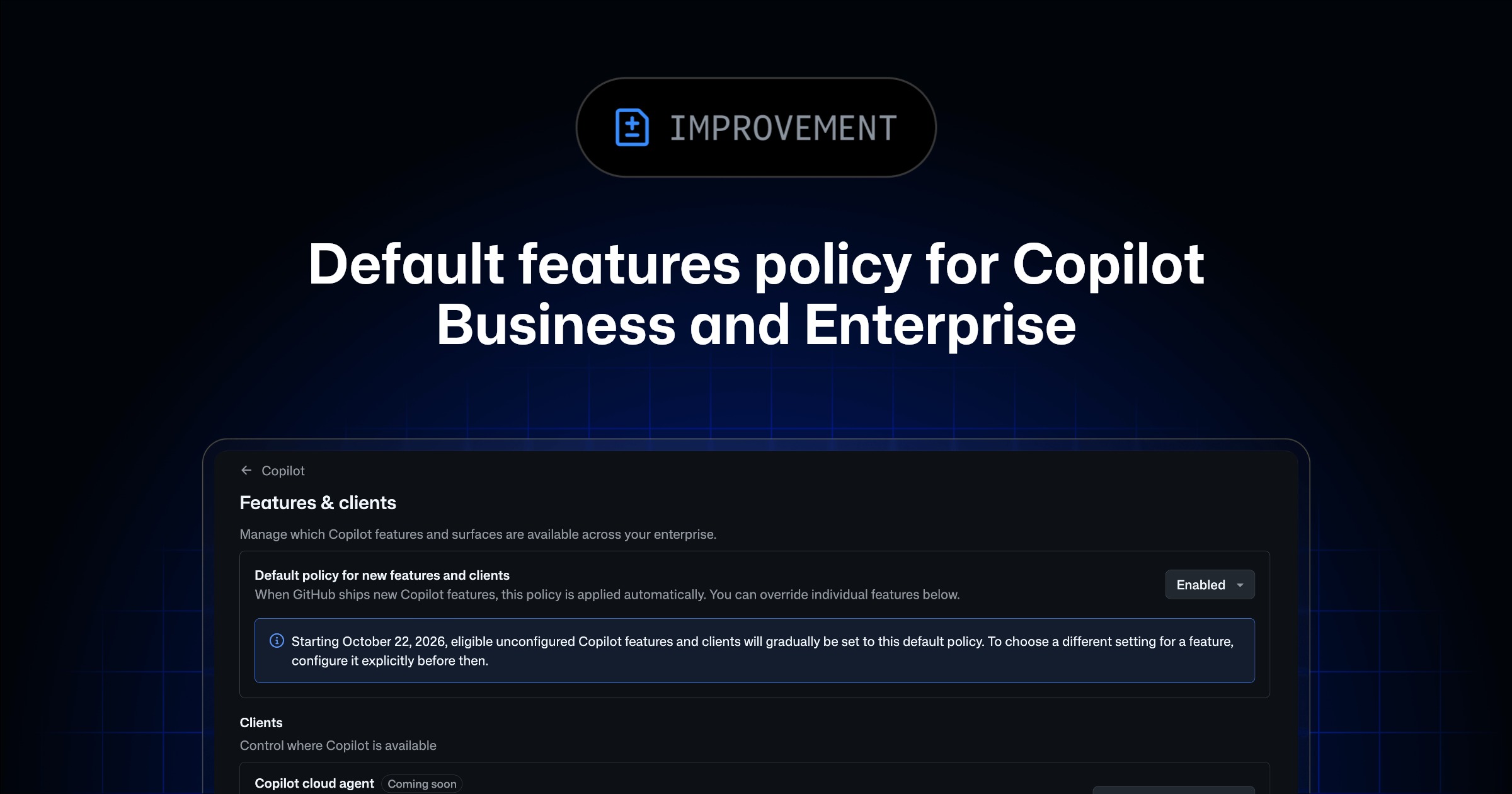
GitHub is introducing an enterprise-wide default policy for generally available Copilot capabilities, covering eligible features, Copilot Code Review, and MCP servers. Administrators can set the default to enabled, disabled, or let each organization decide during a 28-day configuration period. On October 22, unconfigured eligible features will follow that setting, but explicit enable/disable choices and preview-feature opt-ins will be preserved. Enterprises that want a restrictive rollout need to set the policy rather than assuming future Copilot features will remain off.
Read the source →When chat is the wrong UI

GitHub argues that chat is a useful universal starting point for AI, but becomes an inefficient interface once a task is known and repeatable. Its Copilot canvases are embedded full-stack apps that can communicate bidirectionally with an agent, third-party APIs, and local code, allowing purpose-built interfaces such as package managers, database tools, or interactive games. The post’s practical claim is that users should spend tokens once to have an agent build a tool, then perform recurring interactions directly in that tool. It frames agent workflows as a progression from research and prototyping through planning and implementation, with people reviewing at the moments that actually require judgment.
Read the source →AI-powered fuzzing with the GitHub Security Lab Taskflow Agent

GitHub Security Lab released an autonomous C/C++ fuzzing pipeline that accepts a GitHub repository, identifies entry points, writes and improves harnesses, runs AFL++, measures coverage, triages crashes, and produces vulnerability reports. The Taskflow Agent separates decisions from execution: taskflow prompts decide what to fuzz while MCP tools provide constrained primitives for compilation, fuzzing, coverage, and storage, with state persisted in SQLite. Each harness is compiled both with AFL instrumentation and with coverage instrumentation, so queue inputs can be replayed for usable branch and line reports. The project deliberately warns that the agent can run arbitrary LLM-selected build commands, so it should be used only in a disposable, unprivileged environment such as a Codespace or throwaway VM.
Read the source →How to Build an Agentic OS (Claude OS) That Actually Works
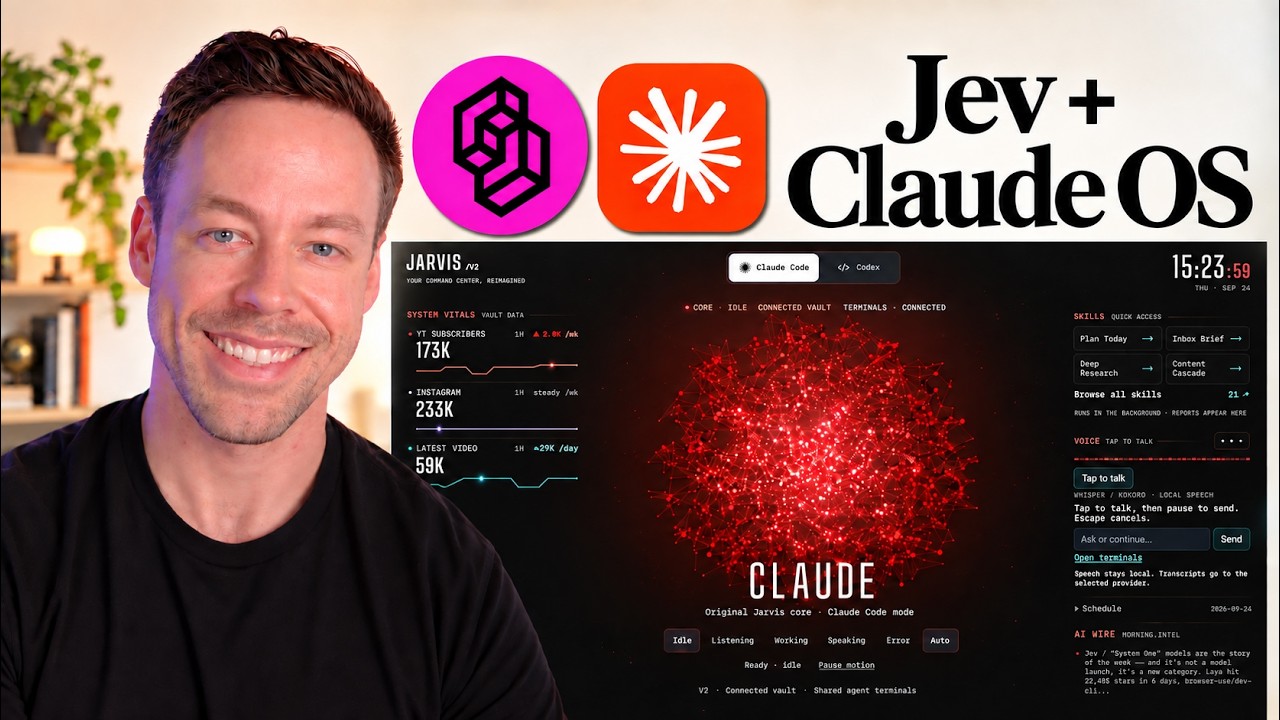
Chase AI describes an “Agentic OS” as a workflow-specific wrapper around AI tools with three layers: a visual interface, persistent memory, and a reusable skill backbone. The proposed system routes deterministic commands directly, lightweight questions to cheap models, and substantive work to Claude Code or Codex; it uses Jev as a classifier that returns probabilities rather than prose. Voice input, transcription, speech output, conversations, and deliverables are kept locally and logged into Obsidian in the author’s implementation. The central recommendation is to turn recurring personal and business tasks into skills and automations, treating the dashboard as the visible output of that operational system rather than its core value.
Read the source →Accelerating vision-language models with LFM2.5-VL-DSpark

Liquid AI released an experimental 280M-parameter DSpark draft model for LFM2.5-VL-3B that uses speculative decoding while adding only 8.9% to deployed parameter count. On Apple hardware it reports 1.57–3.13× faster decoding and 1.30–2.62× end-to-end improvements across six vision workloads; on an H100 it reports 1.64–2.27× end-to-end gains. The post emphasizes that speculative decoding accelerates token generation, not vision encoding or prefill, so overall latency remains constrained by those unaccelerated stages. The drafter is available in Safetensors and GGUF, with day-one paths for llama.cpp, MLX-VLM, and SGLang.
Read the source →Inside NVIDIA: What a world model actually is, and how it connects to the LLM you already use.
Nate’s Newsletter explains NVIDIA’s Cosmos effort as a way to model and simulate physical environments, generate actions for machines, and inform the hardware and software stack NVIDIA builds for developers. The piece argues that better AI shifts developer work toward specifying permissible behavior, inputs, actions, and evidence for safe deployment rather than eliminating the need for developers. It highlights the value of synthetic practice environments, such as generating many virtual kitchens rather than building physical ones, and notes that some tasks are easier to evaluate than to execute. The practical framing is to stop treating AI solely as a text generator and view world models as systems for action and simulation.
Read the source →[AINews] The Future of Latent Space
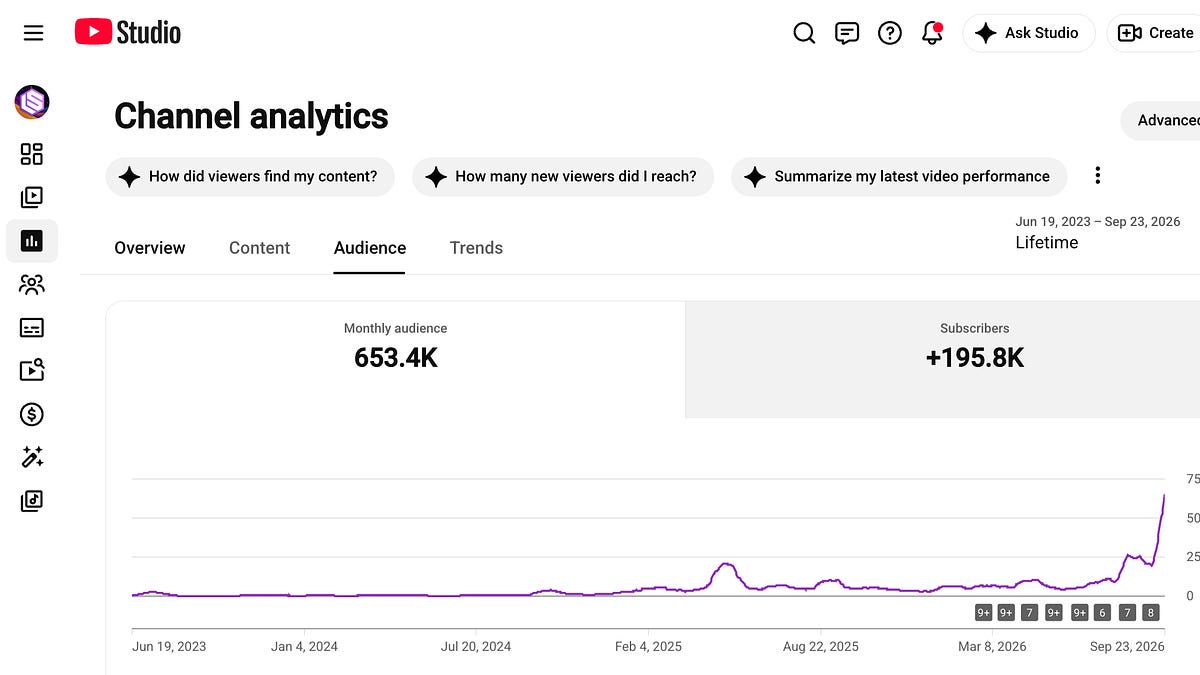
Latent Space says it will merge the practical roles of its AINews newsletter and its increasingly spam-prone Discord community, while exploring a Beehiiv migration and a broader multi-show network. Its news roundup places Claude Opus 5.5, GPT-6 Astra/Sol/Luna, Gemini 3.8 Flash, and Xiaomi MiMo-V2.6-Pro in a new frontier-model wave, with Opus leading several coding-oriented evaluations and Xiaomi offering a far cheaper MIT-licensed alternative. It also spotlights “System One” decision models such as Jev: one cited result claims 152 ms median latency and roughly 277× lower cost than GPT-6 for judgments, though it trails on JudgeBench and benefits from escalation of low-confidence cases. The underlying signal is that model competition now includes routers, judges, and harnesses—not merely the largest general-purpose model.
Read the source →Runway’s WorldPrompt and the Engineering of Real-Time Worlds

Runway’s GWM Worlds 2 research preview generates interactive video-and-audio worlds in real time, and its new WorldPrompt format specifies an initial world plus timestamped events that can be supplied live. Runway positions WorldPrompt as a control layer for characters, cameras, and environments, not a scripting language with durable state like Minecraft or Roblox. The system streams continuous 720p video at 24 fps and 48 kHz audio by fine-tuning an audio-video foundation model to the format, making generation autoregressive, then using distillation to reduce latency. The company acknowledges that difficult actions remain unreliable and that real-time generation is still an unusually hard engineering constraint.
Read the source →Foundries vs Navigators: Lowering the Cost of Science
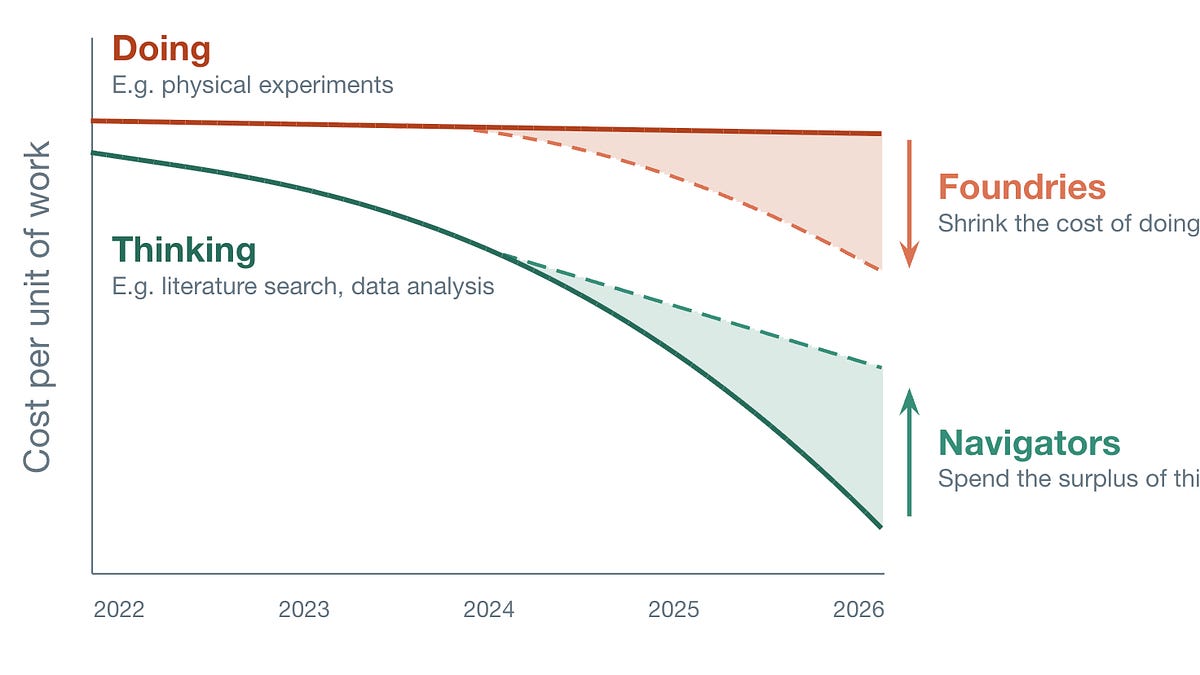
This essay argues that AI has made scientific thinking and analysis much cheaper while physical experiments remain the binding constraint. It calls capital-intensive organizations that industrialize measurement “foundries,” and calls organizations that use AI to improve decisions, processes, and experiment selection “navigators.” Foundries can create data orders of magnitude faster through sequencing, microscopy, or automation, while navigation is available to almost any research company and becomes especially effective in early-stage teams without legacy processes. Faster code generation also reduces the penalty for changing protocols and analysis pipelines, allowing experiments to become more iterative rather than avoiding promising changes because downstream analysis is expensive.
Read the source →v2.1.282
Claude Code v2.1.282 adds a maxProseWidth setting so prose can remain readable in wide terminals while code and tables use full width. It also surfaces telemetry settings that were ignored or disabled, expands a managed Chrome/MCP setting, and adds a gateway readiness grace period for short Postgres outages. Most of the release is reliability work around resumed sessions, extended-thinking preservation, malformed redacted-thinking blocks, compaction fallbacks, sign-in refresh races, permissions, and terminal rendering. The update is chiefly relevant to teams running long-lived or managed Claude Code sessions, where those recovery and policy fixes reduce hard-to-diagnose failures.
Read the source →Goodbye Google
The available article text is dominated by Robert O’Callahan’s author bio, archive links, and site navigation rather than the body of the “Goodbye Google” post. It establishes the post as a September 2026 entry on the author’s personal site, but does not provide claims or evidence sufficient to summarize its argument. Readers should use the linked original for the substantive post.
Read the source →Combining Machine Learning and Homomorphic Encryption in the Apple Ecosystem
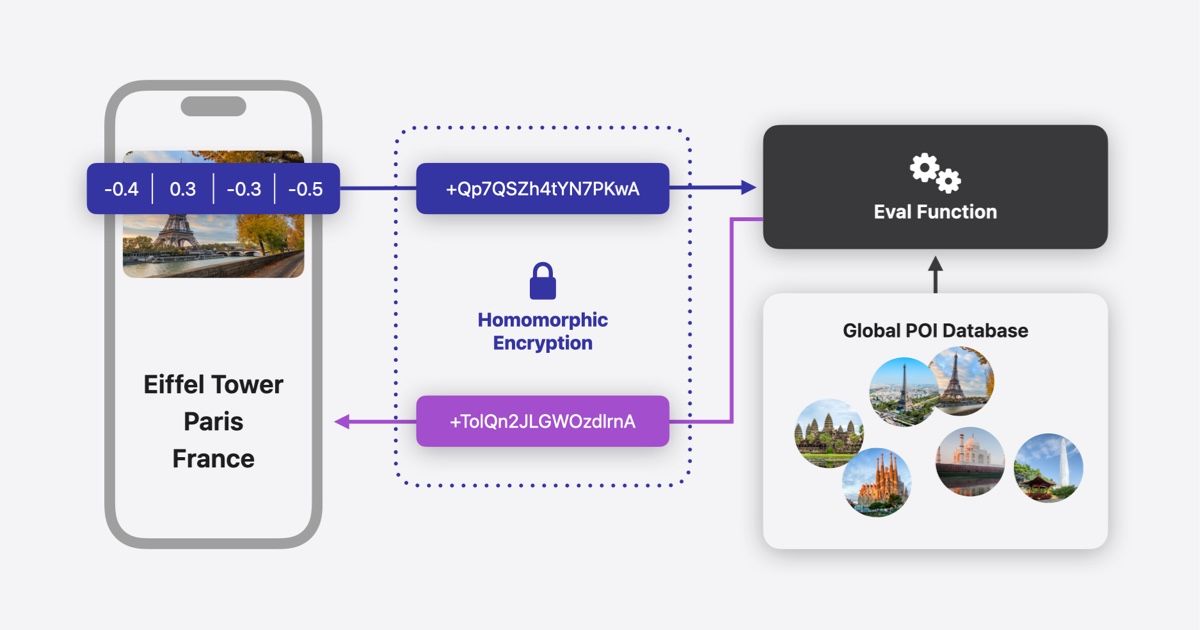
Apple describes how it combines on-device ML with homomorphic encryption, private information retrieval, and private nearest-neighbor search so server lookups can enrich user experiences without revealing the query. In its Enhanced Visual Search for Photos example, the device encrypts a request, the server computes over ciphertext, and only the device can decrypt the response. Apple says it uses the BFV scheme with post-quantum 128-bit security and has open-sourced its swift-homomorphic-encryption library. The tradeoff is computational overhead, which Apple addresses with production-oriented optimizations intended to keep private lookup latency and scale practical.
Read the source →Introducing Gemini 3.8 Live with Live Avatar
Google introduced Gemini 3.8 Live with Live Avatar for Gemini Enterprise, combining live dialogue with low-latency generated video, lip-sync, expressions, and turn-taking. The system can process audio and visual input together and make asynchronous tool calls while continuing the conversation, demonstrated through tasks such as hotel check-in. It supports synchronized speech, expressions, and lip movement across 97 languages, and enterprises can create customized avatars from reference images through allowlisting. Google says all output carries its SynthID watermark, framing identity safeguards and provenance as requirements for deployment.
Read the source →The Pulse: RoR creator sparks new “death of coding by hand” debate
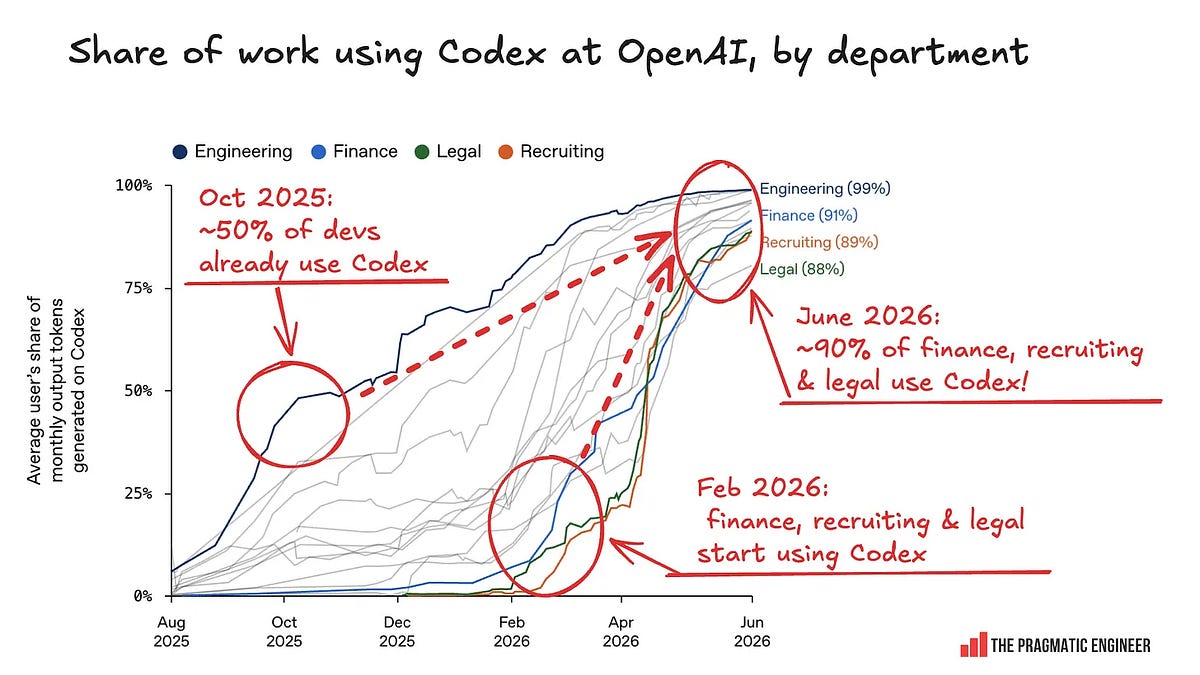
The available excerpt introduces a Pragmatic Engineer Pulse issue centered on David Heinemeier Hansson’s claim at Rails World that professional coding by hand is ending at 37signals. It positions that claim as the opening question in a broader survey of Big Tech and startup developments, alongside hiring struggles at Amazon and Meta. The supplied text does not include the article’s analysis or evidence, so the headline debate—not a resolved conclusion—is what can be supported here.
Read the source →commit-rewriter 0.2
commit-rewriter 0.2 adds support for running against a non-default Git branch via uvx commit-rewriter --branch other. The change is concise but useful for workflows that need history rewriting or generated commit changes on feature branches rather than only the primary branch. No broader behavioral or compatibility changes are described in the release note.
Read the source →datasette 1.0a41
Datasette 1.0a41 adds OpenTelemetry support, contributed by Alec Garcia, giving deployments a standard path for tracing and observability. It also consolidates Datasette’s modal dialogs into one documented Web Component that plugins can reuse. The release therefore improves both operational instrumentation and UI consistency for the plugin ecosystem.
Read the source →Opus 5.5: How Close Are We to Automated AI Research?
The video argues that Claude Opus 5.5’s rapid arrival after Fable 5.1 may reveal that frontier labs have substantially stronger internal systems than their public releases. It uses the model’s lengthy system card, benchmark progress, demonstrations, reports of agent-driven security incidents, and shifting lab promises to ask whether AI research automation is approaching faster than public narratives imply. The presenter cautions against treating flashy demos and scores as the whole story, emphasizing that the pace and volume of related news can obscure unresolved safety and capability questions.
Read the source →Shopify Just Released The Greatest AI Coding Workflow Ever
This video reconstructs Shopify’s Helix workflow for rebuilding a 300-screen mobile app with coding agents while preserving quality controls. Instead of assigning the entire rewrite to one agent, Helix converts a screen into smaller checkpoints, has people review them, and requires each approved checkpoint to pass four checks before work advances. The workflow relies heavily on subagents so each unit of work gets a fresh context window instead of accumulating confusing long-task history. Its broader lesson is that structured decomposition and verification, not unrestricted autonomy, make agent-assisted rewrites dependable.
Read the source →This NEW Jev + Claude OS Just Changed Every AI Workflow
The video presents the same three-layer Agentic OS model: a visual control surface, an Obsidian-based memory layer, and skills that generate the useful outputs displayed by the system. It proposes local Whisper transcription and Kokoro speech, with Jev routing requests among direct actions, inexpensive small-model questions, and heavy Claude Code or Codex work. The presenter argues that Jev is well suited to routing because it returns fast, cheap probabilities over fixed choices rather than conversational text. The durable takeaway is to encode repeated workflows as skills and automations, while treating a dashboard as optional packaging around that operating model.
Read the source →Patrick Collison on Claude Code at Stripe
Patrick Collison says Stripe pairs five-and-a-half-nines API reliability with continuous deployment by investing in devboxes, observability, gradual rollouts, granular data controls, and hard infrastructure barriers rather than trusting model behavior alone. One Stripe engineer reportedly merged more than 600 AI-written pull requests in the first half, with one revert; quality per pull request rose, although minor incidents per unit time increased slightly and were caught by secondary controls. Stripe built a product integrating roughly 50 services with two to three engineers in about two months, which Collison estimates would previously have required a larger team and about six months. He also says new business launches on Stripe have roughly doubled over the past year and predicts that many smaller transactions could become agent-to-agent within roughly three years.
Read the source →How AI is being used in humanitarian work
The video follows an International Rescue Committee nutrition officer in Nigeria, where large numbers of malnourished children are documented through fragile handwritten records. It argues that slow data entry and analysis leave much collected information unused and delay decisions about where aid is needed. The proposed role for AI is to digitize records from photographed cards, analyze data faster, and improve targeting so scarce humanitarian resources can reach people sooner. It presents AI as an operational support tool rather than a replacement for frontline staff in a setting where needs are rising while resources decline.
Read the source →When Will AI Make Me Scrambled Eggs? I Went To NVIDIA To Find Out.
Nate B. Jones interviews NVIDIA Cosmos Lab head Ming-Yu Liu about world models: systems that generate action guidance for embodied machines rather than merely textual descriptions. The discussion contrasts tasks such as laundry folding and cooking eggs, noting that a task may be physically difficult yet easier to evaluate, and that simulation can create thousands of training environments much more quickly than physical replication. The interview frames robotics progress as the growing use of policy models and world models to predict consequences and choose actions in the physical world. It also explains why NVIDIA’s model work extends beyond chips into tools and systems for building embodied applications.
Read the source →Gemini TTS 🗣️, Claude’s novel enzyme 🧬, Google private memory 🔒

The supplied TLDR text is primarily an invitation to an AI conference in San Francisco, advertising three days of talks, more than 30 sessions, hands-on labs, and entertainment. It does not contain the newsletter’s promised discussion of Gemini TTS, Claude’s enzyme finding, or Google private memory. The linked issue is therefore necessary for the substantive news items named in the title.
Read the source →Opus 5.5 vs GPT-6-Sol and Luna
The video reviews a same-day release wave from Anthropic and OpenAI: Claude Opus 5.5 alongside GPT-6 Sol and Luna, with comparison pressure making it tempting to ask only which lab is ahead. It describes Sol and Luna as cost-efficient additions across OpenAI’s stack, while early adopters view Opus 5.5 as a particularly strong return for Anthropic. The episode’s stated aim is to compare releases, benchmarks, first reactions, and concrete use cases rather than treating a launch as a single leaderboard result. Its framing highlights how simultaneous releases make model selection a question of workload fit as well as raw capability.
Read the source →Back to Claude
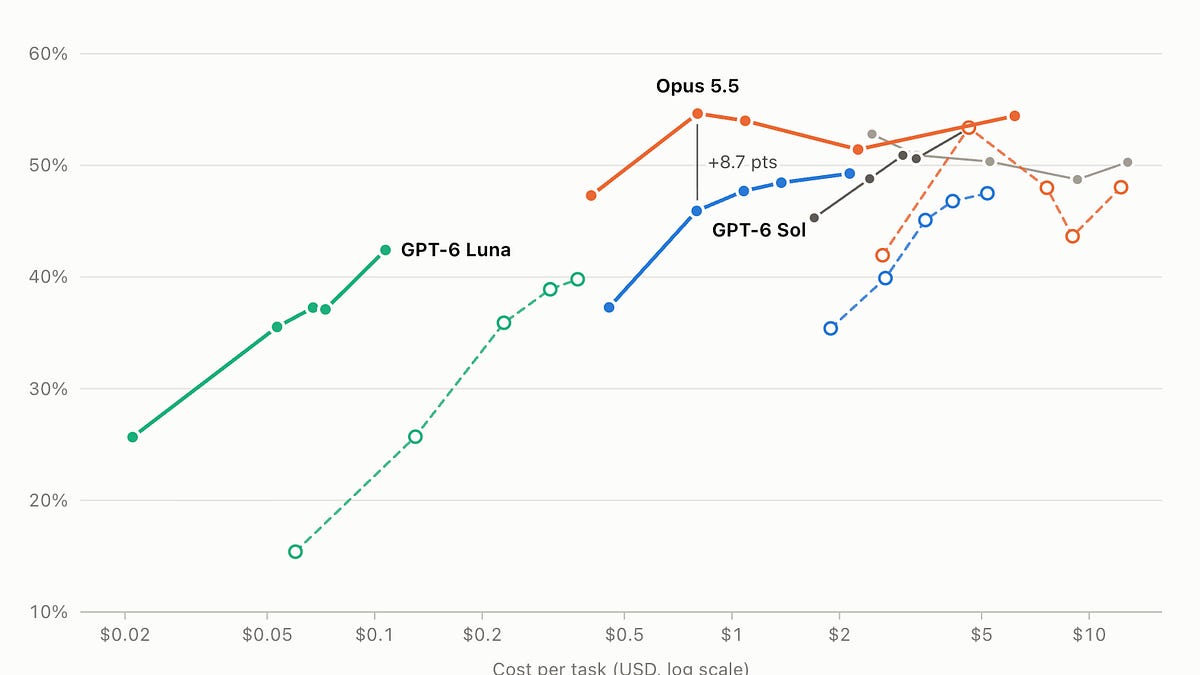
Ben’s Bites argues that Claude Opus 5.5 is currently the strongest all-round choice, citing better benchmarks than Fable 5.1, lower cost than Opus 5, stronger writing, and reliable task execution. It says Claude Code’s five-hour limit rose 20% and now includes a banked rate-limit reset, while the author reports only one limit hit after using high and xhigh thinking on side projects. The newsletter contrasts this with GPT-6 Luna and Sol, which are 50% cheaper than their predecessors at $0.10/$0.50 and $2/$10 per million input/output tokens respectively, but calls their intelligence gains modest and Sol behind Opus. It also notes that a four-hour Sol task consumed 22% of a $100 Codex plan’s weekly allowance, underscoring that unit price is not the same as total task cost.
Read the source →Issue #62

Augmented Coding Weekly says AI-accelerated development commonly relocates bottlenecks, using Linear’s 25-engineer team as an example of a company improving CI through modernized tooling, simpler linting, better job dependencies, and less repeated setup. It argues that human review is still often the tighter constraint even when automation stresses the build system. The issue also distinguishes the remote LLM from the local agent harness that grants tools and service access, and sees open-source harness demand as closely tied to the future relevance of open-weight models. Finally, it characterizes Opus 5.5 as the standout of a busy model-release week: a more focused, less verbose coding agent that early users say changes fewer unnecessary files and finishes tasks with fewer tokens.
Read the source →Claude Platform release notes — September 23, 2026
Claude API cache diagnostics has left beta and no longer needs the cache-diagnosis-2026-04-07 beta header. Developers opt in by including a diagnostics object in a Messages request, while requests that still send the header continue to work. Responses from POST /v1/messages now always include a diagnostics field, set to null when diagnostics were not requested. API clients can remove the beta-header dependency while preserving compatibility during migration.
Read the source →Claude Platform release notes — September 9, 2026
The September 9 release-note entry records cache diagnostics becoming generally available on the Claude API. Requests can opt in through a diagnostics object instead of the former beta header, though the old header remains supported. All Messages API responses now expose a diagnostics field, with null representing requests that did not opt in. The duplicated guidance makes the migration path clear for clients that had been using the beta feature.
Read the source →