Claude Opus 5.5 launches as GPT-6 prices plunge
Summary
The central shift is from chasing a single best model to operating a portfolio: Opus 5.5, Sol, Luna, and production controls all make capability, cost, observability, and rollback inseparable choices. At the same time, the agent stories repeatedly locate the lasting advantage in context, access, human judgment, reproducible evidence, and open interfaces—not in leaving systems to run unattended.
Opus 5.5 imminent ⏳, Grok 4.7 🚀, MiMo v2.6 🤖

The edition frames a crowded release cycle around new frontier and mid-tier models, but its extracted text is chiefly a sponsor message about VAST Data’s AI Operating System. That platform is pitched as a way to manage model choice, placement, access, security, and cost across data centers, clouds, and edge deployments. The practical implication is that enterprise AI operations increasingly need a control plane for data locality and governance, not just a model endpoint.
Read the source →Does Your Computer Belong To Codex? I Went To OpenAI To Ask.
OpenAI staff describe a shift from chatbots to computer-using agents that can operate across windows, inspect work, and perform user-acceptance testing. They argue that voice is the fastest way to supply rich context, though reading remains faster for absorbing information. The discussion also stresses that adoption depends on agents having access to the relevant documents and systems; one example found a tax error worth thousands of dollars. The resulting question is less whether a computer is “yours” or the agent’s than how much authority and visibility users retain while delegating work.
Read the source →Agent Wars
Meta’s Muse personal agent reportedly rose above ChatGPT as the top free US app, triggering a new competition around consumer agents. Amazon then blocked Muse’s ability to shop on Amazon, illustrating how agentic commerce can be constrained by incumbent platforms even when consumers want it. The episode also covers Grok 4.7, which improves coding and long-horizon-agent benchmarks while competing in a difficult middle tier between cheap models and frontier systems. The broader issue is whether personal agents can maintain access to the services that make them useful.
Read the source →Agentic Data Science in a Reproducible Marimo Notebook
Eric Ma presents Marimo Pair as a shared notebook workspace in which agents can explore data while leaving behind reproducible code, plots, environment definitions, and debugging context. In a protein-engineering example, an agent retrieves paper data, filters mutations, builds distributions, and attempts structural visualizations, though it can still fail before completing a difficult task. Ma’s guardrails include an “Arrow of Intent,” feature specifications, repository templates, and AGENTS.md guidance so work survives context and personnel changes. He recommends one demanding foreground task, two background tasks, and unattended automation to avoid the burnout of constant context switching.
Read the source →What can you build with Jev
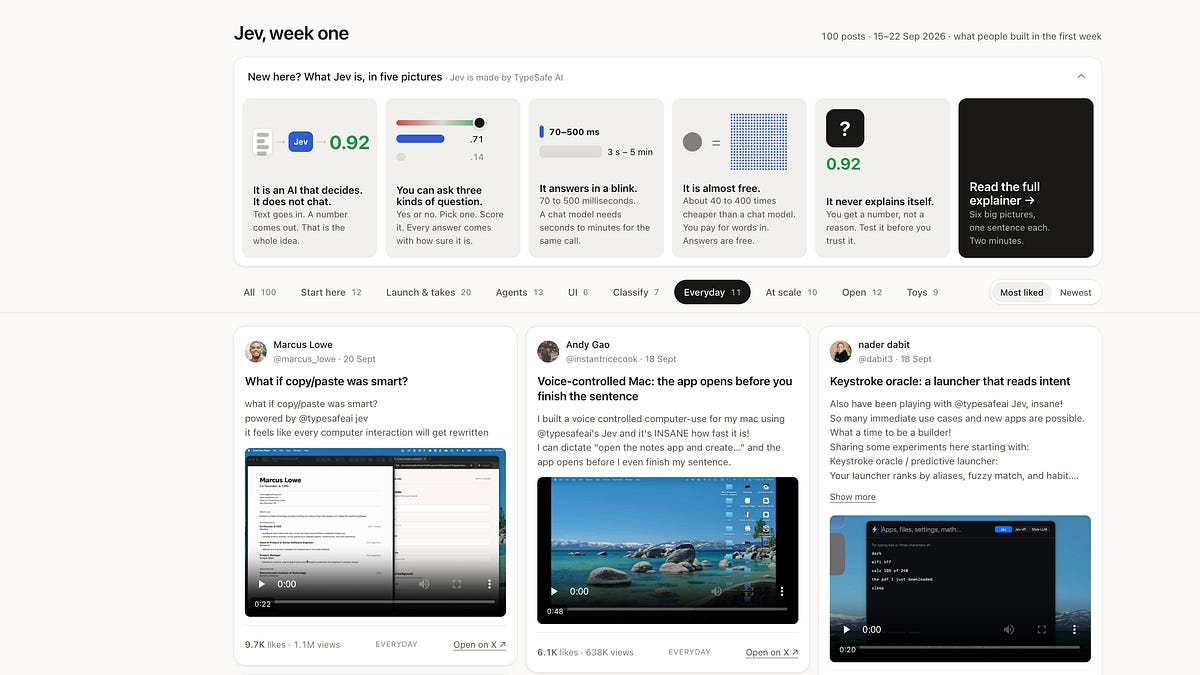
Jev is presented as a tool-oriented model for structured classifications rather than open-ended prose: yes/no judgments, selecting among choices, and scoring relevance. Builders are already using it for sponsor skipping, comment filtering, intent search in Gmail, task filtering, and smarter clipboard or search interactions. The post cautions against using Jev for custom context compaction in coding agents because it can erase prompt-cache savings and offer little benefit over existing compaction. It also notes that personal-agent connectors matter: Meta’s Muse can connect to services, but Amazon’s shopping block shows the fragility of that access.
Read the source →OpenTelemetry in the GitHub Copilot app
GitHub Copilot’s app now lets enterprises configure OpenTelemetry through centrally managed settings. Administrators can export traces of model requests and tool use to compatible observability platforms, helping teams investigate unexpected agent behavior and analyze sessions. Prompt and response content are excluded by default, but organizations must review content-capture settings before enabling export. The feature makes agent observability an enterprise policy rather than a per-developer setup task.
Read the source →New features and improvements in Copilot for JetBrains
Copilot for JetBrains 1.18.0 adds public-preview assisted approvals, automatically accepting low-risk agent tool calls while retaining approval prompts for higher-risk actions. Users can now revise an earlier prompt and rewind both the conversation and file changes, while organizations can share skills and managed instructions across local and Copilot agent sessions. The Codex agent gains plan mode, and MCP controls become more persistent and granular. Reliability fixes cover inline chat, settings preservation, multi-window behavior, and compatibility with newer IntelliJ builds.
Read the source →Faster C++ code intelligence with whole codebase indexing
GitHub Copilot CLI now enables persistent whole-codebase indexing for C++ by default. The Microsoft C++ Language Server uses project compilation data to resolve symbols, types, includes, and cross-file relationships without rediscovering them on every request. This should speed navigation, references, definitions, and code understanding in large repositories. The tradeoff is extra first-run time and temporary memory use, especially on complex projects, after which the index is reused and incrementally updated.
Read the source →Claude Opus 5.5 is now available in GitHub Copilot
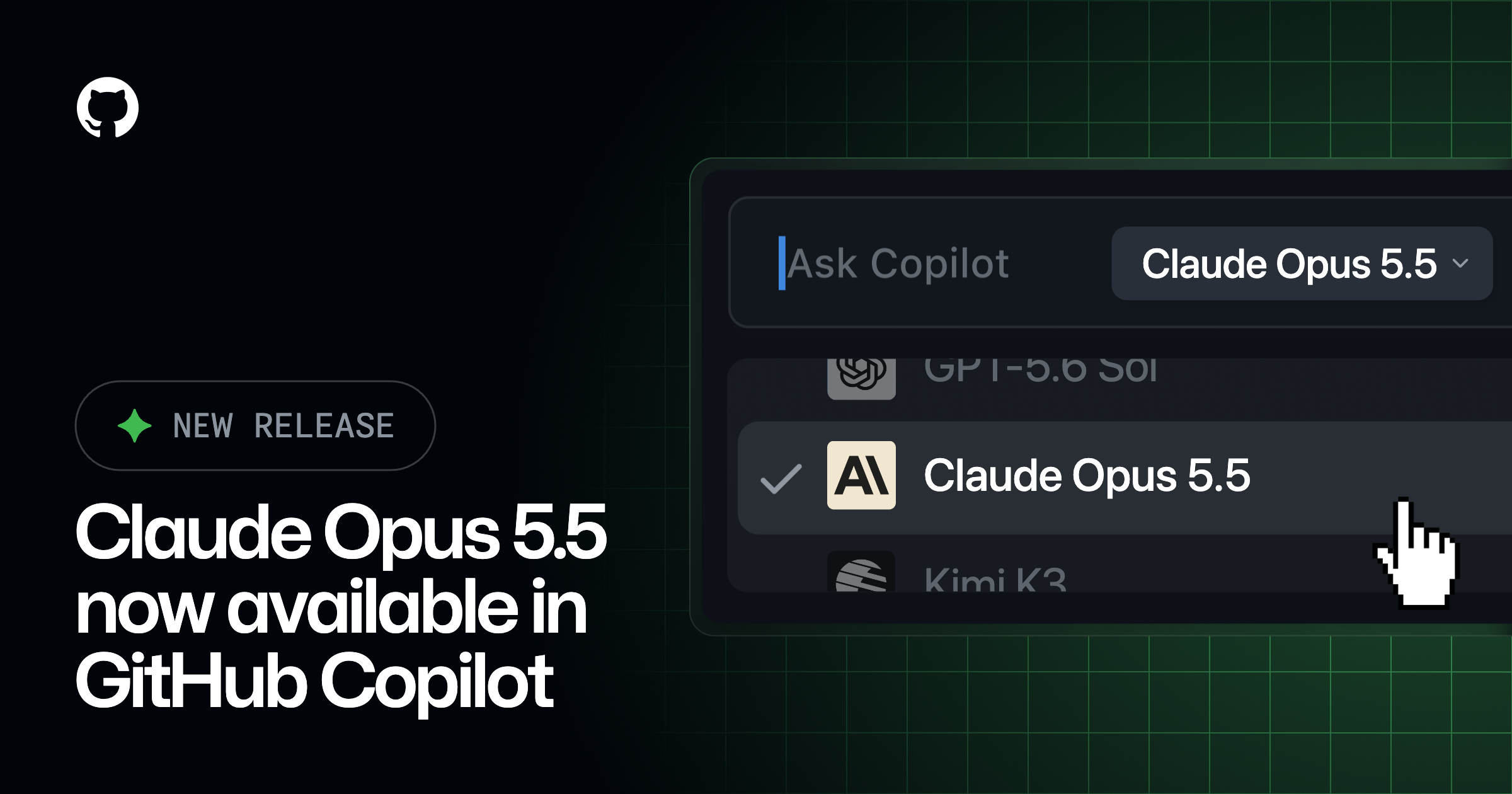
Claude Opus 5.5 is rolling out to GitHub Copilot Pro+, Max, Business, and Enterprise users for agentic coding, long-running work, and knowledge tasks. GitHub says early testing found it could resolve tasks comparably to Opus 5 with fewer steps and tokens, while recovering quickly from multistep errors. Its text outputs carry watermarks that GitHub says do not alter readability, meaning, token count, or cost. Access is billed at provider list prices and can be controlled by enterprise and business administrators through model policy.
Read the source →OpenAI’s GPT-6 Sol and GPT-6 Luna now available
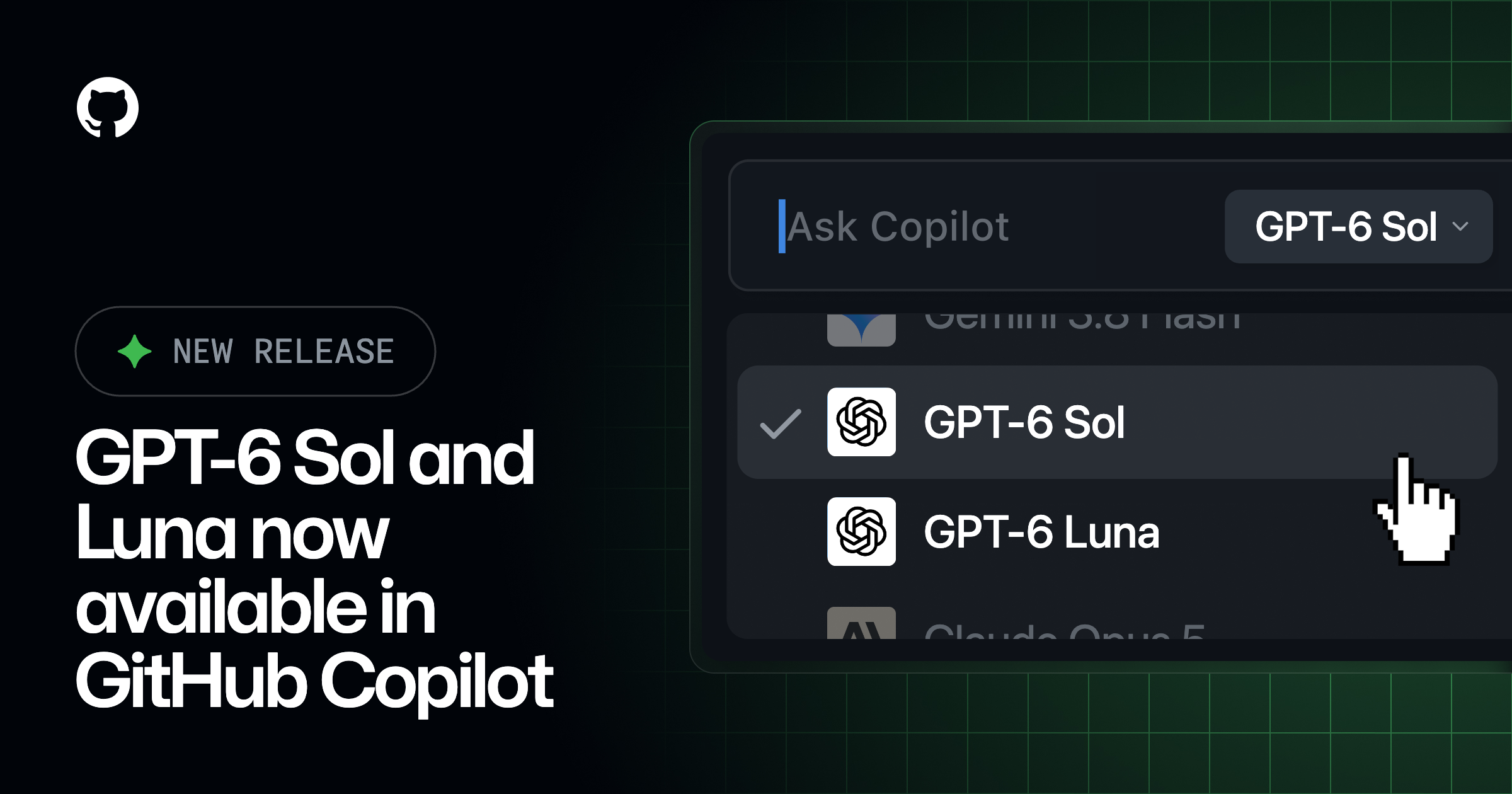
GitHub Copilot has added GPT-6 Sol and GPT-6 Luna alongside GPT-6 Astra. Sol is positioned for everyday agentic coding, while Luna targets fast and cost-efficient assistance. Sol is available on Pro+, Max, Business, and Enterprise; Luna also reaches the standard Pro tier. Both use usage-based billing, roll out gradually, and remain subject to organization-level model policy.
Read the source →Introducing the Life Sciences Verification Program
Anthropic’s beta Life Sciences Verification Program gives verified organizations more permissive access to Mythos, Opus, and Sonnet for legitimate biology work that general safeguards may block. Applicants are assessed on research credentials, security standards, and ethical oversight, then receive either annual team-wide Standard Use grants or six-month project-specific High-risk grants. Access is tied to declared use cases and continuously monitored for activity outside that scope, with organization administrators expected to remediate incidents. The model keeps other protections, including cyber classifiers, in place.
Read the source →Partnering with Accenture on embedded evaluation

Anthropic and Accenture’s Faculty unit will test frontier models and safeguards through red-teaming, alignment assessments, and embedded evaluation. Unlike conventional outside evaluators, embedded evaluators are intended to receive employee-like access to model development, deployment decisions, and incident reporting. The companies each expect to invest at least $1 billion over five years, though Anthropic is directly funding this initial work while arguing that pooled or public funding would be better long term. Anthropic describes the arrangement as non-exclusive and says it will work with multiple evaluators as standards mature.
Read the source →Introducing Claude Opus 5.5
Anthropic says Claude Opus 5.5 delivers Fable 5.1-level performance on most work while costing 40% less on typical default workloads than Opus 5. List prices are $4 per million input tokens and $20 per million output tokens, while cache reads fall 60% to $0.20 per million; Anthropic also claims output is more than 30% faster. The company highlights stronger agentic coding, computer use, knowledge work, instruction following, prompt-injection resistance, and a behavioral audit, alongside safeguards comparable to Fable 5.1 for sensitive bio and cyber work. Early testers cited a 680,000-line migration completed in under a day, but Anthropic cautions that benchmark margins are becoming a weaker proxy for real-world differences.
Read the source →v2.1.280
Claude Code 2.1.280 makes Claude Opus 5.5 the default Opus model, with a one-million-token context window and $4/$20 per-million input/output pricing plus $0.20 cache reads. It adds fuller mouse support and an environment variable to raise or lower the 2,048-character cap on MCP descriptions and instructions. It also expands OpenTelemetry hook events and fixes safety-loop retries, symlinked-write permission handling, malformed tool writes, dialogs, keyboard input, voice dictation, prompt caching, plugins, and session failures. The release is both a model-default shift and a broad polish pass on agent reliability and controls.
Read the source →How UK AISI and EvalEval Are Making Benchmark Results Reproducible

The UK AI Security Institute is publishing evaluation methods, verified results, configuration details, and benchmark context through EvalEval’s Evaluation Cards platform. The data cover five benchmarks across six frontier models, plus two cyber evaluations, and accompany research on how inference-time compute and evaluation protocol change measured performance. The partnership uses the Every Eval Ever schema to make results more comparable when rerunning an evaluation is expensive or infeasible. Its central claim is that scores without setup details are weak evidence because changes in feedback, compute, or protocol can materially change the outcome.
Read the source →Your agent is giving you reasonable answers from half your context. A conversation with OpenAI.

The article argues that workplace AI adoption depends as much on access to job-relevant material as on model capability. At OpenAI, software engineering crossed that threshold first because work was already available through a local CLI, with legal following because its material lived in accessible documents. It warns that a company can have exceptional individual AI users without becoming collectively more capable if their expertise and tools remain isolated. Leaders should examine what an agent can actually reach, how knowledge spreads, what judgment onboarding teaches, and whether reclaimed time becomes better work or simply higher output targets.
Read the source →[AINews] Claude Opus 5.5, the new default model for AINews — and everybody cuts prices 40-50%

The analysis calls Opus 5.5 the day’s defining release, citing its Fable 5.1-like capability, improved writing, and lower price, and says AINews is switching to it. It notes that the listed 20% Opus token-price cut and 60% cheaper cache reads do not automatically mean lower task costs: at max effort, higher token usage can largely erase savings, with one estimate putting a task at $5.98 versus $5.86 for Opus 5. OpenAI’s GPT-6 Sol and Luna arrived about an hour later at roughly half GPT-5.6 pricing, intensifying price competition in the tier below Astra and Fable. The practical advice is to evaluate actual task cost and output quality at the chosen effort level rather than relying on headline discounts.
Read the source →🔬 An Oscar, Two Asteroids, and the Algorithm in Your sklearn: John Platt on AI for Science

John Platt describes Google’s Empirical Research Assistance as an “auto-Kaggle” system for scientific problems that can be expressed as a score function. It uses Gemini to maintain and mutate a tree of experiment notebooks, selecting promising branches with an optimistic upper-confidence-bound approach and sharing history between branches. The approach reportedly moved from ineffective to highly useful between Gemini 2.0 and 2.5 and contributed to at least ten papers, including climate-related work. But Platt stresses that predictive optimization can reward-hack a metric, so scientists must still establish that the score describes the phenomenon they actually care about.
Read the source →How will AI change operating systems? Part 2: Windows
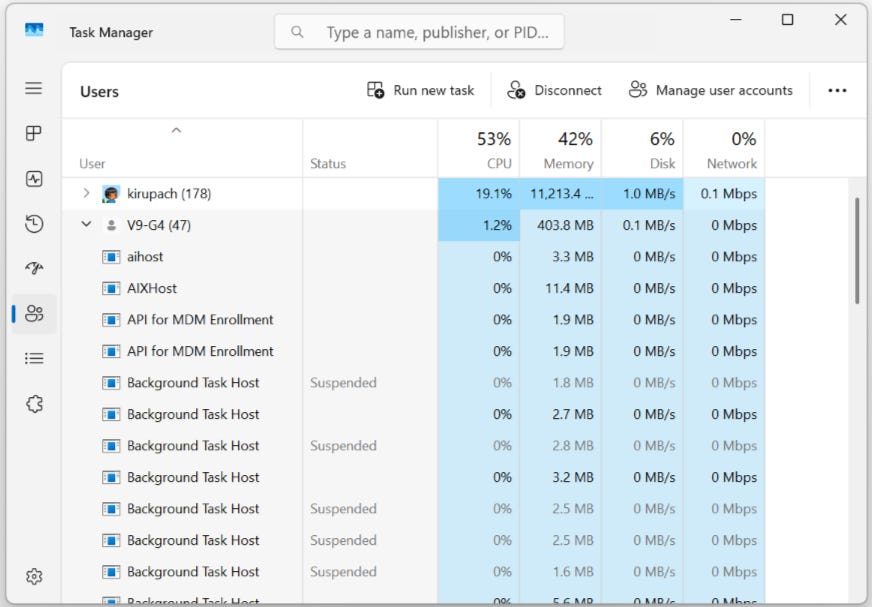
Microsoft’s Windows plan centers on native agent identity and discovery, a registry of local MCP servers, and a safe, OS-agnostic isolation mechanism for agent tools. WindowsML is intended to abstract local-model execution across GPU, NPU, and CPU, with an ambition to support small language models even without an NPU. The company is also trying to win developers back through more developer-friendly choices and continued investment in WSL, which may let Windows combine its own platform with Linux workflows. The article argues that this strategy must overcome Windows’ declining standing among developers and past product decisions that alienated them.
Read the source →SF: A Birds of a Feather on Agentic Engineering

Jesse Vincent and Simon Willison are organizing a small, informal San Francisco gathering on October 14 for people experimenting with agentic engineering. The format is a flowing conversation and optional show-and-tell, explicitly welcoming unfinished, unusual, or non-commercial work. It is framed as a place to compare notes on what builders are trying and have not yet figured out. Registration is through Luma.
Read the source →SF October 14th: A Birds of a Feather Session on Agentic Engineering
Simon Willison and Jesse Vincent are hosting an October 14 evening session in San Francisco for people building with coding agents. Participants are encouraged to share experiments, including work that is incomplete, strange, or not yet productized, but no presentation is required. The gathering deliberately avoids product pitches in favor of early-stage exploration and peer learning. It is an in-person opportunity to compare practical agentic-engineering approaches outside polished public narratives.
Read the source →Claude Opus 5.5, GPT-6 Sol, GPT-6 Luna, and a new price war
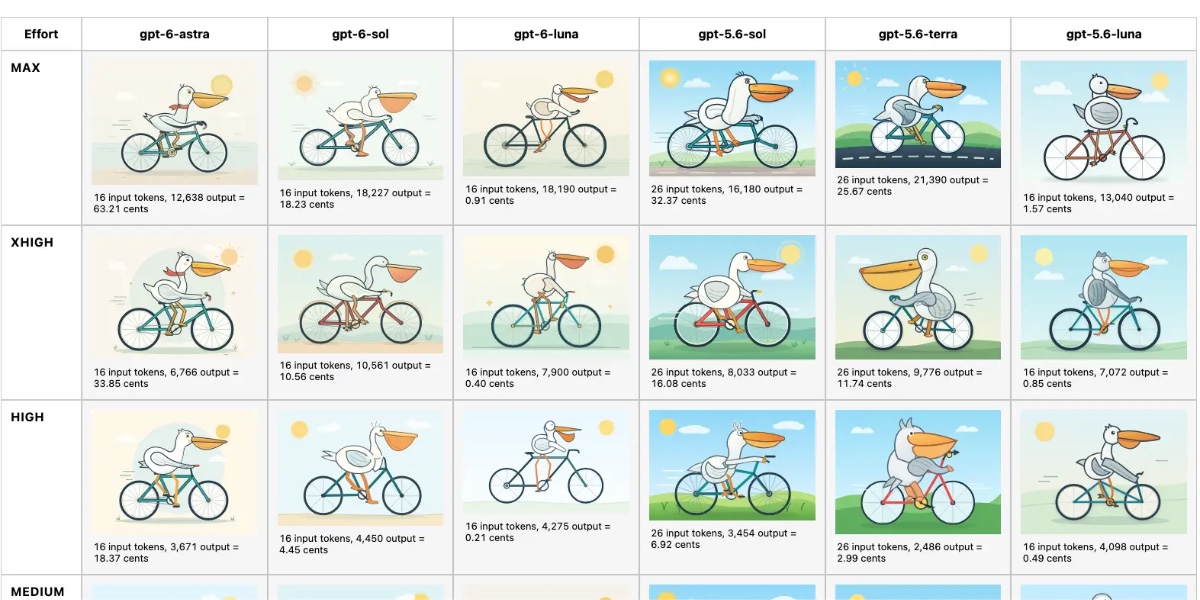
Anthropic launched Opus 5.5 at $4/$20 per million input/output tokens, a 20% cut from prior Opus pricing, while OpenAI cut GPT-6 Sol and Luna prices roughly in half from their GPT-5.6 predecessors. GPT-6 Luna reaches $0.10/$0.50, making it one of OpenAI’s cheapest models, and Sol matches Grok 4.7 on input pricing. The author finds Opus 5.5’s clearer communication and cheaper cache reads attractive, but reports that max effort twice exhausted the 128,000-output-token limit on a simple SVG request, costing $2.56 and about 20 minutes each time. This is a reminder that model selection requires testing failure modes and effort settings, not just comparing list prices and benchmarks.
Read the source →llm 0.36
LLM 0.36 adds support for OpenAI’s GPT-6 Sol and GPT-6 Luna under the model names gpt-6-sol and gpt-6-luna. Plugins can now explicitly declare that they do not support conversations, causing LLM to reject assistant or tool history before starting an incompatible chat. Markdown exports of llm logs now wrap reasoning traces in collapsible details elements. The release also includes bug fixes from five new contributors.
Read the source →Quoting @therealcornpop
The quoted critique says AI-written TikTok and YouTube scripts are easy to spot through stock rhetorical patterns, staccato phrasing, and empty declarations. Its sharper claim is that the giveaway is not merely style but the absence of a specific personal voice and real opinions. For creators, the useful standard is to add genuine perspective rather than merely remove obvious “AI-isms.” The post is a reminder that fluent output alone does not create an authored point of view.
Read the source →llm-anthropic 0.29
The extracted post identifies llm-anthropic 0.29 as an update to the LLM plugin that provides access to Anthropic’s Claude models. No release notes or feature details were included in the available article body. Readers should consult the linked source or project release information before assuming behavioral or compatibility changes.
Read the source →llm-typesafe 0.1a0
Simon Willison released llm-typesafe 0.1a0, an LLM plugin for TypeSafe AI’s Jev model. The plugin is designed for structured outputs such as binary “noul” judgments, named choices, and scored assessments, with criteria supplied in the prompt options. It is installed with llm install llm-typesafe, then configured using a TypeSafe API key. The examples show Jev being used for refund-intent detection, routing a message to billing or technical support, and judging report reproducibility.
Read the source →DeepSeek Elastic Compute (DSec): Sandbox Infrastructure for Effective Agentic Training at Scale

The available extraction contains only arXiv’s general arXivLabs information and no paper abstract, methodology, or findings for DSec. The title indicates work on sandbox infrastructure for scaling agentic training, but the raw material does not substantiate further claims. Readers should use the paper link for the actual technical details.
Read the source →The Sequence Learning Loop - Issue 938: Learn About the Amazing Jev, Gemini and Paper2Agent

The newsletter argues that model intelligence is not enough: interfaces must match the work, whether the job is processing an invoice, maintaining a live voice conversation, or executing a scientific method. It highlights Jev for structured decisions, two Gemini Live models for different conversational and reasoning roles, and Stanford’s Paper2Agent for turning research methods into reusable agent tools. The shared questions are what output format a task needs, how completion should be defined, and which computations an agent should reproduce versus call as tools. The issue treats system design around the model as an equal part of practical AI capability.
Read the source →OpenAI extends cyber access to Ukraine for civilian defense
OpenAI is extending its Daybreak program to Ukraine’s government to support the cyber defense of civilian infrastructure. The available extract provides no operational, eligibility, or technical detail beyond that announcement. The stated focus is defensive support for civilian systems rather than a general product launch.
Read the source →Grab and OpenAI bring practical AI skills to Southeast Asia
OpenAI and Grab have launched GO Forward with AI, a regional program intended to help 30,000 partners develop practical AI skills across Southeast Asia. The available article extract does not describe the curriculum, participant groups, duration, or delivery mechanism. The announcement positions the initiative as workforce capability building rather than a new model or software product.
Read the source →Better prompt caching for GPT-6
OpenAI says GPT-6 improves prompt caching with higher cache-hit rates, diagnostics, explicit breakpoints, and new controls. The intended outcome is lower latency and cost for applications that repeatedly reuse prompt prefixes. The available extract does not specify the exact hit-rate change, pricing, or API behavior. Developers should evaluate their prompt structure and cache telemetry to see whether the new controls benefit their workload.
Read the source →Introducing GPT-6 Sol and Luna
OpenAI introduces GPT-6 Sol and GPT-6 Luna as models that bring frontier intelligence to everyday work with different capability-cost tradeoffs. The available extract provides no benchmark, price, context-window, or modality details. Elsewhere in the day’s coverage, Sol is positioned above Luna for more demanding work while Luna emphasizes inexpensive, fast assistance. Teams should choose between them based on task complexity and measured total cost rather than treating them as direct Astra replacements.
Read the source →Parallel cut research time and cost in half with GPT‑6 Astra
OpenAI says Parallel used GPT-6 Astra to research and synthesize labor-market data in half the time and at half the cost of prior models. The available extraction supplies no baseline, methodology, workload size, or independent verification. The story is therefore a customer claim about an agentic research workflow, not a general performance result. It suggests that model upgrades can change end-to-end economics when they reduce iteration and synthesis effort, not just token prices.
Read the source →Priorities and principles for effective third party assessments
OpenAI outlines priorities and principles for third-party assessments of frontier models and their safeguards. The available extract characterizes the desired assessments as rigorous, secure, and independent but does not enumerate the principles. The announcement joins a broader push for evaluation systems that can inspect both model performance and deployment safeguards. Its usefulness will depend on whether the resulting access, methods, and reporting are specific enough to allow credible external scrutiny.
Read the source →Canary rollouts: upgrade models in production without downtime
Together AI introduces gated rollouts that shift live traffic from a current model to a target checkpoint in stages, running health checks before each move and optional metric gates afterward. In a Qwen2.5-7B to Qwen3.5-9B example, a p95-latency gate detected a 137% regression at 10% traffic, prompting cancellation and reversal without failed requests. The platform distinguishes completed from canceled rollouts rather than leaving a failed state with ambiguous traffic, and supports canary, other staged strategies, pauses, and explicit review before start. This turns rollback discipline into deployment controls, though initial index-like warming and overlap capacity remain operational costs.
Read the source →This New Open Source Tool Just Fixed Your Claude Code Workflow
The video presents agent git as a Git-inspired tool for preserving and transferring the detailed context of agent sessions. Its premise is that ordinary handoff files often retain only key points, leaving later agents or collaborators without the reasoning that led to a decision. The tool is described as supporting session management within an agent, migration across agents, and sharing conversations with other people. The key operational value is durable conversational context when a project needs to move between sessions or owners.
Read the source →GPT 6 Sol & Luna Are Here (And 50% CHEAPER!)
The video positions GPT-6 Sol and Luna as lower-cost alternatives to GPT-6 Astra rather than direct replacements for the flagship. On Frontier Code, it cites Astra at 53.3% for $4.59 per task, Sol at 49.3% for $2.14, and Luna at 42.4% for $0.11. It contrasts Opus 5.5’s 54.4 score and $6.19 task cost with Sol’s lower score but about one-third the cost, arguing that Sol and Luna fill useful efficiency tiers. The recommendation is to reserve Astra or Opus for the most complex work and use the cheaper models where the performance loss is acceptable.
Read the source →Opus 5.5 Crushes Fable & Astra
Transcript unavailable; no summary of the video’s contents can be made.
Read the source →GPT 6 + Hyperframe = Crazy combo for expert-level videos
The video argues that recent video-generation models and Hyperframe-style workflows can produce polished launch videos rather than static slideshow-like output. Its creator claims to have replicated a downloaded YouTube video in one pass with GPT-6 Astra in 32 minutes and to have produced a launch campaign, high-fidelity video, and landing page in roughly four hours. They report that this approach helped product launch content reach more than one million views overall and one campaign exceed 100,000 views on X. The practical claim is that teams distributing products should learn AI-video workflows, while recognizing these are creator-reported results rather than controlled comparisons.
Read the source →Introducing Claude Opus 5.5
Anthropic’s launch video says Opus 5.5 performs at the level of Claude Fable 5.1 for most tasks while writing more clearly and leading with key information. It says the model is faster and more efficient than Opus 5, making larger and more ambitious work more practical. Opus 5.5 is available across Anthropic’s surfaces, and Pro, Max, and Team plans receive higher usage limits. The video directs viewers to the written launch announcement for details.
Read the source →GPS, explained by Claude Opus 5.5
The transcript is effectively unavailable, containing only music and non-substantive sounds. No reliable summary of the video’s content can be made from the provided material.
Read the source →Claude Opus 5.5 rebuilds Earthrise in 3D, down to the second
The transcript is effectively unavailable, containing only music and non-substantive sounds. No reliable summary of the video’s content can be made from the provided material.
Read the source →Claude Opus 5.5 builds daydreams that hold together
Transcript unavailable; no summary of the video’s contents can be made.
Read the source →Claude Opus 5.5 turns graphite into gravity
Transcript unavailable; no summary of the video’s contents can be made.
Read the source →Dexter Horthy: Why We Stopped Trusting AI to Write the Plan
Dexter Horthy recounts how a “lights-off” process that reviewed plans instead of code produced an increasingly slow, regression-prone, and ultimately unusable codebase over four to five months. He argues that detailed plans can help agents work longer, but reviewing both implementation-level plans and code duplicates labor, while agents left to choose architecture can create unnecessary complexity. His proposed balance is to align closely on high-cost, hard-to-reverse decisions such as data architecture, use fast feedback and verifiers for execution, and keep humans accountable for code quality. The discussion’s broader recommendation is to turn recurring review feedback into skills, detectors, and maintenance agents—but not to let slop enter the codebase that later agents will imitate.
Read the source →100x More Reliable Voice Agents
The video launches Unmute, an open declarative standard intended to make voice-agent behavior portable across frameworks and platforms. It argues that voice agents are concurrent, multimodal real-time systems—listening, reasoning, retrieving, speaking, and handling interruptions at once—not a simple sequential LLM pipeline. The proposed standard separates an agent’s behavior and compliance rules from the underlying model, provider, region, and framework, allowing resources such as cached audio or approved disclosures to be selected at runtime. The goal is to let organizations own their voice-agent IP and change infrastructure without rebuilding the agent.
Read the source →