Jev turns AI into a fast decision engine
Summary
The dominant shift is from treating AI as a single chat interface to treating it as an engineering stack of specialized, measurable components: decision models for bounded judgments, local and compressed inference for deployment, and agent harnesses for controlled execution. That shift raises the value of durable context, explicit specifications, verification, and evaluation, because faster and cheaper models also make silent steering failures, opaque scoring, and organizational governance more consequential. The policy pieces echo the same theme at a larger scale: preserving optionality and observability matters when capabilities and the rules around them are changing faster than institutions can stabilize.
Show HN: Lossless-memory – a personal AI memory that never summarizes
Lossless-memory rejects both summary-based memory and similarity retrieval in favor of keeping timestamped raw conversation logs as the source of truth. Each turn becomes a seven-field record in daily JSONL files, while rebuildable indexes and a compact, timestamped topic-marker index make time-scoped recall practical. Its claim is not that this is storage-efficient: it deliberately trades disk space for the ability to retrieve what was actually said and when. The project has reportedly been used daily by one person since July, and includes a quickstart plus a pytest round-trip path.
Read the source →Muse connectors 🤖, Meta SAM 3.1 🖼️, Gemini hacks companies 🔓

The extracted material contains only the newsletter headline and no article body. It therefore does not provide enough substance to verify or summarize the claimed items beyond their names.
Read the source →Netlify's Dana Lawson: 'We Ain't Precious No More'
The talk argues that agentic tooling is expanding software creation beyond professional developers, making product managers, designers, teachers, and small-business owners active builders. A simple export-button example shows the failure mode: an agent passed tests but selected a generic component and missed the specialized component’s accessibility and asynchronous interaction behavior because product context was absent. Autonomy AI reports that 74% of nontechnical contributors’ PRs merge, and 84% of those merged PRs require no developer commits, but the speaker stresses measuring downstream rework as well as volume. The proposed next step is for product teams to orchestrate agents using systems that learn product context, expose uncertainty, and maintain human checks.
Read the source →The Hidden 50% Drop in AI Agents Following Your Rules
Baz’s CEO says model releases can silently change how often coding agents consume repository instruction files such as CLAUDE.md, skills, and other rules; its enterprise data showed an approximately 50% drop in calls to such files after one release. The company found that review feedback framed with a project’s own guidelines was accepted more often, but warns that stale or competing instruction files can steer agents just as strongly as current guidance. It argues that no instruction format, shared memory, or skill registry guarantees consistent multi-agent results; reproducible task setup is the strongest predictor discussed. Teams should compensate with well-written specs, automated verification at the GitHub choke point, and merge queues rather than assuming agent configuration hygiene will remain stable.
Read the source →Jev is the FIRST of a Whole New Class of AI Models (Here's How to Actually Use It)
The video presents Jev as a “System One” or decision model: it reads supplied state and chooses among predefined answers rather than generating prose. That narrow output format is framed as useful for fast, cheap, repeatable classification and routing within applications, rather than as a replacement for LLMs. The presenter says the model’s novelty should not be overstated, since it overlaps with existing classification ideas, but argues that its capability and economics make the pattern newly useful in production. The practical implication is to identify workflows where the desired output is a bounded decision, then use a generative model only where open-ended writing is actually needed.
Read the source →Self-Compact Pi Agent: ZERO HYPE Agentic Coding Devlog
This devlog treats context-window management as the persistent constraint on long-running coding agents, especially swarms that may run for hours. Instead of relying only on a fixed automatic-compaction threshold, it builds a Pi agent that is aware of its context and has a dedicated tool to decide when to compact itself. The claimed payoff is lower cost and more durable operation for long agent loops, where unbounded accumulated context otherwise becomes expensive or prevents continued work. The underlying recommendation is to make compaction an explicit part of an agent harness, not an afterthought delegated solely to the model provider.
Read the source →Why More Data Cannot Replace Prior Structure - Alexander Mattick
Alexander Mattick argues that information is expensive: refusing to encode useful prior structure merely forces a learner to rediscover it from scratch. He is skeptical of treating a reward function as sufficient for every task, and questions whether current labels such as energy-based models, JEPA, and world models describe genuinely new approaches rather than rebranding. His concern is that systems are often optimized for compelling demonstrations without enough visibility into how frequently they fail. The discussion pushes toward evaluating models against the cost of learning, assumptions, and reliability, not only impressive examples.
Read the source →Why Developers Are Losing Their Minds Over AI That Can't Write
The video explains Jev as a general-purpose classifier that can inspect text but returns only one of the answers supplied by the developer. It says Jev became Vercel AI Gateway’s fastest-adopted launch, with more than twice as many paid teams adopting it in its first 24 hours as any prior model launch. The appeal is not writing: a fast, cheap model that can put judgment into filtering, prioritization, routing, and other multiple-choice decisions fills a different software primitive. The presenter also emphasizes that Jev complements LLMs and has failure cases, so teams should reserve it for bounded decisions rather than expect it to generate solutions.
Read the source →NVIDIA Made 4-Bit AI Work. It’s a Nightmare.
The video explains why NVIDIA’s upcoming Vera Rubin hardware emphasizes MVFP4, a low-precision floating-point format used to advertise very high AI throughput. It starts from the basic tradeoff: fewer bits make model numbers cheaper to store and compute, but preserving useful behavior at 4-bit precision is technically difficult. The point is that headline petaflop figures only become meaningful in the context of precision, because a model’s quality and deployability depend on which tensors can safely be quantized and which cannot. It positions low-bit inference as a key path to making larger models practical, while warning that the numerical details are far from simple.
Read the source →The State of the AI Debate
The episode depicts an AI-policy debate splitting between acceleration, proposals for safety controls such as kill switches, and concerns about strategic competition with China. It reports that Anthropic delayed its IPO until November, with sources attributing the timing to the chance to show strong third-quarter financials rather than its CEO’s call for a slowdown. The underlying question is whether unilateral pauses or domestic policy can matter if China does not join a coordinated approach. The discussion frames upcoming US–China engagement as a test of whether the debate can move from polarized rhetoric toward concrete international arrangements.
Read the source →The AI Challenges Businesses Are Actually Focused On Right Now
The episode contrasts the public fixation on catastrophic AI-risk arguments with enterprises’ need for more specific policy, monitoring, and implementation guidance. It notes polling suggesting 17% of Americans believe AI will end humanity, arguing that the debate may have become over-calibrated even if safety awareness was previously too low. Anthropic’s proposed measurements are presented as an attempt to make the pace of advanced-AI development more legible. For businesses, the relevant question is not simply whether safety discourse has intensified, but what operational risks, controls, and opportunities can be identified clearly enough to act on.
Read the source →Grok 4.7 is now available in GitHub Copilot
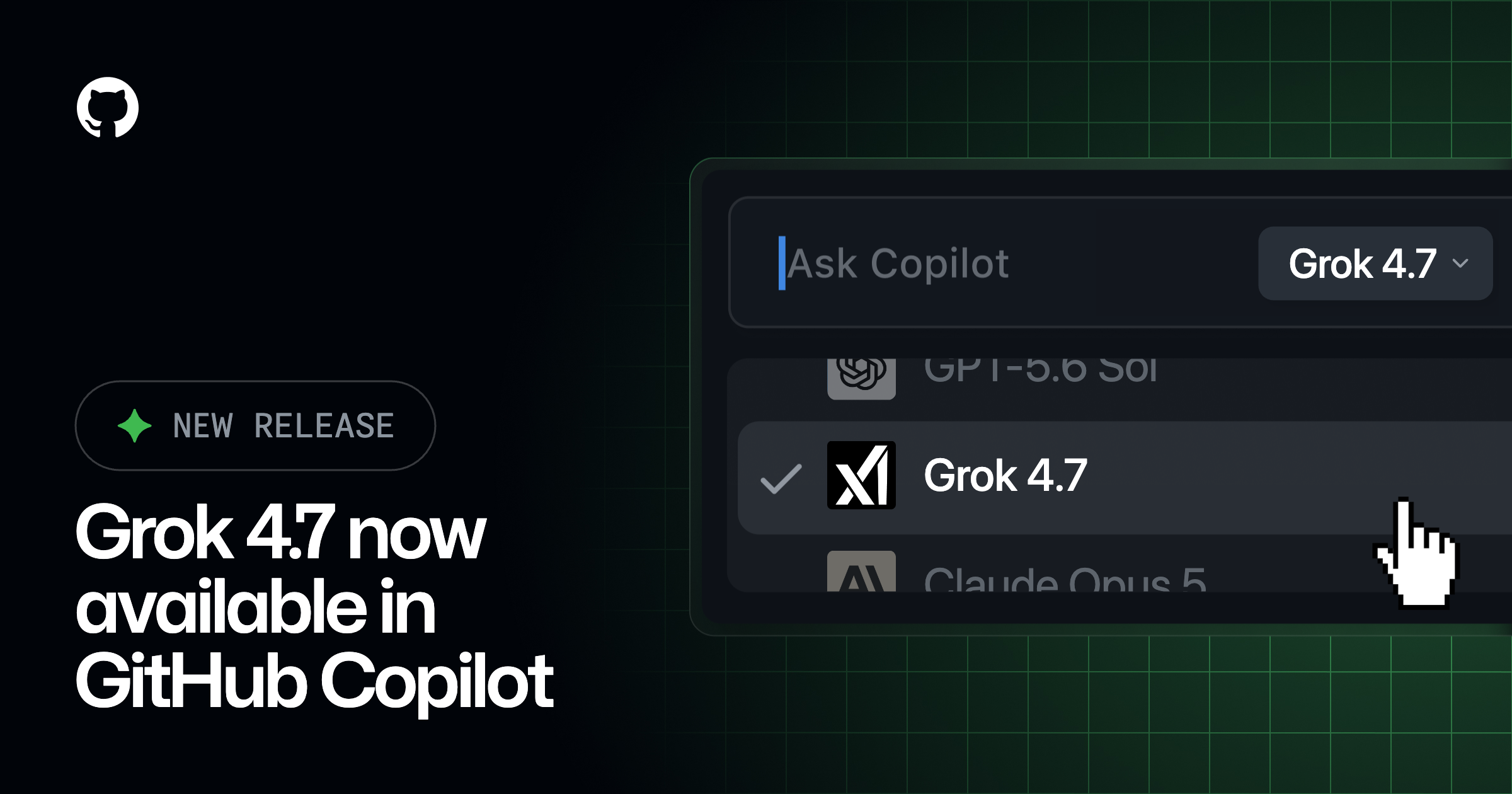
GitHub is gradually rolling out xAI’s Grok 4.7 in Copilot, positioning it for agentic coding and complex multistep work. It will be selectable in VS Code, Visual Studio, the Copilot CLI and cloud agent, Copilot app, JetBrains, Xcode, and Eclipse for Pro, Pro+, Max, Business, and Enterprise users. Usage-based billing follows the provider’s list pricing. Business and Enterprise administrators can control access through model policy, while default model enablement turns on new models unless the global default or this specific model is disabled.
Read the source →What a Word Actually Does Inside an AI Image Model, and How to Write Prompts That Land

This explainer shows that adding a phrase to an image prompt does more than insert the object named by that phrase: with the seed held constant, “red wine on a white tablecloth” changes the table, wall, window, and light as well. It traces the mechanism to diffusion: text tokens become vectors fed through attention into every denoising step, while classifier-free guidance pushes each step in the prompt-conditioned direction. Because the model learns expected noise or image direction from image-caption distributions, a word can shift the entire distribution of plausible scenes rather than act as a local edit instruction. The usable lesson is to test prompt effects under fixed seeds and recognize that compositional wording can globally alter a generation.
Read the source →Claude Platform release notes — September 18, 2026
The extracted release notes identify updates to the Claude API, client SDKs, and Claude Console, with the newest changes first. They warn that Opus 4.1 does not permit temperature and topp together, so callers must choose one sampling control. The excerpt also says some previously beta-gated Claude API features have become available without a beta header, though it does not include the full feature list. API users should therefore review the current release notes before changing request parameters or removing beta headers.
Read the source →Import AI 473: The US's superintelligence strategy; human brain in a mouse skull; and machine hermeneutics

Import AI highlights RAND’s recommendation that US superintelligence policy preserve “freedom of action” because the pace, danger, and geopolitical structure of an AI transition remain uncertain. The proposed portfolio includes a human-AI ecosystem, AI-security architecture with compute visibility and agreement verification, modernization of national-security institutions, and broader societal capacity to respond. RAND maps options from dominance and co-development through moratoria, deterrence, civilizational continuity, and acceleration, with the right choice depending on proximity of danger, feasibility of coexistence and restraint, and whether decisive advantage or suppression is possible. The article’s main point is that taking these scenarios seriously requires investments that keep choices open, rather than prematurely committing to one doctrine.
Read the source →Transformers now runs llama.cpp quants

Hugging Face added Transformers support for GGUF quantized models, initially targeting local Qwen3.5 inference on Apple Silicon while retaining the familiar frompretrained API. The implementation reuses llama.cpp’s ggml kernels to approach llama.cpp performance, and can also expose models through an OpenAI-compatible Transformers Serve endpoint. Users can choose quantizations such as Q4KM, Q5KM, or Q6K to trade memory for quality; the guidance is to begin with Q4KM and evaluate against the actual task. If a compatible quantization kernel is unavailable, the loader falls back to dequantization and consumes more memory.
Read the source →Jun Kim, oMLX creator and maintainer, joins Hugging Face to support the MLX community

Hugging Face hired Jun Kim, creator and maintainer of oMLX, to give the Apple-Silicon local-AI project sustained funding and maintenance while keeping it Apache 2.0 and under Kim’s leadership. The team wants oMLX to act as a testbed and to work with projects such as mlx-lm, mlx-vlm, and LM Studio rather than fragmenting the ecosystem. A stated technical priority is speeding the path from a Transformers model definition to a reference MLX implementation usable by multiple inference engines. The post also records a temporary GitHub repository disappearance that commenters attributed to possible automated moderation, with a fork offered while resolution was pending.
Read the source →Pruning LLMs Like a Physicist: Block Removal as an Ising Optimization Problem

Multiverse Computing reframes transformer depth pruning as constrained binary optimization: each block is either kept or removed, and pairwise interactions between removals are represented by an Ising-glass energy. Unlike heuristics that rank blocks independently, the method uses a second-order loss approximation to account for the fact that removing one block can change the cost of removing another. The Hessian is computed once using a small calibration set, then cheaply scores many candidate pruning configurations and can be reused across compression targets. At 50% compression of Llama-3.3-70B-Instruct, the authors report nearly a 23-point MMLU gain over the best competing block-removal method.
Read the source →tokenizers v1: encode, decode and scaling, measured

Hugging Face’s Tokenizers v1 aims to eliminate CPU tokenization as a bottleneck for fast models, large training corpora, high concurrency, and long inputs, while preserving v0.23 token IDs, API, vocabulary, and merge ranks. The release candidate claims speedups often in the tens of times through improvements across the pipeline, particularly BPE pre-tokenization and model stages. For common fixed regex patterns it replaces generic runtime regex work with specialized SIMD-aware splitting functions that process many UTF-8 bytes in parallel; uncommon patterns retain the slower regex path. The project publishes broad benchmarks and a tokbench command so users can test throughput, latency, threading, memory, and model/language behavior on their own hardware.
Read the source →[AINews] Xiaomi MiMo-V2.6-Pro 1T-A42B: the new top Open Weights model, trained for $3M
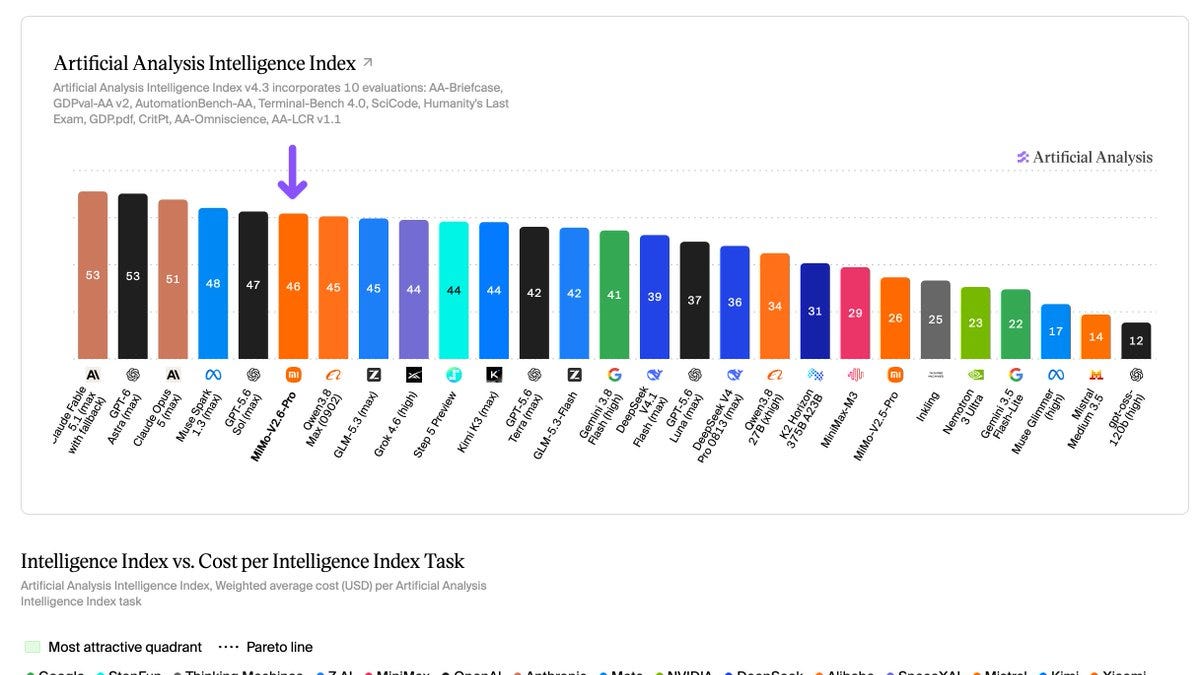
Xiaomi released open, natively omnimodal MiMo-V2.6 Pro and Flash models, plus an UltraSpeed variant claimed to produce output up to 20 times faster at equivalent quality. MiMo-V2.6-Pro has 1.02T total parameters and 42B active parameters, and Artificial Analysis reportedly ranks it first among open-weight models on its Intelligence Index at 46; the report quotes $0.435 per million input and $0.87 per million output tokens. Xiaomi’s distinctive claim is transparency around its reinforcement-learning stack: asynchronous updates use 1,568 samples, contexts up to 1M tokens, and 3.5–3.7B tokens per step across coding, general-agent, visual, cyber, and music environments. It plans to open-source training recipes, environments, and harness tooling, though not yet the complete 7,000-plus task datasets.
Read the source →Jev: System One models for Prod, not God — with Diogo Almeida, CEO, TypeSafe AI

This interview frames Jev as a move away from autoregressive chat models toward programmable, calibrated decisions that can disappear into ordinary software. TypeSafe says its unpublished “reinforcement learning for calibrated decisions” optimizes epistemically honest probabilities for System One tasks, in contrast to preference-driven RLHF and rubric-verifiable RLVR. The argument is that chat alignment, refusals, and generative outputs are poor defaults for software components that need measurable reliability and composable control flow. Developers are encouraged to replace giant prompts with structured state and decompose workflows into small decisions, while resisting shallow copies of the API or generic benchmarks.
Read the source →A Continual learning model trained from scratch on 8GB VRAM laptop with batch-1 stream of data
mini-AGI is an experimental byte-level continual-learning model intended to train from scratch and continue learning on a single consumer GPU with 8GB of VRAM. It pages ordinary-file weights from disk, so capacity is bounded by available storage rather than VRAM, grows and prunes experts during training, and uses the same forward path for reading/training and generation. Its recurrent architecture can apply a shared expert block up to 24 times per character, dynamically spending between roughly 4 and 14 rows in the cited trace. The author explicitly calls it a small toy rather than a frontier model and says weights are not yet published, but uses it to demonstrate continuous learning without catastrophic forgetting on modest hardware.
Read the source →You cannot tell which parts of your software should stop calling an LLM. My Jev guide has a prompt that scans your projects and names them.

The accessible extract says software has gained a third building block and cites Jev’s unusually rapid Vercel AI Gateway adoption: more than twice as many paid teams as any earlier model launch within 24 hours. The rest of the guide is subscriber-only, so the extraction does not substantiate its proposed project-scanning prompt or specific migration advice. Its visible premise is that teams should identify software functions that need decisions rather than generated text.
Read the source →Superpowers 6.4

Superpowers 6.4 adds support for Meta Muse, OpenCode 2.0, and Qwen Code, with planning and brainstorming changes designed to curb skipped steps and unrequested scope. It refreshes Native Execution for stronger frontier models; internal evaluations say it is roughly twice as fast and half as expensive as the framework’s subagent-driven approach, while bare-agent implementations remain faster and cheaper but significantly buggier. The release also adds a diagnosing-superpowers skill for investigating unexpected session behavior and tunes code-review prompts toward more reasonable judgment to reduce runaway review loops. It is available immediately through the Superpowers Marketplace and OpenAI Codex, while other marketplaces update on their own schedules.
Read the source →Jev introduces a new shape of LLM - System One, aka Decision Models
Simon Willison describes Jev as a decision model that accepts text or semi-structured state but returns typed probability-like outputs—categories, ratings, yes/no answers, and confidence—rather than generated text. Its input-only price is $0.042 per million tokens, with free output, and multiple questions about one state can run in parallel, making it suitable for classification, labels, prioritization, and search reranking. He also flags a critical tradeoff: a raw score cannot explain which signals drove its choice, making bias and high-stakes ranking applications especially concerning. The low cost makes large-scale evaluation practical, but he argues those evals and structured experiments are more essential, not less.
Read the source →Cloudflare Python Workers are now generally available
Cloudflare has made Python Workers generally available after a two-year preview, making Python a supported language on its developer platform. The runtime compiles Python to WebAssembly using Pyodide inside Cloudflare’s V8-based workerd environment, which brings important constraints: multiprocessing and threading do not work in that WebAssembly VM. Local development uses pywrangler, packaged as workers-py on PyPI, to simulate the stack with Pyodide, V8, and a 123MB workerd binary. The release reflects a larger investment in Python and Pyodide, whose core maintainers are credited on the announcement.
Read the source →MCP was always a bad idea?
Simon Willison argues that declaring MCP obsolete confuses the needs of unconstrained terminal agents with the needs of safer, user-facing integrations. A full coding agent with unrestricted internet access can call APIs directly, but other products need fine-grained service permissions, authentication that keeps API keys away from the model, a UI for connecting services, and audit logs. MCP makes those controls easier to provide. The argument is therefore not that MCP should sit in every agent loop, but that it remains valuable as an integration and governance layer.
Read the source →Advisory Group on Mathematics and Artificial Intelligence
OpenAI says it is working with an independent Advisory Group on Mathematics and Artificial Intelligence. The group is intended to guide the review and communication of emerging AI results. The extracted announcement provides no membership, remit, or process details beyond that purpose.
Read the source →Higgsfield AI ships new video features in a day with GPT-6 Astra
OpenAI says Higgsfield AI uses GPT-6 Astra to make video-ad creation easier for small businesses and bring creative features to market more quickly. The extracted item does not provide product metrics, implementation details, or an independent comparison. Its concrete claim is a startup use case: turning prompt-driven AI capability into a faster video-production workflow.
Read the source →Building standards for the next phase of AI
OpenAI calls for shared global AI standards built around coordinated evaluation, reporting, and governance. The stated objective is better safety as AI enters its next phase. The short extracted announcement does not specify proposed standards, enforcement mechanisms, or participating governments and organizations.
Read the source →Expanding OpenAI Academy with new learning paths
OpenAI Academy has added learning paths aimed at employees, developers, leaders, educators, and students. The program is positioned around acquiring and demonstrating practical AI skills, rather than serving only technical builders. The extract does not describe curriculum length, credentials, pricing, or regional availability.
Read the source →How V7 gives AI agents institutional memory
OpenAI says V7 uses GPT-5.6 to turn scattered company files into context that agents can use for complex work with source links. The stated product promise is institutional memory: connecting information distributed across an organization rather than requiring an agent to work from isolated documents. The extract provides no detail on ingestion, retrieval, permissions, or measured performance.
Read the source →The Sequence Knowledge - Issue 937: RSI in Post-Training: The Loop That Already Shipped

The Sequence argues that the economically important form of recursive self-improvement is already operating inside frontier labs’ post-training pipelines, not in an agent directly rewriting its own code. The loop is simple: a model generates many candidate answers, a grader selects the good ones, those become training data, and the improved model repeats the process. It connects this pattern to STaR, RLVR, and the organizational label “post-training,” and argues that it transformed frontier systems from chatbots into agents. The key distinction is whether work has an answer key: that determines what parts of the AI factory can be automated now.
Read the source →