AI shifts from chat to governed business work
Summary
The common shift is away from treating AI as a chat interface or a unit-cost line item and toward deliberately bounded, measurable systems embedded in real operations. That makes reliability, privacy, credential handling, serving efficiency, and the redesign of work inseparable concerns: expanding AI’s reach also expands the consequences of its defaults. The items point to a practical dividing line between open-ended generative help and controlled systems that can safely make or support consequential decisions.
PD Serving of Qwen3.8-2.4T
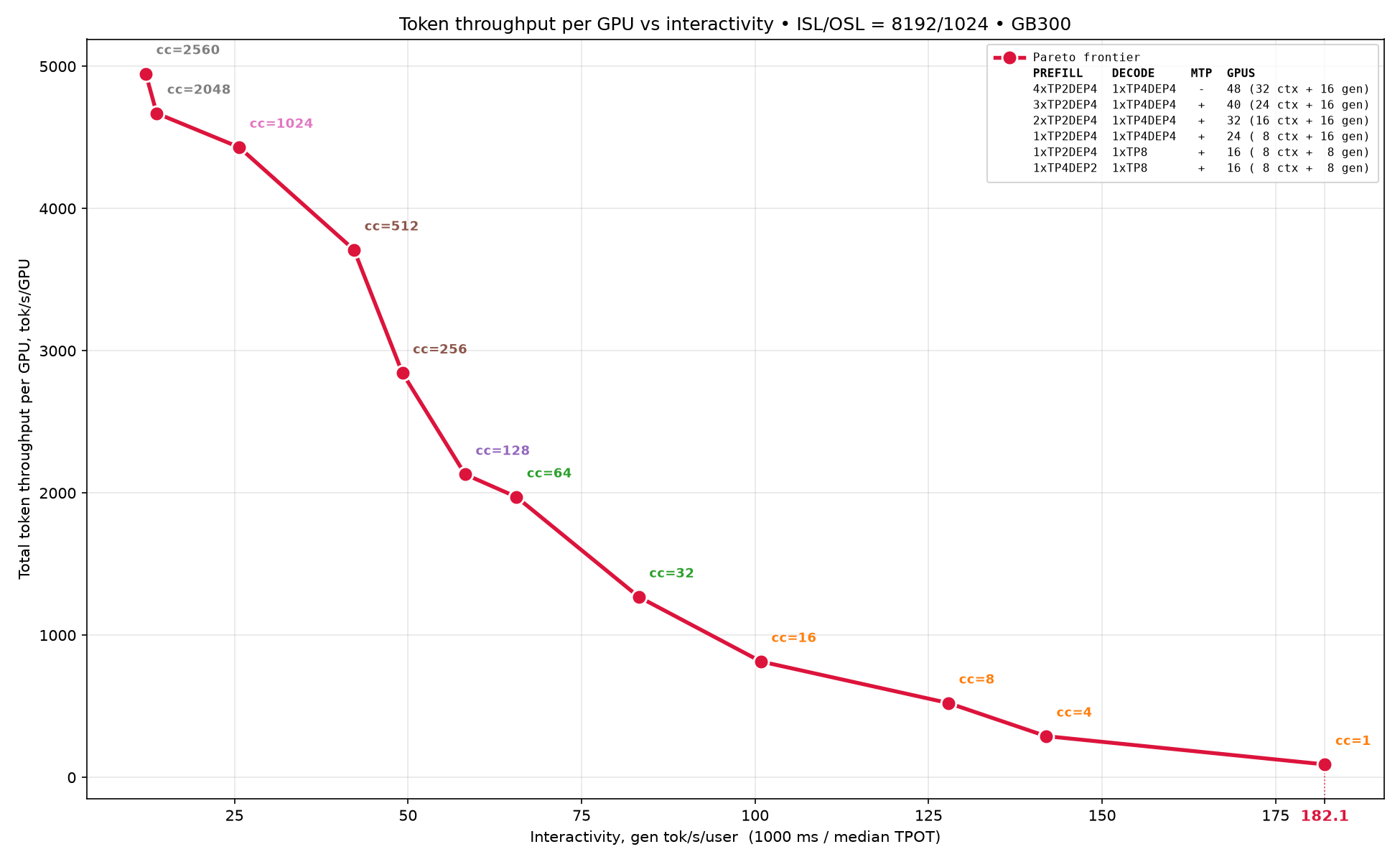
vLLM reports disaggregated-prefill serving results for Qwen3.8-2.4T on a GB300 NVL72 cluster using an 8K-input/1K-output workload: 5,000 total tokens per second per GPU in its high-throughput configuration and 180 generated tokens per user in its low-latency configuration. Rather than presenting one benchmark point, the post maps a throughput-versus-interactivity Pareto frontier and publishes reproducible srt-slurm recipes. Its central tuning lesson is to begin with KV-cache accounting: this hybrid model’s fixed per-request GDN state is much larger than its per-token full-attention state, driving a 2,112-token, 4.125 MiB cache block. Prefill and decode block sizes must also match for KV transfer, so manually increasing block size can be necessary even though it wastes some cache capacity.
Read the source →1.5.1
ExLlamaV3 1.5.1 adds model support for KimiLinearForCausalLM and DFlash2, plus tensor-parallel support for Qwen3.8-Flash-Next, GLM5.3, and DeepseekV3/V4. The release includes MoE optimizations and a fractional-trellis quantization mode. It also improves the self-calibration pipeline, including highly experimental YAQA support. Memory leaks and a Windows/Conda issue involving EXL3MOEPINNEDARENA are among the fixes.
Read the source →Executive Briefing: Where Your AI Money Actually Goes (+ the Token Saver Guide and the 15 Changes I Use)
The argument is that token costs are a misleading focal point unless they are compared with the cost of attention and coordination that an AI workflow replaces. Businesses historically used service tiers, minimum account sizes, forms, and standardized offers because skilled human attention was scarce; cheaper AI-enabled attention makes those choices revisitable. The author urges companies to redesign the customer offer—serving customers that were formerly too small or providing outcomes that were formerly uneconomic—rather than merely attaching an agent to the existing product. Any efficiency gain is contestable: competitors may use it to improve the offer instead of retaining it as margin, so evaluations should measure the customer promise rather than only model spending.
Read the source →ChatGPT now knows what you do on other websites via ad collector
The article reports that OpenAI’s ad collector creates a long-lived obi cookie on .openai.com that can link a ChatGPT account or persistent anonymous device identity to activity on advertiser websites carrying OpenAI’s pixel. In the author’s captures, simply loading the pixel’s script disclosed the cookie, while the SDK also collected advertiser-provided data and scraped form fields, rendered text, and tag-manager data. The investigation cites 936 advertiser pixels across 1,029 hostnames; scraped identity appeared in 685 observed events versus 255 advertiser-supplied events, and email and phone were hashed while location fields were sent in clear text. The author says the identifier crossed 12 commercial sites on one device, notes that it is configured as the only OpenAI cookie with SameSite=None, and questions why this behavior is classified under analytics consent rather than marketing.
Read the source →Quoting voxium
Simon Willison republishes a first-person account from someone newly employed at a large company where the writer says specs, code, tests, PRDs, tickets, and reports are being made by Claude Code. The quoted engineer says management treats code production as no longer being a bottleneck and pushes teams to ship more, while employees work 12–13-hour days largely directing the tool. The account alleges that engineers across seniority levels are doing the same work—talking to Claude—and that almost nobody is reading the resulting material. It is presented as an attributed quotation, not an independently substantiated report.
Read the source →llm-keys-ui 0.1
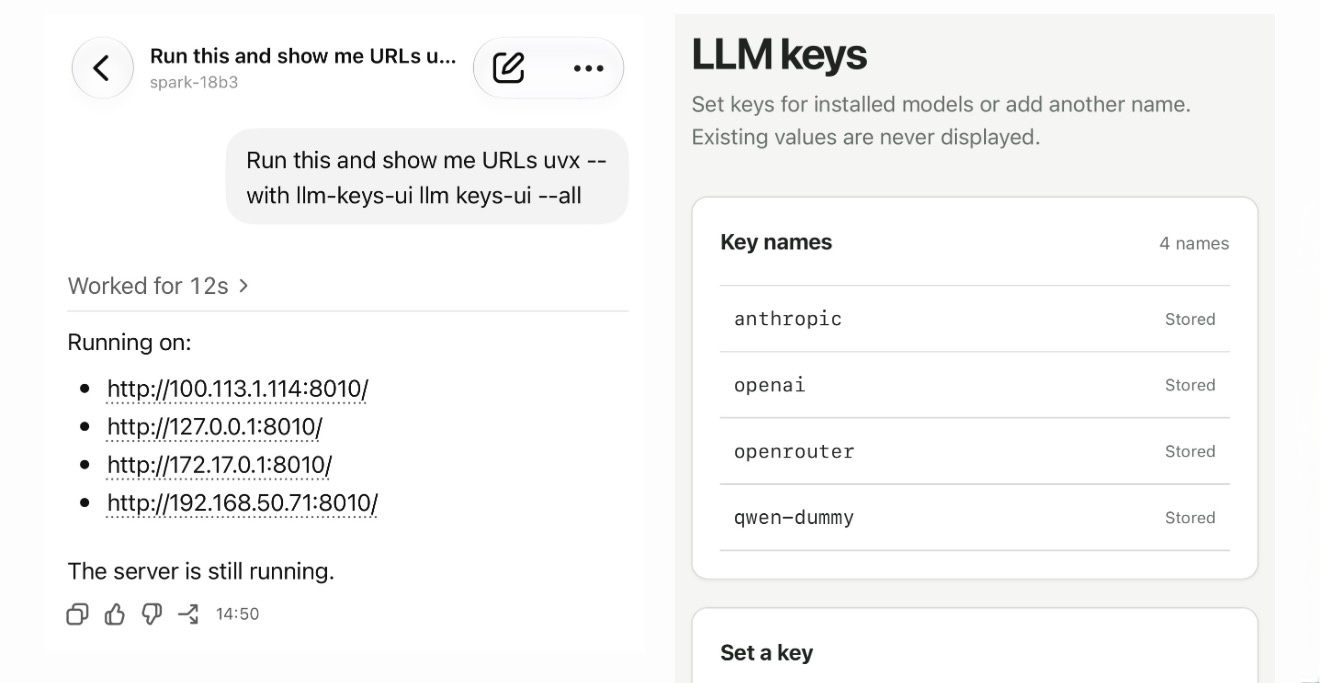
Simon Willison’s llm-keys-ui plugin is designed for using coding agents remotely without pasting API keys into an agent session or ChatGPT on a phone. An agent can run the plugin and return a URL—using a local-network or Tailscale IP—to an interface where the user saves additional keys. The agent can later retrieve a configured credential through commands such as llm keys get anthropic as part of a shell command. The approach separates key entry from the conversational control channel used to operate the remote machine.
Read the source →datasette-explain 0.2.2
datasette-explain 0.2.2 is a new release of Simon Willison’s explain plugin, prompted by his upgrade of datasette.simonwillison.net to Datasette 1.0a40. The supplied post contains no further feature list, performance result, or migration guidance. Readers therefore only have confirmation that the plugin has been updated alongside that Datasette alpha upgrade.
Read the source →How to use Jev to automate your business (Step-by-step w/ Treg)
The video argues that general-purpose language models can excel at advanced coding and math yet remain unsuitable for many business workflows because those workflows demand calibrated confidence, near-perfect decision accuracy, low cost, and speed at high volume. It describes Jev as a system trained with “reinforcement learning for calibrated decisions,” built to select among supplied options rather than generate prose, code, or its own alternatives. By outputting probabilities over a fixed answer set instead of generating tokens sequentially, the presenter says Jev is faster and cheaper than conventional large models. The tradeoff is deliberate constraint: it is intended for reliable decisions, not open-ended assistant behavior.
Read the source →You can be ambitious without the huge token bill. Here's how.
Nate B Jones argues that stronger agents can raise spending if companies simply automate or expand existing work, so cost control starts with questioning whether that work should exist at all. Drawing on Dreamforce conversations, the video frames AI adoption around the business outcome: redesign how work is done to deliver the same or better value, then choose models and spending from that goal. The presenter wants organizations to pursue larger, more ambitious agent-enabled work without treating every deployment as an uncontrolled financial commitment. The proposed opportunity is not only cheaper execution, but rethinking jobs and workflows so that AI capability becomes affordable across company sizes.
Read the source →7 Ways How We Use AI Is Changing
AI Daily Brief argues that interaction patterns with AI have moved beyond prompt engineering through context, harness, and loop engineering as people learn how to use a new general-purpose technology. The episode says the recent changes are more substantive than successive buzzwords and are likely to persist, making them worth attention for people trying to use AI efficiently. One highlighted force is product design: AI experiences are being simplified and integrated, offering users fewer cognitive choices rather than more. The broader premise is that AI is reshaping both how existing work is performed and which new kinds of work become possible.
Read the source →