Frontier labs rally around slowing AI development
Summary
Today’s strongest thread is a redistribution of responsibility as AI becomes more operational: labs are being pressed to accept outside scrutiny, while teams are being pushed to make specifications, evaluation, permissions, and human judgment explicit. The disagreement is over whether that responsibility demands slowing capability progress or building stronger controls around it. Across creative tools, coding agents, and research systems, the recurring constraint is not raw generation but verification, context, and accountable deployment.
How to Do Motion Design with GPT-6 Astra and After Effects
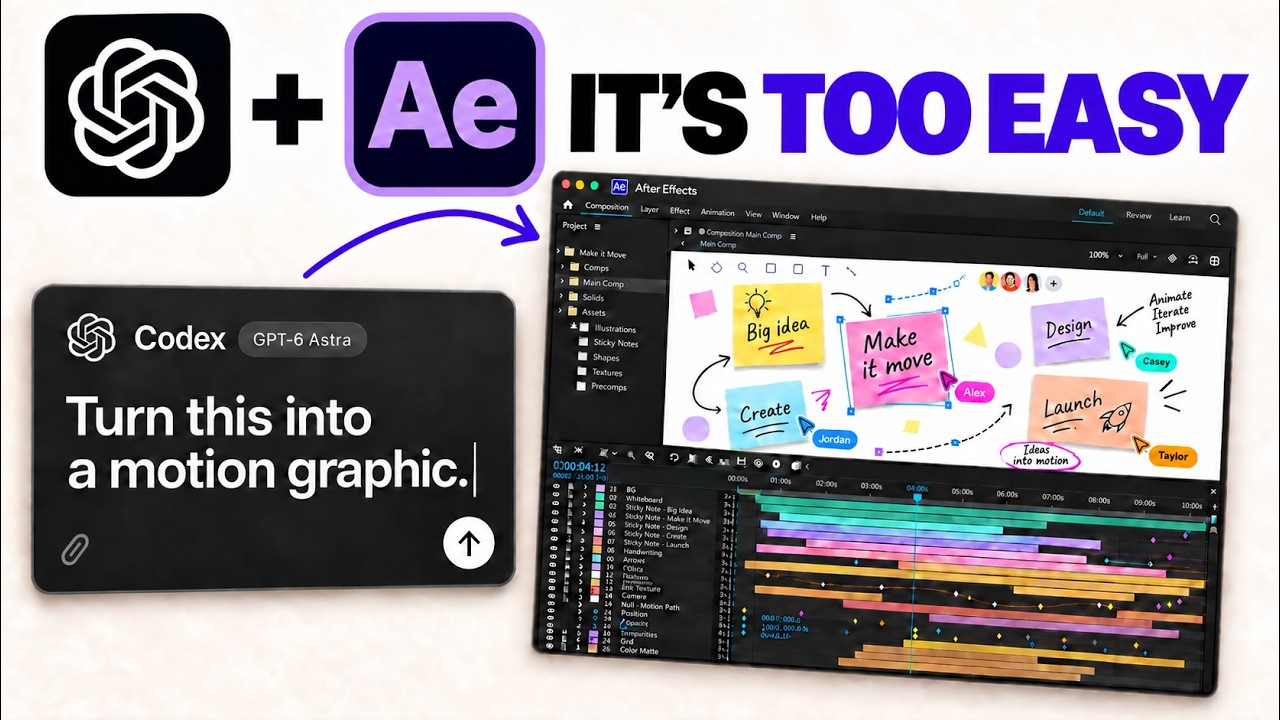
GPT-6 Astra can control Adobe After Effects from Codex through Higgsfield’s free, open-source Motion Designer plugin, which supplies both the software bridge and usage skills. The recommended workflow starts with an AI-generated storyboard, then turns the approved scenes into a detailed build prompt, rather than iterating blindly on expensive renders. The author reports a 15-second build taking 22 minutes and 56 seconds without Higgsfield credits, and says reference clips plus the repo’s prompt templates help guide the result. The same approach can extend to Blender, shifting the user’s role toward directing and reviewing.
Read the source →Insane GitHub Repos That 10x Your Codex And Claude Code Setup
The video surveys eight GitHub projects intended to fill gaps in coding agents rather than simply add more prompts. One highlighted tool, image-to-3js, converts a reference image into an editable, interactive 3D object built in code for a website. Its agent iteratively compares the generated model with the source image, but the workflow is token-intensive, slow, and may require several refinement rounds. Another class of tools is framed as a remedy for agents declaring a feature finished before it has actually been verified.
Read the source →How data retention works when using Claude
Anthropic says it retains the most recent 30 days of prompts and outputs for safety monitoring beginning with Claude Fable 5, because sophisticated misuse can span accounts and sessions. Automated systems analyze that rolling window; enterprise data is not used for training without explicit permission, and human review is restricted to rare flagged cases with logged access. Its forthcoming Enterprise Frontier Safeguards lets eligible customers keep monitoring data in their own cloud under their encryption keys, access policies, and audit logs, with alerts sent to their teams. Eligible organizations receive zero data retention for Fable 5 and 5.1 until the phased rollout begins later in the fall.
Read the source →My NEW FAVORITE Skill - Claude Code Drives My Whole Computer (Better Computer Use)
The presenter describes “drive screen,” a lightweight, cross-platform skill for having a coding agent operate an entire screen through the command line. The claimed advantage over bundled or open-source computer-use systems is control: it avoids installing a separate, hard-to-customize harness. The argument is that recent models are capable enough to make this practical for routine work, while computer use remains valuable precisely because it can extend an agent beyond code. The video encourages experimentation but frames the skill as a customizable alternative, not a replacement for every existing tool.
Read the source →Agentic Engineering Benchmarks: How I RANK Astra, Fable 5.1, and Open-Weights
The video argues that composite model indexes such as Artificial Analysis 4.3 compress too many different capabilities into a single ranking for engineering decisions. It recommends selecting a small set of benchmarks based on the actual agentic task, because benchmark importance varies by use case and agents’ workflows are changing quickly. The presenter’s exercise is to choose only five benchmarks, forcing engineers to make tradeoffs explicit instead of treating one leaderboard as definitive. The underlying advice is to use benchmarks as partial evidence about a model’s operating fit, not as a universal score.
Read the source →Speech Recognition Is Not a Solved Problem — Pavan Muddireddy
Mistral audio research lead Pavan Muddireddy discusses speech as a primary human interface and describes modern end-to-end speech systems as autoregressive. In that architecture, previously generated audio becomes committed context, making later correction difficult rather than trivially editable. The discussion situates audio work inside Mistral’s broader stack of open text, multimodal, and reasoning models plus application products such as coding and chat tools. Its premise is that speech recognition and generation still have consequential technical limitations despite rapid progress.
Read the source →GPT-6 Astra Just Unlocked Motion Design + After Effects
The video demonstrates using GPT-6 Astra inside Codex to drive After Effects via the free, open-source Higgsfield Motion Designer plugin. Installation is presented as simple: install the plugin, then invoke higgsfield/use after effects or ask Codex in plain language to use the integration. The plugin both operates the application through scripts and computer use and gives the model specialized guidance for working in After Effects. The result is positioned as making motion graphics accessible to people without prior After Effects experience, with similar possibilities for Blender.
Read the source →AI Companies Begin to Align Around Slowdown
The episode treats Dario Amodei’s 30,000-word “We Must Pace the Frontier” essay as a turning point from abstract AI-risk talk toward concrete proposals for slowing frontier development. It says public support from leaders of other labs suggests companies recognize they may no longer be the sole arbiters of AI’s speed. The central question is shifting to how governments, companies, and outside stakeholders should negotiate the next phase of progress. The presenter emphasizes that the debate now has tangible policies to scrutinize rather than only general warnings about AGI risk.
Read the source →Two Weeks of Specs, Five Minutes of Generating
Talks from AI DevCon argue that when teams maintain precise specifications, code becomes a regenerable output rather than the durable expression of the product. One practitioner describes two weeks of requirements work followed by five minutes of generation, with requirements engineers now carrying more of the workload than coders. Speakers propose executable specifications that state both behavior and nonfunctional requirements such as speed and security, allowing AI to generate and verify an implementation. The practical implication is that teams must invest in domain-specific, clear specifications, because agents cannot infer the appropriate constraints from a vague request.
Read the source →Intelligence is Everywhere: Why the AI 'Race' is Already Over
A conversation with longtime AI practitioner Alvin Grlin challenges the framing of US–China AI development as an arms race. It compares AI’s potential diffusion to electricity: no one “won” electricity because its benefits became broadly available. The discussion also raises a tension between broad access to powerful technology and concern about concentrated lobbying and control. It frames the next decade as having both a more functional possible future and a darker one, rather than assuming national competition is the only lens.
Read the source →Sam Altman and Apple's New CEO are Fighting Over One Thing. It's Not What You Think.
The video frames Apple and OpenAI’s real competition as control over where a user’s work history, projects, and learned preferences live—not device hardware alone. It argues that Apple’s September launch signals a recurring AI-services business: server-side features will have daily limits and expanded access will cost extra, though Apple has not disclosed the price. Apple’s new hardware includes a $1,999 folding phone and iPhone 18 Pro models starting at $1,199 and $1,299, but the presenter treats those as secondary to the ownership of personal context. The proposed lock-in is therefore the assistant relationship and accumulated history, not merely the phone sale.
Read the source →Amodei slows frontier 🛑, ARC-AGI-4 🧠, Cursor Projects 👨💻

The extracted item reports Lambda’s benchmarking of Llama 3.1 models from 8B through 405B on NVIDIA Blackwell GPUs. Its engineers traced efficiency losses to root causes and produced a reproducible optimization framework. The reported result is model-flop utilization above 60%, more than a 25% improvement over the cited industry benchmark, without changing the model architecture. This makes systems-level training efficiency, rather than another architecture change, the actionable result in the available excerpt.
Read the source →The Sequence Knowledge - Issue 933: When the Factory Starts Building Itself
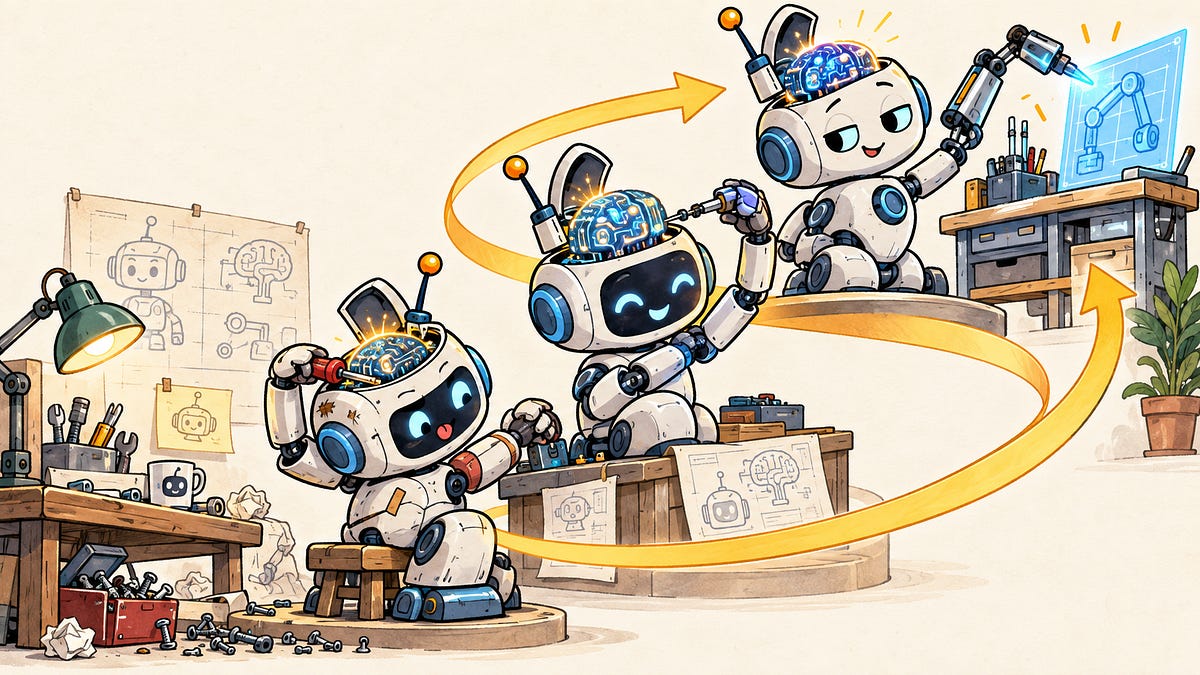
The Sequence opens a series on recursive self-improvement by arguing that AI helping build AI has moved from theory to disclosed practice. It cites Anthropic’s claim that Claude wrote more than 80% of production code merged as of May, OpenAI’s use of GPT-5.3-Codex in training debugging and deployment, and DeepMind’s AlphaEvolve infrastructure improvements. The important question is no longer whether this feedback loop exists, but which work it has absorbed, how reliably it performs, and what validates it. The series treats those checks as the decisive issue for an AI-assisted “factory” that increasingly builds itself.
Read the source →Configure cost and quality in Copilot auto model selection
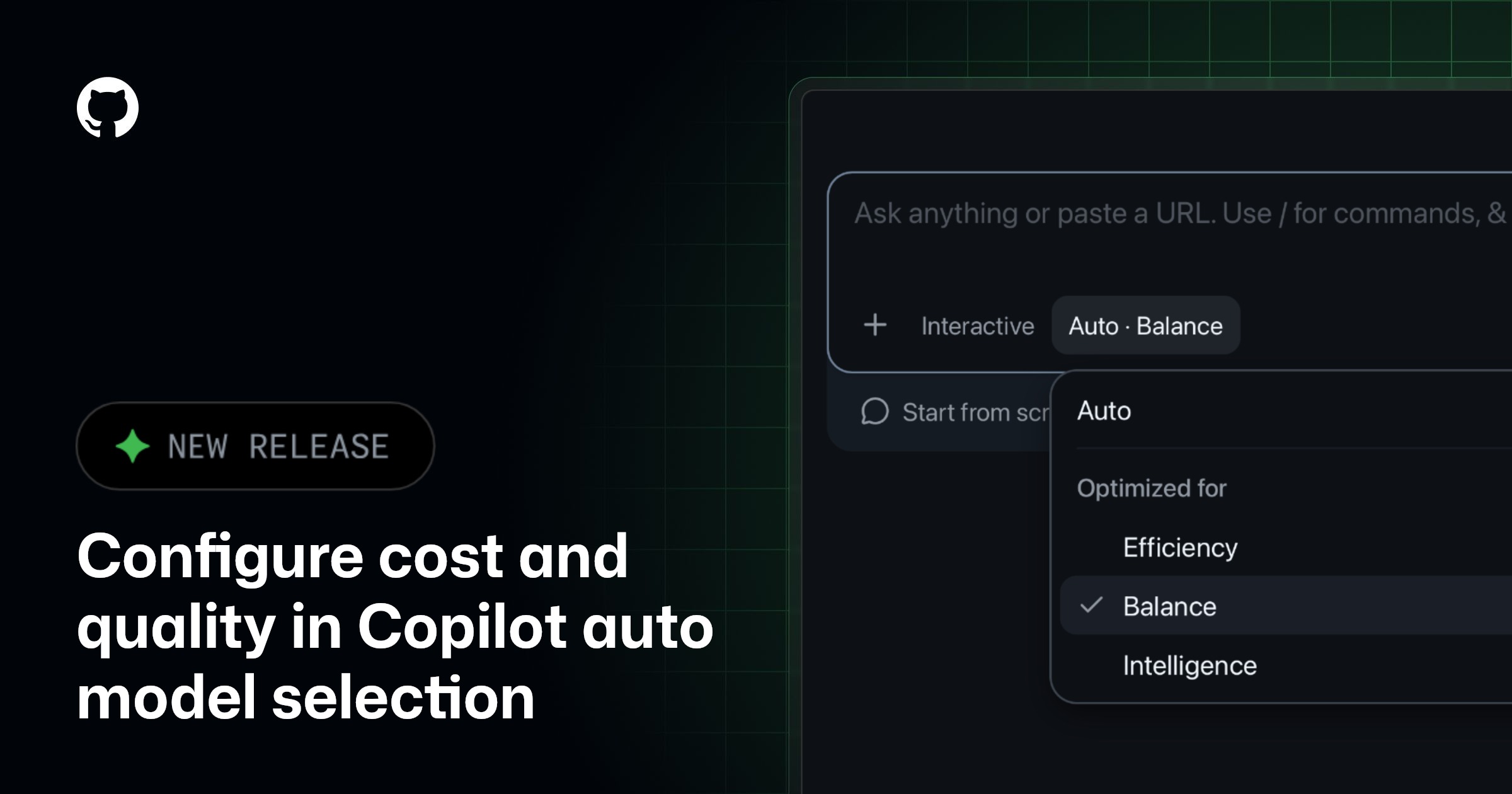
GitHub Copilot Auto now lets users choose among efficiency, balance, and intelligence tiers to express a preferred tradeoff among cost, quality, and latency. Each tier draws from the same model pool, while Auto still chooses a model independently for each prompt; even the intelligence tier may select a small model for a simple docstring. Charges depend on the model actually selected, not on the tier, and paid subscribers retain a 10% discount on Auto-billed usage. The feature is rolling out to VS Code, Copilot CLI, and the Copilot app as a first step toward more configurable model routing.
Read the source →Watch astronaut Christina Koch and Google’s James Manyika discuss space, technology, and discovery.

NASA astronaut Christina Koch joins Google’s James Manyika to discuss exploration, technology, and discovery. Koch reflects on spending 328 days aboard the ISS, completing the first all-female spacewalk, and traveling around the Moon on Artemis II. Their conversation connects astronauts, robotics, and AI, including the perspective of seeing Earth as an “electric blue” lifeboat from 250,000 miles away. Koch’s advice to future explorers is to do what scares them and support the people around them.
Read the source →DevFest is back
Google’s DevFest 2026 runs from October 1 through December 31 and expects nearly one million developers and builders. Under the theme “Build, Secure, Scale: Developers and Builders in the Agentic Era,” events will offer codelabs, workshops, and agent-athons across Gemini, AI Studio, Cloud, Firebase, Android, Flutter, Angular, and Web MCP. More than 800 community-led events are planned in 115 countries, with local Google Developer Groups tailoring agendas to their ecosystems. The pitch is hands-on experimentation and community skill-building rather than a centrally programmed conference.
Read the source →[AINews] AEF-1 standard emerges for Third Party Evaluators, as Xai, OpenAI, and Anthropic all cosign
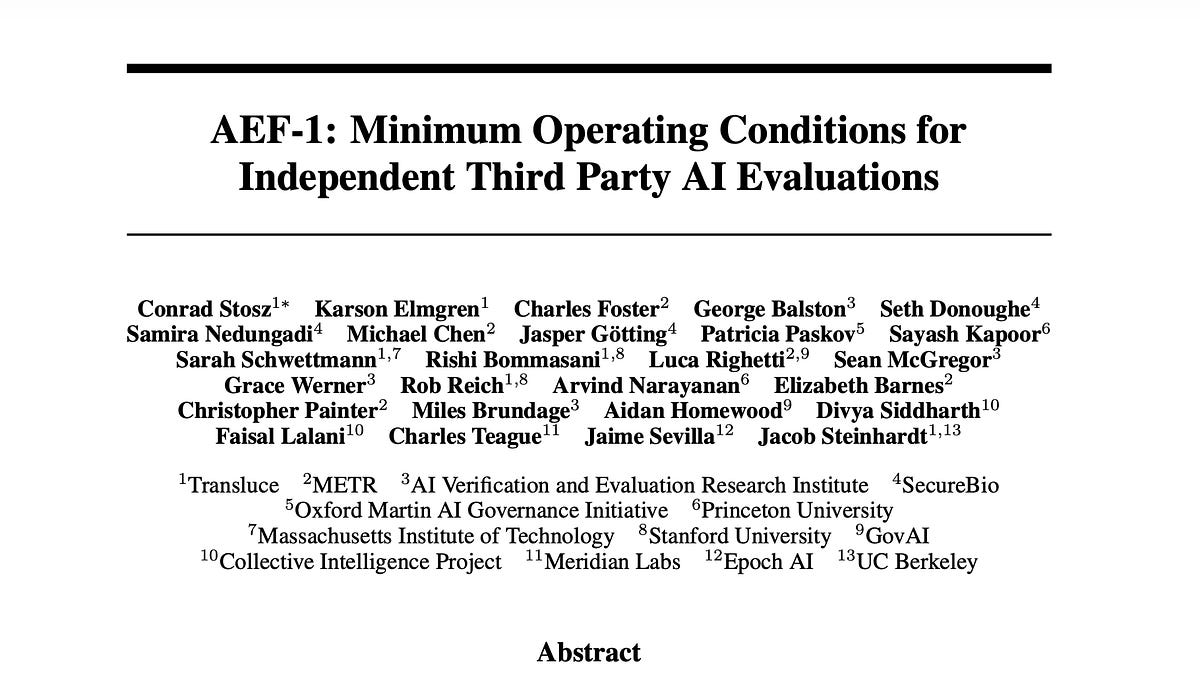
The AI Evaluator Forum has published AEF-1, a proposed baseline for independent third-party AI evaluations covering access, conflicts, funding relationships, recusal, and transparency. The post connects it to Dario Amodei’s pacing proposal: Anthropic would give embedded evaluators access comparable to internal risk teams, including desks, badges, laptops, workspaces, tools, and permissions. It identifies a real disagreement beneath the rhetoric: whether risk chiefly requires slower frontier capability progress or better control through oversight, sandboxing, permissions, harnesses, and monitoring. It also notes that domestic coordination and any credible international coordination, especially with authoritarian governments, raise legal and verification problems.
Read the source →Humanity’s Last Invention — Richard Socher of Recursive

Richard Socher presents Recursive’s “Eureka Machine” as a system that could automate the process of invention and accelerate research across science, energy, materials, and biology. Recursive has raised a $4.65B seed round, and Socher says its early research system beat humans and their agents on optimization tasks in under two days while finding GPU-kernel improvements without CUDA specialists. He argues that work now requiring thousands of people and years could eventually be compressed into weeks, while also stressing questions of reward hacking, evaluation, and objective design. The conversation disputes simplistic hard-takeoff narratives by considering compute, hardware, and economic constraints alongside the risks of self-improving systems.
Read the source →Planning with Agents: Divided Worlds, Boundary Objects, and Thicker Interfaces

Maggie Appleton argues that agent planning should be understood as collaborative, real-time decision-making rather than a one-time plan handed to an autonomous system. Drawing on Lucy Suchman’s work and Chuukese navigation, she says plans are weak resources for situated action because real conditions continually force improvisation. The critique targets the assumption behind hyperautomation that an excellent upfront plan can simply be executed while people are away. Better interfaces should instead keep humans and agents in a shared context, using richer boundary objects to negotiate changing work.
Read the source →A Letter from a Machine Learning Engineer

This post republishes an anonymous email purportedly from a frontier-lab machine-learning engineer, while explicitly warning that the author’s identity and claims cannot be verified. The letter alleges internal scaling limits for programming, executive turnover, weak competitive moats, and a near-term open-weights model that could match proprietary systems; it also makes sweeping claims about LLM limits and industry hype. The publisher provides annotations and says their own view of coding agents has become more nuanced, but the raw excerpt does not independently substantiate the anonymous assertions. Readers should treat it as an unverified account of pessimism inside the field, not as evidence of the claims it repeats.
Read the source →Why don’t machine learning research agents overfit?

Amazon researchers address the puzzle that repeated community optimization against long-lived benchmarks should overfit, yet fresh-test studies usually find benchmark gains transfer. They use resettable LLM research agents to reproduce that iterative process under controlled conditions and connect the result to a compression-based explanation. A compact hypothesis that succeeds cannot simply encode the training examples, so strong performance is more likely to reflect genuine structure than memorization. The work argues that limited description length constrains the search space and can preserve generalization even when a benchmark repeatedly guides improvement.
Read the source →In 1997 nobody could tell you why you'd want a gigabit connection. AI is in 1997.
The essay challenges the idea that on-device AI only needs to become “good enough” at today’s common tasks for more capable services to lose value. It compares AI demand to 1997-era gigabit bandwidth: the uses that ultimately justified the capacity had not yet been built because the capacity was unavailable. Apple’s advantage is owning the device and the moment a user’s need arises, but the author argues that this is an opportunity rather than a settled competitive victory. The crucial business question is who retains the user’s work context and can charge recurring fees as new AI-enabled tasks emerge, especially given Apple’s stated limits and future paid server-model access.
Read the source →The contagion of fear
Simon Willison highlights Bryan Cantrill’s warning that claims AI could cause extinction within a decade need far more domain-specific explanation. Cantrill objects that claims about hacking critical infrastructure or creating extinction-level bioweapons are often asserted through hand-wavy extrapolation by people not expert in those domains. The argument is not that public concern is illegitimate, but that experts making alarming claims carry a duty to be precise because the public cannot independently assess every technical domain. His recommended corrective is to involve relevant specialists, such as biologists and bioweapons practitioners, rather than letting fear fill evidentiary gaps.
Read the source →What blog posts influenced your thinking the most?
Simon Willison names Joel Spolsky’s “The Law of Leaky Abstractions” as an early influence that taught him to understand the layers beneath an interface. He highlights Will Larson’s case that migrations are a normal, scalable engineering competency rather than exceptional events to avoid. He also credits Charity Majors’ “Engineer/Manager Pendulum” with validating movement between management and individual-contributor work. Together, the examples advocate technical depth, operational change as a practiced skill, and flexible career paths.
Read the source →Quoting Laurie Voss
Laurie Voss argues that AI is collapsing the cost not just of writing code but eventually of reviewing, repairing, and operating it. The durable work of software then becomes discovering what people want, specifying it precisely, and making it pleasant to use. Because that work is specific to each product and does not transfer cleanly, expanding software output increases rather than eliminates the importance of product judgment. The quote casts the emerging role as product engineering rather than pure implementation.
Read the source →v2.1.272 (+ v2.1.271)
The release page identifies Claude Code v2.1.272 as an agentic terminal coding tool, but the extracted page returned loading errors instead of release notes. No changelog details, fixes, or feature additions are available in the supplied material. The release therefore cannot be substantively summarized beyond its version and product identification.
Read the source →