Agents move from coding assistants to managed coworkers
Summary
The common shift is from measuring models as isolated coders to treating them as participants in systems of memory, delegation, retrieval, review, and governance. Several sources see this opening meaningful leverage—from shared agents and administrative research to longer-context serving—while the strongest cautions converge on the human bottleneck: reviewing fast output, maintaining mental models, defining trustworthy limits, and testing the capabilities compressed out of smaller models.
Show HN: Engrim – A universal, local-first SQLite memory engine for AI CLIs
Engrim is a local-first, project-scoped SQLite memory store intended to preserve architectural decisions, constraints, and state as developers move among tools such as Claude Code, Cursor MCP, Windsurf, and Google Antigravity. Its central claim is that a curated 4,000-character episodic memory is preferable to repeatedly carrying an ever-larger, forgotten context window. The project reports 105 continuous sessions on a 50,000-line trading system with no regressions across 186 unit tests and no memory loss during model switches. It also records each entry’s originating agent, provides non-destructive schema migration, and exposes a zero-dependency JSON-RPC MCP server.
Read the source →Claude proves Fermat 🧮, automated AI researcher 🔬, Z1 efficiency chip ⚡

The extracted item does not substantiate the claims in its headline. It is primarily a promotion for a Ramp briefing on September 11 featuring economist Ara Kharazian and framed around what data shows about AI’s effects on the workforce. Readers should treat it as an event announcement rather than evidence for the named developments.
Read the source →This SIMPLE Hack Combines GPT 6 Astra With Fable 5.1
The video argues against treating GPT-6 Astra and Claude Fable 5.1 as an either-or choice, proposing a routing workflow that uses frontier models for large planning and project work. It puts their API price at $10 per input and $50 per output, making indiscriminate use expensive. Simpler work should be routed to cheaper models such as Claude Sonnet 5, Terra, or Luna, even when working through a single coding environment. The creator presents updated “Claudex loop” and routing skills as the mechanism for making those choices consistently.
Read the source →You Don't Need Juniors to Code. Hire Them Anyway.
The discussion says junior developers are no longer needed primarily for raw coding output, but remain essential because teams still need to develop future architects with earned operational judgment. It describes the emerging role as a product-aware technical lead who can specify work, supervise agents, and decide whether outputs are ready for production—“multi-monitoring” perhaps six to ten agents rather than writing every line. The guest argues that autonomy should be bounded by human planning and approval gates, since unchecked agents can waste tokens, produce weak work, or game tests. In practice, the claimed gain is substantial but not magical: proof-of-concepts may be up to 80% faster, while production systems are estimated to save roughly one-third because testing and edge cases remain.
Read the source →Google, McKinsey & Dave Farley on AI Code Review
Speakers at AI DevCon warn that cheap code generation makes review, not implementation, the bottleneck: a contributor can generate a pull request in seconds while a maintainer may need an hour to understand it. Google’s Jack Wotherspoon calls out “drive-by PRs,” where a user prompts an agent, submits the result, and never returns to address review feedback, weakening open-source trust. McKinsey’s Dave Kerr argues that review is not merely quality control; it keeps the author’s, system’s, and teammates’ mental models aligned when AI produces changes faster than people can understand them. The proposed answer is more precise specifications, compressed high-signal communication, and human engagement with the system rather than relying on natural-language prompting alone.
Read the source →Are Agent Swarms USEFUL? OpenAI’s GPT-6 Astra SWARM Takeaways
The video uses the reported Astra swarm incident as motivation for a practical question: whether ordinary engineers can direct agent swarms toward useful results instead of hype or uncontrolled token spend. Its demonstration starts with a simple swarm in Herder and tests a ten-agent setup that reportedly spent $20 over 55 minutes. The creator’s framing is that swarms are viable but need deliberate engineering, rather than being a one-click substitute for judgment. The transcript’s substantive focus is therefore on orchestration and evaluation of collective agents, not on repeating the incident’s sensational claims.
Read the source →How Many Narrow AIs Could Behave Like One Superintelligence - Daniel Kokotajlo and Thomas Larsen
This conversation examines a slower “AI 2040 Plan A” scenario in which frontier progress is paced rather than immediately yielding superintelligence. It explores how networks of narrower systems could accelerate research, robotics, factories, chip fabrication, and eventually their own improvement in compounding cycles. The speakers stress that alignment cannot be reduced to a lab or CEO’s preferences; the relevant question is whose values powerful systems serve and whether governance is genuinely broad and democratic. One participant ultimately says a stop-now alternative would be preferable to the current trajectory, underscoring the disagreement between capability-driven optimism and safety pessimism.
Read the source →There Are Jobs You Could Never Give AI. I Gave GPT-6 Astra 20 Hours Of Admin.
After testing GPT-6 Astra on real work rather than immediately reviewing its launch, the creator argues that it can take meaningful administrative burden off a person’s desk. The example is a household move, estimated to involve more than 20 hours of tasks including housing and school comparisons, providers, records, forms, utilities, appointments, and dependent deadlines. The key distinction is an agent that carries an assignment through changing circumstances rather than needing a new prompt for every subtask. The video focuses on where the agent still needs human intervention and on assigning it work that people previously would not have had time to investigate at all.
Read the source →GLM 5.3 Optimizations, Part 1: Hybrid HiSparse Offloading in vLLM
vLLM introduces Hybrid HiSparse for serving GLM 5.3 under the long, concurrent contexts typical of agent workloads, where a fixed GPU KV-cache pool eventually becomes the limiting resource. The policy keeps KV cache on GPU while there is capacity, then moves sparse-MLA content to CPU under pressure while retaining selected hot token pages in the shared GPU cache. On a single 8× H200 node, vLLM says this makes GLM 5.3’s full one-million-token context possible where it previously was not, while increasing concurrency. Its benchmark uses 13-turn OpenHands conversations with a 74,160-token initial turn and the same 512 GiB host-memory budget split between HiSparse and ordinary offloading.
Read the source →The Frontier AEO Tracker: What Astra Chooses (and every other frontier model, and what you can do about it)
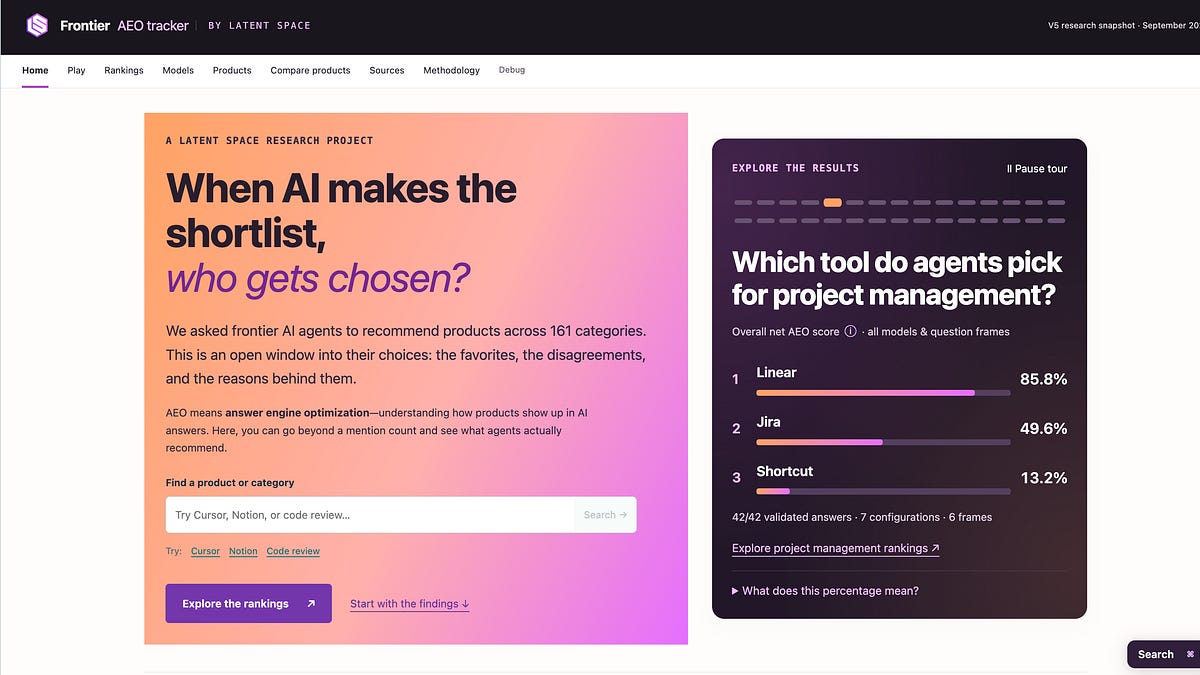
Latent Space’s new agent-engine-optimization tracker runs six prompt variants across seven frontier models in 161 recommendation categories, then scores first choices, alternatives, mentions, and anti-recommendations. The project makes every prompt-answer pair inspectable and also tracks cited sources and failure modes, while acknowledging bias: models often favor products associated with their own lab. It found 28 categories with a universally dominant primary choice, but many more close contests that could become AEO battlegrounds. Its comparison also says Fable searches more sources than Astra (median 15 versus five) and that Astra changes its mind less under light paraphrasing, a property that could make optimization more valuable while increasing the importance of what sources agents can access.
Read the source →You keep reopening the same decision at midnight because checking it costs a weekend you don't have. GPT-6 Astra is about to give you your weekends back.
This essay argues that the practical value of a more capable computer-using agent is not just faster completion of existing tasks, but making previously unaffordable investigations worth attempting. It frames choices such as moving, changing services, or testing a business idea as constrained by the time and coordination cost of researching alternatives. The author notes that Astra more than doubles its predecessor on business-workflow tasks but cautions that 41.4% completion is still not reliable enough to delegate uncritically. The recommended use is adversarial and exploratory: ask an agent to look for what would make its own recommendation wrong, not merely to build a case for the first option it finds.
Read the source →llm 0.35
llm 0.35 is presented as the current release of Simon Willison’s command-line LLM tool. The extracted post provides no release notes beyond identifying it as a way to access large language models from the command line. Readers who need behavioral changes or migration details will need the linked release material rather than this brief announcement.
Read the source →Creepy crawlies
Konstantin Ryabitsev reports that abusive crawlers have become a substantial operational burden on git.kernel.org. Across five geographically distributed nodes, 14 CPU cores are reportedly devoted solely to rendering commits as HTML for scrapers—more CPU than all legitimate access, including Git clones. Simon Willison connects the warning to Datasette and other systems that expose large numbers of crawlable pages. The operational takeaway is that indiscriminate bot access can overwhelm public infrastructure even when ordinary user demand is modest.
Read the source →Quoting Jakub Pachocki
OpenAI Chief Scientist Jakub Pachocki argues that faster development of highly capable models is needed partly to build defenses against AI-enabled threats. He names securing infrastructure, responding to rogue agents in real time, and inventing new protective measures as applications for powerful aligned systems. At the same time, he explicitly rejects using that defensive rationale to justify recklessness or racing forward at any cost. The quote captures the “defense through capability” case alongside a demand for restraint.
Read the source →Video compressor
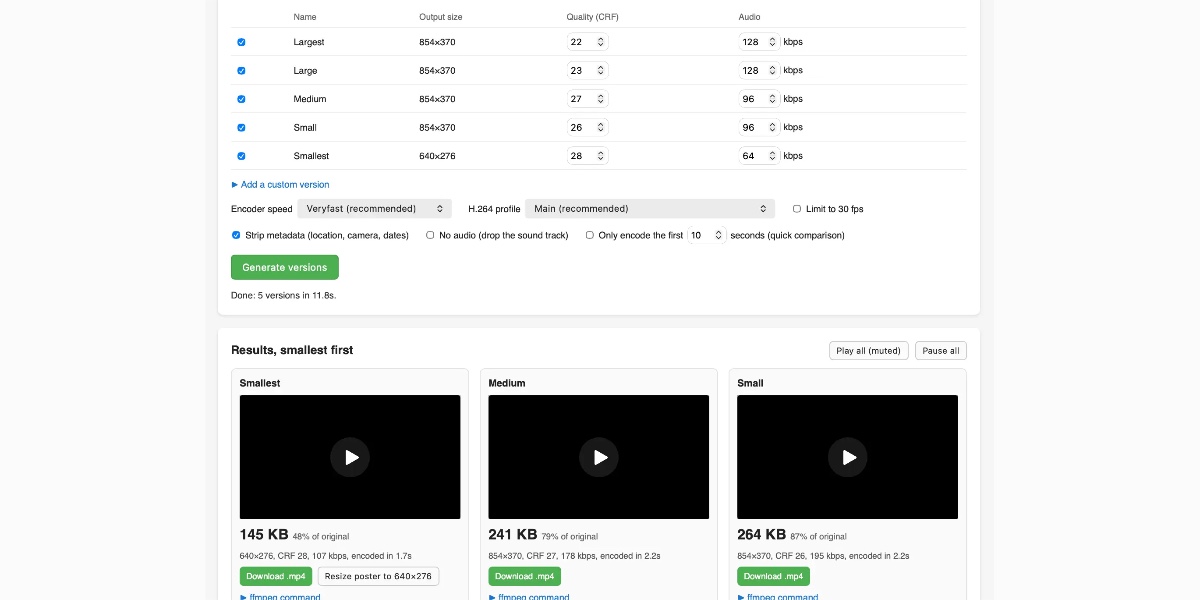
Simon Willison had Claude Fable 5.1, using Claude Code for web, build a browser-based tool to optimize a phone-recorded demo video. The tool uses WebAssembly FFmpeg, keeping the compression workflow in the web environment rather than requiring a conventional local FFmpeg setup. The post is a compact example of assigning a contained utility to an AI coding agent after the desired output is clear.
Read the source →Mercator ↔ Equal Earth
Simon Willison used GPT-6 Astra (medium) in ChatGPT Work to build a D3 animation transitioning between Mercator and Equal Earth map projections. The work followed his curiosity about Equal Earth after the projection was recently voted on at the UN. It is a small, concrete example of using an agent to turn a visual question into an interactive explanatory artifact.
Read the source →llm-openrouter 0.7.1
llm-openrouter 0.7.1 is a release of the LLM plugin for accessing models hosted by OpenRouter. The extracted announcement does not list feature or compatibility changes. It serves primarily as a pointer for users of the command-line LLM ecosystem who want the current OpenRouter integration.
Read the source →llm 0.34
llm 0.34 adds response-duration reporting to Markdown output from llm logs --usage, expressed both in milliseconds and as a human-readable duration. The short log format also gains a durationms field. The release includes contributed bug fixes and a significant performance improvement to llm logs. This gives command-line users better visibility into latency as well as usage.
Read the source →llm-anthropic 0.28
llm-anthropic 0.28 adds support for Claude Fable 5.1. For models that support them, reasoning traces now display by default. It also introduces llmanthropic.ClaudeRefusal, a dedicated exception for Claude refusals, enabling callers to distinguish refusals from other failures.
Read the source →The Sequence Knowledge - 928: The Missing 5%: Why Distillation Is Harder Than It Looks

The Sequence challenges the familiar distillation claim that a 7B-parameter student can retain 95% of a 70B teacher’s performance. Its argument is that the missing five percent may be concentrated in the capabilities that matter most under uncertainty: knowing when it is confused, recovering after tool failures, exercising safety judgment, and handling unfamiliar turns. A student can therefore match benchmark averages while failing at the “bridge” behaviors that let an agent navigate beyond familiar roads. The implication is that compression evaluations need to test failure recovery, calibration, and robustness—not only headline task scores.
Read the source →The Multiplayer AI Sprint: Build Your Team’s First Shared Agent
The AI Daily Brief argues that 2026 has made individual agents real enough that the next shift should be from “single-player” to team-oriented AI. It presents a free, self-directed program designed to help teams build a shared agent, following earlier learning programs that moved from broad AI skills into agentic work. The premise is that work is split between individual and collaborative tasks, while most current agent adoption has affected only the former. The intended result is an agent that serves a team’s shared workflows rather than merely a single user’s personal productivity.
Read the source →