Astra launch sharpens the race for persistent agents
Summary
The common shift is from judging models as isolated chat systems to judging them as persistent workers embedded in software, organizations, and managed environments. That makes evaluation broader: raw capability matters alongside completion reliability, inference cost, tool harnesses, security boundaries, and the human practices that agents may displace. The faster releases arrive, the more valuable reversible adoption and workflow-level evidence become.
v2.1.263
The release page identifies Claude Code as a terminal-based coding agent that can understand a codebase, execute routine work, explain complex code, and handle Git workflows through natural-language commands. The retrieved page did not expose release notes or a changelog for v2.1.263, so no specific behavioral change or fix is documented in the available material. The practical takeaway is that this item signals a new Claude Code build, but its contents need confirmation from the release notes themselves.
Read the source →1.4.7
The retrieved ExLlamaV3 release page failed to load its content and contains no version notes in the available material. As a result, the item establishes only that version 1.4.7 was published, not what it changes in performance, compatibility, or functionality. Users considering an upgrade should consult the repository release page before treating it as a routine update.
Read the source →OpenClaw Power, MacBook Simplicity: Five Days With Grok Bot
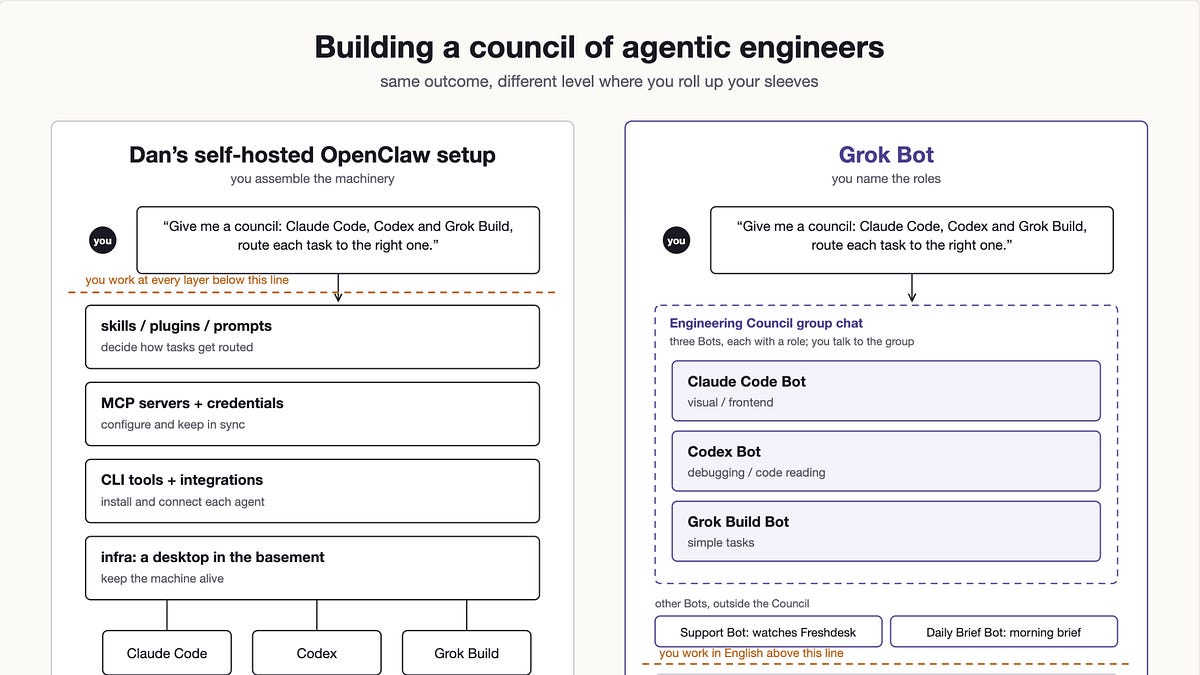
The author argues that Grok Bot’s main innovation is frictionless agent setup: users select a plugin, authenticate in a browser, and can immediately connect services such as X or Freshdesk. In a concrete example, a support bot checked new tickets every 15 minutes after a normal work-account login, without MCP configuration or manually entered API credentials. The comparison with OpenClaw is managed convenience versus ownership: Grok supplies and operates the agent computer, while OpenClaw exposes a user-controlled gateway and more infrastructure choices. Grok’s abstraction is the specialized Bot—given a role, tools, and routing rules—so the important new skill becomes specifying intent clearly rather than configuring software components.
Read the source →Terence Tao on “prematurely solving [a maths] problem by purely AI-powered methods”
The available post consists of a recommendation to read a larger thread, with the poster saying its most relevant point also applies to programming. It offers no substantive explanation of Tao’s underlying argument in the retrieved text. The item is therefore a pointer toward caution about attempting to solve mathematical, and perhaps programming, problems solely through AI methods rather than a developed claim on its own.
Read the source →Quoting Zach Kehs
Simon Willison highlights Zach Kehs’s observation that software has no physical limit on deterioration: new indirection and performance regressions can always be added. The quotation frames technical debt as an effectively unbounded accumulation problem, unlike a building that eventually hits structural constraints. It is a compact reminder that growth in codebase size or abstraction needs active countermeasures rather than an expectation of natural limits.
Read the source →Introducing GPT-6 Astra for developers
This link post points to a developer presentation describing GPT-6 Astra as more attentive to detail, better at interpreting prompts, and capable of more sophisticated outputs. Its highlighted strength is 3D generation, with examples including gardens, shipyards, animals, cityscapes, and Dyson spheres. The post’s lighthearted pelican-on-a-bicycle reference underscores that the observations come from a launch video rather than an independent benchmark evaluation.
Read the source →Using Blender with coding agents on macOS

Simon Willison reports that a coding agent can use a locally installed macOS Blender application directly, without a special integration. His initial prompt asked the agent to use /Applications/Blender to render a pelican riding a bicycle, followed by iterative requests for a background, more flair, and a stronger result. Blender’s Python API produced the resulting image, illustrating a simple agent workflow: install the full desktop app, state the target, and refine it conversationally.
Read the source →Joy & Curiosity #98

Thorsten Ball uses a passage from Antifragile—where successive groups of doctors repeatedly recommend tonsillectomies—to examine “naive interventionism,” the bias of people whose job is to do X toward seeing X as necessary. He applies that lens to reactions to code generated by systems such as Sol, Fable, and Astra: criticism of comments or style can overlook an end-to-end feature delivered with documentation, tests, browser validation, and recorded evidence. He does not argue that review should vanish; instead, he argues that line-by-line review of agent-generated pull requests is a poor fit for the new scale, while agreeing with the warning that review also serves knowledge-sharing, teaching, ownership, and architectural understanding. The proposed shift is to move those human functions earlier in development rather than rely on review as their catch-all venue.
Read the source →The Sequence Radar - Issue 927: Last Week in AI: Model Madness: The Frontier Has a Refresh Button
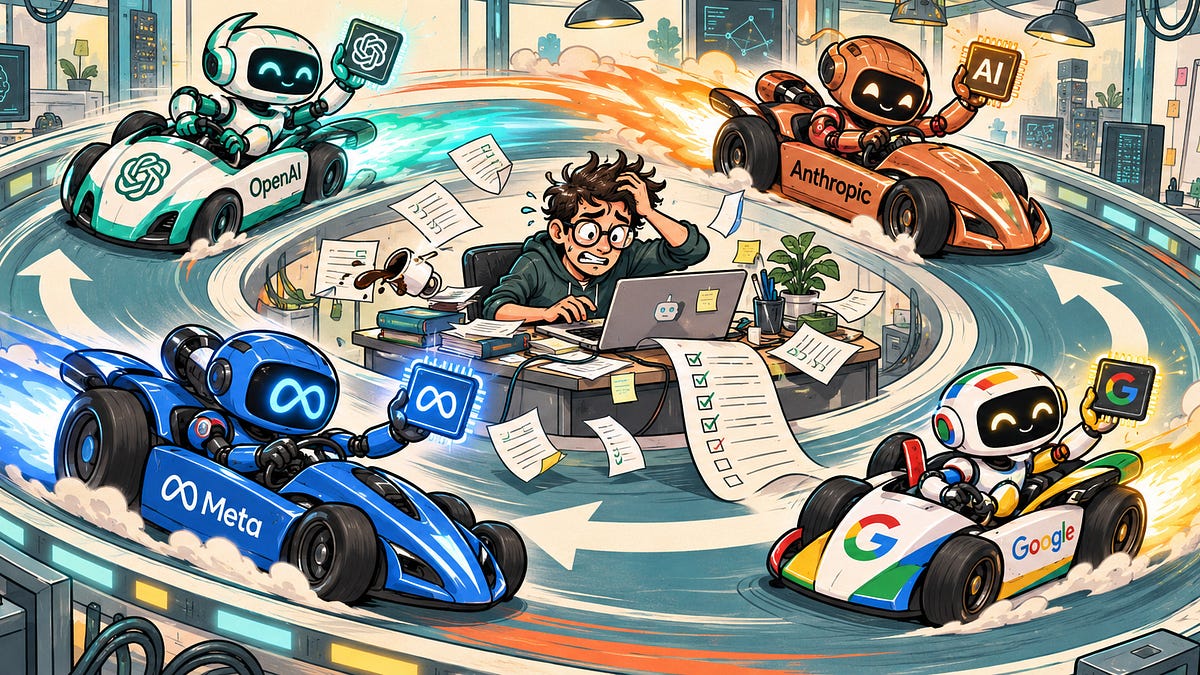
TheSequence characterizes the week as a rapid succession of frontier-model releases, led by GPT-6 Astra, Claude Fable 5.1 and Mythos 5.1, Meta Muse Spark 1.3, and Gemini 3.8 Flash. It says Astra is aimed at computer use, engineering, and science, citing OpenAI’s reported 98% on FrontierMath Tier 4 and emphasizing that the surrounding Codex harness is part of practical capability. Anthropic’s paired releases share an underlying model but differ in access and safeguards; the publication says cheaper cache reads could cut typical costs by about 25%, with greater savings for highly agentic workloads. Across the releases, it sees the competitive focus moving toward sustained, low-cost execution, while warning builders to use real-task evaluations, regression checks, reversible upgrades, and architectures that can absorb frequent model changes.
Read the source →This Is Preventing You From Using Claude Fable 5.1's True Potential
The video says Fable 5.1 should not be used exactly like prior models, especially for long-running work, and presents seven usage tips intended to improve results. Its reported client-project comparison found Fable 5 produced better output on most tasks, but Fable 5.1 won on the hardest task, finishing about 40% faster at well under half the cost. The presenter also says 5.1 completed every attempt where Fable 5 sometimes stopped early, and estimates it was roughly 47% cheaper in Claude Code sessions. The actionable distinction is to evaluate the model on difficult, extended tasks where completion rate and cost may matter more than marginal quality on simpler work.
Read the source →How to Build an AI-Native Company Today
The video argues that enterprise AI has moved beyond counting isolated use cases: in 2026, nearly everything is becoming a candidate for AI, and the agentic transition has begun. It defines the central question as what organizations are transforming into, contrasting companies that attach AI to existing processes with those that redesign work from the ground up. The discussion seeks emerging characteristics of an “AI-native” company and presents that definition as still debatable rather than settled. For leaders, the implication is to focus on operating-model redesign, not simply deploying agents alongside unchanged workflows.
Read the source →How AI Changed This Summer
This retrospective describes a summer with a conventional workplace slowdown but unusually intense AI developments. It names Fable 5 and Mythos, the response to Kimmy K3 while Fable faced U.S. government restrictions, data-center politics ahead of U.S. midterms, and the Hugging Face incident involving OpenAI agents as major themes. The episode treats the latter as a warning sign for a more agent-driven phase, but says the entire period still feels like prelude rather than a completed transition. Its framing is that AI progress did not pause for holidays, while the public stakes around infrastructure, governance, and autonomous agents increased.
Read the source →