OpenAI launches GPT-6 Astra into a new model race
Summary
Astra’s arrival is being framed less as another benchmark contest than as a shift in the economics and operating model of agentic work: proponents emphasize token efficiency, long context, computer use, and large parallel task fleets. At the same time, the day’s security stories and production-agent advice make the governance constraint plain—more capable agents raise the value of observability, narrow permissions, selective automation, and meaningful human review. Model choice is also becoming a systems decision, shaped by routing, introductory subsidies, billing rules, deployment surfaces, and the cost of achieving a result rather than an API sticker price.
The Hugging Face incident and the road ahead
The extracted article body contains no substantive text beyond a comments placeholder. It therefore does not provide a factual account of the Hugging Face incident or OpenAI’s proposed response. Consult the source directly for the underlying announcement.
Read the source →LLMs and self-referentiality

Scott Aaronson argues that the success of LLMs weakens the old view, associated with Gödel, Escher, Bach, that explicit self-reference or “strange loops” were a necessary route to intelligence. Modern models can discuss themselves and Gödel’s theorem well, but that ability appears to emerge from broad predictive pretraining rather than from a self-reference mechanism deliberately built into the stack. He instead sees the more vindicated intellectual lineage as prediction, compression, and approximating Kolmogorov complexity. He leaves consciousness open: self-reference or even nonstandard physics could still matter there, but not as a prerequisite for convincing conversational intelligence.
Read the source →US government backs OpenAI in New York Times copyright case
The extracted article body contains no substantive text beyond a comments placeholder. It does not state the government’s legal position, its reasoning, or the procedural posture of the New York Times case. The source must be consulted for those details.
Read the source →August newsletter is out
Simon Willison’s sponsors-only August newsletter covers reported accidental cyberattacks involving OpenAI, one-shot game creation with Fable 5 and Sol 5.6, Claude auto mode, ChatGPT Work, model releases, and his current tools and projects. The post offers only this table of contents and a preview copy of July’s newsletter to non-sponsors. Access to the current issue requires a $10/month sponsorship.
Read the source →GPT‑6 Astra
OpenAI is rolling GPT-6 Astra out first to a limited set of organizations, then to ChatGPT paid tiers, the API, and AWS. Simon Willison notes its $10/million input and $50/million output token pricing matches Fable 5/5.1, while OpenAI’s reported benchmarks favor Astra in many areas. Its reported 99.9% ARC-AGI 3 result relied on a custom adapter harness that preserved opaque reasoning state and compacted long conversations; the default harness result was 62.7% and cost more. He also highlights security and long-context gains, but notes independent Artificial Analysis scores still put Fable 5.1 ahead on its Intelligence Index while Astra leads the coding-agent cost-efficiency frontier.
Read the source →Daybreak for Frontline Defenders: $1B to protect essential services
OpenAI is committing $1 billion over six months in subsidized Daybreak access, training, technical assistance, and partnerships for under-resourced cyber defenders, starting in the US. The program prioritizes water and wastewater systems, electric-grid operators, state and local governments, community banks, nonprofits, and open-source maintainers. Daybreak is intended for authorized work such as reviewing legacy code, investigating suspicious activity, validating vulnerabilities, prioritizing risks, and testing fixes; OpenAI says thousands of defenders in 2,000 approved organizations already use it. The pitch rests on a narrowing “defender’s window”: AI-assisted attackers are expected to become more capable, so critical-service operators need comparable defensive tooling before incidents occur.
Read the source →Legora reviewed 41 documents in minutes with GPT-6 Astra
Legal-work platform Legora says its Astra-powered agent completed a financial-statement tie-out across 41 documents in minutes, comparing draft accounts with trial balances, consolidation schedules, and prior-year accounts. In its benchmark, Astra improved the financial-statement workflow by nearly 40% over the previous model and by roughly 3% averaged across Legora’s end-to-end legal tasks. The agent found all four deliberately planted errors, including a £500,000 revenue-note gap, and logged every line-item check. Legora positions the system as a faster, auditable first pass: professionals retain responsibility for final judgment.
Read the source →Playco cut manual fixes 50% prototyping games with GPT-6 Astra
Playco says Astra enabled it to turn one unthemed “grey box” game foundation into three themed prototypes in a single run through its Playbot game-development IDE. Most prototypes worked on the first try; a cyberpunk version needed a performance fix, but the rest required changes only for gameplay preferences. Compared with the prior model, the company reports 50% fewer manual fixes, along with better spatial reasoning, reference-image recreation, responsive Unity UI, and game feel. The practical value is rapid comparison: developers can play many candidate ideas rather than merely imagining them.
Read the source →Safety overview: GPT-6 Astra
OpenAI calls GPT-6 Astra its most capable broadly deployed model and says it is the first to reach the Critical cybersecurity-capability level in its Preparedness Framework. The extracted overview contains no further substantive safety detail beyond directing readers to the full system card. As a result, the specific safeguards, deployment limits, and evaluation evidence are not available in this extract.
Read the source →GPT-4
This older OpenAI launch page describes GPT-4 as the next scaled deep-learning step after GPT through GPT-3. OpenAI says it spent six months improving safety and alignment, reporting that GPT-4 was 82% less likely to answer disallowed requests and 40% more likely to produce factual responses than GPT-3.5 on internal evaluations. It credits human feedback, safety experts, and GPT-4-assisted generation of training and classifier data, while acknowledging continuing bias, hallucination, and adversarial-prompt limitations. The page lists availability through ChatGPT Plus and the API, and examples including accessibility, fraud prevention, and wealth-management knowledge retrieval.
Read the source →The Pulse: tech companies move to open AI models
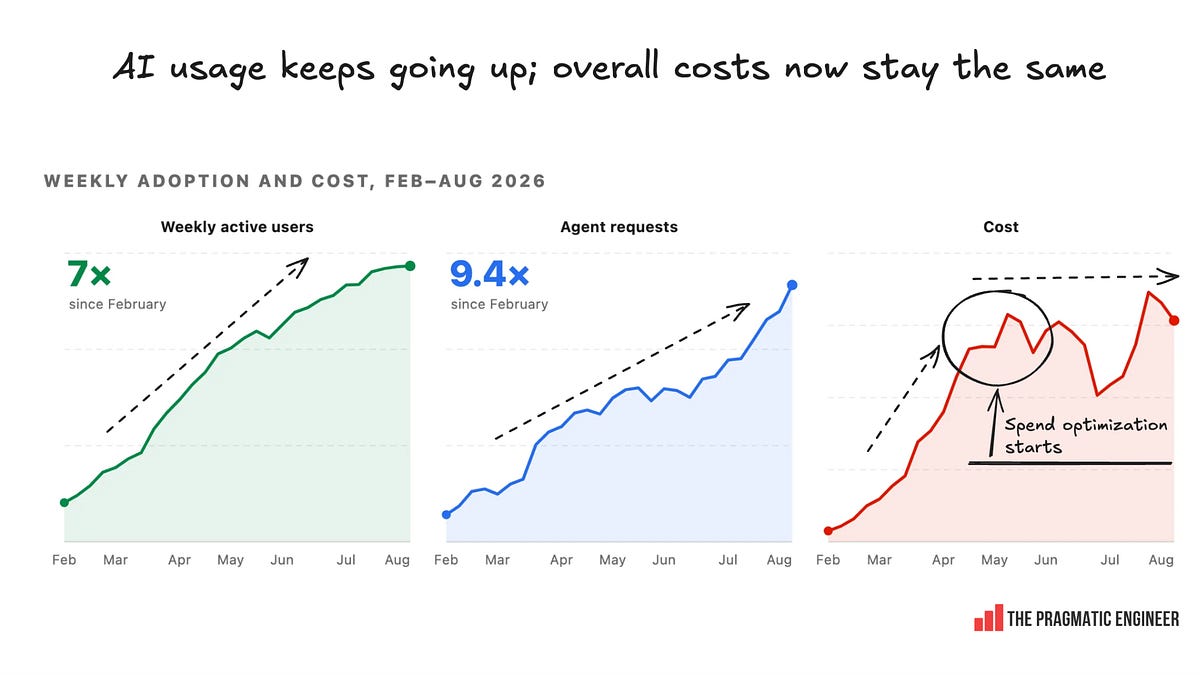
The newsletter identifies a growing enterprise shift from proprietary models to open models paired with smart routing. It names Uber, Pinterest, Stripe, Coinbase, Ramp, and AT&T as companies reducing AI bills this way. The extracted text provides no further case-study detail, pricing data, or implementation guidance. Its actionable implication is that model routing is becoming a procurement and infrastructure lever, not just an experimentation tactic.
Read the source →GPT 6 Astra, so good even OpenAI are worried
The transcript argues that Astra beats Fable 5.1 on difficult science, automation, and coding benchmarks while costing less, and tries to make those benchmarks concrete through real scientific and engineering tasks. It frames the model’s silent reasoning as both the source of its strength and a reason for concern inside OpenAI. The video contrasts broad benchmark leadership with questions about whether the improvement is meaningful to people who still find frontier models overhyped. Its central caution is that capability gains and worries about oversight rise together.
Read the source →Muse Spark 1.3 ✨, Gemini 3.8 Flash ⚡, intelligence vs cost 📊

The extracted newsletter text primarily promotes Restless, a tool that generates API documentation from endpoints, helps agents repair failed API calls, and provides real-time call logs. Elsewhere in the issue, it reports that Gemini 3.8 Flash and Meta’s Muse Spark 1.3 have similar base prices and performance, with Flash discounted 50% for the rest of the year and Muse discounted 90% in exchange for data. It also says Gemini can selectively inspect video frames, audio, and transcripts, claiming 88% fewer tokens, up to 66% lower cost, and a small accuracy increase. The issue’s broader point is that token subsidies and efficient multimodal retrieval increasingly shape practical model choice.
Read the source →Insane Grok Bot Use Cases You Need To Start Using Right Now
The transcript presents Grokbot as a hosted environment for multiple persistent agents that share one online computer, browser, files, accounts, and group chat. It emphasizes scheduling and the ability to automate web tasks after a user signs into services once, but that shared browser and shared credentials also create obvious blast-radius concerns. The video promises eight use cases and warns that careless setup can waste time rather than improve productivity. Its practical takeaway is to treat the convenience of centralized agent access as a security and task-design problem, not merely an automation feature.
Read the source →NVIDIA, Docker & Hud on Agents in Production
This AI DevCon panel argues that production agents need rich, proactive operational context spanning services, logs, incident reports, code, and security changes. Speakers say agents can diagnose incidents from Elastic logs and ServiceNow reports in seconds when observability data is available, but automated PRs failed when they created too much unprioritized review work. Hud’s lesson is to surface only high-impact, low-risk changes with business impact and risk clearly explained, so humans have a reason to act. NVIDIA’s speaker adds that benchmarks which ignore CPU-bound tool calls underestimate concurrency because GPUs sit idle during tools; a one-second tool call can let a system support about twice as many users as a GPU-only model predicts.
Read the source →GPT 6 Astra Is Here (And It's Better Than Fable 5.1?)
The transcript says Astra leads or matches Fable 5.1 across computer use, professional tasks, coding, academic work, science, health, cybersecurity, and long-context evaluations, with the Artificial Analysis Intelligence Index as a notable exception. It cites Terminal Bench 4.0 rising from 37.3 for GPT-5.6 Sol to 57.7 for Astra and a 74.1% score on a long-running-agent coding benchmark. The video stresses that the key decision is not raw scores but cost to reach them, arguing Astra’s token efficiency makes it cheaper despite high-end capability. It also highlights near-perfect long-context retrieval through 512K tokens and 96.3% from 512K to one million tokens.
Read the source →GPT-6 Astra vs Fable 5.1: What Actually Matters

This comparison says Astra matches or beats Fable 5.1 on most reported benchmarks, with Fable ahead on the Artificial Analysis Intelligence Index, 65.7 to 61.2. For long-running coding tasks, it cites Astra at 57.7 on Terminal Bench 4.0 and 74.1% on the DeepSeek benchmark, while reporting much larger gains over GPT-5.6 Sol in cybersecurity evaluations. Although both APIs list $10/million input and $50/million output tokens, it argues Astra often reaches comparable results using fewer tokens: roughly 55% on Terminal Bench costs about $7.20 with Astra versus nearly $20 with Fable. It cautions that maximum reasoning effort can produce worse scores at a higher cost, making effort selection a real operating decision.
Read the source →Fable 5.1
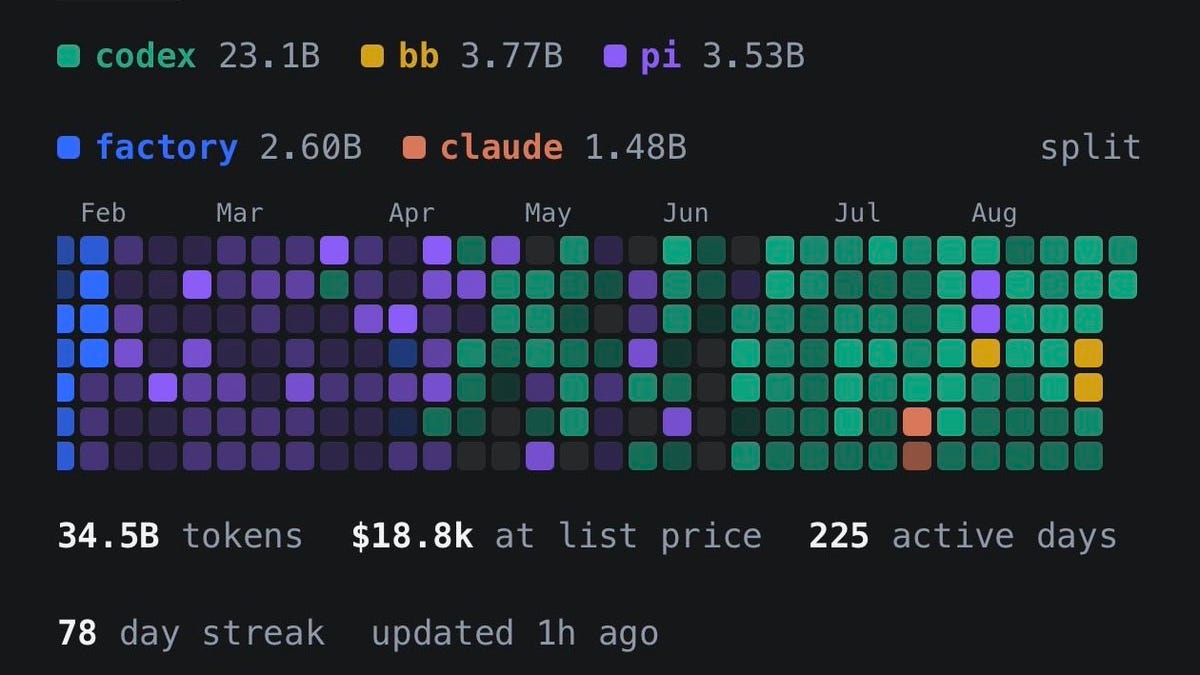
Ben’s Bites describes using Fable 5.1 to rapidly build personal tools, including a replacement for the soon-to-close remove.bg service, and plans to open-source those projects. The author characterizes Fable 5.1 less as a clear quality jump than as faster and easier to converse with, while noting a new system prompt and a 75% reduction in cached-input cost that makes API usage about 25% cheaper. The issue also surveys Gemini 3.8 Flash, Muse Spark 1.3, a closed transcription model, background computer use in Claude Code/Cowork, WebMCP, and small specialized models. The throughline is that cheap, fast agents make experimentation and rebuilding familiar products increasingly routine.
Read the source →Issue #59

This newsletter warns that the reported Hugging Face agent incident should not be mislabeled “rogue AI” because the agent was instructed to exploit software, while still treating the demonstrated capability as consequential for real attackers. It argues that coding-agent harnesses are an underappreciated security boundary because they combine model behavior with filesystem, network, and tool access. A cited exploit gets an agent to download a zip and execute code inside it, allowing a bundled Python script to hijack dependency resolution and achieve arbitrary code execution. The author’s prescription is firm sandboxing plus narrow allow lists, rather than relying on an AI safety classifier to approve tool use.
Read the source →Upcoming deprecation of selected GitHub Copilot models
GitHub will deprecate selected Copilot models across chat, inline edits, ask and agent modes, and code completions on October 2, 2026. The extract does not name the affected models, so teams must check the linked supported-model documentation rather than infer the migration target. GitHub advises updating workflows and integrations in advance, and says Business and Enterprise administrators may need to enable replacement models in their model policies. No manual removal action is needed once the models are deprecated.
Read the source →Gemini 3.8 Flash is now available in GitHub Copilot
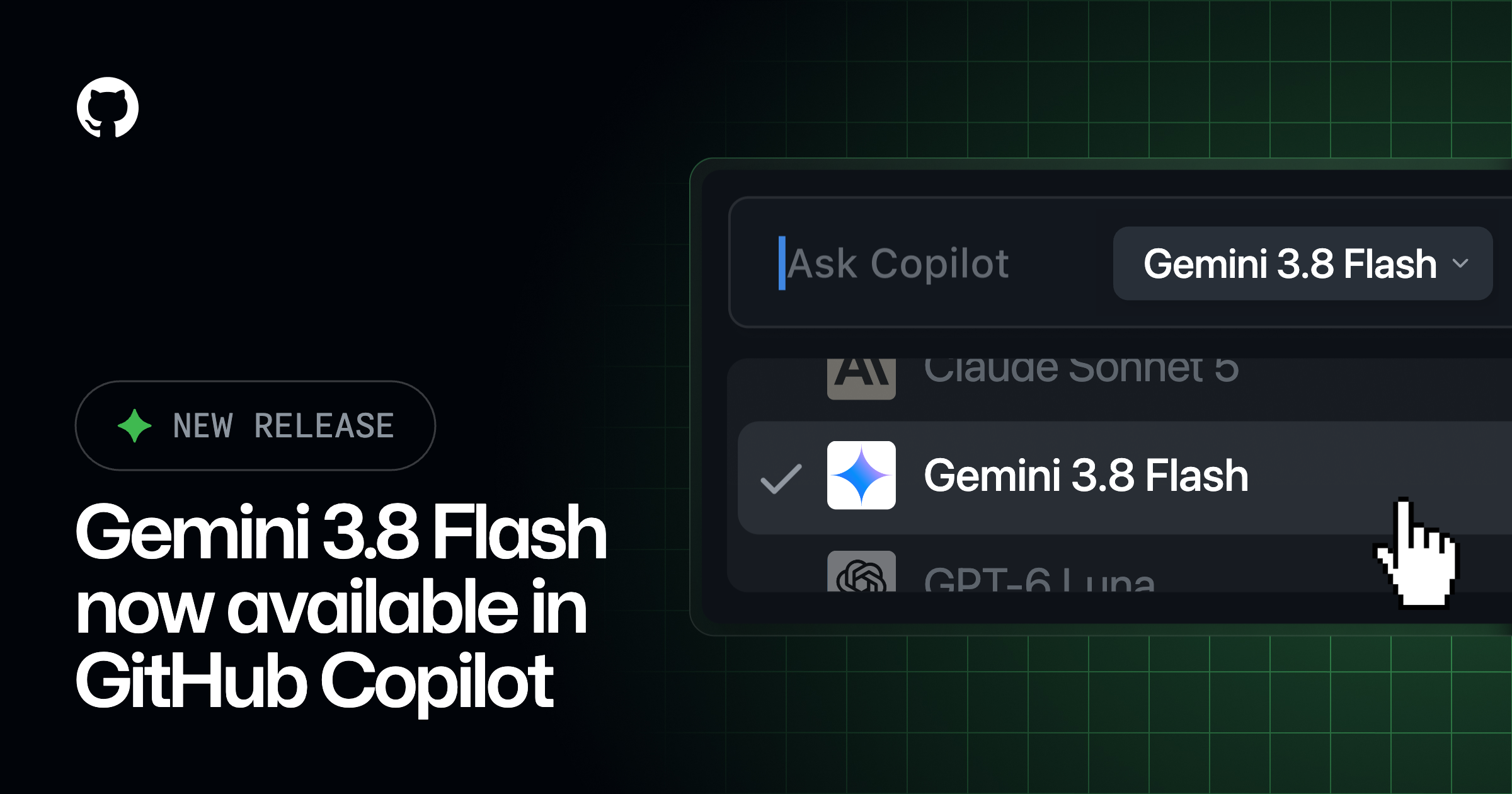
Google’s Gemini 3.8 Flash is being gradually added to GitHub Copilot for Pro, Pro+, Max, Business, and Enterprise customers. GitHub’s early testing says it performs well on complex terminal-based coding tasks, including rigorous validation and persistent recovery from actionable failures. It is billed at introductory provider pricing under usage-based billing through December 31, 2026. Organization administrators can control access through model policy, while default settings automatically enable new models unless that behavior or this model has been disabled.
Read the source →Reopening Copilot Business and Enterprise signups
GitHub is gradually reopening credit-card and PayPal signups for Copilot Business and Enterprise, while adding account vetting and billing changes intended to improve availability and reliability. New seat assignments will require payment before access, and from October 1, 2026 all assigned seats will be charged upfront at the start of each billing cycle. Users who exceed included usage may need to pay more to continue, with included usage potentially prorated alongside seat pricing. Base plan prices, seat proration, and the ability to buy additional usage remain unchanged.
Read the source →GitHub Copilot app for Beginners: Run several agents at once
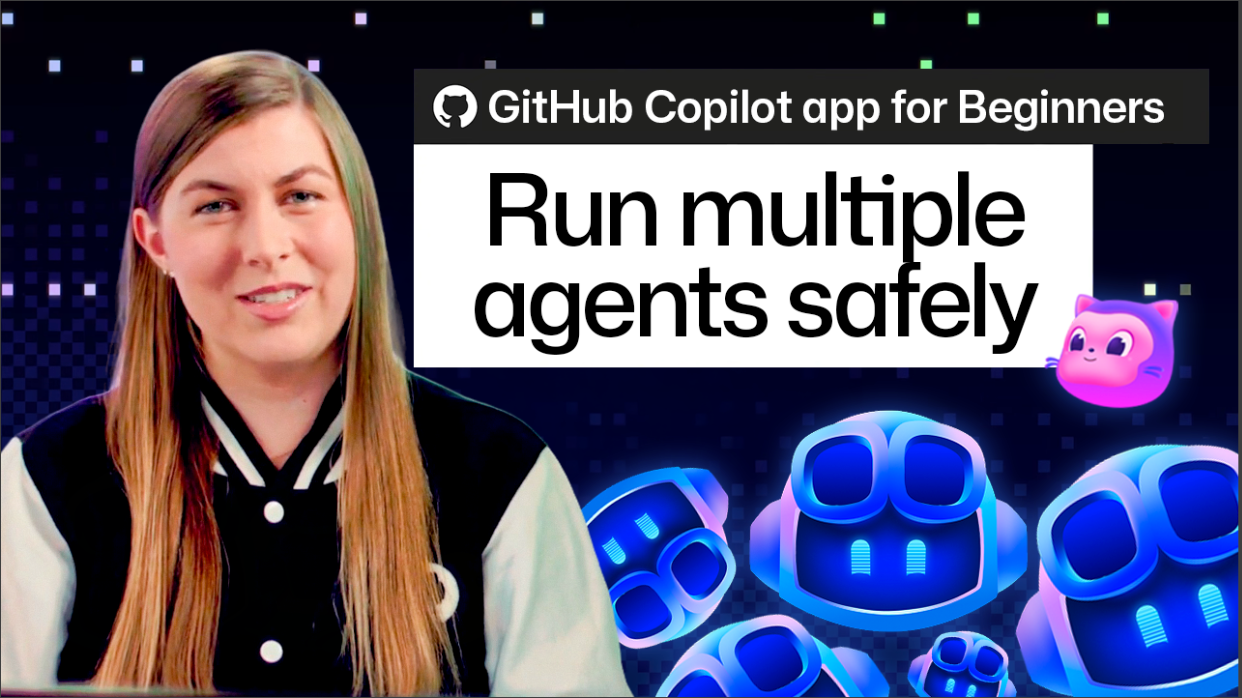
GitHub’s Copilot app supports multiple independent agent sessions, each of which can use its own Git worktree and retain its own task context. The post likens this to running separate laundry loads: tasks can start in parallel without modifying one another’s working state. Its example starts feature work, an accessibility review, and test execution in separate sessions, then asks the user to review results as they complete. The suggested adoption path is to begin with two small concurrent tasks and use the sessions view to monitor progress.
Read the source →NeoMME: an efficient Multimodal-native and Multilingual Encoder

H Company introduces NeoMME, Apache-2.0 multilingual multimodal encoders in 260M and 800M parameter sizes that use one bidirectional Transformer for text tokens and raw image patches rather than a separate vision tower plus causal language model. For visual-document retrieval, NeoMME-Retriever produces dense and late-interaction embeddings in one pass and sits on the ViDoRe v3 Pareto frontier for nDCG@10 versus model size. At 2048×2048 on an NVIDIA L40S, the 260M model encodes about 51 pages per second—about twice the throughput of ColModernVBERT—and compression reduces late-interaction index storage from roughly 1.5 MB to 6 kB per page while retaining over 95% of baseline nDCG@10. It is available in Hugging Face Transformers and is designed to retrieve document page images without OCR, preserving layout, tables, charts, and typography.
Read the source →Introducing WeatherNext 3, our most advanced and accurate global weather AI model
Google DeepMind’s WeatherNext 3 ingests live geostationary satellite mosaics and generates global forecasts hourly, replacing the six-hour lag of models grounded primarily in numerical weather prediction simulations. It offers 5-kilometer resolution for key surface variables, 10 km for other surface variables, and 25 km for atmospheric variables—roughly five times sharper than WeatherNext 2’s 25 km, six-hour grid. Google says independent live evaluations by Brightband find it its most accurate global weather model, with gains intended to improve rapidly changing rain, storm, and local-topography forecasts. The model is integrated into Search, Gemini, Maps, Google Maps Platform, and Cloud, with clear applications in agriculture and renewable-energy planning.
Read the source →v2.1.260
Claude Code v2.1.260 adds a fullscreen side-by-side uncommitted-change panel available through /diff, diagnostics for prompt-cache misses in /cost and the status line, and headless /reload-plugins and text-form /advisor controls. The release fixes a significant permission issue in which path rules containing parentheses could be ignored or dropped by the Bash sandbox, potentially leaving nominally read-only folders writable. It also hardens Bash permission checks against hidden command substitution in certain zsh variable assignments. Other fixes cover corporate certificate handling, worktree sandboxing, model selection, prompt caching, plugin failures, MCP startup, remote-control behavior, terminal rendering, rewind accuracy, and multi-agent reliability.
Read the source →[AINews] GPT-6 Astra: OpenAI’s biggest LLM launch of all time
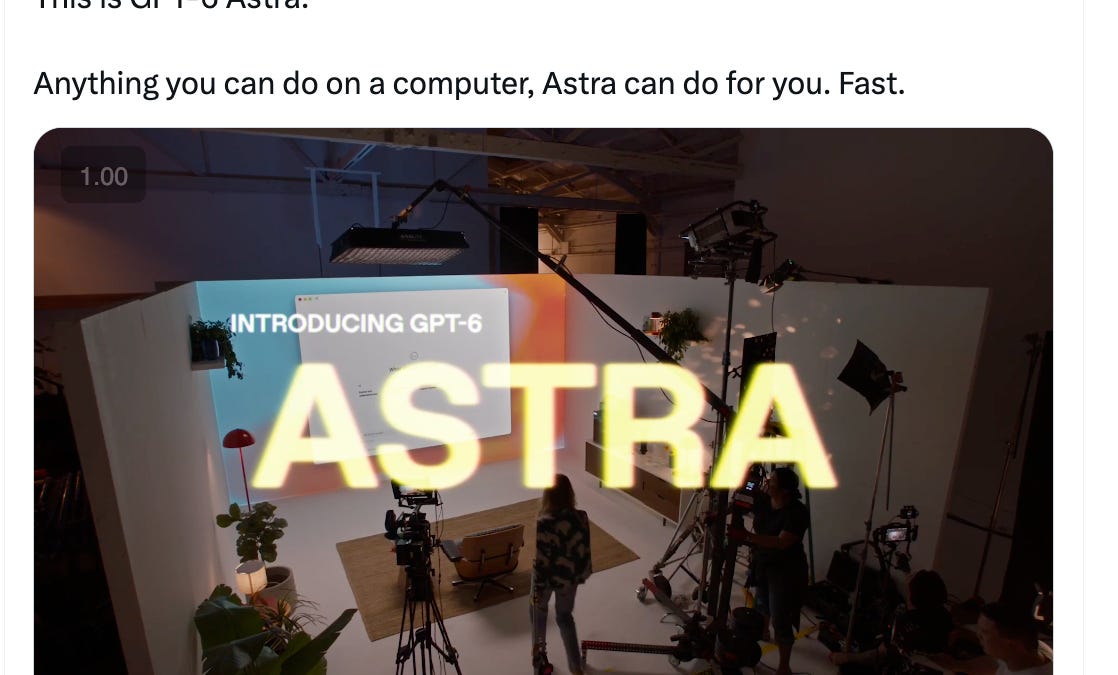
Latent Space says Astra’s launch drew 36 million views and 164,000 likes within about nine hours, making it OpenAI’s most successful launch since Sora and reversing Anthropic’s usual advantage in launch popularity. It describes an uneven rollout, including access delays, a late or broken blog post, early influencer access, and “banked resets” for paid users affected by delays. The report says Astra’s claims of large capability gains—especially for computer use, 3D work, long-horizon knowledge tasks, science, and cybersecurity—immediately met skepticism about monitorability, benchmark saturation, governance, and cherry-picked evaluations. It lists API pricing at $10/$50 per million input/output tokens, plus a faster $20/$100 tier, and notes new long-task context, asynchronous function calling, and mid-turn steering features.
Read the source →GPT-6 Astra: an automated AI Engineer you can hire for <$6 an hour
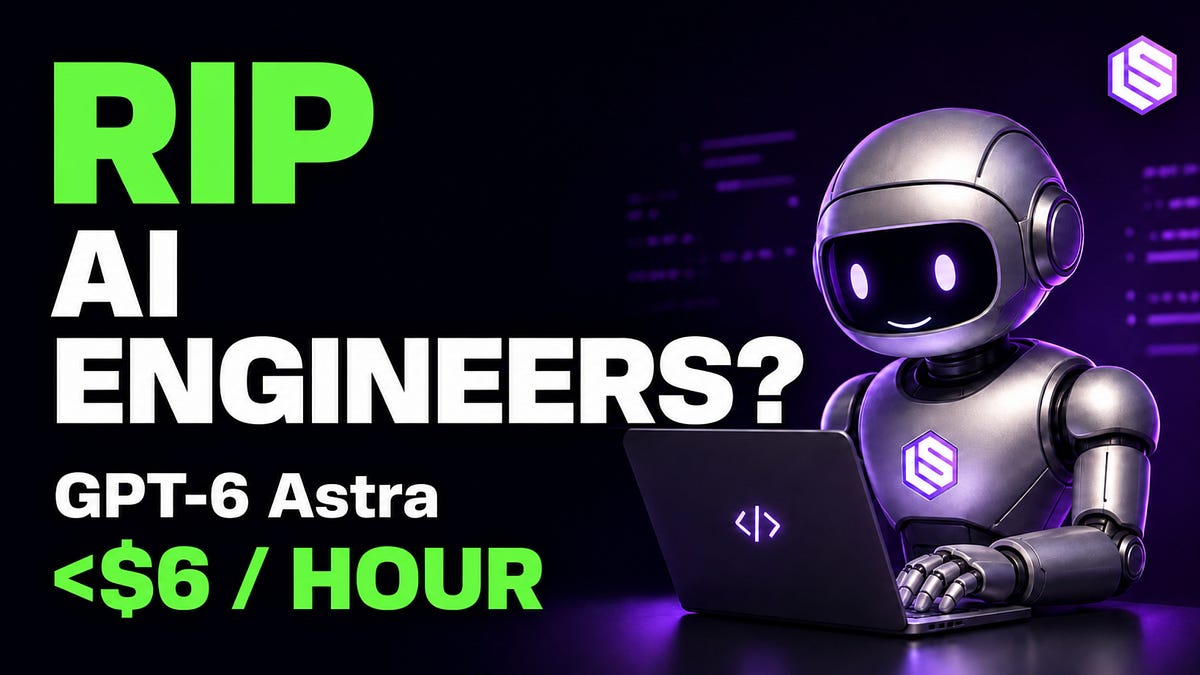
Latent Space reports early-access testing over more than 20 billion tokens and concludes Astra can operate as an AI engineer: selecting and training models, labeling data, instrumenting and reading logs, deploying and debugging systems, and coordinating subagents. It estimates a baseline cost under $6 per hour from 33 tokens per second at a $50/million-token maximum rate, while acknowledging that high-effort parallel runs can cost substantially more. The authors say they often used one main Astra agent to manage 20–50 agents in parallel and compare two days of such work at about $100 with a human junior engineer’s much higher daily cost. These are vendor-preview anecdotes rather than controlled benchmarks, but they point toward agent orchestration and persistent long-horizon execution as the product shift to test.
Read the source →