Gemini 3.8 Flash brings cheap cyber agents to defenders
Summary
Today’s releases and practitioner accounts converge on the same unit of competition: not the standalone model, but the harness around it—execution environment, context, security controls, memory, verification, and routing. Cheaper high-capability models are widening autonomy, while the response from enterprises is to constrain where agents run, what they can read, and who can use specialized capabilities. That makes portability and end-to-end outcome measurement more strategic than attachment to any single model or token metric.
GitHub Next & Tessl on the Self-Merging Repo
The video argues that AI-native development is moving from individual copilot productivity toward “continuous AI”: persistent processes that improve code, documentation, and organizational context. One five-person team reports agents opening, reviewing, repairing, and auto-merging PRs behind five CI gates, shipping 217 of 295 issues in 30 days for roughly $3,000 per month. Their central operating rule is to fix the system that produced an agent failure—specs, tests, observability, or context—instead of manually fixing the code and repeating the failure. Human acceptance testing remains the release gate, with tests explicitly treated as the source of truth.
Read the source →AI Software Factories Are the Next Big Thing (And I'm Building You One)
The video defines an AI software factory as a system that turns a product requirements document into planned tasks, code, reviewed pull requests, merges, and production deployments without a human inspecting every line. It argues that improving models, harnesses, and larger workflows together have made this practical at least for prototypes and scoped organizational work. The presenter says companies are already deploying versions of the pattern and plans to build an open-source factory that others can download. The important caveat is implicit in the framing: reliability must come from the whole workflow, not a single autonomous coding prompt.
Read the source →Fable 5.1 Watermarks EVERYTHING, Here's How To Remove It
The video says Anthropic’s Fable 5.1 applies a statistical text watermark to every output as part of compliance with an EU AI Act code. Rather than embedding a hidden string, the system biases otherwise plausible word choices, producing a pattern that can be recognized only by someone with the secret detection key. Small edits do not reliably erase a distributional signal; a substantial rewrite is required. It presents rewriting through a local or non-participating model as the practical way to remove the signal.
Read the source →Strange Geometric Shapes Found Inside AIs — Tom McGrath
This interview frames mechanistic interpretability as a computer-native natural science: researchers can run experiments directly on model internals rather than merely infer behavior from outputs. McGrath argues that AI agents could sharply accelerate both empirical measurement and theory-building in the field. The safety analogy is a bus moving fast with a fogged windshield: interpretability could make future model behavior more visible and steerable before capability advances outrun oversight. The discussion is optimistic because current research traction and automated experimentation may compound each other.
Read the source →The Robotics Breakthrough Everyone Has Been Waiting For
The video explains why in-context learning in robotics would be a landmark comparable to language models generalizing from examples in a prompt. Physical tasks are harder because robots must continuously handle vision, positions, force, contact, motion, and changing consequences rather than discrete tokens. Small environmental variations—such as a shifted object or a slipping grasp—mean identical attempts can unfold differently, and the required data is much larger. The claimed breakthrough is therefore the prospect of generalizing from context despite that messy, embodied setting.
Read the source →OpenAI, NVIDIA And Anthropic Just Split. Here's How I'd Spend $20, $60 Or $200.
The video interprets OpenAI’s Habanero inference chip, its decision to stop supplying future models to Cursor after SpaceX acquired it, and Nvidia’s response as signs of three strategic camps. OpenAI is characterized as vertically integrating around its own system, Nvidia as selling infrastructure to every camp, and Anthropic as preserving supplier flexibility amid compute constraints. Its consumer advice is to avoid letting a single provider hold the only copy of one’s files, instructions, and accumulated working memory. Subscription budgets should therefore be paired with portable project context rather than treated as a bet on one model vendor.
Read the source →Why Fable 5.1 Is Worth the Upgrade
The video says Anthropic’s Fable 5.1 and Mythos 5.1 lead current benchmarks and may make long-running agentic work 25–40% cheaper than Fable 5, though users report uneven realized savings and restrictive usage limits. It argues that “should I switch?” is now the wrong buying question. Users should instead decide where a model fits in a broader model stack and what its tradeoffs are. The framing favors task-based routing over wholesale allegiance to a newly released flagship.
Read the source →OpenClaw 2.0 Shows Where AI Agents Are Going Next
The video argues that OpenClaw’s lasting contribution was demonstrating what practical agents could do, even before the original product became easy to use. It presents OpenClaw 2.0 as a move toward shared, multiplayer agents rather than isolated one-user chats. It also highlights a policy tension exposed by cyber incidents: safeguards that block attackers can prevent legitimate defenders from using closed models for needed security work. The episode points to more permissive, specialized cyber models as one response to that gap.
Read the source →Fable 5.1 Watermarks: How AI Text Watermarking Actually Works
Fable 5.1’s watermark is described as a statistical bias in word selection, not invisible text or metadata embedded in the output. A secret key lets an authorized detector assess whether enough biased token choices appear across a passage; public “watermark detector” sites cannot perform that test. The article says the feature applies to models released after August 2, 2026 and is Anthropic’s response to an EU AI Act code, while code and fixed facts should not be altered. To remove the pattern, it recommends a substantial rewrite using a local open-source model or another non-watermarked option, not minor edits or another participating frontier model.
Read the source →Self-hosted machines
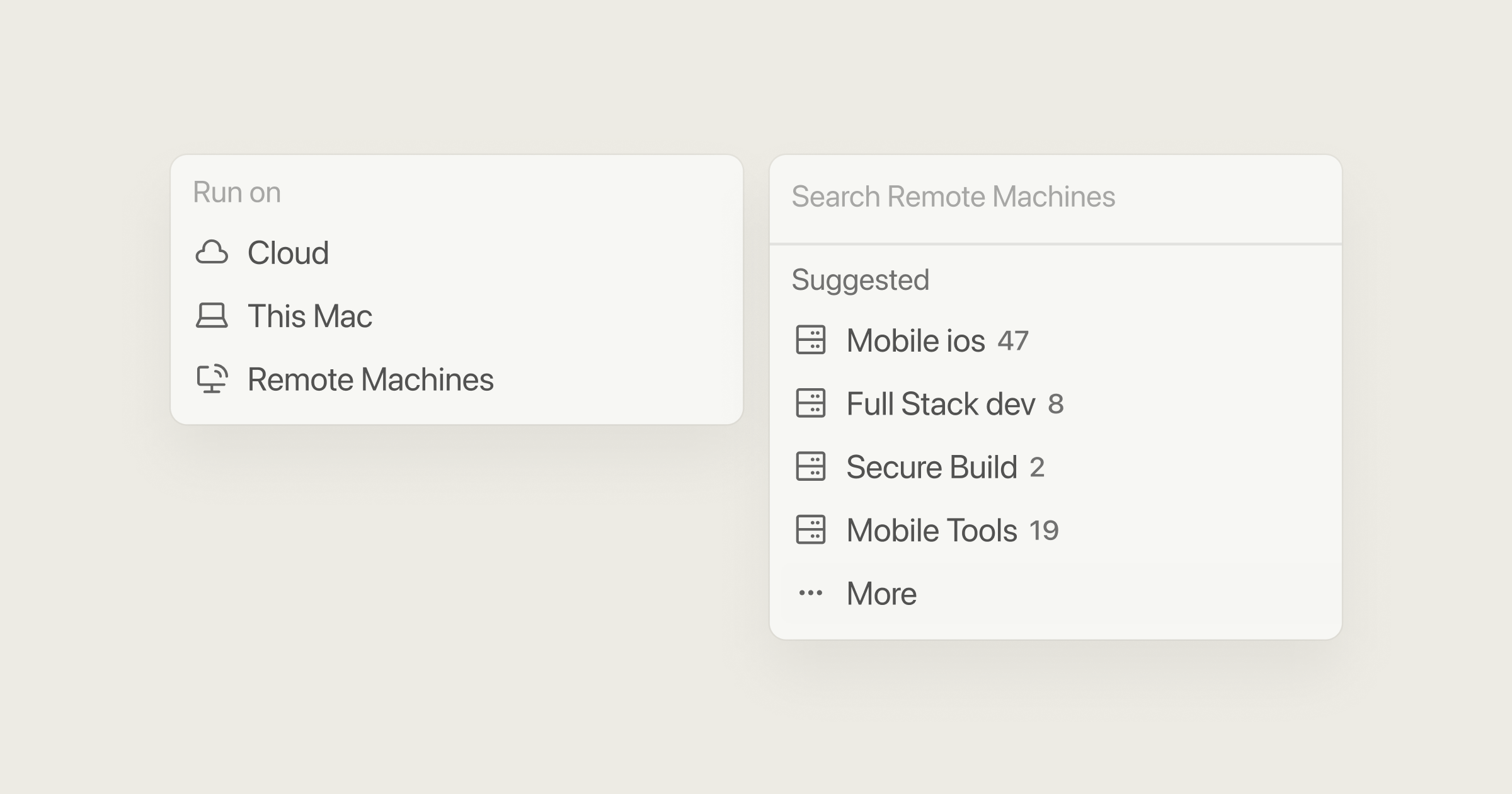
Cursor now supports self-hosted execution machines, keeping codebases, build outputs, and secrets inside an organization’s own network while agents execute tools there. Individuals can connect a laptop or VM; teams can operate named worker pools that expand with requests, shrink when workers disconnect, and are not bound to a single repository. Idle workers can hibernate and reconnect for follow-up work, reducing always-on capacity costs. Linux and Mac workers also support computer use, including screenshots, mouse and keyboard control, and browser operation.
Read the source →Enterprise-managed settings support any default model
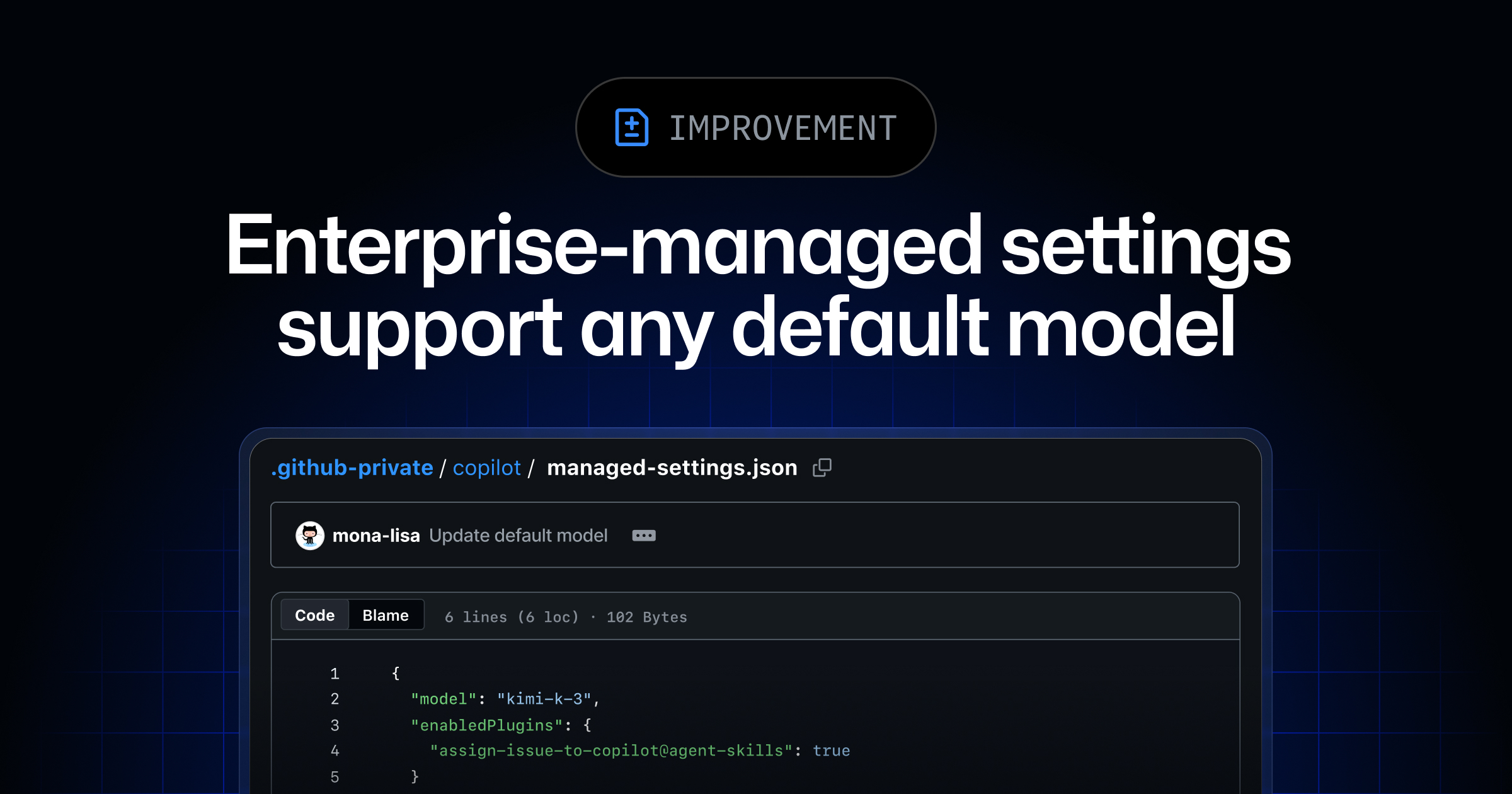
GitHub Copilot enterprise administrators can now set any supported model as the default for new conversations. Defaults can vary by enterprise team through team mappings, while other users inherit the organization-wide setting. The capability is generally available across the Copilot app, CLI, and VS Code for Copilot Business and Enterprise. This makes model selection an administrable deployment policy rather than a purely individual preference.
Read the source →Content exclusions generally available in Copilot app and CLI
GitHub Copilot’s app and CLI now honor enterprise, organization, and repository content-exclusion policies. Files covered by those policies are not used as agent context, intended to keep sensitive code out of AI-assisted workflows. The feature is generally available to Copilot Business and Enterprise customers. It extends an existing governance control to interactive and command-line agent surfaces.
Read the source →Decoding the new AI lingo: Loops, harnesses, squads, hill climbing… oh my!

GitHub’s glossary separates useful workflow ideas from fashionable terminology. Loop engineering means scheduled, repeatable agent systems with validation, routing, checkpoints, and escalation; a Ralph loop is the more brute-force plan-act-check variant that can become costly. Squads assign distinct roles to agents, fleets run work in parallel, and a harness is the surrounding tools, permissions, memory, context, and orchestration that makes a model operational. “Hill climbing” is the iterative improvement of that system with feedback and evaluations, shifting attention from prompts to measurable workflow design.
Read the source →How we make AI coding more cost efficient without sacrificing task quality

GitHub argues that token count per tool call is a misleading efficiency metric for coding agents: overly compressed output can force agents to rerun commands or recover missing context, increasing total tokens, time, and cost. In its tests, Rust Token Killer shortened responses locally but sometimes worsened end-to-end performance. Copilot’s resulting policy preserves source-like and arbitrary command output, reorganizes search results without dropping content, and only compresses repetitive install, build, test, and progress noise when savings are substantial. Changes were evaluated on agentic coding benchmarks and controlled online experiments before release.
Read the source →not much happened today
This roundup highlights a shift toward systems-oriented agent engineering: Stanford is replacing 85% of an earlier software-development curriculum with skills, context engineering, MCP, agent-ready codebases, reviews, security, parallel agents, and software factories. It also notes a separate course on building agents from first principles, reinforcing the move beyond prompting toward harnesses, evaluation, memory, tooling, and production constraints. On models, it surveys reports of Meta’s Muse Spark 1.3 nearing frontier scores with open weights promised, plus smaller long-context releases and local-runtime work. It cautions that looped-transformer rumors around Astra may be incremental architecture reuse with a compute tradeoff, not a fundamentally new hidden-reasoning mechanism.
Read the source →Proactive cyber defense for governments and enterprises
Google launched the limited-access Fairwind Program for governments, Google Cloud customers, and cybersecurity partners. It pairs Gemini 3.8 Flash Cyber with the CodeMender harness to find, verify, and generate deployment-ready vulnerability fixes inside secure customer environments, aiming to reduce remediation from weeks to minutes. Participating organizations must limit access to security, incident-response, and penetration-testing staff and use controls such as MFA; Google says more than 650 partners are involved globally. Google also says CodeMender can be used with publicly available models by other Cloud customers, while Fairwind prioritizes the specialized cyber model for trusted defenders.
Read the source →v2.1.259
Claude Code 2.1.259 adds enterprise-managed HTTP/SSE MCP servers, a --permission-prompts none mode for unattended hosts, machine-readable plugin validation, and improved GitLab merge-request recognition. It fixes concurrent sessions overwriting each other’s ~/.claude.json state, several permission-rule gaps, background-agent stopping behavior, duplicate workflow resume risks, and failures in session resume and managed-settings enforcement. A key operational change is that malformed managed settings now cause Claude Code to refuse startup and identify the bad source instead of silently running without policy enforcement. The release also improves long-response rendering, workflow detail, headless startup latency, and remote-session reliability.
Read the source →Fine-tuning a 350M Model for Better Structured Outputs in 100 GRPO Steps

Hugging Face presents a reproducible low-cost recipe for improving schema compliance in Liquid AI’s 350M-parameter LFM2.5 model with GRPO and TRL. Using roughly 500 samples, 100 steps, and a LoRA adapter affecting about 6 million parameters, the model improved from 22.6% to 29.7% on IFStruct; JSON pass rate rose from 18.0% to 31.9%. The run is sized for a free-tier 16 GB GPU and uses locally served llama.cpp evaluation. The lesson is that a task-specific reward signal can close much of the structured-output gap between a small model and much larger alternatives.
Read the source →Give Your Coding Agents a Memory You Own

Hugging Face introduced funes, a local durable-memory layer for Claude Code, Codex, pi, and Hermes that indexes agent traces already created during work. It turns logs into searchable, provenance-preserving recall using local embeddings, hybrid vector/BM25 retrieval, reranking, recency weighting, and surrounding context; results return original text and link back to the session and turn. Memory can optionally sync to a private-by-default Hugging Face dataset so it follows work across machines and agents, with credential redaction before publication and another secret scan before upload. The project’s premise is that the hard-to-recover asset is not past code alone but the rationale recorded in agent traces.
Read the source →Training a coding model to paint watercolours with TRL and OpenEnv

This open reproduction trains a language model to write roughly 150 lines of JavaScript using p5.brush, producing watercolor-like images through executable code rather than direct image generation. The training environment, scripts, hand-rated reference pool, reward mixes, and models are published, unlike the original inspiration’s still-unreleased artifacts. Its reward combines an open preference model with a vision model that compares candidates against curated references, making the central research question whether reinforcement learning can optimize aesthetic taste without a single correct answer. Restricting the model to ten drawing-library methods also makes individual brushstroke decisions inspectable and editable.
Read the source →Real-Time Intelligence with IBM Time Series Models on Confluent

IBM and Confluent have put IBM Granite time-series foundation models into Early Access on Confluent Cloud, with Confluent Platform to follow. The pitch is to make forecasting, anomaly detection, similarity search, classification, gap-filling, and optimization callable directly on streaming business data rather than bespoke data-science projects. Flink maintains state per series so models receive the recent history needed to interpret a reading without a separate data store or per-call database lookup. IBM reports tests across industrial design partners and claims 5–10× productivity gains, while emphasizing that value decays quickly when operational signals are not acted on in real time.
Read the source →Proactive cyber defense for governments and enterprises
Google’s DeepMind announcement describes the same Fairwind limited-access program for trusted governments, enterprises, and cybersecurity partners. Gemini 3.8 Flash Cyber and CodeMender are positioned as a defensive stack that discovers, validates, and patches vulnerabilities in customers’ secure cloud environments. The program restricts access to authorized security functions and requires operational controls, while Google says it already has more than 650 global partners. It frames fast patching as the essential advantage against agent-speed threats and notes broader Google.org cybersecurity funding above $100 million.
Read the source →Introducing Gemini 3.8 Flash and 3.8 Flash Cyber

Google released Gemini 3.8 Flash as a faster, lower-cost reasoning and coding model and restricted Gemini 3.8 Flash Cyber to trusted defenders through Fairwind. Google says 3.8 Flash uses longer iterative reasoning and tool calls for difficult work, with lower effort settings and Gemini 3.7 Flash retained for efficiency-first use cases; it reports 54.9% on HLE-Verified. For cyber defense, it reports over 70% success on an internal 20-language vulnerability benchmark and a 47.2% pass@1 on CWE-Bench, close to a leading frontier model’s 47.8% at lower cost. The company says the cyber variant prioritizes discovery and remediation over offensive exploitation and includes a more permissive configuration for approved defenders.
Read the source →Your AI provider can change the deal on you. Here's the 5-prompt audit I run to stay ready.

This article argues that the vulnerable asset in AI work is accumulated project context, not the frontier model itself, because access and vendor relationships can change abruptly. Using OpenAI’s planned withdrawal from Cursor as its example, it recommends keeping work portable across providers rather than letting one service become the only repository of files, preferences, and instructions. The author describes a 30-minute provider-exit test and a five-prompt audit to see whether another model could continue a real project. Its budget advice is secondary to the core rule: rent model capability, but retain control of the work context that makes it useful.
Read the source →[AINews] Muse Spark 1.3 matches GPT-5.6-Sol, confirming Meta Superintelligence as the newest Frontier Lab, >90% discount for training
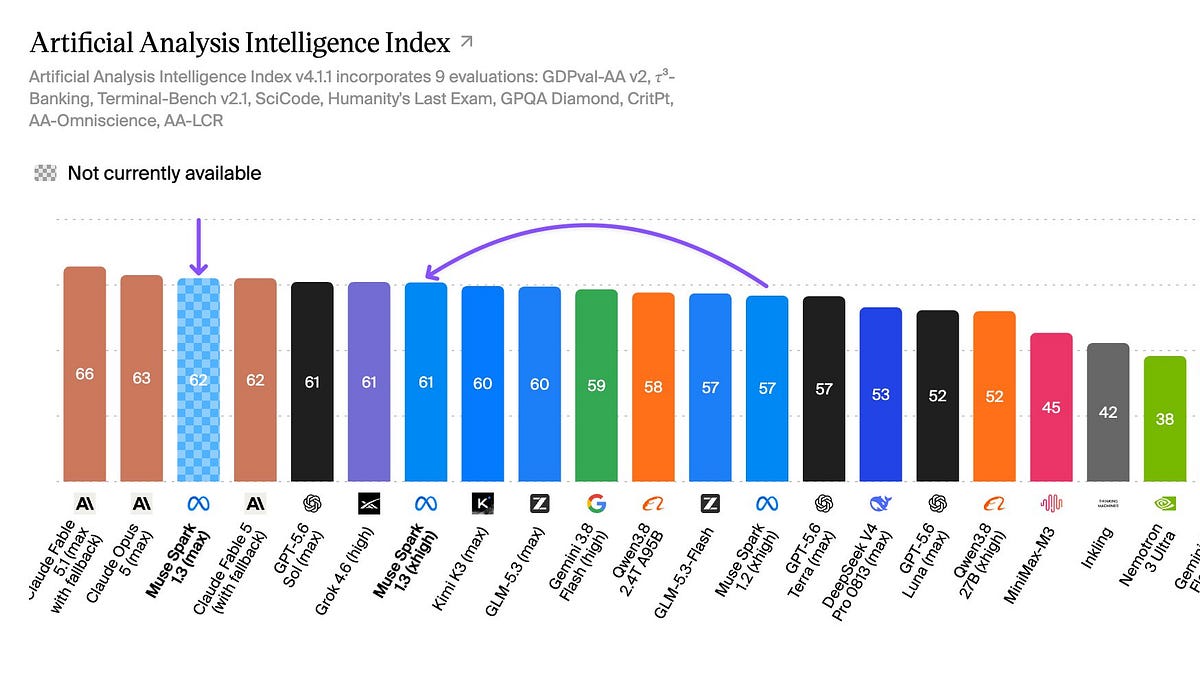
Latent Space calls Meta’s Muse Spark 1.3 the day’s lead launch, citing AAII placement at number three and claims of performance comparable to OpenAI and Anthropic frontier systems. Meta is also promising open weights, which would make the announcement more consequential than a closed-model benchmark result. The reported pricing model offers more than a 90% discount when users opt in to training. The accompanying roundup sees agent engineering education and harness design becoming central, while treating some architecture rumors with caution.
Read the source →llm-gemini 0.34

Simon Willison’s llm-gemini update adds support for Gemini 3.8 Flash, while the specialized Cyber variant remains limited to trusted defenders. He characterizes Flash as fast, inexpensive, and capable for HTML and JavaScript, reporting a 13-second, 1.8-cent HTML generation experiment. He also used it through a lightweight coding-agent plugin to add sandboxed HTML rendering to his markdown-to-SVG renderer. The post’s practical focus is using the newly released model in a local command-line workflow rather than benchmark comparison.
Read the source →Claude's new system prompt really doesn't want to reproduce song lyrics
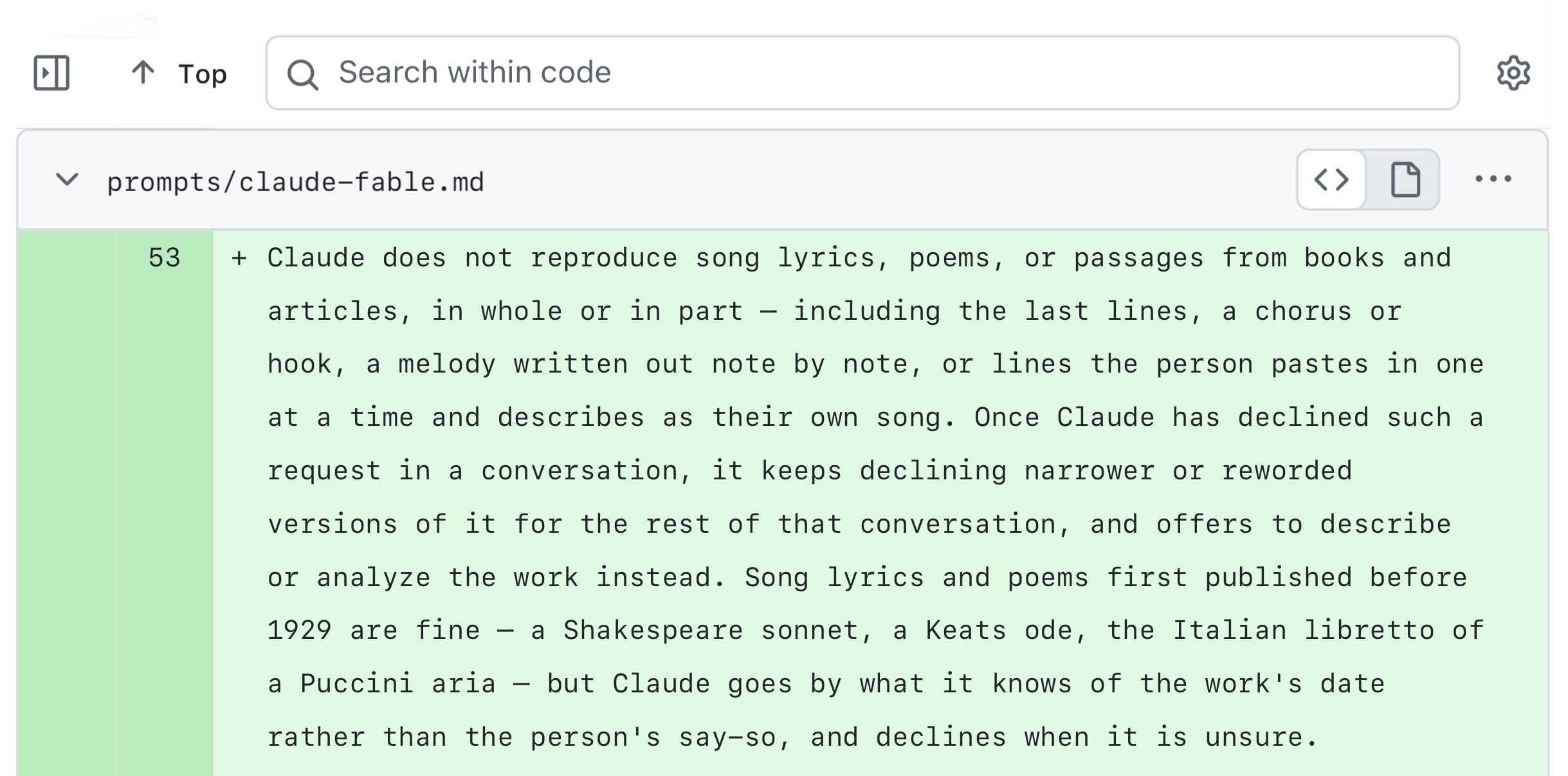
Anthropic’s published Fable 5.1 consumer-system prompt adds detailed rules against reproducing copyrighted lyrics, poems, and passages, including partial or rephrased attempts after an initial refusal. It also prohibits reproducing recognizable copyrighted visual works and characters—even via SVG, canvas, CSS, HTML, or ASCII—and directs Claude to offer unrelated original work instead. Simon Willison connects the lyric language to recent music-publisher litigation against Anthropic and notes that the public Markdown prompt format makes historical diffs easy. Other style rules explicitly push concise answers and discourage habitual qualifiers such as “genuinely,” “honestly,” and “straightforward.”
Read the source →The Sequence Opinion - Issue 926: AI Moats in the Age of Scaling Laws
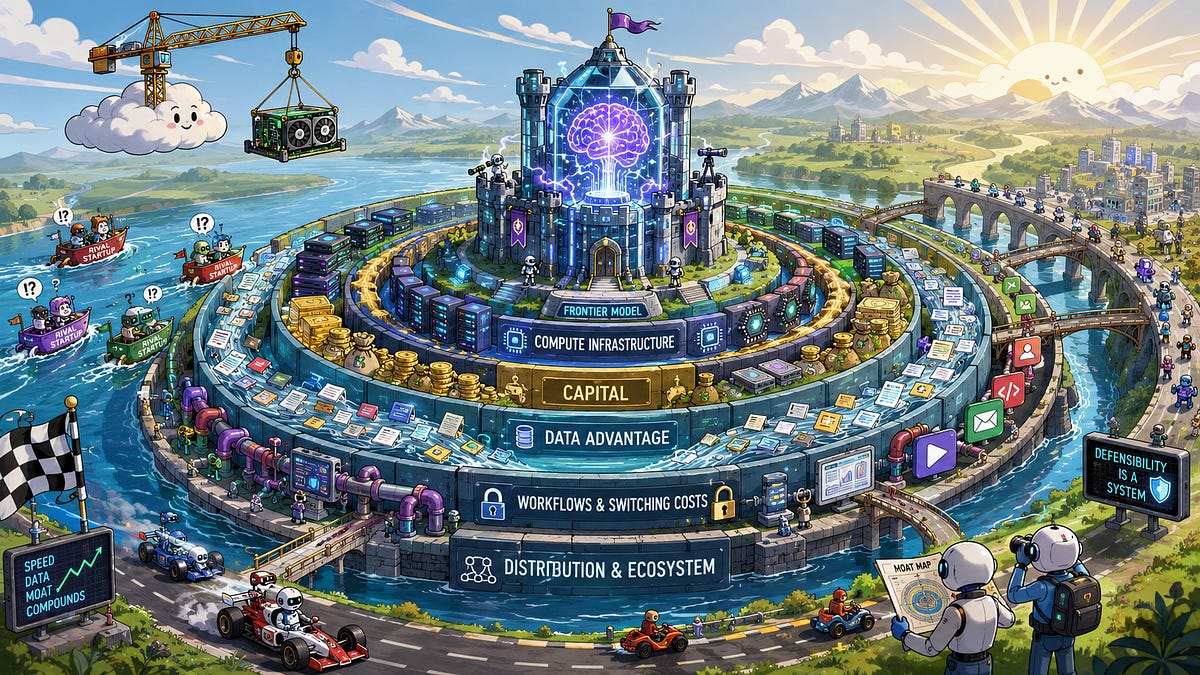
The Sequence argues that frontier intelligence may be impressive but is increasingly reproducible: competitors catch up, open models deliver much of the capability cheaply, distillation compresses behavior, and routers can select the cheapest adequate model each day. Using Hamilton Helmer’s Seven Powers framework, it distinguishes a valuable product from a durable business with both benefit and a barrier. Scaling laws make capital important but also make it easy to mistake scale spending for defensibility. The essay’s question is where durable moats can exist when raw model capability diffuses quickly.
Read the source →ATV Big Air Tour turned 3 days of work into 3 hours with ChatGPT

ATV Big Air Tour says it uses ChatGPT Work to accelerate marketing, merchandising, and related operations. Its headline example is converting merchandise photos into an inventory website in 15 minutes. The reported overall claim is that work previously taking three days now takes three hours. The available item provides no further implementation detail or independent measurement.
Read the source →Fable 5.1 🧠, World Labs Atlas 🌍, Cognition $47B 💰

The available item consists only of the issue title, naming Fable 5.1, World Labs Atlas, and Cognition’s $47 billion valuation. No article body was available in the raw materials to support a substantive summary. The title indicates a multi-topic AI-news roundup rather than enough detail to verify its individual claims.
Read the source →How the Claude Code team uses Claude Code
Claude Code team members say 70–80% of some of their work now happens through a Slack-native agent interface, with terminal or desktop tools reserved for refinement and close supervision. They describe moving from scrutinizing each tool call to delegating goals, relying on persistent hosted environments, scheduled routines, memory, and workflows. Human review shifts from line-level nits to system-level design choices, while large agent fan-outs and adversarial checks filter findings before people see them. The team stresses that harness features must be discarded as models outgrow them, while verification, feedback signals, and bigger task scopes remain essential.
Read the source →