Anthropic launches Fable 5.1 with cheaper agent caching
Summary
The day’s dominant shift is from models as chat interfaces toward governed, persistent workers: lower cache costs, tool-connected workflows, and agentic media analysis all reward repeatedly reusing context rather than issuing isolated prompts. But the same move raises the importance of operational controls—explicit specifications, verifiers, access policies, retained or customer-controlled monitoring, and human approval at consequential handoffs. The Fable 5.1 coverage also shows why headline capability claims now need cost, routing, and safety caveats alongside benchmark results.
Fable 5.1: Better Benchmarks, 25% Lower Cost

Fable 5.1 keeps the $10/M input and $50/M output list prices, but cuts cached-input reads by 75%, which the author says reduces typical bills about 25% and long-running agent workloads by as much as 45%. The practical recommendation is to use persistent, context-heavy sessions and lower reasoning effort: medium for routine work and high only when needed, because maximum effort raises cost far faster than quality on most tests. The post also says safeguards now produce fewer benign cybersecurity refusals, while warning that benchmark gains are only a directional proxy for day-to-day usefulness.
Read the source →Show HN: Weedout – Safari extension that hides YouTube AI-labeled videos
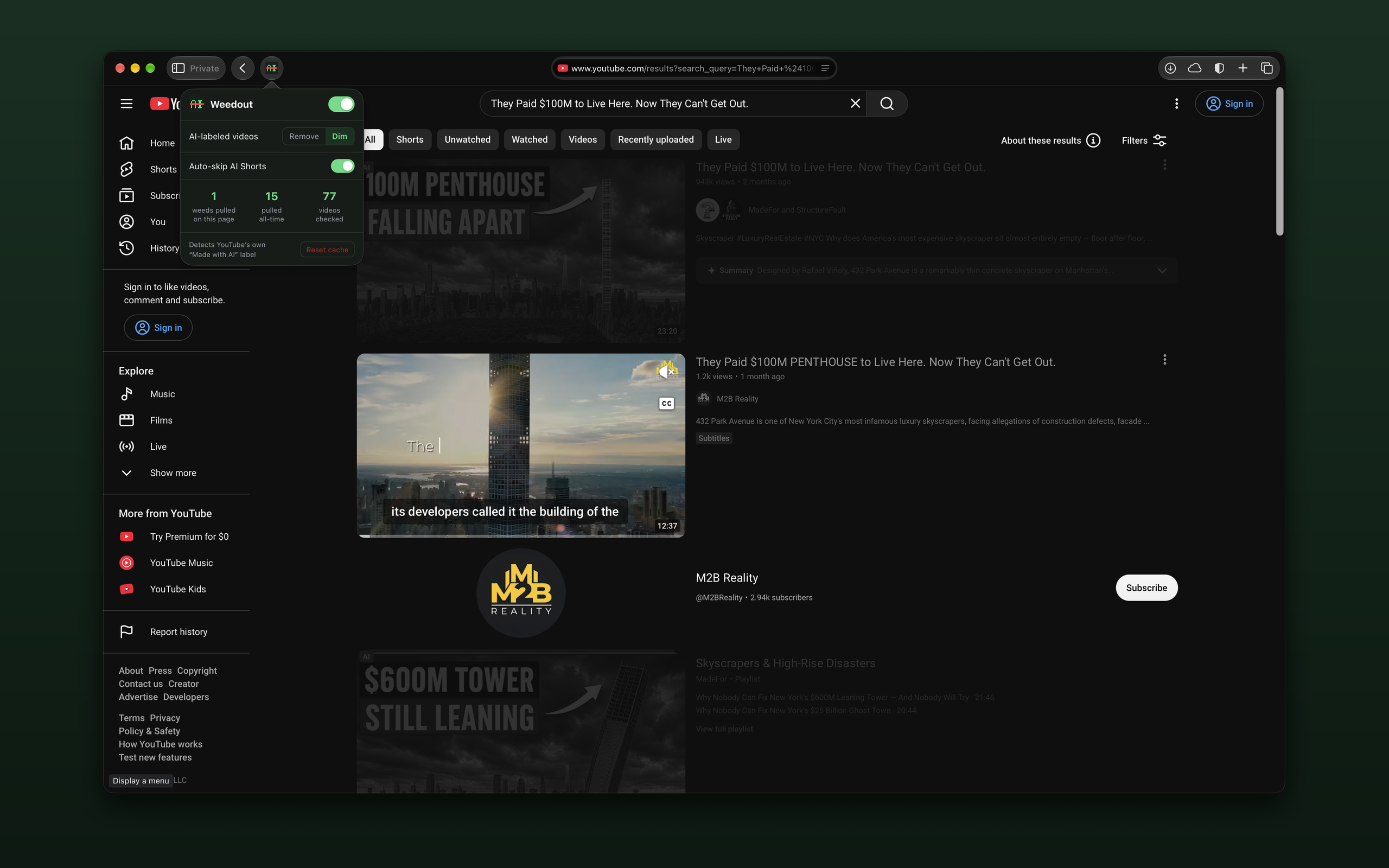
Weedout is a Safari extension that removes YouTube videos carrying YouTube’s own “Made with AI” badge from feeds, search, related-video panels, and Shorts. It makes no judgment from heuristics, so it avoids falsely accusing unlabeled videos but deliberately does not filter unlabeled AI content. The project says cached listings can disappear before rendering and others in roughly half a second.
Read the source →The Pragmatic Engineer: Five years
The Pragmatic Engineer marks five years since its first issue and reports more than 1.1 million readers, tens of thousands of paid subscribers, and over 500,000 YouTube subscribers. Founder Gergely Orosz describes a long path from a 2007 blog and a 2019 email digest to a full-time engineering publication after leaving Uber in 2020. The anniversary offer temporarily returns annual pricing to $100 through September 8 and accompanies a writing contest with prizes up to $10,000.
Read the source →Quoting Rick Brewster
Paint.NET’s creator says Claude helped produce a clean-room, managed rewrite of Direct2D for Wine because Wine’s Direct2D support was not sufficient and could not simply be disabled. The effort generated about 180,000 lines of largely “vibe coded” code, too much for thorough human review. Brewster credits the agent with tireless reverse engineering but says he had to correct resource-management omissions and poor architectural choices.
Read the source →Claude Fable 5.1 made me a really nice animated pelican

Simon Willison tested Fable 5.1’s five effort levels by asking it to draw a pelican riding a bicycle in SVG. Low and medium appeared to use no visible reasoning and cost about 10 cents in roughly 23 seconds, while xhigh used 36,767 output tokens and cost $1.83. Max used 65,927 output tokens, took nearly 14 minutes, cost $3.30, and produced the best result, illustrating how sharply effort can increase token use for a modest visual task.
Read the source →Codex bundles LibreOffice
Simon Willison found that the desktop Codex app’s roughly 1.7GB runtime cache includes Python, Node.js, Poppler, git, and the LibreOffice suite. Skills in the bundled documents plugin describe how Codex can locate and use those binaries. The finding means the app can perform office-document workflows through a self-contained runtime rather than assuming those tools are installed separately.
Read the source →GeoJSON Map Viewer
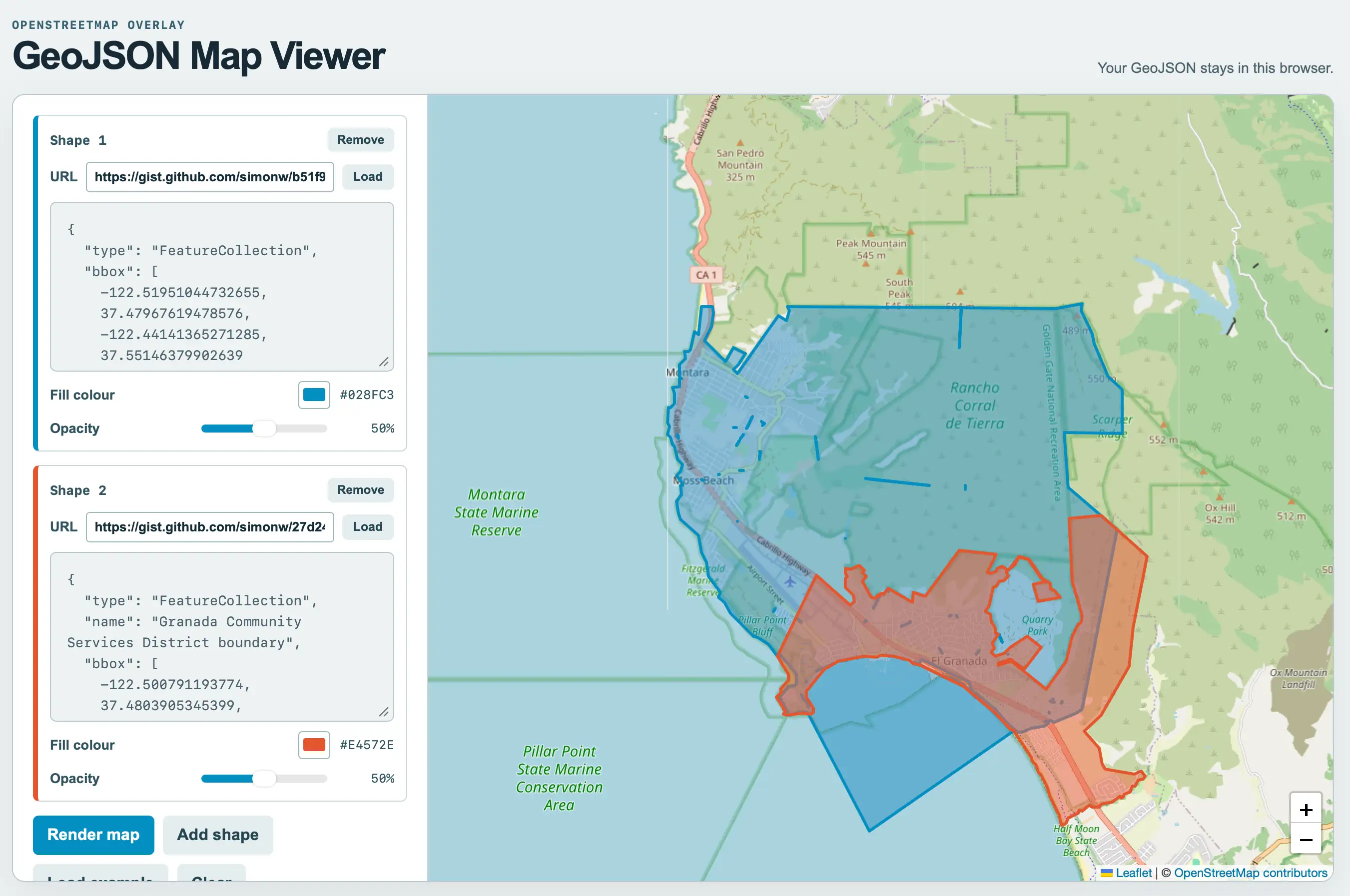
A request for a way to display GeoJSON political boundaries and export a PNG led to a browser-based map viewer assembled with GPT-5.6 Sol, Claude Code, and Fable 5.1. Willison also reports that ChatGPT Work could retrieve and combine government boundary sources into the requested GeoJSON for two California local bodies. The example frames code agents as useful for quickly creating narrow, practical data-visualization tools.
Read the source →Quoting Tarn Adams
Dwarf Fortress co-creator Tarn Adams objects to describing game characters as having “AI,” preferring the term “dwarf behavior.” The quip distinguishes authored simulation behavior from contemporary generative AI terminology. It is presented as a short quotation without further analysis.
Read the source →datasette-mcp 0.2
Datasette-MCP 0.2 changes executesql results from positional arrays to objects keyed by column name. The author says this should make result interpretation easier for weaker models that lose track of column positions. It also now requires mcp>=2.1.1 and is presented as the plugin’s first non-alpha release.
Read the source →How AI-native companies turn workflows into operating capability
OpenAI argues that leading enterprise users are moving from assistance to execution: the top 10% by AI usage generate 8.3 times as many output tokens per active user as typical firms, up from 2.6 times in January. Its cases emphasize converting stable work into reusable, tool-connected workflows with persistent context and human review at consequential decisions. Basis reportedly reduced first-day onboarding from two hours to 30 minutes, while Clay’s per-account agents save roughly an hour of nightly inbox triage and Exa uses Codex to pursue integration opportunities through tested PRs.
Read the source →Path to Astra: critical capabilities and frontier safeguards
OpenAI says Astra is its first model judged to meet the “Critical” cybersecurity threshold, capable with appropriate tools of finding unknown flaws and developing exploit paths across protected systems without step-by-step human guidance. It cites a 100% ExploitBench score and internal tests where Astra found two zero-days as part of exploit chains, now being disclosed. Release was partially delayed while safeguards were strengthened; the most advanced cyber capability will initially be limited to testers and Daybreak Blue access.
Read the source →Healthcare organizations can now connect EHR and additional industry data to ChatGPT

ChatGPT for Healthcare can now connect authorized Epic patient-record context and query nine official public sources through a Healthcare Public Data plugin, including PubMed, DailyMed, ClinicalTrials.gov, and CMS Coverage. OpenAI says physicians rated 99.1% of 4,363 responses safe across 27 connected-EHR use cases, while more than 93% of responses were rated good or better for each of five connected public sources. The product is positioned as a governed research and review aid that returns supporting chart evidence, not a replacement for clinicians’ judgment.
Read the source →How law firm Gilbert + Tobin governs and scales AI with OpenAI
Australian law firm Gilbert + Tobin attributes broad adoption to CEO sponsorship, role-specific training, Australian data residency, and explicit rules for approved use and human review. By June, 87% of enabled ChatGPT seats were active—more than twice the firm’s normal adoption rate for tools. Reported examples include reducing recruitment research and data extraction from about four hours to 20 minutes, while keeping staff responsible for constraints, verification, and final approval.
Read the source →The Sequence Learning Loop - Issue 925: Learn About Fable and Mythos 5.1, GLM-5.3-Flash, and Qwen 3.8

This issue presents three competing approaches to affordable autonomous work: Anthropic’s Fable/Mythos 5.1, Zhipu’s 320B-parameter GLM-5.3-Flash with 18B active parameters, and Alibaba’s Qwen 3.8 family. It characterizes Fable and Mythos as one set of weights offered with different safeguard regimes. The common question is how models can work independently for hours while remaining economical.
Read the source →NVIDIA RISC-V for NVIDIA GPUs at Hot Chips 2026
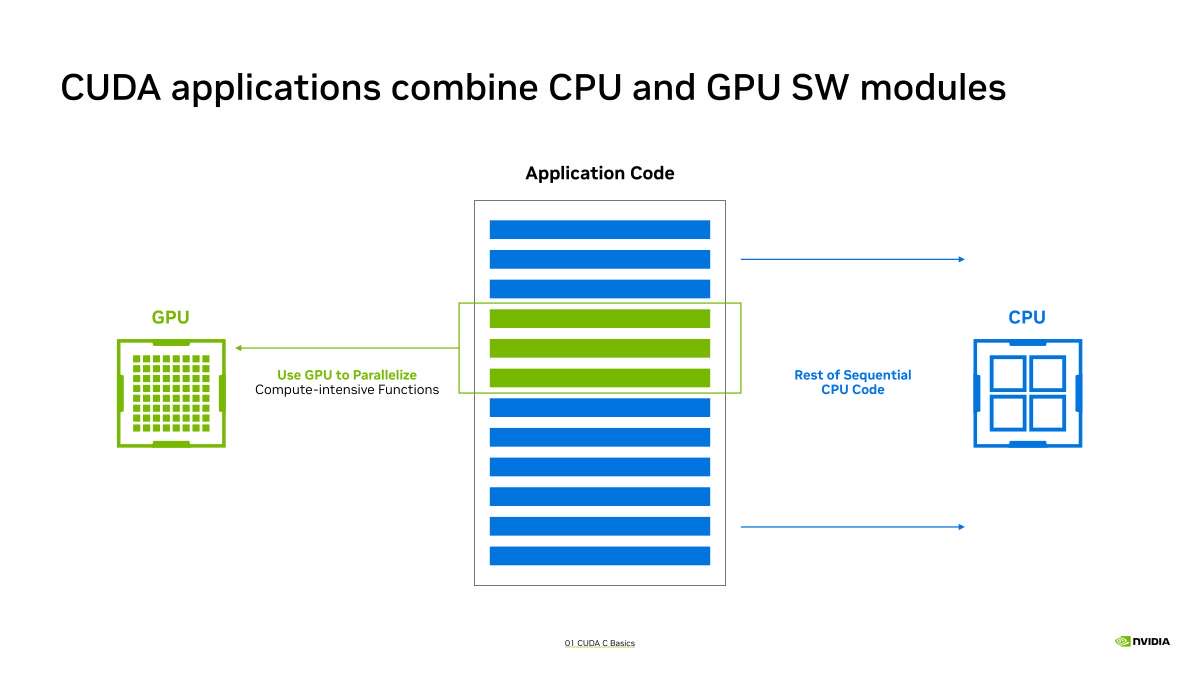
NVIDIA described requirements for RISC-V server CPUs to host CUDA workloads, including the RVA23 profile, boot/runtime specifications, ACPI, PCIe coherency, and peer-to-peer GPU communication. For NVLink Fusion, custom CPUs must also support high-speed C2C connectivity and associated software such as DOCA and NCCL. The talk places RISC-V alongside x86 and Arm as a potential third server-CPU option and identifies SiFive as an NVLink Fusion CPU partner.
Read the source →NVIDIA and Mediatek Ink $3.5B Investment Deal, Accelerate NVLink Fusion Adoption
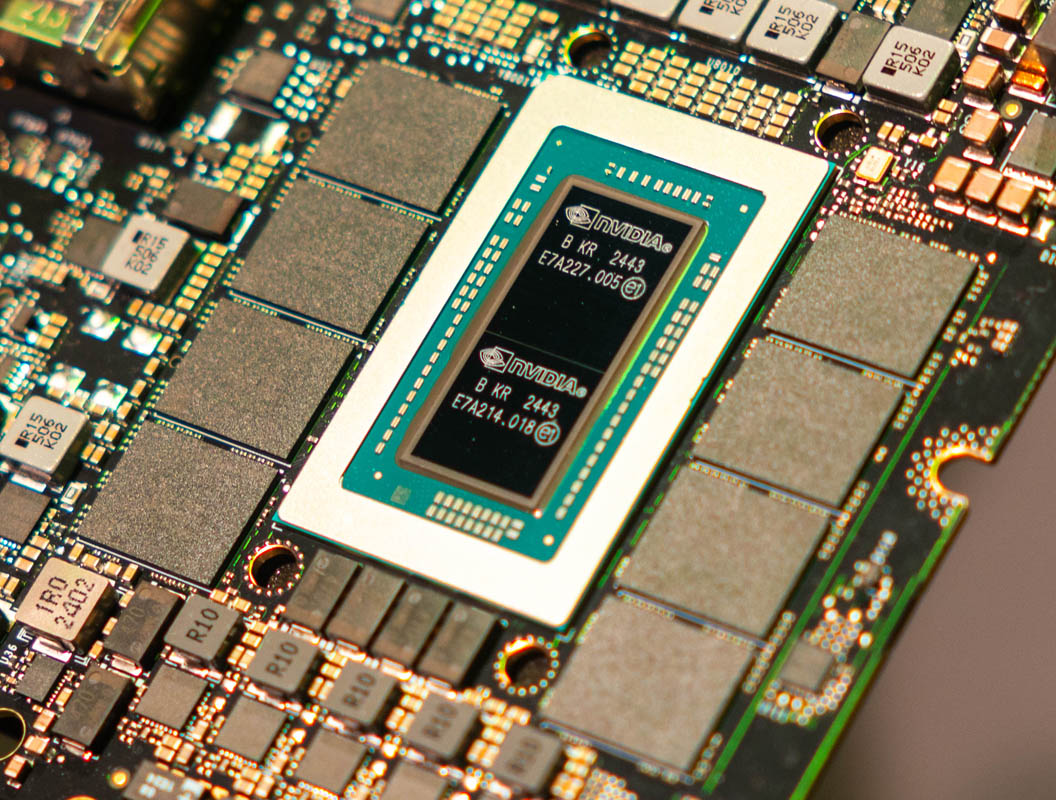
NVIDIA will invest $3.5 billion in MediaTek convertible bonds while MediaTek adopts the full NVLink Fusion stack for its custom-silicon customers. That package includes the NVLink Fusion chiplet, NVLink-C2C, and NVIDIA’s new NVHBM memory protocol, allowing customer XPUs to connect into NVIDIA rack-scale systems. The deal extends the companies’ GB10 and future Spark collaboration and is framed as NVIDIA hedging against hyperscalers’ growing appetite for their own accelerators by making its interconnect ecosystem easier to adopt.
Read the source →850 PRs a Week: How Tessl Runs a Software Factory
Tessl says it reached a weekly peak of about 850 pull requests, with agents handling roughly 85–90% end to end. Its “factory” model moves people toward defining specs, maintaining skills and automation loops, and reviewing high-leverage decisions rather than manually producing every change. The company says surplus capacity also improves quality work—such as design consistency and copy fixes—that would otherwise remain in a backlog, but argues this requires explicit, reusable definitions of correctness and verifiers rather than generic agent prompts.
Read the source →Debugging across the whole stack with Claude Fable 5.1
Transcript unavailable.
Read the source →Claude Fable 5.1 builds the ops review in Slack
The video depicts Fable 5.1 taking raw team inputs to a leadership operations-review deck inside Slack. It catches a number that does not reconcile, flags the discrepancy, and recalculates after a person provides clarification. The workflow retains team review before the deck goes to leadership, presenting the agent as an auditable collaborator rather than an unattended publisher.
Read the source →Claude Fable 5.1 runs the forecast overnight
The example shows a B2B revenue forecast covering both contract and consumption revenue being updated unattended through the API overnight. In the morning, an analyst asks the model to backtest prior forecasts, and it evaluates its own accuracy on demand. A human still reviews and approves the result before distribution.
Read the source →Claude turns flight data into "look behind you"
The transcript demonstrates an agent turning live-like flight information into a location-specific natural-language observation. It identifies a Delta Airbus A330-300 descending through 2,600 feet at 200 knots, estimates its direction and 1.7km passing distance, and predicts a landing about five minutes away. The example’s value is combining aircraft state with spatial orientation and timing for an immediately actionable explanation.
Read the source →Claude codes turn-by-turn directions for the Moon
Claude built a browser-based lunar navigation app that plans routes over real NASA terrain, deciding whether crater slopes are traversable and explaining each turn. It uses public LOLA elevation data, LROC imagery, IAU/USGS place names, and published landing coordinates. The project was built from scratch without libraries and renders a hand-built 3D globe.
Read the source →Claude codes a watercolor engine
Claude built a working browser watercolor simulator from scratch without libraries. It simulates water movement, pigment settling, and light’s color mixing in real time. The brief showcases a generated interactive physics-and-rendering experience rather than a static illustration.
Read the source →Claude designs proteins that bind in the lab
Claude autonomously generated, folded, scored, and selected protein-binder designs for 12 targets over 24 hours using open biomolecular models and bioinformatics tools. Two independent labs, Adaptyv Bio and GenScript, made and measured the designs; nearly half bound their intended target and most targets produced a high-affinity binder. The demonstrated output is experimentally validated binders, not merely computational predictions.
Read the source →Claude turns calculus into combustion
Transcript unavailable.
Read the source →Claude codes a sentence traveling through a brain
Claude built an interactive browser visualization tracing “Could you pass the salt?” through brain processing, from brainstem activity at five milliseconds to auditory processing at 20ms, meaning around 400ms, and frontal-lobe action selection. The timings derive from published EEG, MEG, and intracranial recordings and are slowed about 100-fold for viewing. It uses procedural code rather than downloaded scans, models, or assets.
Read the source →Building Enterprise Frontier Safeguards with our customers
Anthropic customers including Visa describe EFS as a way to get safety monitoring without surrendering data control. Signals and logs can remain in the customer’s cloud, under its control, while automated review emits restricted findings rather than customer content. The claim is that this architecture lets regulated organizations expand AI use into sensitive cyber-defense work that was previously too risky.
Read the source →Fable 5.1 Is The Greatest Model Ever (And Cheaper Than Fable 5)
Transcript unavailable.
Read the source →11 Tiny Coding Agent Fixes With A Stupid Amount Of Payoff
The presenter offers 11 small, tool-agnostic workflow changes intended to make coding agents more reliable rather than requiring a wholesale switch in tools. The first principle is to write for the agent with specific instructions and no implicit assumptions. The transcript frames the guidance as applicable to both newcomers and experienced users, with Claude Code used only for some demonstrations.
Read the source →How To Navigate the Next Wave of AI Competition
Transcript unavailable.
Read the source →Claude Platform release notes — September 1, 2026
Claude Fable 5.1 and Mythos 5.1 launch with one-million-token context, 128K maximum output, adaptive thinking, and $10/$50 per million input/output tokens; cached reads cost $0.25/M. The models do not support toolchoice values any or tool, and preserved thinking blocks have model/version and prefix-binding restrictions. New beta controls include per-message effort, turn-scoped system messages, and short thinking-progress updates; the models also apply text watermarks and C2PA credentials to supported generated media.
Read the source →Introducing Claude Fable 5.1 and Claude Mythos 5.1
Anthropic introduces Fable 5.1 for general availability and Mythos 5.1 for trusted-access cyber and life-science work, describing them as the same underlying model with different safeguards. It says cheaper cache reads lower typical token-billed workload cost by about 25% and highly agentic work by up to 45%, while new cyber safeguards cut false positives 60%. The company also says eligible customers can receive zero-data-retention access until Enterprise Frontier Safeguards, where customer-controlled cloud storage is intended to preserve privacy alongside monitoring.
Read the source →Developing Enterprise Frontier Safeguards with our customers
Enterprise Frontier Safeguards is Anthropic’s planned customer-controlled monitoring architecture for Fable-class models, intended to combine zero-data-retention-like privacy with cross-session and cross-account misuse detection. Activity data can be stored in the customer’s S3, Azure Blob, or Google Cloud Storage environment under the customer’s own keys, policies, and audit logs; monitoring signals go to the customer for review. Anthropic says it developed EFS with more than 100 customers and will phase rollout in later this fall, with eligible Fable users retaining ZDR in the interim.
Read the source →Set an expiration date for individual user budgets
GitHub Copilot Business and Enterprise administrators can now assign expiration dates to individual user budget overrides. On expiry, the user falls back to the next applicable cost-center or universal budget, eliminating manual cleanup of temporary allocations. Administrators can select no expiry, the next billing cycle, or a specific date, including through the REST API’s expiresat field.
Read the source →Copilot code review can now approve pull requests
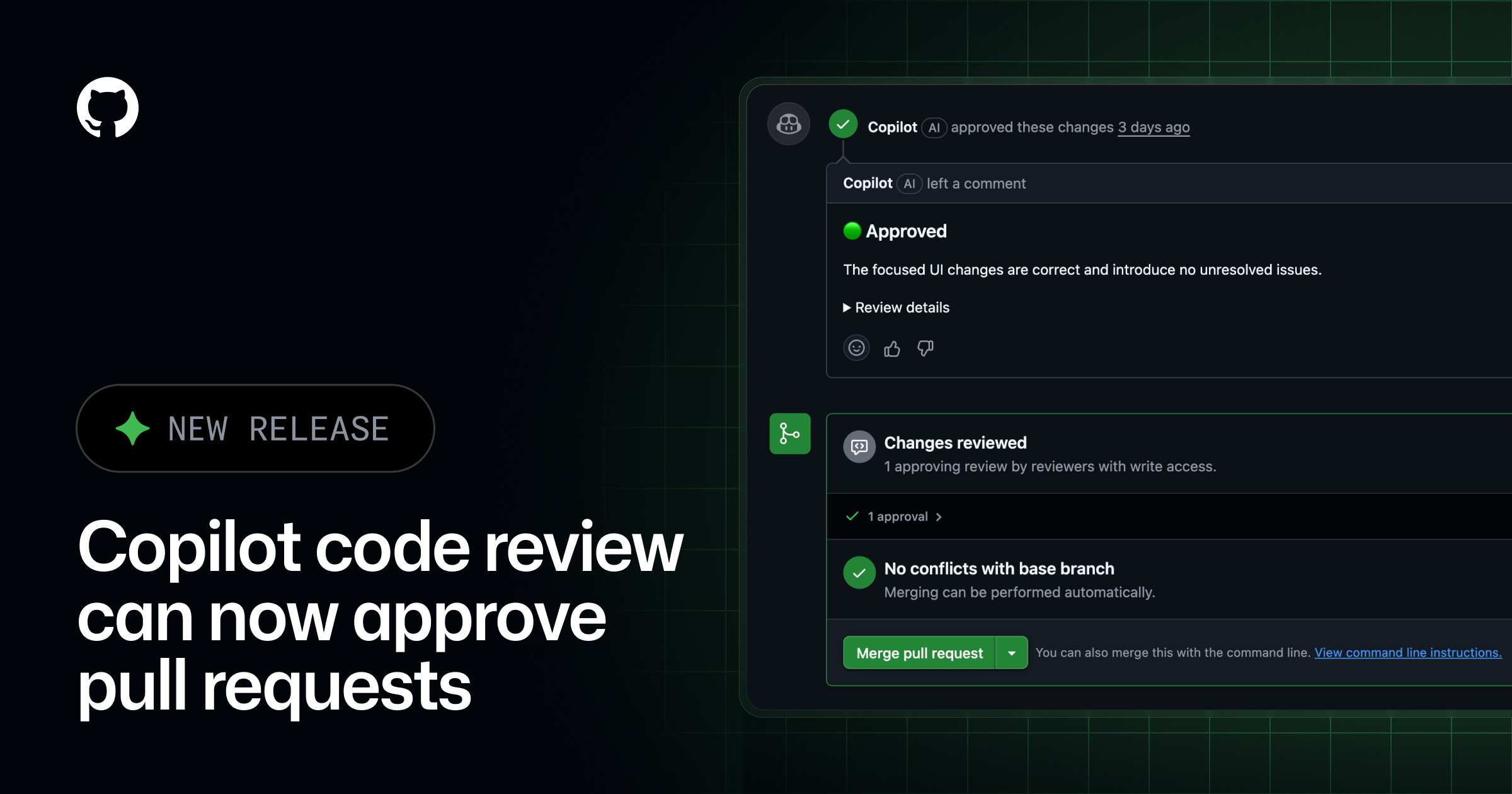
Every Copilot code review now includes an overview assessment indicating whether the agent considers a pull request ready to approve. Admins can optionally let Copilot submit an approval that counts toward required-approval rules, with controls at enterprise, organization, and repository levels. The capability is off by default, in public preview, and approvals are dismissed when new commits arrive just as human approvals are.
Read the source →Claude Fable 5.1 is generally available in GitHub Copilot
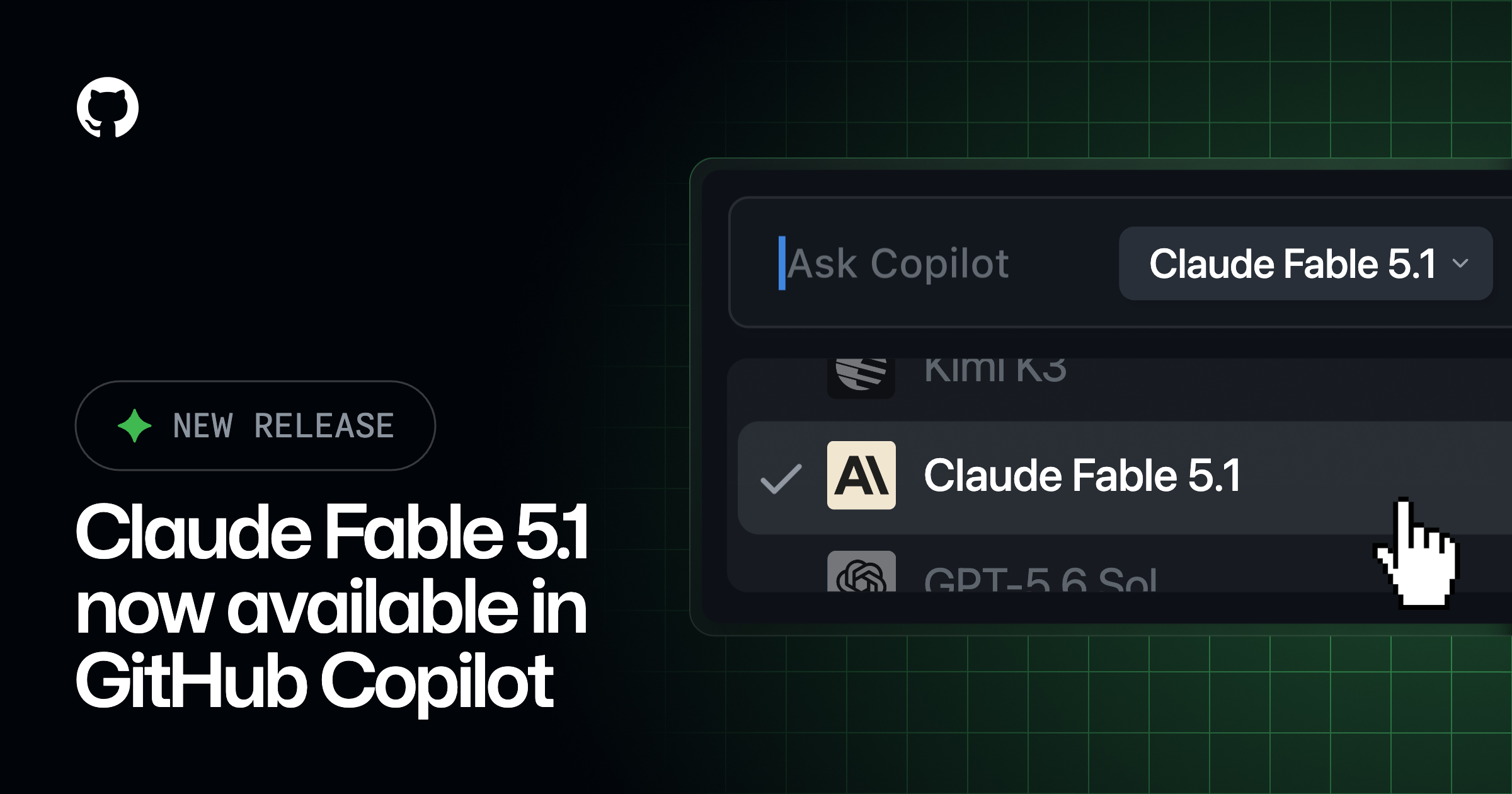
Claude Fable 5.1 is rolling out to Copilot Pro+, Max, Business, and Enterprise customers for long-running coding, research, and agent workflows. Enterprise and Business admins must explicitly enable the policy, which is off by default. The model normally requires Anthropic data retention for safety classifiers, though eligible enterprises can receive temporary ZDR routing through year end while EFS becomes available.
Read the source →Selected GitHub Copilot models deprecated
GitHub has deprecated selected models across most Copilot experiences as of September 1, including chat, inline edits, agent mode, and completions. Organizations should update workflows and may need to enable replacement models through model policies. Claude Sonnet 4.6 remains available to annual individual subscribers.
Read the source →Claude Fable 5.1 and Claude Mythos 5.1
AINews portrays Fable 5.1 as a flagship launch centered on an autonomous worker that is faster, more deployable, and cheaper in cache-heavy agent loops than its predecessor. It notes a central caveat: Artificial Analysis observed about 1.7× more output tokens and estimated a 20% higher per-task cost in one framing despite the 75% cache-read price cut. Community reaction split between strong reports of coding quality and normaler tone, and concerns about access limits, safeguards, retention, and ambiguity around fallback routing to other models.
Read the source →The latest AI news we announced in August 2026

Google’s August roundup highlights Gemini 3.7 Flash, offered at half the introductory per-token price of 3.6 Flash, alongside Gemini 3.5 Transcribe and Pixel 11 devices built around Tensor G6 and Gemini Nano. Google says the Gemini app surpassed one billion monthly users, with more than 150 million images generated daily. Other emphasis areas include a free year of a Google AI plan for eligible students, hands-free Gemini Live productivity features, educational Search tools, and creative/scientific model releases.
Read the source →v2.1.258 (+ v2.1.257)
The retrieved release page did not provide release notes beyond a generic Claude Code product description and loading errors. No substantive changes can be reliably summarized from the available content.
Read the source →BenchMIRT: What are LLM benchmarks actually measuring?

AllenAI introduces BenchMIRT, a multidimensional item-response-theory method that audits what individual benchmark prompts actually measure rather than trusting a single aggregate score. Trained on results from 100 models, 16 benchmarks, and more than 34,000 questions, it independently recovered two stable dimensions: general reasoning and safety. The analysis finds that purported safety measures can be confounded—for example, BBQ aligns more with reasoning, while WMDP scores inversely relate to reasoning because refusal/failure is the desired outcome.
Read the source →[AINews] Claude Fable/Mythos 5.1: new SOTA model, 75% cache price cut but 70% more output tokens

Latent Space’s roundup argues that the Fable/Mythos 5.1 launch should be read through deployment economics, not just a headline benchmark win. It repeats the 75% cache-read reduction but cites Artificial Analysis observations of roughly 1.7× output-token use, yielding an estimated 20% higher cost per task in that analysis. It also flags uncertainty over whether Fable and Mythos labels represent base-model differences or safety/fallback routing behavior, alongside reports of subscription friction.
Read the source →PRs NOT Welcome: How Top AI Open Source Projects Are Managing Thousands of Contributors
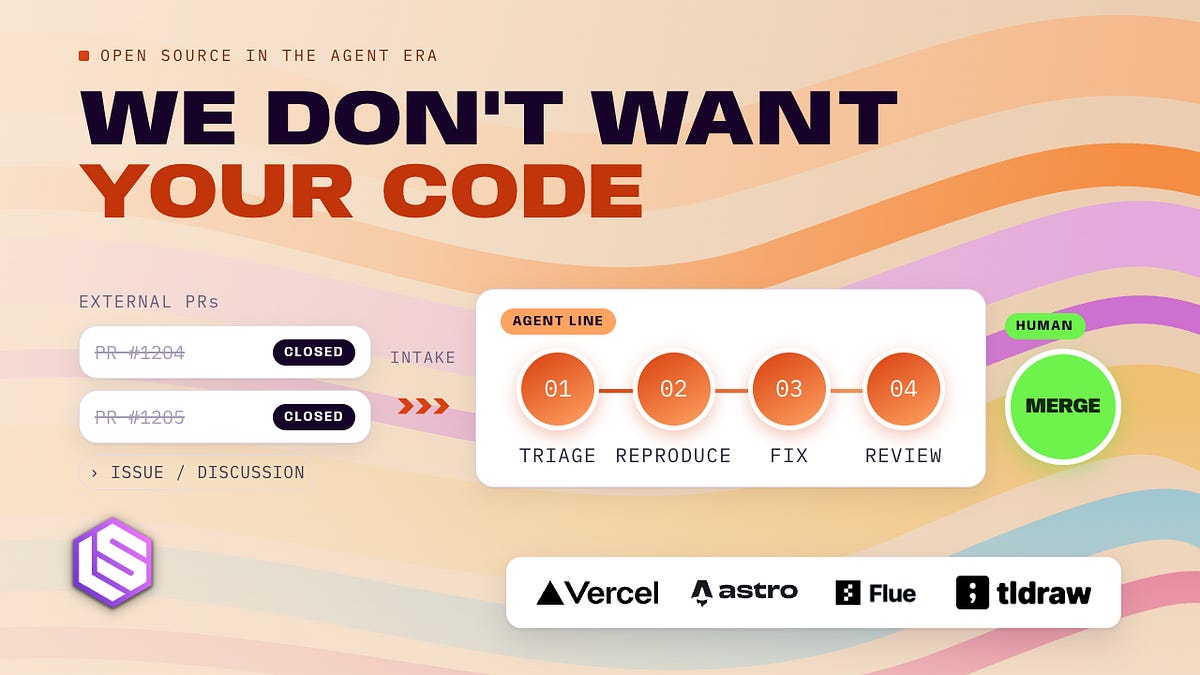
Latent Space reports that some AI-native open-source projects now automatically close external PRs and convert them into issues or discussions, partly to avoid low-quality AI-generated submissions. Vercel’s AI SDK “software factory” uses specialized agents for reproduction, fixes, and review; four weeks after deployment it reportedly authored 25–35% of merged PRs and closed 70–80% of issues from a backlog of nearly 800 PRs and over 1,000 issues. Astro and Flue similarly use agents to triage, reproduce, prioritize, implement, and verify fixes, shifting maintainers from backlog cleanup toward weekly prioritization.
Read the source →Introducing agentic video understanding with Gemini
Google has launched agentic video understanding for Gemini 3.7 Flash, 3.6 Flash, and 3.5 Flash-Lite through the Gemini API. Instead of analyzing all video at a fixed frame rate, the model can choose which moments and modalities—frames, audio, or transcript—to inspect, reducing token use by up to 88%, costs by up to 66%, and improving quality by up to 7% on cited benchmarks. Developers enable it by setting processing to agentic; it has no separate feature fee and is planned for Gemini app and YouTube experiences.
Read the source →1.4.6
The retrieved release page returned only loading errors and no usable release notes. No changes can be reliably summarized from the available content.
Read the source →Bye Bye Perspective API: Lessons for Measurement Infrastructure in NLP, CSS and LLM Evaluation
The extracted source contains only arXiv site boilerplate and no paper abstract or body. Its substantive argument cannot be summarized reliably from the available material.
Read the source →Researchers use AI to ‘democratize’ 3D printing of crucial metal alloy
Washington State University researchers used an AI-guided active-learning approach to find printable settings for NASA’s GRCop-42 alloy, an aerospace material normally requiring high-power equipment. Starting from 37 failed configurations, they used only 40 experiments over three months to identify six successful settings and achieved a successful print at 500 watts for the first time. The method targets rare-success, expensive-experiment problems and could reduce energy, wear, and access barriers for additive manufacturing.
Read the source →44% on ARC-AGI-1 in 67 cents
A researcher reports training a small transformer from scratch in 1.5 hours on an RTX 5090 to reach 44% on ARC-AGI-1 for 67 cents, comparable to cited TRM/HRM results. The work emphasizes sample efficiency, using output-token-only supervised loss, filtered non-overlapping ARC-2 tasks to avoid leakage, and representation changes including 3D RoPE and per-task embeddings. The author says the code is open source, argues the result challenges validation-loss-focused optimization, and believes further transformer-only gains may be possible.
Read the source →