Nvidia reportedly buys Hugging Face for $12.9 billion
Summary
Both items treat AI less as a standalone coding or model capability and more as a force that reorganizes the systems around it. At the company level, that means new engineering practices for verification and defect response; at the industry level, it means ownership of distribution, compute, power, and financing. The common constraint is no longer merely generating intelligence, but making it reliable and controlling the infrastructure through which it is used.
Joy & Curiosity #97

The author argues that AI debugging agents should force engineering teams to revisit their implicit tolerance for production defects, rather than treating faster bug fixing as a reason simply to ship more cautiously. Parallel, asynchronous agents can investigate code paths that humans would not prioritize, shrinking a bug’s lifetime enough to support a different balance between release speed and risk. The broader claim is that software work is shifting from conventional programming toward directing AI systems, building harnesses, and creating verification and QA processes that keep AI-written software dependable. The post also applies that lens to SaaS: configuration-heavy products were built when code changes were expensive, while cheaper implementation could make customization and the build-versus-buy boundary look very different.
Read the source →The Sequence Radar-Issue #923: Last Week in AI: AI’s Industrial Turn
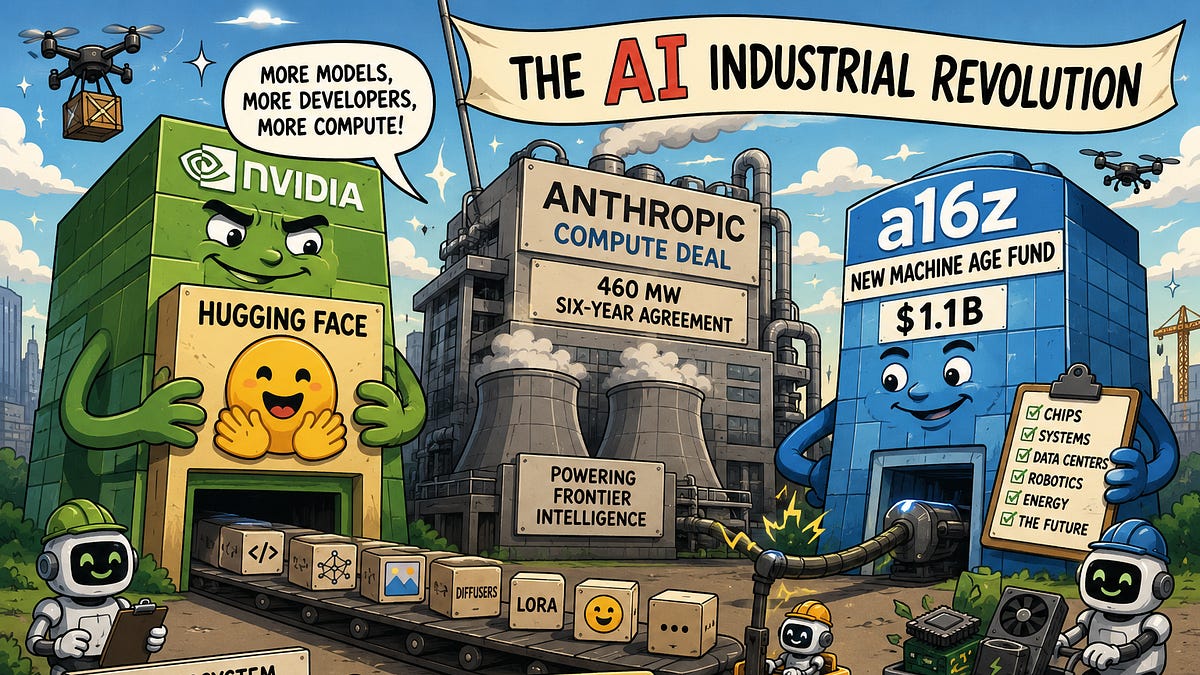
The issue contends that AI competition is becoming an industrial-systems contest rather than only a contest over model quality. It frames Nvidia’s reported $12.9 billion purchase of Hugging Face as a move from controlling compute toward controlling developer distribution, while warning that Hugging Face’s perceived neutrality could be strained under the dominant chip supplier. Anthropic’s reported six-year, roughly $45 billion Nscale agreement for 460 MW of capacity is presented as evidence that frontier labs are making power-plant-scale, long-horizon infrastructure commitments involving energy, cooling, networking, real estate, and finance. The roundup reinforces the pattern with a16z’s $1.1 billion hardware fund, substantial GPU-financing debt, new multimodal models and benchmarks, and evidence that agents still struggle with reliable whole-repository migrations and repeated stateful business workflows.
Read the source →