OpenAI says it may hit its AGI bar by December
Summary
The day’s strongest thread is that AI progress is becoming a systems problem rather than a single-model problem: review rules, deployment harnesses, interoperable robotics stacks, routing layers, and governance all decide whether capability can be trusted in practice. Open infrastructure remains strategically important, but the reported Hugging Face acquisition talks show how quickly that dependence can become a concentration risk. Across the items, the useful response is not frictionless automation alone, but explicit standards, inspectable controls, and human judgment retained where accountability matters.
AI Code Review That Understands Your PR's Intent
Tessl presented Code Review as a response to the new bottleneck created by coding agents: reviewing and trusting the flood of code they can produce. Its review is meant to read a PR’s title and summary, then apply repository-specific “review lenses” for concerns such as security or design, scoped to parts of a codebase with globs. Those lenses live as versioned files in the repository, so teams can share a baseline standard across repos while retaining local exceptions. The company argues that editable, transparent review policy is what lets software factories become more autonomous without turning the review stage into another black box to audit.
Read the source →Upcoming changes to GitHub Copilot policies and billing
GitHub will reopen credit-card and PayPal sign-ups for new Copilot Business and Enterprise customers on September 1, while adding stronger account vetting and revised billing; existing customers move to those billing changes on October 1. Organizations that fully cancel and later return may be subject to the new vetting and billing behavior. No earlier than September 28, GitHub plans to merge Copilot Chat on the web and mobile with the cloud agent into one unified experience; opting out means losing Copilot on github.com and GitHub Mobile after launch. On the same date, the default code-review effort level changes from Lite to Balanced, so admins that want Lite must explicitly select it at the organization or repository level before then.
Read the source →not much happened today
This roundup spotlights reports that Nvidia may acquire Hugging Face for roughly $12.9 billion to more than $13 billion, prompting concern over control of a central open-model distribution hub. Its discussion emphasizes that critical model artifacts can be mirrored legally when licenses permit, but that torrents need published SHA-256 hashes or signed manifests to guard against tampered weights. It also covers Qwen3.8-Flash-Next, a hybrid-attention MoE with 125B language-model parameters but 6B activated per token, 51B n-gram embeddings, 262k native context, and emerging vLLM, SGLang, GGUF, and llama.cpp support. The accompanying debate cautions that its relatively small benchmark gains over a 27B alternative may not justify the expensive GPU and memory setup for most local users, while arguing that n-gram “Engrams” are better understood as cheap static-memory lookups than a way to run trillion-parameter models locally.
Read the source →How do you push back on an AI answer when you're not the expert? The two-mode prompt guide I use.
The author argues that AI-related “brain rot” is not simply laziness: it can occur amid excellent, high-volume work when a model forms the first opinion, resolves ambiguity, interprets criticism, and leaves the human only approving polished output. The proposed remedy is “friction-maxxing”—deliberately adding resistance at moments where accepting a smooth answer would outsource an important judgment. The stakes, the piece says, span education, strategy, and product design, because persuasive output can hide the fact that a user cannot defend the underlying assumptions. Its practical guide is partly paywalled, but the stated standard is to judge agents by how clearly they disclose limits and to preserve one’s own taste rather than endlessly requesting variations.
Read the source →[AINews] OpenAI to reach AGI bar by end-2026

Latent Space reports that OpenAI chief scientist Jakub Pachocki describes the unreleased Astra model as the automated AI research intern he had targeted for September 2026, while Sam Altman says OpenAI may declare AGI internally by December. The newsletter treats those timeline claims cautiously because “AGI” remains ill-defined and hard to hold accountable. Its broader roundup identifies cheap, open robotics as a concrete counterpoint: Pollen Robotics and Hugging Face’s $399, 25-cm Microduck combines an open simulator, sim-to-real transfer, 15 actuators, and a rich sensor suite, with reported rapid early sales. It also describes GLM-5.3-Flash as a 320B-total-parameter, 18B-active open model with 1M context and aggressive local quantization claims, alongside Google’s Gemini Omni 1.1 Flash video controls and a growing focus on agent harnesses, browser-agent permissions, and shared cyber-defense/evaluation practices.
Read the source →Supporting Thailand’s next generation of AI startups
OpenAI and Thailand’s Ministry of Higher Education, Science, Research and Innovation are launching an eight-week accelerator. The program will work with 10 startups in health, wellness, and education. Its stated aim is to help them turn AI prototypes into products that users can trust.
Read the source →The Sequence Robotics - Issue #922: Learning About LeRobot: The Transformers Moment for Robots
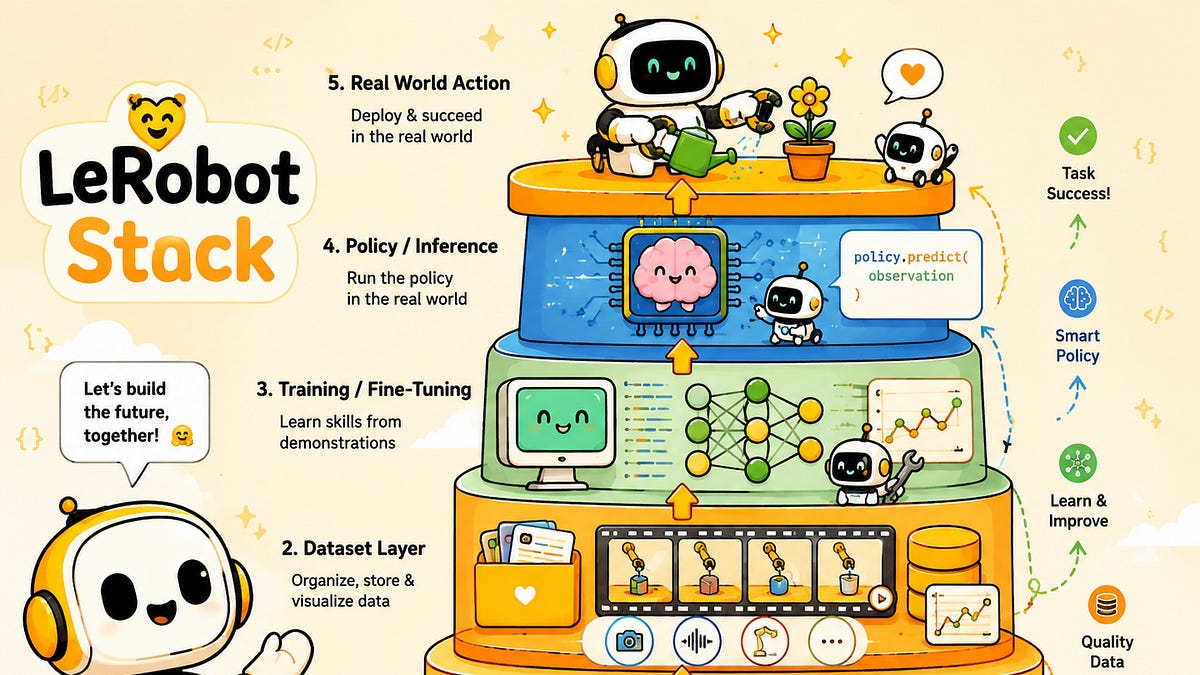
The piece argues that robot learning’s main constraint has been incompatible infrastructure rather than inadequate model architectures: labs have maintained separate data formats, teleoperation rigs, training loops, and drivers. It casts Hugging Face’s LeRobot as a protocol layer that standardizes those pieces, analogous to how Transformers and Diffusers made prior machine-learning workflows composable. Backed by an ICLR 2026 paper and contributions tied to NVIDIA GR00T and Isaac Teleop, LeRobot is presented as an emerging default substrate for open robot learning. The core claim is that standardization can unlock faster progress by allowing datasets, hardware, training, and policies to interoperate rather than forcing every lab to rebuild the stack.
Read the source →Gemini Omni 1.1 🎬, Cohere Parse 📄, Codex persistent mode 👨💻

The available excerpt focuses on an AI routing service rather than the issue’s named product updates. It pitches intelligent routing across providers based on price, latency, and quality, including an “Auto Router” option. It also claims multi-provider failover and degradation routing for reliability, plus per-request policies, team controls, observability, and auditability. The service is presented as easy to adopt because it exposes an OpenAI-compatible API, allowing existing SDK users to change models with a parameter.
Read the source →How I built this
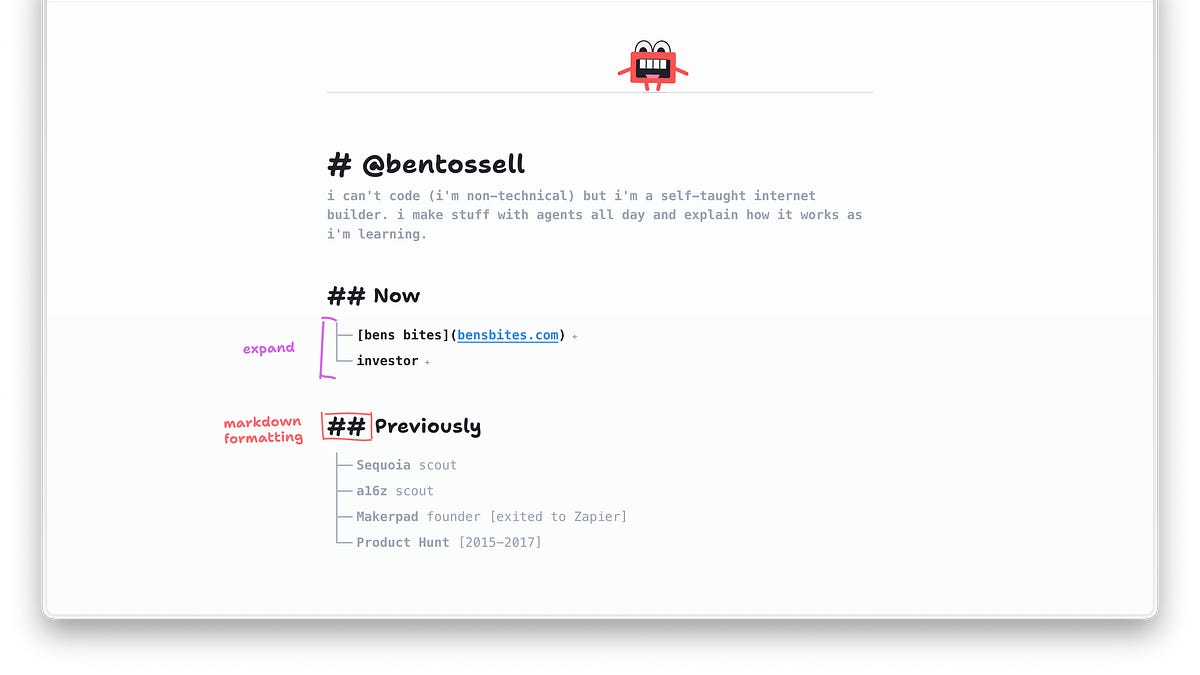
Ben Tossell recounts using coding agents to prototype a personal website, initially pursuing an agent-app interface with thread-based content. His most effective design loop was visual: ask for several versions, annotate screenshots in tldraw, and send the marked-up image back for targeted changes; he found GPT required more explicit tweak instructions than Claude for this work. He ultimately rejected the increasingly elaborate agent-site concept because it invited endless features and instead deployed a simpler, canvas-like static site whose content sits in separate Markdown files. The account also illustrates the practical value of rapid deployment and version control: the agent published directly from a local project folder, updated DNS for a custom domain, and the domain settled in about 20 minutes.
Read the source →