AI shifts the edge from models to systems
Summary
The day’s items converge on an operational shift: model capability is increasingly a commodity, while throughput, reliability, and advantage come from the systems that supply context, orchestrate heterogeneous models, evaluate outputs, and move data efficiently. That same systems focus appears at every layer—from agent harnesses and synthetic training environments to RL runtimes and memory-bound chips—suggesting that implementation discipline, not a single model choice, is becoming the main differentiator.
Intelligence EXPLOSION: Harness Engineering with Pi Agent, Deepseek, and Gemini
The video argues that a rush of model launches and price cuts makes model selection less useful than maintaining a flexible “fusion harness” that can route work across models. Its demonstration assigns Claude, Gemini Flash, and DeepSeek roles for independent opinions, multi-round debate, planning, building, and final architectural integration. The presenter finds the cheaper models competitive on many engineering tasks, while portraying Gemini Flash as unusually fast and frontier models as far more expensive; the proposed decision metric is useful agent output per cost, not a leaderboard alone. The practical recommendation is to own a customizable harness, hide model identities during cross-model debate, validate outputs, and evolve toward autonomous software-factory workflows rather than repeatedly supervising one agent in a terminal.
Read the source →VeRL-Omni v0.2.0: Faster Diffusion RL and Stable Omni Training
VeRL-Omni v0.2.0 makes request-level batching the default rollout path for supported diffusion adapters, replacing serial diffusion requests with packed transformer forwards and adding a V1 trainer path. In the Qwen-Image OCR LoRA example, isolated generation time falls from 226 seconds to 108 seconds, a 52% reduction, while GPU utilization rises from roughly 80% to about 100%; the suggested maxnumseqs range for True-CFG at 512 px is 8–32 before memory pressure becomes likely. The release also fixes policy-correctness-sensitive paths around batched log-probabilities, asynchronous rollouts, LoRA weight updates, and rollout correction. For multimodal training it introduces reusable model adapters and a stable Qwen3-Omni recipe that reports 0.833 validation reward and 0.998 actor-rollout correlation on MMK12.
Read the source →Artificial Analysis' Qwen3.8-27B benchmarks put it neck and neck with DeepSeek V4 and GPT-5.6 Luna Max
The captured Reddit entry contains only a submission marker and links, not the benchmark charts, methodology, or discussion. It therefore provides no substantive evidence beyond the post’s claim that Artificial Analysis compares Qwen3.8-27B favorably with DeepSeek V4 and GPT-5.6 Luna Max. Readers should consult the linked thread and underlying benchmark before treating that comparison as a performance conclusion.
Read the source →Xiaomi AI Cube announced with 1.2TB/s memory bandwidth
No readable body was extracted for this Reddit post. The raw material supplies only the title, which says Xiaomi announced an AI Cube with 1.2 TB/s of memory bandwidth, without architectural, pricing, availability, or benchmark details. There is not enough extracted information to assess what workload the bandwidth figure represents or how the system compares with alternatives.
Read the source →The Future of AI and Work
This discussion rejects the simple “AI takes all jobs” framing, arguing that automation removes stable, explicit tasks while expanding the scope for human judgment, coordination, creativity, and care. It distinguishes efficiency AI from opportunity AI: the latter means inventing workflows that were previously impossible, rather than merely automating today’s process. Several essays predict that agent-facing infrastructure, shared live records of goals and constraints, and organizational alignment will matter more than a company’s choice of base model. The video’s through-line is that abundant machine intelligence should return human attention for ambiguous, relational, and high-responsibility work—not simply create more automated busywork.
Read the source →Import AI 470: No rights for machines; automating environment generation with SPADE; and building better GPU kernels with Hawkeye

Import AI highlights METR evidence for uneven AI-driven acceleration: reported cyber vulnerabilities rose dramatically in 2026, mathematics shows more activity and some notable solved problems, while broad algorithmic AI research has not yet shown measurable acceleration. It then describes SPADE, a self-play framework in which an LLM writes executable training environments and another agent solves them; at the 30B Qwen3 scale, its game suite average reached 58.3, 8.1 points above base and 5.3 above the strongest fixed-environment baseline. The newsletter frames SPADE as a way to create broader synthetic training data cheaply, while stressing that it cannot bootstrap beyond the creative capability of the environment-generating model. It also introduces Hawkeye’s approach to hardware-aware GPU-kernel agents: package minimal, architecture-specific optimization knowledge as unit tests pairing solution kernels with profiling metrics.
Read the source →AI Chip Architectures
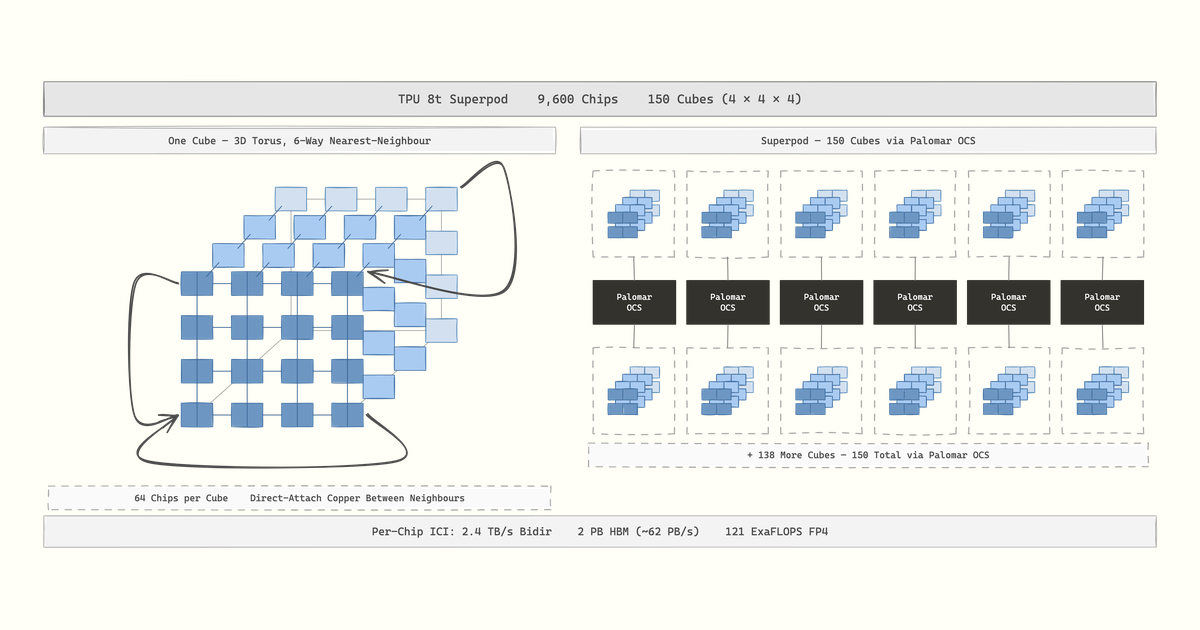
This survey explains AI hardware through the memory wall: training and prompt prefill are compute-heavy matrix-matrix workloads, whereas autoregressive decode becomes bandwidth-heavy matrix-vector work that repeatedly reads model weights and the KV cache. It argues that batching, speculative decoding, and multi-token prediction recover utilization by converting more work back toward matrix-matrix operations, though long contexts can shift the bottleneck to KV-cache bandwidth. The piece maps the deployed landscape—GPUs, systolic accelerators such as TPUs and Trainium, Cerebras’s wafer-scale engine, and Groq’s LPU—as different answers to where data lives and how it moves to compute. Its GPU walkthrough shows NVIDIA steadily pushing matmul execution toward larger, more asynchronous, lower-precision Tensor Core operations while retaining CUDA’s general-purpose programming model.
Read the source →Your executable is a SQLite database
Simon Willison points to a Linux technique that makes a SQLite database directly executable. It writes SELF—for Structured Executable & Linkable Format—into SQLite’s four-byte application ID field and stores ELF components across SQLite tables. A custom C interpreter extracts and executes those components, and Linux binfmtmisc can register the file signature so the kernel invokes that interpreter automatically. The result is a deliberately unusual but usable combination of a queryable SQLite container and an executable file.
Read the source →DeepSeek Flash Vision 👀, Claude Mythos security 🛡️, inside Grok Bot 🤖

The captured newsletter excerpt contains only this headline and a sponsor placement. It includes no article text, links, claims, or analysis about DeepSeek Flash Vision, Claude Mythos security, or Grok Bot. No substantive summary can be made from the supplied material.
Read the source →Anthropic, OpenAI & Thoughtworks on Context Engineering
Speakers from Anthropic, OpenAI, and Thoughtworks argue that the durable leverage in agentic development is the context and feedback system around a model, not the prompt or model alone. They identify human attention, model attention, and the context window as the binding constraints, recommending smaller parallel tasks and deliberate resurfacing or compaction of operational context. Thoughtworks splits a harness into guides that steer an agent and sensors that expose quality, combining LLM review with deterministic checks such as static analysis, logs, browser inspection, and codemods. The proposed operating model treats context as code: teams should package, evaluate, secure, observe, and continuously improve it, while agents increasingly execute the software-development lifecycle itself.
Read the source →