AI’s agent systems turn cheap models into the default
Summary
The day’s strongest theme is that model quality is becoming less decisive than the system surrounding it: retries, verifiers, tools, training environments, and routing policies can turn cheaper or open models into competitive production choices. That increases the value of evaluation and operational control, while also shifting risks outward—from hallucinated maintenance rationale and autonomous access to public resistance over the physical infrastructure required to run these systems.
I vibe-coded a C compiler that can build SQLite

Jesse Vincent gave an agentic harness, Evener, a broad autonomous goal: build an ARM64 C compiler in Swift that could compile SQLite. Using GLM 5.2 and recursive subagents, it worked for about 21 hours, debugging issues such as malloc, variadic functions, and generated assembly comparisons without web access. The resulting compiler built the 274,000-line SQLite amalgamation and completed a basic INSERT/SELECT smoke test. It is not standards-compliant yet and has many missing features, so the author has started a further run against compliance suites rather than treating the demonstration as a finished compiler.
Read the source →Robot comment classifier
A developer argues that AI-written code comments can inject confident but invented operational claims, such as asserting that a cache condition is “the usual case” or that an optimization is essential. They built a comment-provenance classifier that flags their examples as likely robot-written, but estimate its practical accuracy at only about 80%, making it supporting evidence rather than an authority. The model finds stylistic signals including heavier punctuation and symbol use, more prepositions and directions, fewer TODOs and code snippets, and a stronger tendency to end comments with periods. Its training data appears dominated by Anthropic-generated prose, so the findings should not be generalized as universal markers of all AI writing.
Read the source →GLM-5.3 vs. GPT-5.6 Sol on DeepSWE: Cost, Coding, and Routing

Together AI’s 113-task, four-trial DeepSWE comparison puts GPT-5.6 Sol ahead on first attempts, 72.7% pass@1 versus GLM-5.3’s 69.0%, and shows Sol completing rollouts in roughly 19 rather than 35 minutes. GLM costs $3.99 per rollout versus Sol’s $8.37, ties it at pass@2, and leads at pass@4, 87.6% to 85.8%, while producing fewer regressions of the existing test suite (11% of failures versus 20%). The two models differ enough by task—GLM leads on JavaScript and Rust, while Sol leads Python, Go, TypeScript, protocol conformance, and systems-oriented domains—that the proposed deployment is GLM first and Sol only after tests reject the result. That cascade reportedly reaches 85.9% solved at $6.61 per task, better coverage and lower cost than Sol alone, provided a reliable verifier is available.
Read the source →GLM-5.3 vs. Claude Fable 5 on DeepSWE: Cost, Coding, and Routing

On the same 113 DeepSWE tasks and four trials each, Claude Fable 5 and GLM-5.3 are essentially tied on pass@1: 69.7% versus 69.0%. GLM pulls ahead with retries, reaching 81.1% pass@2 and 87.6% pass@4 against Fable’s 77.1% and 84.1%, at $3.99 rather than $21.63 per rollout. Fable is marginally more reliable on individual attempts and has real advantages in Rust and serialization-heavy work, while GLM leads in JavaScript, query/config work, concurrency, runtime internals, and five of eight task domains. Because their task-level correlation is high at 0.65, the article recommends GLM as the default and Fable only as a costly specialist escalation for Rust or strict serialization needs.
Read the source →Patrick at Micro Center Columbus Ohio Grand Reopening with Jeff Geerling
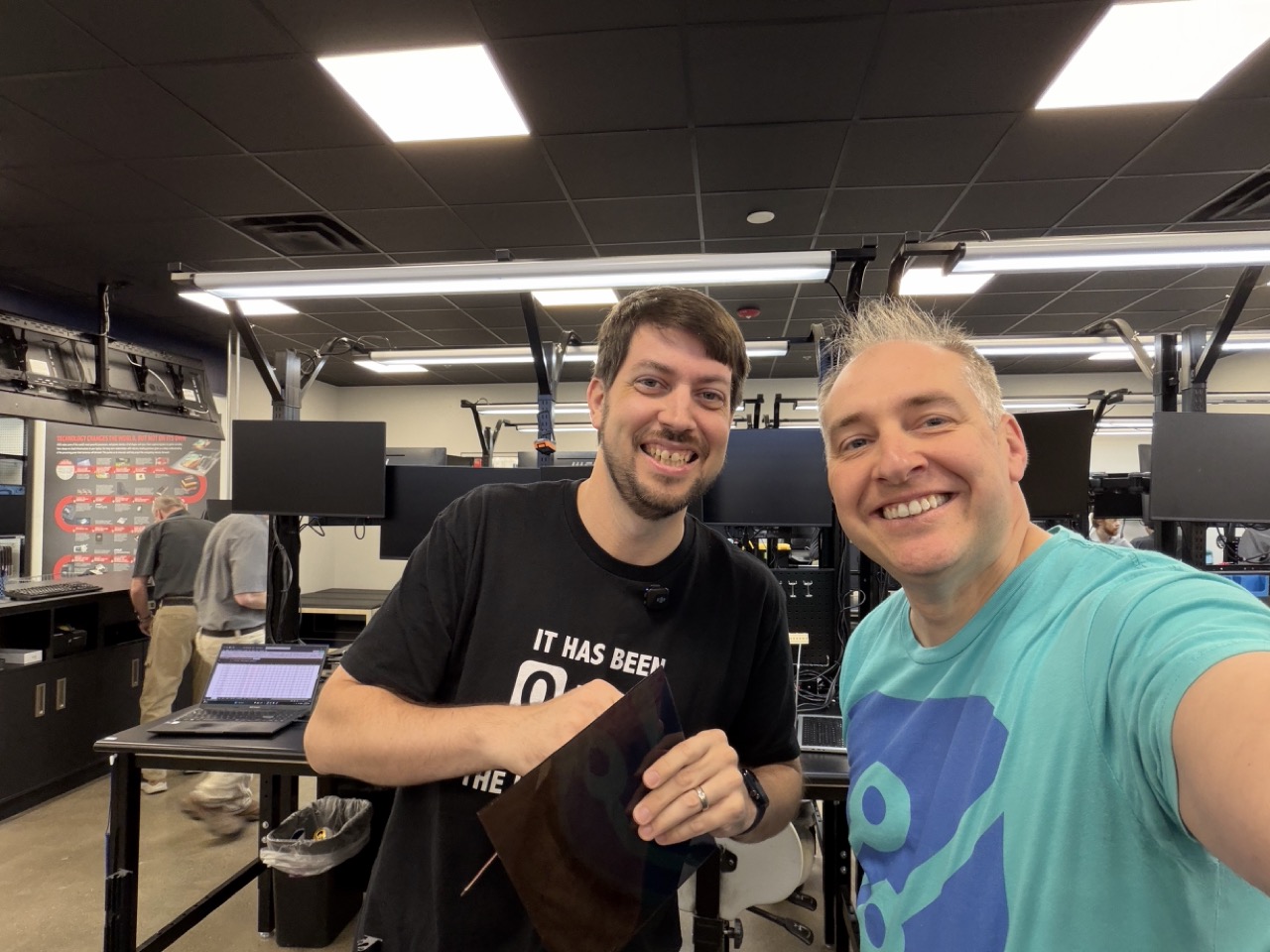
ServeTheHome’s Patrick Kennedy announces an appearance at Micro Center’s Columbus, Ohio flagship reopening alongside Jeff Geerling. They plan to build a mini-rack around Ubiquiti’s UniFi Cloud Gateway Fiber, and Kennedy will join a livestream focused on using the Minisforum N5 Max as an all-in-one homelab. The revised store is described as large and modeled on newer Micro Center design ideas, with an early line already around the building. The post is chiefly an invitation for local attendees and a preview of the on-site hardware projects.
Read the source →How Claude Watermarks AI-Generated Text
Sebastian Raschka explains Claude’s planned invisible text watermark as a small modification to normal token sampling, not a separate generation process. The intended use is attribution: Anthropic can decode a signal in text and identify output from a model such as Claude Opus 4.8, while ordinary readers cannot see it. The lecture begins from tokenization, model logits, and next-token sampling to clarify where a watermark can bias choices and why its cost can be modest. It also frames watermarking as imperfect and potentially removable, urging readers to assess its benefits and tradeoffs rather than assume it makes generated text inherently worse.
Read the source →Why Everyone Suddenly Hates AI Data Centers
The video argues that escalating opposition to data centers is now a political issue, with polling showing majorities of both Democrats and Republicans opposed and midterm candidates responding to the backlash. It rejects a one-cause account centered solely on AI-industry messaging, Big Tech’s reputation, or foreign influence, emphasizing instead that communities feel they lack agency over changes imposed on them. The discussion presents the conflict as potentially solvable and economically valuable if builders address local control rather than treating public resistance as simple misinformation. It offers an end-to-end primer on the infrastructure build-out and whether a constructive path remains.
Read the source →not much happened today
AINews’ roundup highlights a widening tradeoff in local models: Qwen3.8-27B is reported as unusually capable at tool use and autonomous workflows on a single RTX 3090, while users report weaker offline factual recall than Qwen3.6. It also notes DeepSeek-V4-Flash-Vision-Exp’s large reported multimodal and agent benchmark gains, alongside an elaborate 16-GPU DeepSeek V4 Flash setup claiming 100–150 single-user tokens per second and 727 aggregate output tokens per second at concurrency. On training efficiency, one experiment reports a 1.02B-parameter MoE with 145M active parameters trained for about $252 on one H200 and slightly exceeding GPT-2’s HellaSwag score. The issue also flags Nvidia’s reported licensing-and-investment arrangement with Poolside as a possible route to strengthen its open coding-model ecosystem.
Read the source →[AINews] 10% worse, 100x cheaper, 10000x faster: Why Simulation is taking over
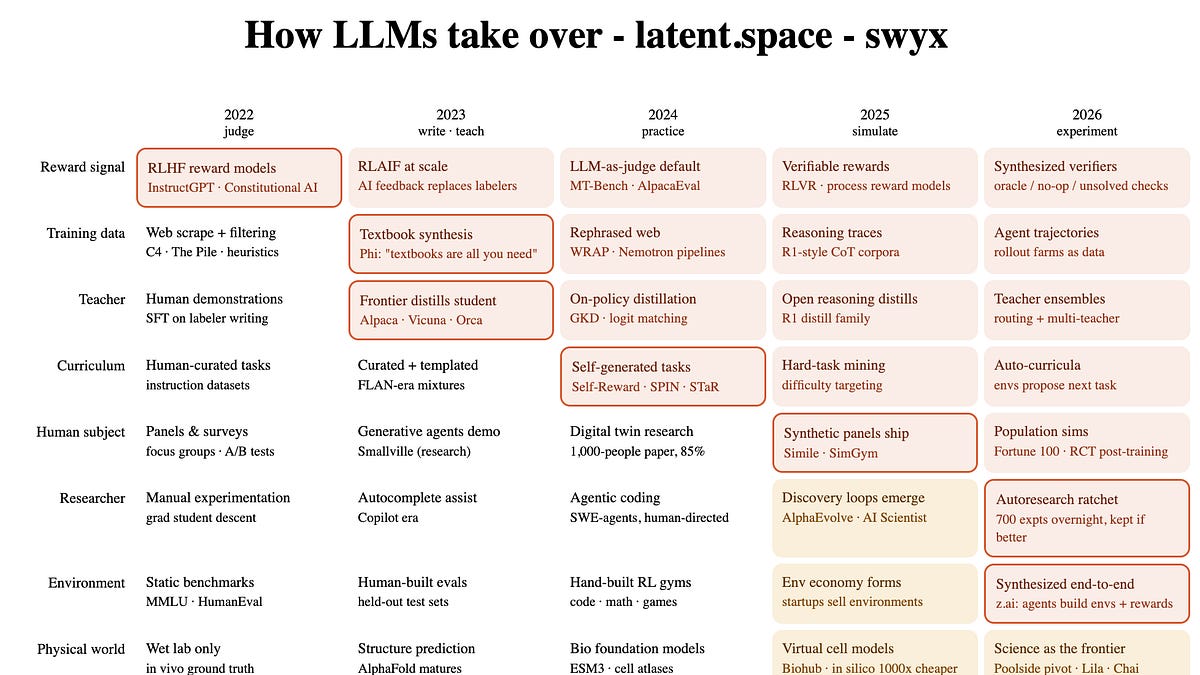
Latent Space argues that AI development is progressively replacing human-made components with synthetic ones: model judges, training data, instruction teachers, curricula, research loops, RL environments, and increasingly simulated users. It traces the shift from RLHF and synthetic textbooks through distilled instruction following to systems that generate tasks, test solvability, construct verifiers, and run automated experiment loops. The practical claim is not that synthetic systems are flawless, but that being somewhat worse can be overwhelmed by being roughly 100 times cheaper and 10,000 times faster. The proposed boundary is experiment-bound work: simulations can compress physical reality and human behavior, but they cannot substitute for real-world feedback such as wet-lab experiments.
Read the source →The Evolution of the Agent Harness
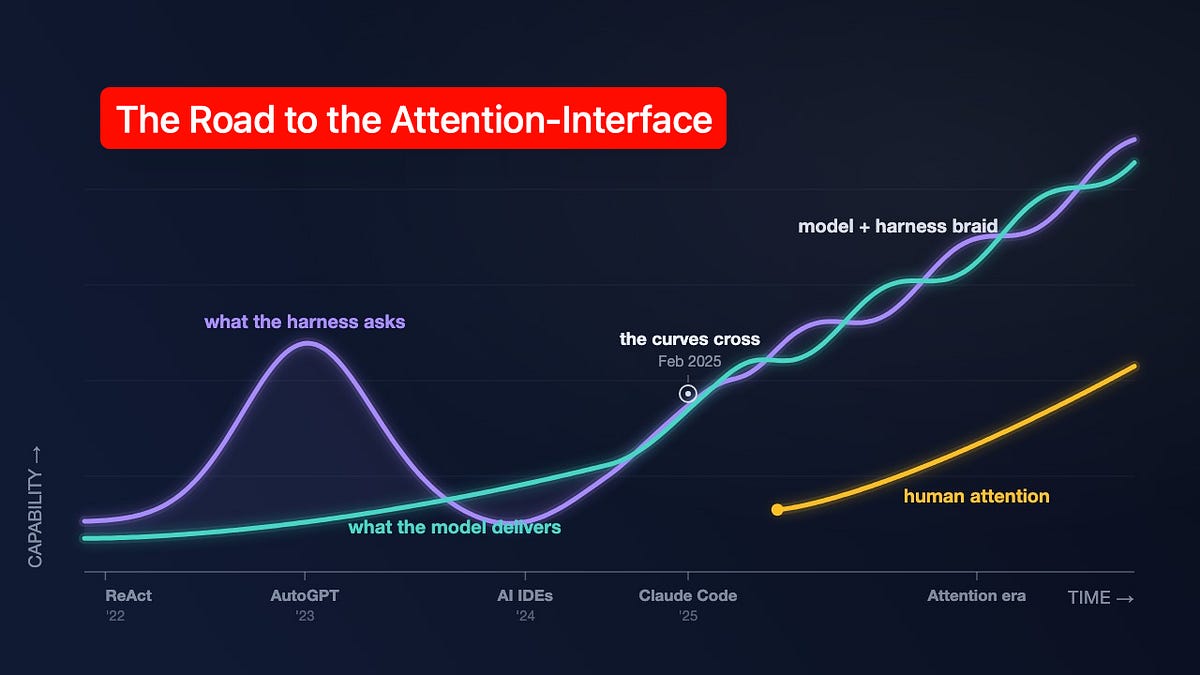
Latent Space defines an agent harness as everything around model weights that gives an LLM context, tools, memory, permissions, and guardrails—the body for an otherwise isolated predictive model. It argues that early autonomous-agent systems failed because the harness demanded more reliability than models could supply: even 95% per-step reliability yields only about a 36% chance across a 20-step task. As reasoning models improved, systems such as Claude Code could safely restore more autonomy; the article cites harness benchmarks where the same model scored from 52.4 to 76.2 across harnesses, and an ARC-AGI-3 improvement from 13.3% to 38.3% through retained reasoning and compaction. Its central prediction is that training will absorb successful harness behavior into model weights, allowing engineers to delete scaffolding—Anthropic reportedly removed 80% of Claude Code’s system prompt—and shift the remaining harness toward directing human attention.
Read the source →