AI’s next scaling fight moves beyond parameter count
Summary
The day’s material treats the frontier less as a race to advertise bigger models than as a systems problem: physical power, quantized and heterogeneous inference, training environments, and the runtime around an agent all affect useful capability and cost. That shift increases the value of transparency and control, but it also moves more responsibility to users—from vetting powerful plugins to demanding benchmark details that expose real operational tradeoffs.
The Sequence Opinion- Issue 918: The Energy Scaling Laws of AI

The essay argues that AI scaling is constrained by physical infrastructure, not just software metrics: every model response ultimately depends on chips, memory movement, cooling, transformers, and electricity generation. It recasts datacenters as factories that turn energy into intelligence, with nearly all supplied energy eventually becoming heat. Its central claim is that the next scaling law will include how efficiently societies build and operate power, transmission, and cooling systems alongside how they train models.
Read the source →Muse Video leaks 📹, Ramp Router launch 🔀, why Stripe bought OpenRouter 💰

The extracted material supplies only the headline and no article body, so it does not establish the details behind the reported products, launch, or acquisition. The item cannot be substantively summarized without inventing claims beyond that headline. Readers should consult the source for the underlying reporting.
Read the source →Introducing Qwen3.8-27B Dynamic v3 Unsloth GGUFs
Unsloth released post-training Dynamic v3 GGUF quantizations for Qwen3.8-27B, claiming more than 10% higher top-1% accuracy at equivalent GGUF sizes than competing offerings. It says configurations range from 1-bit versions usable on roughly 8GB of RAM to BF16, while retaining public imatrix calibration data for independent evaluation and fine-tuning. The release explicitly does not use QAT or QAD; commenters asked for comparisons with prior UD 2.0 quants and more diagnostics, including category-level results and KV-cache quantization divergence.
Read the source →Simple agents
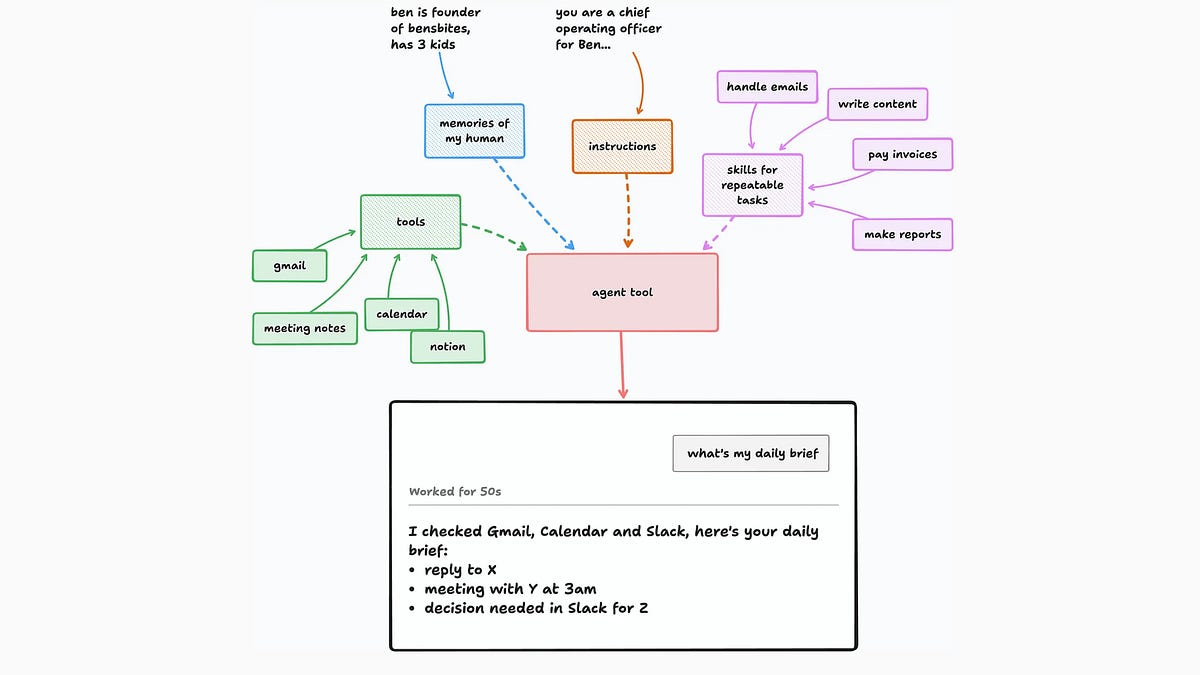
Ben’s Bites argues that a personal agent is fundamentally a portable folder of context files, instructions, and tools rather than a proprietary application. In this framing, memory is simply material read at the start of a session, so the same setup can be pointed at different agent products or model subscriptions. The practical recommendation is to keep the agent’s working context in files and make one instruction unambiguous: questions request answers, not unasked-for changes. The post also flags growing competition around routing, shared agent memory, collaboration inside Slack, and lightweight coding harnesses, while noting Ramp’s claim of 40% lower costs through automatic model selection.
Read the source →DeepSeek Harness: Is the Fastest-Growing Repo Worth It?

The review describes DeepSeek Harness as an open-source coding-agent environment whose distinctive feature is that even its core agent loop is implemented as editable plugins under the Cordis architecture. It reportedly reached 167,000 GitHub stars in under a week, supports hosted providers through OpenRouter or local models, and exposes unusually detailed observability such as token rates, cache hits, system prompts, trajectories, and downloadable session JSON. Its major tradeoff is security: every installed plugin currently gets full shell and filesystem access, so third-party code needs review before installation. The author finds its extensibility and debugging visibility compelling but does not consider it a clear replacement for Claude Code yet; it is most useful as a free, local tool to experiment with alongside an existing workflow.
Read the source →[AINews] Death of Params: Z.ai CEO Jie Tang on GLM 5.3 and the new Post-training Scaling Law
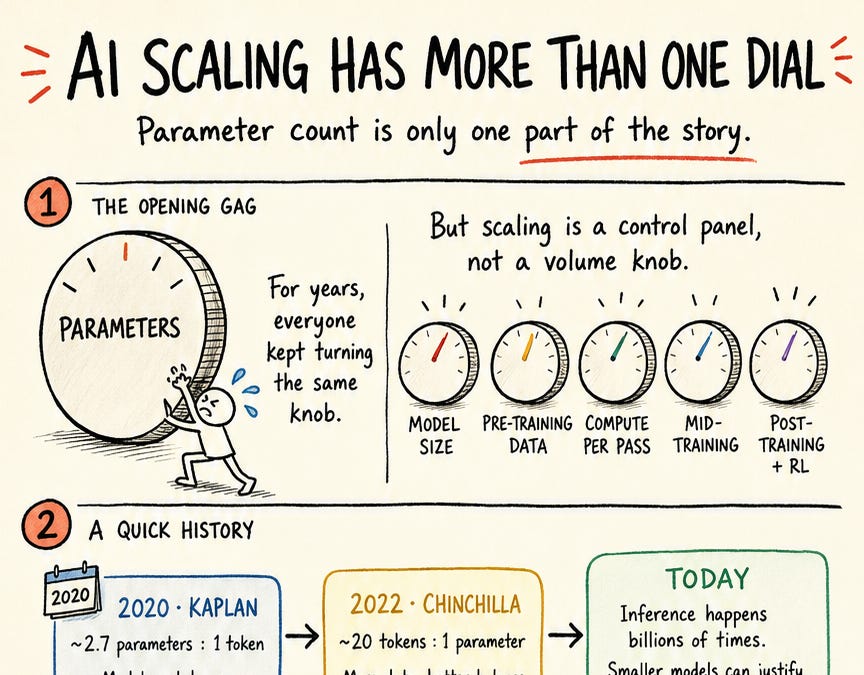
Jie Tang’s argument is that parameter count is meaningful only in combination with data, training and inference compute, sparsity, and the conditions under which a model is served. The cited GLM-5.3 gains allegedly came with the same base architecture and parameter counts as GLM-5.2, but from roughly a month of larger long-horizon environments and reinforcement learning. The account distinguishes memorization, which benefits from capacity, from reasoning, which it says benefits more from post-training data and effective depth; MoE systems further separate total knowledge capacity from active reasoning compute. Z.ai’s proposed training system creates executable, verifiable professional-style tasks synthetically, uses judge agents and checks for reward loopholes, and aims to make binary rewards dependable enough for direct RL.
Read the source →not much happened today
The roundup presents open-weight progress as increasingly dependent on compression, inference engineering, and training recipes rather than raw model scale alone. It highlights Unsloth’s Qwen3.8-27B quantization claims, local deployments that use multi-GPU tensor placement or speculative decoding for high throughput, and Alibaba’s reported 30-token-per-second CPU inference result, while commenters consistently ask for fuller context-length and quantization benchmarks. It also frames agent harnesses as a new competitive layer: DeepSeek Harness emphasizes a plugin-controlled runtime, while TrueForge claims comparable enterprise-agent quality with fewer tokens and much lower costs when routed to GLM-5.2. Across the model discussion, GLM-5.3 is offered as evidence that long-horizon RL environments, data quality, and effective depth can yield major gains without increasing parameter count.
Read the source →