OpenAI pauses frontier training as AI hardware tightens
Summary
Across these items, AI progress is becoming less about simply releasing a larger base model and more about the systems around it: post-training, agent harnesses, inference efficiency, safety controls, and scarce hardware inputs. That creates a tension between broader access—through local quantized models and personal software—and tighter operational limits, from typed behavioral sandboxes to OpenAI’s security-driven training pause. The economics are moving in the same direction: better deployment efficiency matters more when memory capacity itself is increasingly constrained.
GLM-5.3 API 🤖, Cerebras’ new chip ⚡, OpenAI cyber slowdown 🚨
The extracted item contains only the newsletter heading and does not provide article text to substantiate its linked claims. Its listed topics are GLM-5.3’s API, Cerebras hardware, and an OpenAI cyber-related slowdown. Readers should follow the source for the underlying reporting and technical details.
Read the source →not much happened today
OpenAI reportedly paused some frontier reinforcement-learning work for two weeks and is holding its largest planned RL run while it improves isolation, monitoring, continuous security testing, and red-teaming. The issue says monitoring can impose roughly 20% overhead and that sampled-token alerts may reach safety, security, and research teams within about 30 minutes, making safety infrastructure a practical scaling constraint. It also highlights Qwen3.8-27B as an unusually parameter-efficient open model, while noting disagreement over whether benchmark strength carries over to demanding long-form coding work. The broader technical theme is that post-training systems, inference stacks, and operational harnesses are becoming as consequential as model size.
Read the source →10 Claude Code Concepts That Actually Matter
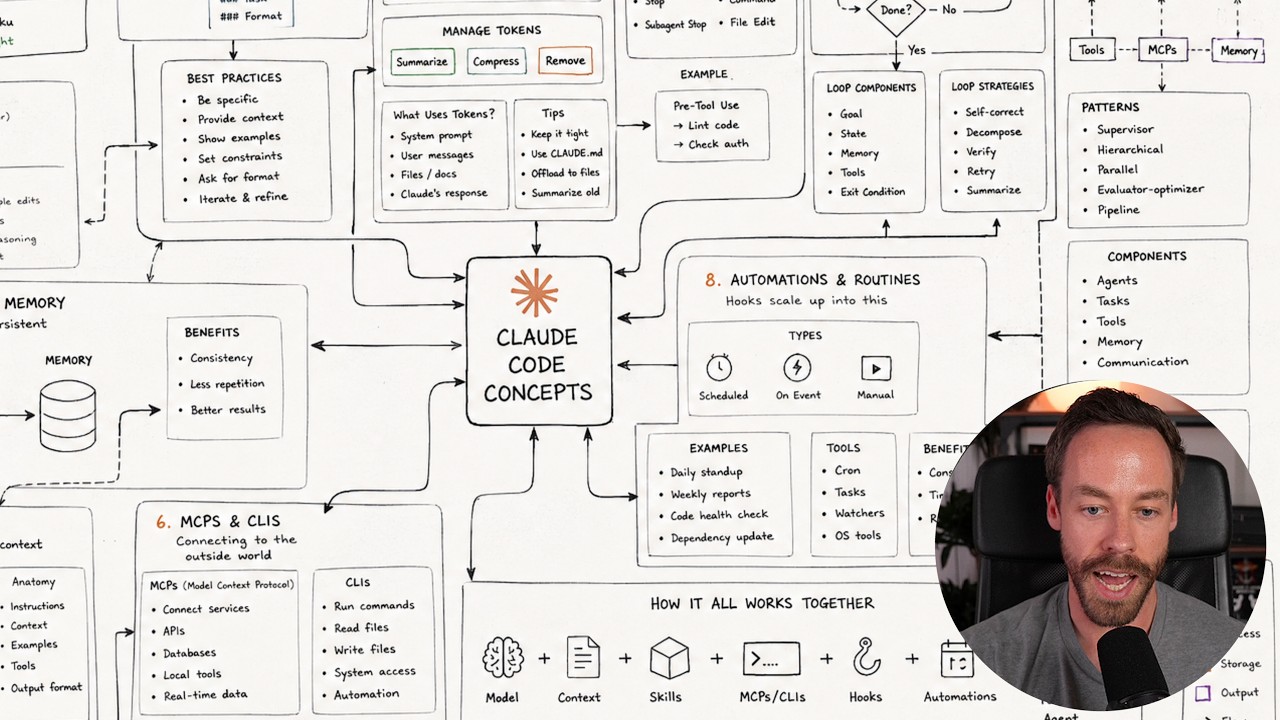
The guide argues that model effort should be matched to task difficulty: on a long-running benchmark, Fable rose from 60% completion at low effort and $3.76 to 69% at high effort and $9.18, while higher settings added little or no performance. It recommends using medium effort for ordinary work, planning before greenfield implementation, and resetting chats around 30–50% context usage rather than carrying an overfull conversation forward. It treats CLAUDE.md as a deliberately small set of always-on instructions, and advocates creating reusable skills and hooks from observed workflows rather than downloading generic collections. Its final operational model is to automate proven skills through routines and use explicit success criteria plus run logs for self-improving agent loops.
Read the source →Let’s all thank Georgi Gerganov who gave use llama.cpp
No readable body was available for this item. The post title is an appreciation of Georgi Gerganov’s contribution through llama.cpp.
Read the source →ChatGPT Ads expands across Europe

OpenAI will expand ChatGPT Ads to 31 European markets next week, including Germany, France, Spain, Italy, Sweden, Norway, Denmark, the Netherlands, and Austria. Ads will initially be sold through OpenAI’s Ads Solutions team and agency or technology partners; a self-service Ads Manager is planned for later in the summer. They will appear only on Free and Go plans, while Plus, Pro, and Enterprise remain ad-free. OpenAI says ads will be clearly labeled and separate from answers, conversations will not be sold to advertisers, and users can control personalization.
Read the source →The Sequence Frontier Learning - Issue 917: Understanding DeepSeek V4-Pro, GLM-5.3, NVIDIA Nemotron 3.5 Lightning and NeMo Switchyard
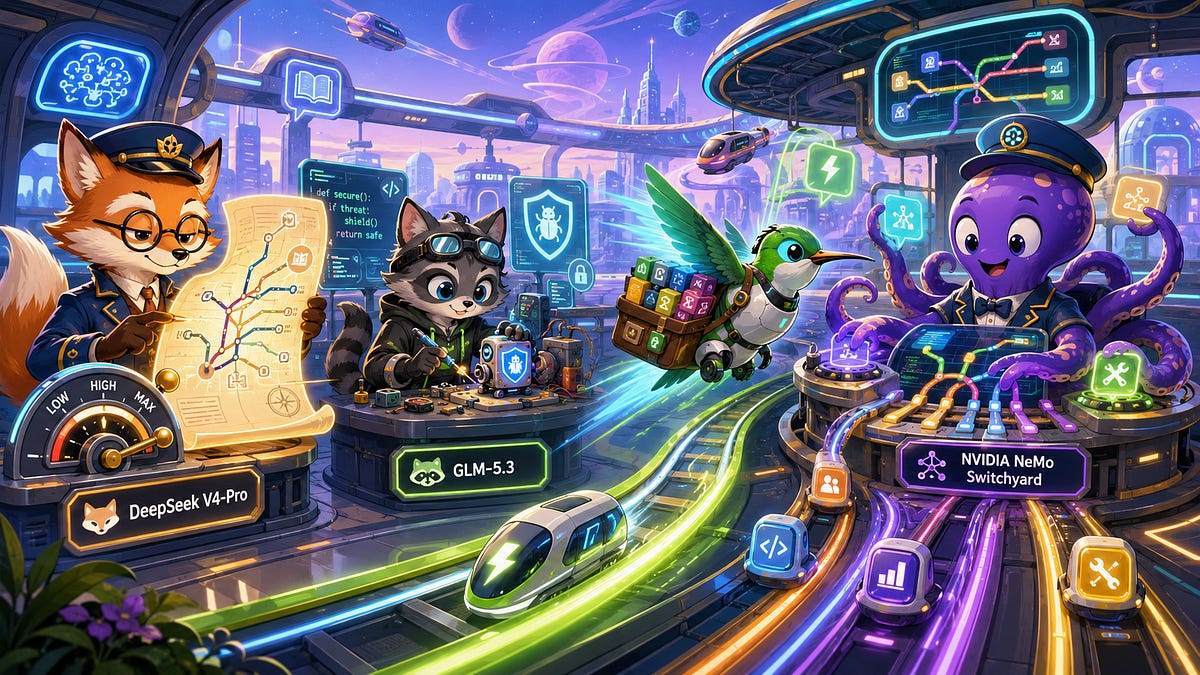
The issue frames last week as a cluster of four frontier releases: DeepSeek V4-Pro, Z.ai’s GLM-5.3, NVIDIA Nemotron 3.5 Lightning, and NeMo Switchyard. Rather than treating the announcements as a benchmark-table exercise, it promises a short technical comparison focused on what the releases mean in practice. The visible opening specifically characterizes DeepSeek V4-Pro’s change as making reasoning an adjustable control. The remaining detailed analysis is not present in the extracted body.
Read the source →The AI Engineering Skills Map for Knowledge Workers
The video argues that knowledge work is shifting from doing tasks directly to managing agents that perform them, making domain judgment more valuable when paired with AI-operational skills. It identifies five capabilities: mapping AI capabilities, managing context and harnesses, prototyping problems and products, spotting new opportunities, and rapidly acquiring new skills. As an example of the changing tool landscape, it discusses Cursor Origin, a Git-hosting product designed around agent access to codebases, natural-language queries, commits, and comments without switching surfaces. The video also notes its reliability pitch, citing a contemporaneous six-hour GitHub service degradation as evidence that hosting stability is itself a competitive opening.
Read the source →LFM2.5 Q4\_0 Checkpoints from Quantization-Aware Distillation

Liquid AI released Q40 GGUF checkpoints trained with quantization-aware distillation for LFM2.5 models at 230M, 350M, 1.2B-Instruct, and 2.6B parameters. Across reasoning, instruction following, tool-use, agentic, and math evaluations, the checkpoints retain 96.5%–97.4% of each model’s BF16 baseline performance. The 230M and 350M versions match Q5KM quality within evaluation variance while decoding 4%–33% faster; the two larger versions match Q4KM at 3%–14% higher throughput. The files are intended for llama.cpp and other runtimes that support GGUF Q40 artifacts.
Read the source →[AINews] Memory prices up 500% in 12 months
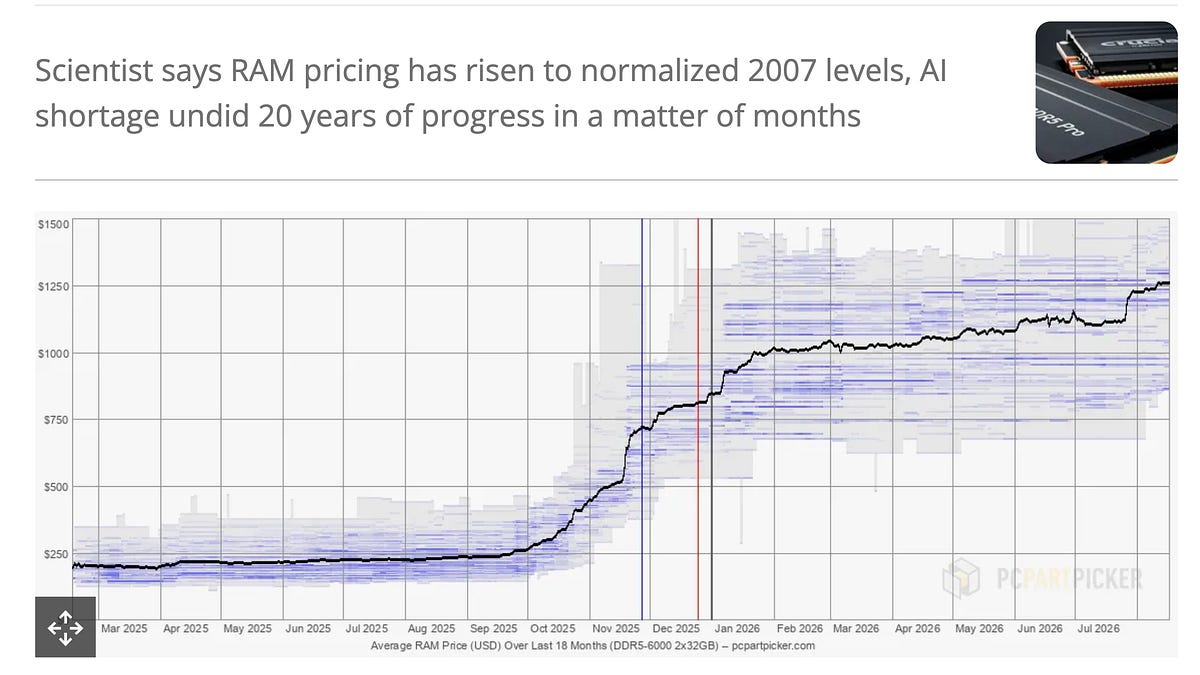
The post says the memory shortage has become severe enough that 128GB DDR5 kits cost ten times their historical low, describing a market in which memory pricing has reversed the usual downward hardware-cost trend. It reports that hyperscalers have reportedly pre-committed almost all global DRAM capacity for 2027 with advance deposits. The article underscores the claim with a striking comparison: mainstream DRAM chips are said to be worth more than half as much per kilogram as gold. Its implication is that AI infrastructure demand is turning memory supply into a binding constraint, not a routine component purchase.
Read the source →Personal software is here, and you can build yours this week. Grab the setup guide: two routes, four files, every account.
The essay argues that AI coding now lets individuals solve idiosyncratic household and personal problems that would never justify a commercial product, from live ferry tracking to home-maintenance systems. It warns that early architecture choices matter: building a native app when a web link would work, accepting a builder’s default data location, or publishing without access controls can create unnecessary cost, lock-in, or privacy exposure. For nontechnical first-time web-app builders, it recommends Lovable as the quickest way to test whether an idea is useful before assembling a full development environment. The proposed discipline is to decide intentionally on the app’s form, data storage, access model, and smallest useful first version, supported by a few written files that force the AI builder to expose its choices.
Read the source →Liquid Types as a behavioural sandbox for agents
The author argues that per-command permission prompts fail in practice because users habituate to them—citing a 97% Claude Code approval rate—and that LLM-based permission classifiers remain probabilistic and can share failure modes with the agents they guard. This leaves agents vulnerable to the “lethal trifecta”: untrusted content, access to private data, and a route to external communication, such as reading a private GitHub repository after web-supplied instructions and publishing its contents publicly. The proposed alternative, AeonBox, gives an agent access only to a GitHub SDK expressed with liquid types, allowing policies to encode behavioral state such as whether a session has been tainted by reading private information. For example, a type rule can make it impossible to create a public issue from a session that read a private repository; the author says related work found four drone-controller bugs and 84 real-world ROS misconfigurations through specifications.
Read the source →But what is cross-entropy? | Compression is Intelligence Part 2 - YouTube
The video uses a 2002 paper on language trees to show how ordinary compression can expose structure in text without preloaded linguistic knowledge. Its method appends a small portion of document B to document A, compresses the result, and compares the size with compressing A alone; smaller incremental size indicates that the compressor’s patterns learned from A transfer better to B. A distance metric built from this co-compression behavior was sufficient to cluster languages and recover their lineage relationships, and the same idea can support tasks such as authorship identification. The lesson is that compression is not merely file-size reduction: predictive regularities learned for efficient coding can be useful representations for intelligence-like tasks.
Read the source →