DeepSeek-first cascades cut coding-agent costs
Summary
The day’s strongest pattern is a shift from choosing a single “best” model to building controlled systems around multiple models: cheap-first routing, endpoint experiments, bounded agent workflows, and handoff packets all make verification and escalation the real operating layer. That same operational framing raises the bar for safeguards—human review, tests, stable cohorts, permission boundaries, and monitoring matter as much as raw benchmark scores. Meanwhile, better retrieval and potential test-time-compute distillation point to continued gains from system design and inference strategy, not just larger base models.
Show HN: Sokoban AI Solver

This browser-based Sokoban solver uses a JavaScript port of the author’s native C++ A implementation and promises provably minimum-move solutions rather than merely valid ones. It solves boards 1–14 live in milliseconds, avoiding the state explosion of naïvely searching every keeper movement. The exceptional 8-box board requires roughly 49 million states and more than 1 GB for optimal search, so its 184-move solution was computed offline by a parallel C++ version in about five seconds on 24 cores and then replay-verified. It is a concise illustration of where browser-side optimal search is practical and where precomputation is the sensible interface choice.
Read the source →Every Repo Is a Software Factory Now | Don Syme, GitHub
GitHub principal researcher Don Syme frames “continuous AI” as a separate complement to CI/CD: recurring, repo-situated automation for subjective work such as issue triage, documentation, research, performance improvement, and small bug fixes. GitHub’s public-preview Agentic Workflows run a choice of coding agents in Actions with explicitly bounded inputs, permissions, and outputs; untrusted outside issues are ignored by default, and the aim is not to put nondeterministic AI inside CI itself. Syme argues that human approval should remain the gate for code changes, while agents can improve review throughput by collecting evidence, applying automated quality checks, and discarding weak pull requests before they reach people. He favors operational controls such as schedules, cost budgets, model comparisons run simultaneously against the same ledger, and repo or side-repo boundaries that make authority and automation ownership understandable.
Read the source →A new way of TRAINING LLMs with 3x less memory...!?
The video discusses research that may reduce training memory use by roughly two to three times, with a more speculative ceiling of six times, across text generation, image generation, and image classification. It also claims to address a communication bottleneck in distributed training, which could matter as model training spans more devices. The presenter cautions that the result has only been confirmed at a few hundred million parameters so far, not at billion-parameter scale. The practical takeaway is promising but preliminary: memory savings should not be assumed to translate to frontier-scale training until the scaling evidence arrives.
Read the source →Do you use a personal agent?
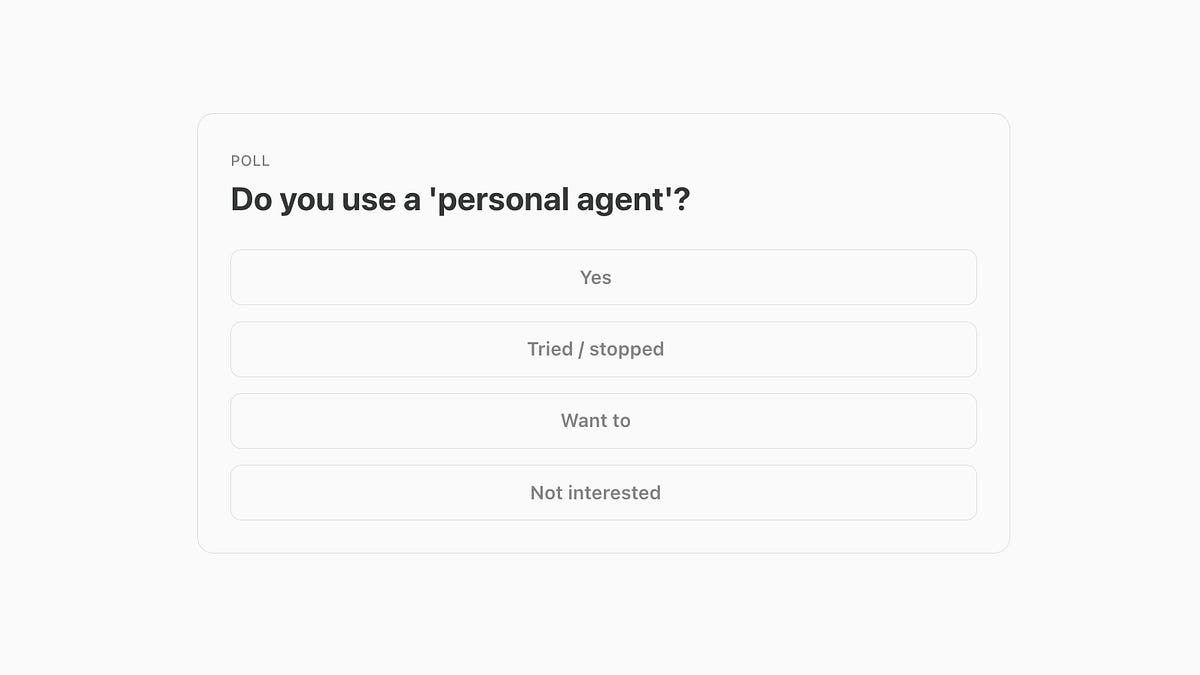
Ben’s Bites asks readers whether they use agents outside work for organizing life, handling email, or operating a computer, while noting that agent products are increasingly adopting a “bot mode” interaction model. The newsletter points to an opt-in Codex/ChatGPT desktop computer-history feature that turns activity across apps and websites into a searchable memory and timeline, highlighting the privacy and usefulness tradeoff in more persistent assistants. It also flags rapid model and tooling churn, including Gemini 3.7 Flash’s claimed benchmark gains and temporary discount, GPT-5.6 Sol API access for select customers, and Cursor’s Origin launch during another GitHub outage. Its broader signal is that agents are moving from isolated prompts toward durable personal context, desktop control, and production software workflows, while governance remains a major organizational blocker.
Read the source →The Handoff Packet for Local Agentic AI
Paul Everitt and Dan Gerlanc argue that local coding agents become more dependable when engineering systems take work away from the model: static analysis, type checking, language servers, AST edits, structured tools, and clear tests reduce the turns a smaller model needs. They advocate tightly scoped “handoff packets,” with a large model shaping the project, a medium model orchestrating, and a small local model executing bounded tasks rather than conducting long unsupervised runs. Their proposed economics are hybrid: local models handle routine work on accessible hardware, while remote models handle difficult reasoning; optimized and quantized deployments could make useful 12B–27B coding workflows viable more broadly. The pair stresses that specs can drift and tool calls can fail, so developers must still inspect, test, and own shipped code.
Read the source →Multi-Vector (Late Interaction) Embedding Models with Sentence Transformers

Sentence Transformers 6.0 adds MultiVectorEncoder support for ColBERT-style late-interaction retrieval, loading PyLate, Stanford-NLP ColBERT, and compatible ColPali visual-document checkpoints through the familiar library API. Instead of compressing an entire document into one vector, the approach retains token-level vectors and uses MaxSim to let every query token find its strongest document-token match, improving precision for exact identifiers, multi-constraint queries, and long or out-of-domain text. The tradeoff is a much larger index: one example produced 608,414 token vectors for 4,874 passages—about 42 times a MiniLM index before compression—though a PLAID-compressed version was 92 MB, comparable to some dense indexes. It also enables text-to-page-image retrieval without OCR, making the release relevant beyond conventional RAG.
Read the source →Partnering with CodeAI to prepare the first AI generation
OpenAI says it is partnering with CodeAI to help students build AI literacy, think critically about AI, and develop skills to use and shape it responsibly. The stated emphasis is not only using AI tools, but understanding their implications and exercising judgment around them. The announcement offers no operational detail in the supplied text about curriculum, scale, dates, or how the partnership will measure outcomes. For educators, the actionable signal is OpenAI’s continued positioning of responsible AI fluency as a core student skill rather than a purely technical specialty.
Read the source →Introducing ChatGPT for Teens: Built for learning, backed by protections
OpenAI introduces ChatGPT for Teens as a learning-oriented product with stronger built-in protections, healthy-use features, and additional parental controls. The supplied announcement presents the service as intended to support thinking critically and using AI with confidence, not simply as unrestricted access to a general chatbot. It does not specify in the available text which safeguards, age thresholds, parental settings, or enforcement mechanisms distinguish the teen offering. Parents and schools should therefore treat the announcement as a product-positioning signal and seek the detailed controls before relying on it for policy decisions.
Read the source →The Sequence Knowledge - Issue 916: From Thinking Longer to Learning Better

The Sequence argues that test-time compute—sampling many answers, voting, searching reasoning paths, or self-verifying—has become a major way to buy better model performance without retraining weights. Its central question is whether an expensive inference ritual can be distilled back into the same model’s weights, teaching one forward pass to approximate the result of many. That makes test-time-compute distillation unusual: the teacher is not a larger network but the same network given more time to reason. The implication is that a scaling law may be hiding in inference spend, with repeated reasoning potentially becoming future training data rather than a permanent per-query cost.
Read the source →DeepSeek V4 Pro 0813 vs GPT-5.6 Sol on DeepSWE: Cost, Coding, and Routing
Together AI’s 904-rollout DeepSWE comparison finds GPT-5.6 Sol ahead on first attempts (72.7% pass@1 versus DeepSeek V4 Pro’s 62.8%) and much faster per rollout, but DeepSeek ahead after four attempts (88.5% versus 85.8%) at $0.24 instead of $8.37 per rollout. Sol is stronger across six of eight task domains and four of five languages, especially data modeling and serialization, but its failures regress existing tests 20% of the time versus Pro’s 11%. The proposed production policy is test-gated routing: run Pro first and escalate rejected work to Sol, reaching 83.0% solved at $3.35 per task—better than Sol alone’s 72.7% at $8.37. That recommendation depends on reliable automated verification; without it, Sol’s first-try precision and lower latency are the more relevant advantages.
Read the source →DeepSeek V4 Pro 0813 vs Claude Fable 5 on DeepSWE: Cost, Coding, and Routing
Together AI reports that Claude Fable 5 wins first-shot DeepSWE accuracy over DeepSeek V4 Pro (69.7% versus 62.8%), but Pro overtakes it by four attempts (88.5% versus 84.1%) while costing $0.24 per rollout against Fable’s $21.63. Fable’s price is most defensible for Rust (85% versus Pro’s 65%) and serialization-heavy work, while Pro leads in TypeScript, stateful reactivity, and concurrency/durability and produces fewer severe misses. The models have unusually low task-level correlation (0.39), so their strengths are genuinely complementary rather than redundant. A Pro-first, test-rejected escalation to Fable is reported to solve 82.7% at $8.28 per task, 13 points above Fable alone and 62% cheaper, provided the test suite can reliably decide whether to escalate.
Read the source →A/B test models in production
Together AI adds endpoint-level A/B experiments that split live traffic across one control and up to 20 model variants, so teams can measure product outcomes rather than merely latency, errors, and throughput from shadow traffic. Variants must have zero weight in the endpoint’s normal traffic split; the experiment owns their fixed percentages, preventing autoscaling or replica counts from contaminating cohort shares. Teams can start at 95/5, update the complete member list to ramp exposure, use etags to prevent conflicting edits, and delete the experiment to return all traffic to the control without leaving application-side routing code behind. The platform attributes each response to a deployment, but leaves product-quality measurement—ratings, retries, retention, or completion—to the customer’s analytics; stable user sampling keys are necessary when session consistency matters.
Read the source →Cursor Origin 👨💻, Anthropic $65B revenue 💰, deadline dividend scaling 📈

The supplied TLDR extract focuses on agent-security promotion rather than the broader newsletter title: it advertises an October 21 NYC AI Agent Security Summit and a guide to threats from rogue skills, MCP servers, and dependencies in coding agents. It cites a claim that only 15% of security teams feel confident detecting an AI-agent incident. The concrete message is that as coding agents gain access to tools and repositories, incident detection and supply-chain controls are lagging adoption. The available extract does not substantiate the title’s claims about Cursor, Anthropic revenue, or deadline-dividend scaling, so no additional conclusions can be drawn from it.
Read the source →