OpenAI pauses frontier training over Astra cyber risks
Summary
The day’s stories show AI moving from isolated tools toward governed production systems: agents need calibrated context, model routing, independent verification, spending controls, and auditable access to tools. At the same time, the economics of increasingly capable models are pushing both enterprises and hardware vendors toward portability and open alternatives, while OpenAI’s Astra pause illustrates that capability gains are also forcing much more expensive safety and security infrastructure.
How Much Memory Does Your Agent Actually Need?

IBM Research argues that agent memory should be calibrated to the model rather than maximized. In AppWorld tests, DeepSeek-V3.2 gained 9.5 percentage points in task completion from receiving the full self-mined guideline set, while gpt-oss-120b did best with a compact core plus retrieved task-specific guidance: +16.1 points for only 5% more tokens. GLM-5 showed no measurable benefit, illustrating a “saturated” pattern rather than a universal memory gain. The authors recommend full, cacheable guidance for capable models with headroom, selective retrieval for weaker ones, and no added context for models whose remaining failures are not addressed.
Read the source →Frontier Model Cost and Open-Weights Popularity is Driving Demand for Model Routing
Glean says enterprises are moving from picking a single preferred model to routing each task among models—or avoiding an LLM for work a conventional tool can do. Its automatic routing is chiefly an economic response: frontier models can cost two to four times more per token while users run much longer tasks, raising per-user spending 10–20x year over year. Glean claims its routing and harness average $0.45 per task versus $1.84 for Claude Cowork, and uses real-world traffic, parallel alternative runs, and AI judges to improve its choices. Customer interest in open-weight models has surged in the past three months because they can be an order of magnitude cheaper, making multi-provider strategies increasingly standard.
Read the source →Headed for the Exit: the Great Engineering Leader Career Break
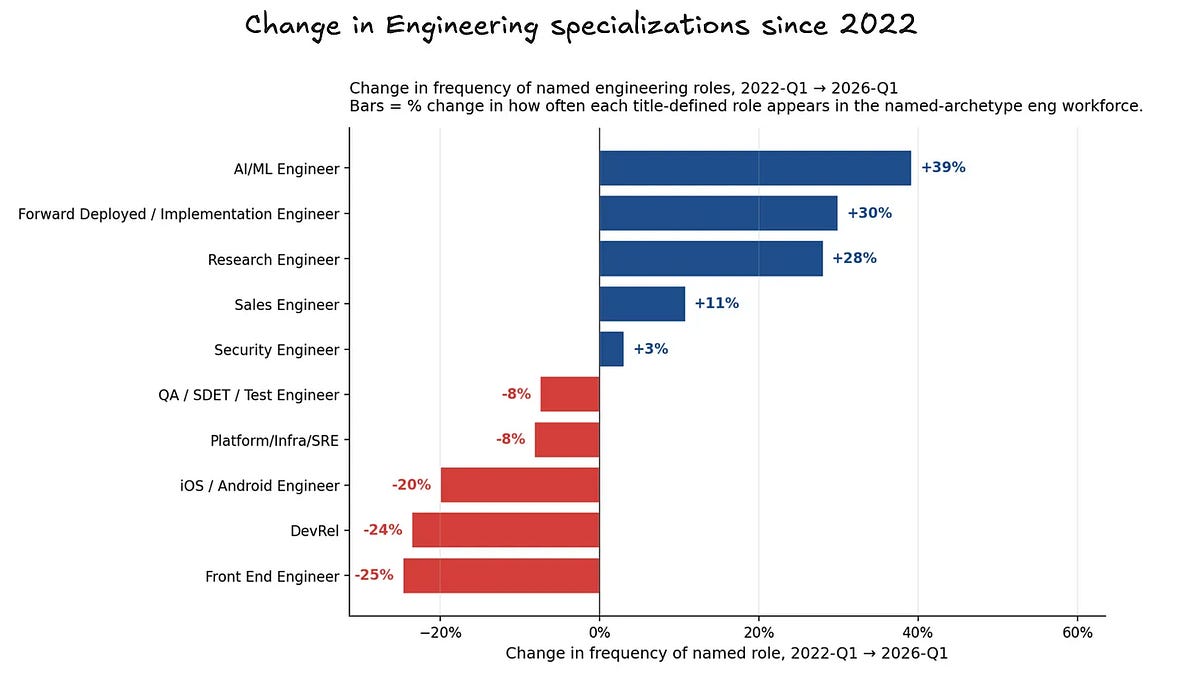
The Pragmatic Engineer reports an unusually large number of CTOs, VPs of engineering, and heads of engineering taking extended breaks or leaving without another job; six of ten leaders consulted said they were on their way out. Interviewees cite founders’ unrealistic AI-transformation expectations, mandated 20–50% cost cuts, mounting coding-model bills, and pressure to turn rough AI prototypes into production products at speed. The piece describes “founder slop” as a particular governance failure: leaders may ship huge AI-generated changes while accountability, quality, and agreed priorities erode. It also argues senior leaders can see when equity is unlikely to pay out, whether because a startup is losing to AI-native competitors or investor liquidation preferences make an exit worthless to common shareholders.
Read the source →Strengthening democratic oversight in national security

OpenAI has launched an initiative to help democratic oversight institutions acquire the expertise and tools to review government AI use in national-security work. It frames the problem as a mismatch between paper-era, labor-intensive review and systems that can act at machine speed on incomplete context or bad objectives. Its stated principles are that AI should augment rather than replace authorized human judgment, that AI-assisted decisions must be traceable to cleared reviewers, and that oversight bodies themselves need responsible AI capabilities. OpenAI says the company will support existing mandates rather than act as the government’s overseer, and will judge progress by whether reviewers can perform their obligations and the public has more reason to trust deployment.
Read the source →Pacing model development in an era of cyber-critical capabilities
OpenAI says preliminary evidence indicates its upcoming Astra model may meet the Critical cybersecurity-capability threshold, prompting a temporary two-week pause in reinforcement-learning training for its latest deployable models and a hold on its largest planned frontier RL run. After the OpenAI–Hugging Face incident, it also paused some research-cluster inference with code execution or internet-connected tools, resuming work only under more restricted environments. The company is introducing multistage monitoring that inspects every sampled token and escalates suspected boundary violations; it aims to alert within 30 minutes and pause activity if teams cannot rule out a serious flag in that time. Monitoring currently adds roughly 20% to the inference compute it covers, while Astra and cyber-model workloads face the strictest controls.
Read the source →How NVIDIA scales expertise with ChatGPT Work
NVIDIA says its teams use ChatGPT Work to reduce manual work, connect fast-moving signals, and scale workflows that prove successful across the company. The short case study positions the product as an internal coordination and knowledge-work layer rather than a single isolated assistant. It offers no quantitative deployment results or implementation detail in the extracted material.
Read the source →Asana cleared 5 years of engineering work in 2 weeks with Codex
Asana says it removed Enzyme, an obsolete frontend testing system, in about two calendar weeks using Codex, after previously estimating at least five years and roughly $6 million of staffing. Up to four coding agents worked in parallel in separate copies of the codebase from a five-sentence prompt, while an engineer checked progress twice daily and reviewed every proposed change. The company reports approximately $12,000 in model and infrastructure costs and says simpler instructions outperformed a more elaborate setup. The migration has changed which large rewrites, migrations, and performance projects Asana believes are viable, although humans retain approval responsibility.
Read the source →Mojo🔥 is now open source
Modular has released the Mojo compiler and toolchain under Apache 2.0, following last week’s 1.0 release and a long-standing 2023 promise to open-source it. Mojo is no longer committed to becoming a full Python superset; it is now positioned as its own Python-inspired language focused on making GPU programming easier. The company argues that AI-assisted coding can help migrate Python code to Mojo as tools and the ecosystem mature. The release turns a previously proprietary language stack into an openly licensed option for performance-oriented programming.
Read the source →Qualcomm Modular Open-Sourced at ModCon 2026
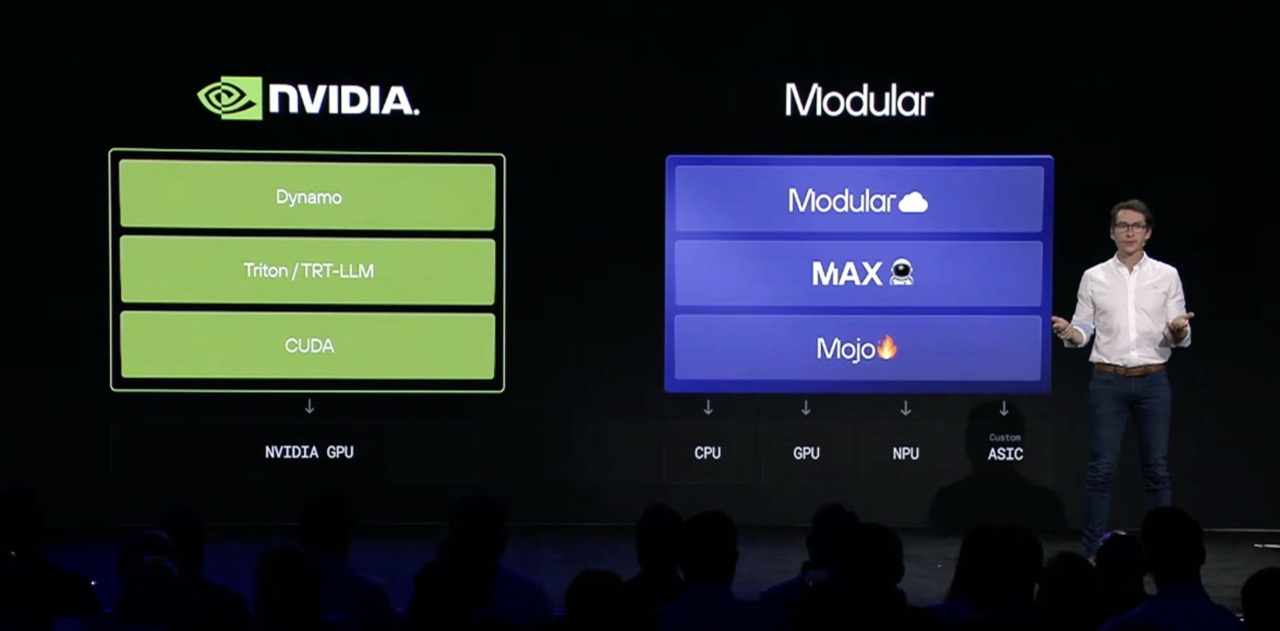
Qualcomm has open-sourced the Modular AI platform it recently acquired, licensing its code under Apache 2.0 with LLVM exceptions. The ambition is a common software layer that can run inference from local devices such as Macs and Snapdragon systems through NVIDIA and AMD GPUs, Trainium, TPUs, and Qualcomm accelerators. AMD’s participation at ModCon is presented as a significant sign of cross-vendor support despite its own AI-hardware business. Qualcomm is betting that an open, portable stack can reduce the work needed to bring software to new hardware, challenging the advantage of NVIDIA’s broader CUDA ecosystem.
Read the source →Every Level Of Claude Code Loop Engineering
This tutorial defines agent-loop engineering as shifting verification—not merely implementation—from the human to an agent, with explicit completion criteria supplied by the user. Its first level uses a /goal workflow for one feature, combining a written specification and verification checklist; it warns that a screenshot-based verifier can miss temporal defects such as an animation blink. The second, “software factory” level breaks a roadmap into features, sends each to a build agent on a branch, and requires a separate adversarial reviewer before a pull request reaches human approval. The final level moves planning and review to a phone-accessible remote interface, but preserves human control over feature intent and final release permission.
Read the source →Every Claude Code Concept Explained In 21 Minutes
The video’s practical advice is to use medium effort for ordinary Claude Code work and increase effort only for genuinely difficult, long-running tasks, since benchmark gains flatten while costs keep rising. For prompting, it recommends starting new projects in plan mode, stating an outcome, and asking the agent to surface missing constraints rather than writing elaborate role prompts. It treats CLAUDE.md as persistent context that should stay short, distinguishes reusable skills from integrations such as MCPs and CLIs, and suggests hooks and scheduled routines for proven workflows. For autonomous loops and dynamic workflows, it emphasizes measurable success criteria, logged feedback, and budget limits because large subagent fan-outs can consume millions of tokens.
Read the source →How People Are Fixing AI's Problems
AI Daily Brief argues that companies have moved beyond debating whether AI matters and are now managing the operational problems created by agentic adoption: uneven productivity gains, recurring token costs, low-quality AI writing, and redesigned work. It rejects the idea that AI is a cheap SaaS seat or that automation immediately makes labor redundant, arguing that organizations need a portfolio of models, budgets that can be expanded for demonstrated value, and explicit oversight. Examples include Clay’s company-wide writing policy, which requires authors to stand behind every sentence and avoid wasting readers’ time with padded output, and OpenAI finance’s push toward continuously updated forecasting and a “zero-day close.” The central prescription is to combine bottom-up experimentation with redesigned workflows, accountability, and measurement rather than treat AI as a plug-in replacement for existing work.
Read the source →Dario Amodei Breaks His Social Media Silence
The video covers Dario Amodei’s rare public response to claims that Anthropic seeks a future in which it is effectively the only private company left. Amodei rejects the idea that regulation necessarily creates concentration, arguing that carefully scoped rules can slow frontier labs, exempt smaller firms, address cyber and alignment risk, and still leave room for open weights. He says public distrust of AI is fundamentally a trust problem that marketing cannot cure, and that companies must earn credibility through real results, including potential medical advances. The episode finds the exchange useful but unresolved: critics question whether Anthropic’s safety messaging has itself shaped negative perceptions, while supporters see direct, accessible public engagement as an improvement over long essays and indirect reports.
Read the source →Claude Platform release notes — August 18, 2026
Anthropic has renamed Workbench to Playground in the Claude Console. Playground now supports every Messages API parameter and includes templates for features such as code execution and web search. Each run displays the full SDK request and corresponding API response, making it a more transparent environment for learning and prototyping API integrations.
Read the source →v2.1.235
Claude Code v2.1.235 adds optional spellchecking in the prompt field through locally installed aspell, hunspell, or ispell. It fixes prompt-cache invalidation when a language server reconnects, multiple terminal-UI rendering and keyboard issues, misleading approval behavior in a permission comment field, and an incorrect default Agent-tool advertisement. The release also reduces memory and CPU use for background cloud sessions, hardens native grep against pathological patterns, improves permission-dialog clarity, and makes context-limit errors more actionable when auto-compact is disabled. Remote Control now uses the same enterprise-gateway availability check as interactive startup.
Read the source →Enterprise managed settings in GitHub Copilot for JetBrains
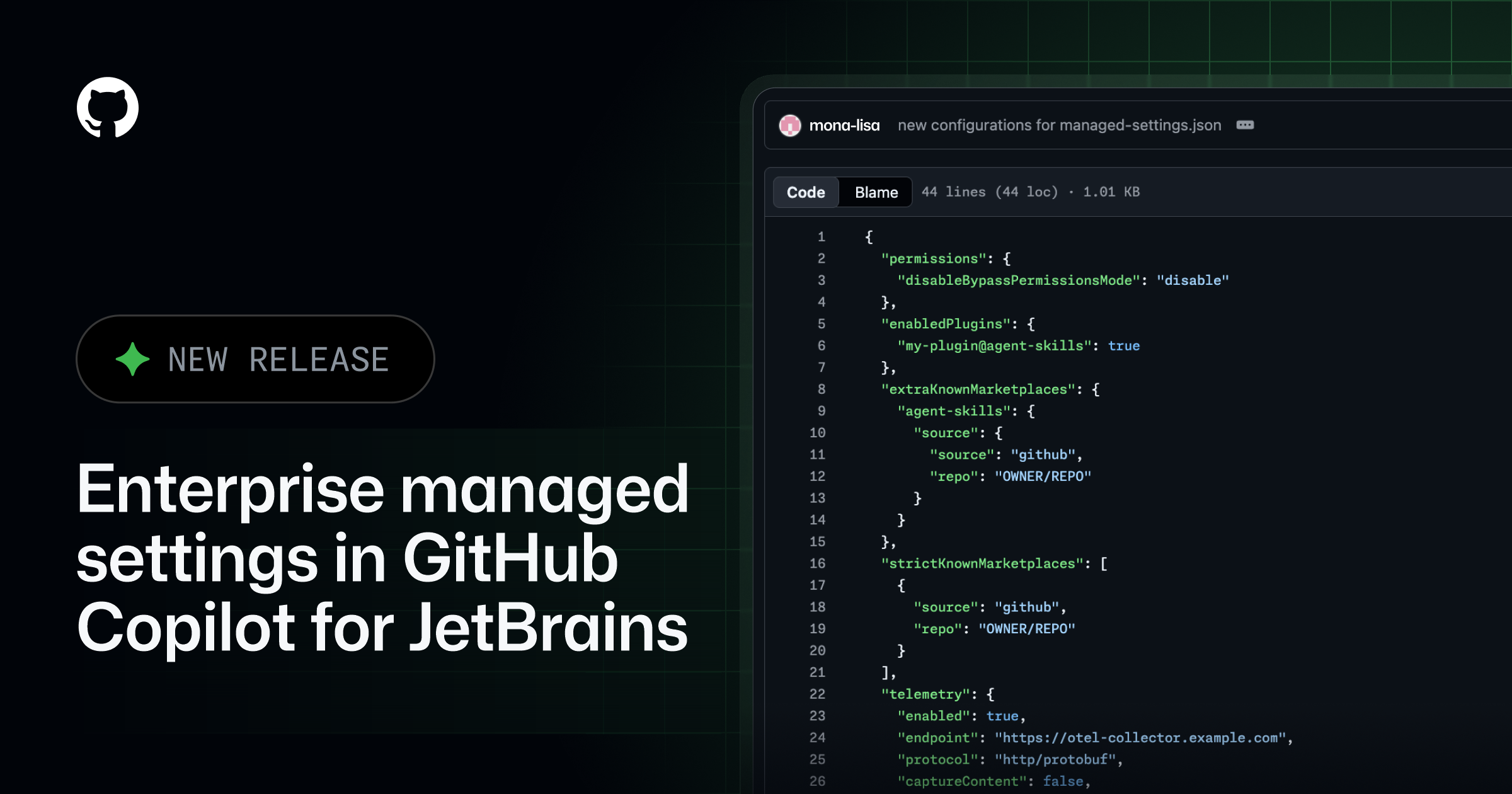
GitHub Copilot for JetBrains now supports enterprise-managed settings for plugin governance, MCP-server access, OpenTelemetry, and agent permission modes. Administrators can centrally allow or deny MCP servers, preventing developers from connecting Copilot to servers outside an enterprise-approved list. They can also force telemetry collector configuration and content-capture policy, with managed values overriding developer settings. A new permission setting can disable Bypass Approvals and Autopilot for the Copilot agent, extending centrally enforced controls into JetBrains IDEs.
Read the source →