SpaceX closes $60 billion Cursor acquisition
Summary
The common change is that AI advantage is increasingly being framed as operational control rather than raw model intelligence: integrated products, reusable workflow context, and rapid feedback loops determine who can turn capabilities into reliable work. That makes the frontier less about choosing one best model and more about designing the environments, interfaces, data flows, and verification systems around many models. It also sharpens a tension between centralized, vertically integrated platforms and user-owned, modular stacks.
Build a Claude Code Command Center in Obsidian

The author argues that an Obsidian-based Claude Code setup is useful only when it becomes an operational interface for real skills and automations, not merely a visual dashboard. Their custom plugin combines token usage, social metrics, calendar data, headlines, and one-click automation controls; a local-GPU voice layer can answer from precomputed reports rather than repeatedly launching live research. Requests are routed into tiers so quick retrieval stays fast while deeper work can run separately, with Haiku as the default router but a local model as an option. The proposed memory benefit is not graph RAG or magically expanded context: well-indexed Markdown folders and a clear claude.md navigation guide give Claude Code a map through a large vault, improving retrieval speed, accuracy, and token use.
Read the source →Joy & Curiosity #95

Thorsten Ball says he has recently shipped a provider backend, bug-reporting and triage features, resource warnings, startup logs, dictation settings, theme preferences, a hidden game, and other changes entirely through remote agent-operated “orbs,” while also fixing about 20 bugs and removing 5,000 lines of obsolete code. His central claim is that agents with permissive, task-specific remote environments can supply convincing, bespoke proof of behavior—such as presentations or narrated, frame-by-frame demonstrations—reducing the need for a local development setup or line-by-line review. He still sees iterative visual design as a hands-on need, but says dictation, screenshots, assets, and rapid generation of many variants turn the human into a selector and director rather than the sole implementer. The post treats this as a broader shift in software work: architectural judgment and spot checks remain important, while local checkouts and traditional development rituals become optional.
Read the source →CORS Chat
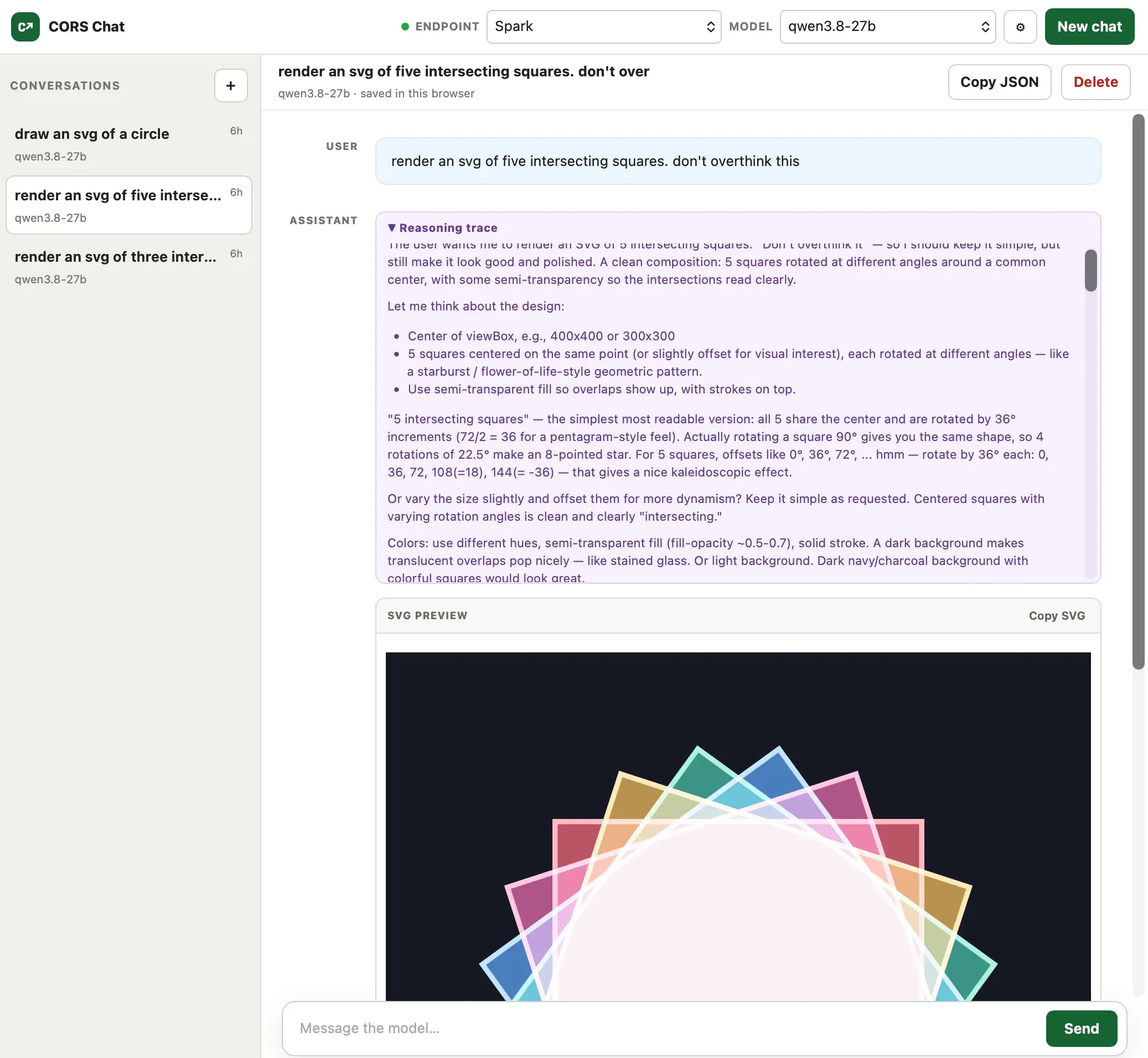
Simon Willison built a browser-based chat client to test OpenAI Responses-compatible endpoints, specifically Qwen 3.8 27B served through LM Studio on an M5 MacBook Pro and an NVIDIA DGX Spark. It has also worked against LM Studio with CORS enabled and against OpenRouter. The client stores conversations locally in the browser and lets users export them as copy-pastable JSON. A notable interface detail is progressive rendering of generated SVG images while tokens stream, making it easier to inspect visual-model output in real time.
Read the source →The Sequence Radar- Issue 915: Last Week in AI: The Cursor Acquisition, New Grok and GLM Models, Anthropic’s Latest Deal, and River AI
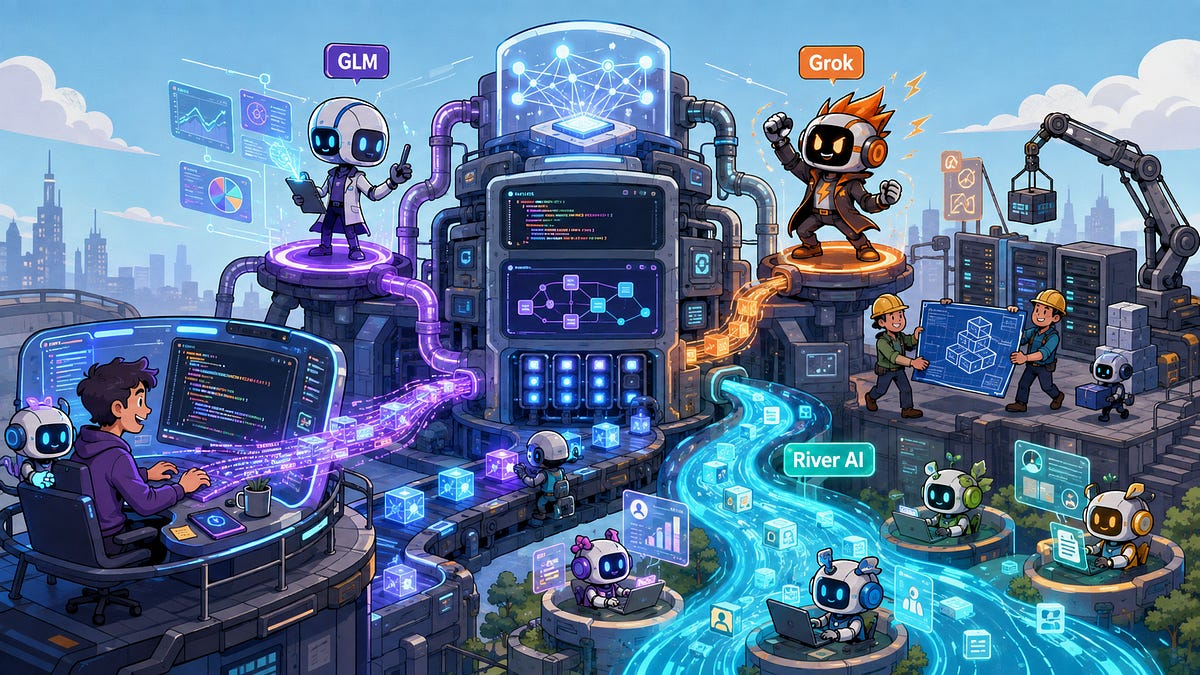
The newsletter’s main thesis is that AI competition is shifting from standalone benchmark wins to ownership of integrated systems and, above all, feedback loops. It highlights SpaceX’s completed $60 billion all-stock acquisition of Cursor, Grok 4.6’s deployment into coding and agent products, and Anthropic’s reported roughly $6 billion pursuit of infrastructure and world-model company Decart as signs of vertical integration from compute through applications. In contrast, River AI’s $1.1 billion raise advances a modular model in which organizations train and own intelligence shaped by their own data, rewards, and preferences; Z.ai’s GLM-5.3 is presented as further evidence that open-weight models are narrowing the gap with closed systems. The roundup also notes Grok 4.6’s 500K context window and $2/$6-per-million-token pricing below/above its prompt threshold, NVIDIA’s 30B MoE with 3B active parameters and 1M context, and an agent-routing library meant to choose the cheapest capable model per step.
Read the source →How to Help AI Do Your Work Better
The video proposes a practical filter for AI delegation: prioritize work that is frequent, time-consuming, teachable, easily verifiable, and does not require the human personally to perform it. It argues that Grok Bot’s recorded-task teaching and ChatGPT’s computer-history learning move the bottleneck from model capability toward supplying enough work context. The episode also reports Google’s Gemini 3.7 Flash as an efficiency-oriented release, citing Artificial Analysis testing at 340 tokens per second and a Deep Sweep coding score increase from 48.6% to 65.3% versus Gemini 3.6 Flash. Its actionable message is to identify repeatable work with clear verification first, then use demonstrations and accumulated context to make automation dependable.
Read the source →