AI scientist agent beats frontier models at replication
Summary
The technical items converge on evaluation as the scarce capability around increasingly powerful models: one turns scientific replication into a training signal for research judgment, while the other treats classification as a fallible verifier for generated prose. Both imply that a score alone is not enough—the quality of the task definition, rubric, and failure analysis determines whether model-assisted systems are useful or misleading.
GLM 5.3 Released
The post announces the release of GLM 5.3, but the available material contains no readable article body beyond that headline. It therefore provides no substantiated details on the model’s capabilities, weights, licensing, benchmarks, deployment options, or availability. Treat the release as a lead to investigate rather than evidence for a particular performance claim.
Read the source →Training AI Scientists to Replicate Research

Inherent Labs introduces Faraday, a 27B-parameter agent trained with long-horizon reinforcement learning to reproduce figures from research papers under constrained time and compute budgets. Its Replica benchmark starts with 310 tasks drawn from 100 ML and AI-for-science papers, and the company says Faraday beat Claude Opus 4.8 and GPT-5.5 across every paper category it tested, including more recent work outside the base model’s pretraining exposure. The central claim is that figure replication demands hypothesis formation, experimental design, and recovery of unpublished negative results—not merely matching a plotted output—making it a useful curriculum for scientific judgment. The training recipe uses task-specific rubrics, multi-sample judging, and turn-level credit assignment to reduce noisy LLM-judge rewards; Faraday also directs a larger coding model as a tool and can switch to a stronger tool model at test time.
Read the source →Northern Gannet
Simon Willison reports a sighting of Morris, a Northern Gannet in Pillar Point Harbor, California. Morris is described as the only known Northern Gannet in the Pacific Ocean, after first appearing at the Farallon Islands off San Francisco 14 years ago. The bird has made the harbor a regular home and can be identified by its white body and yellow head among the smaller, black Brandt’s cormorants near the harbor sign at the commercial pier. The post is a concise wildlife observation rather than an AI or technology report.
Read the source →Building an AI Text Detector From Scratch
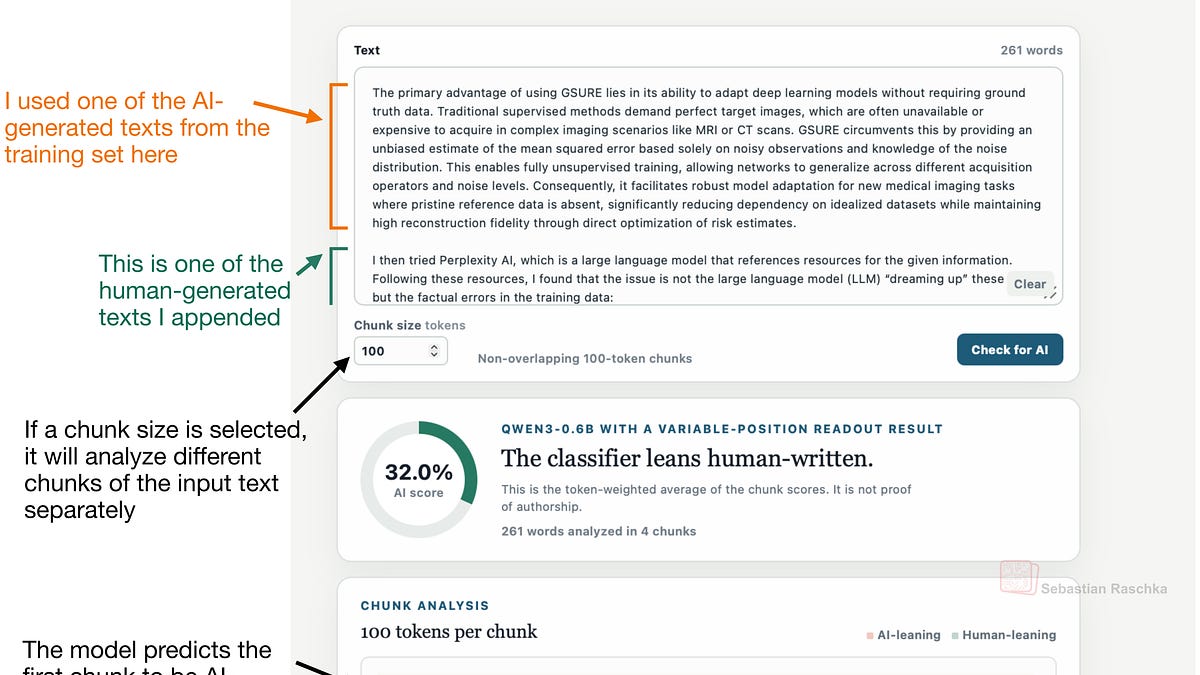
Sebastian Raschka outlines an educational project to build a local AI-text detector, motivated in part by Substack’s newly visible detector and by interest in small-language-model applications. The proposed system fine-tunes a DistilBERT classifier to output a 0–100 score representing its estimated AI-generated class probability under its training distribution, not a universal probability that a text was written by AI. The project will expose the detector through an API and UI, using an approach similar to Pangram models, while also treating the scorer as a verifier that can guide an LLM to revise text without raising its detection score. Raschka emphasizes the unavoidable cat-and-mouse dynamic: models can evade learned signals, detector updates must follow, and human writing can be falsely flagged—especially after grammar tools over-polish it.
Read the source →