Gemini 3.7 Flash revives Google’s model race
Summary
Today’s material points to the agent layer becoming a product and engineering discipline in its own right: model access is increasingly paired with persistent state, tool orchestration, shared workspaces, and auditable execution. The competitive question is moving beyond raw model quality toward whether teams can make generated work reviewable, secure, and durable enough to trust in real workflows. That shift rewards composable infrastructure and strong engineering governance while making a polished consumer wrapper a meaningful differentiator rather than merely a cosmetic one.
Grok Bot costs $200 a month. I wouldn't touch it under $1,000 of monthly value. Start with one of my two Bots: the Superdoer and Business in a Box.
The author’s test for an agent is whether it merely advises or leaves behind a completed artifact, and argues that consumer AI has mostly remained on the advising side. In about eight hours, they configured more than a dozen Grok Bots for roles including chief of staff, landing-page work, research, email, calendar, travel, and contacts. The core product choice is a shared cloud Linux computer: bots have separate jobs and screens but can use the same files, browser sessions, connected tools, and credentials, reducing the user’s role as an integration layer. That convenience also makes the shared machine the important security boundary; the author sets a roughly $1,000-per-month value threshold before paying $200 monthly and recommends starting with two bots aimed at producing finished work.
Read the source →[AINews] Gemini 3.7 Flash brings GDM back to the forefront
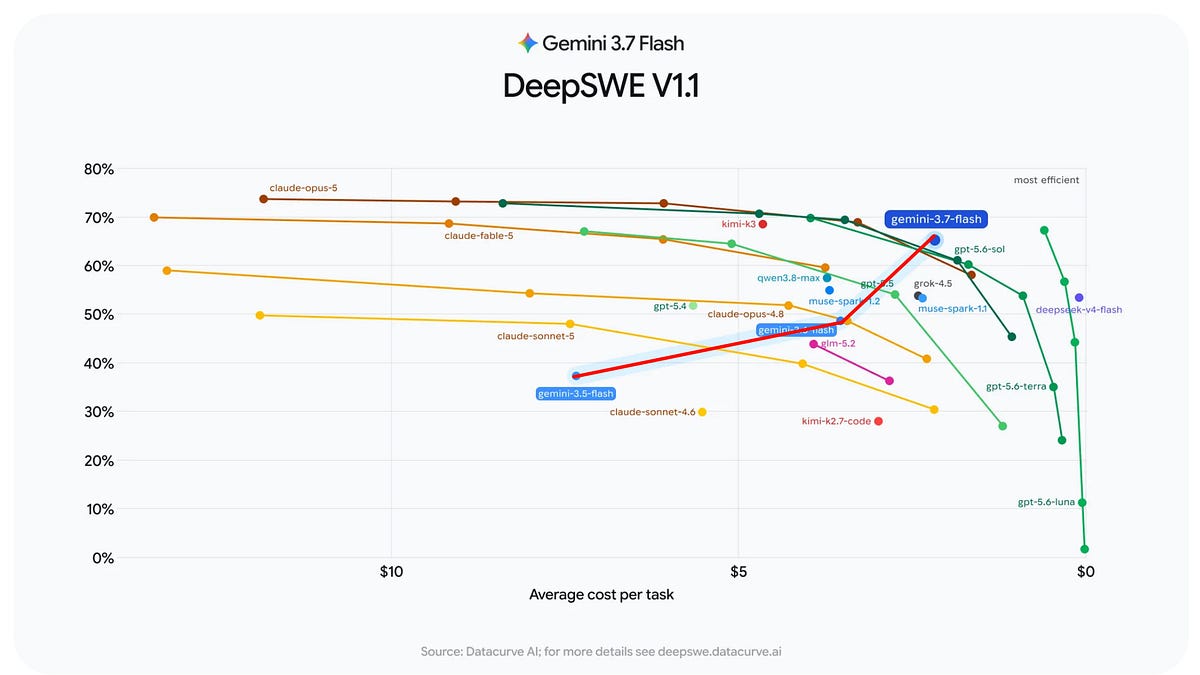
The available excerpt says Gemini 3.7 Flash’s most compelling evidence was a chart comparing its position with prior Flash releases. It characterizes Gemini 3.5 and 3.6 Flash as having fallen behind the newer Claude 4.8+ and GPT 5.5+ series. The remainder of the analysis is subscriber-only, so the excerpt does not substantiate further claims about the new model’s capabilities, pricing, or benchmarks.
Read the source →DeepSeek Harness developer preview: Everything is a plugin
DeepSeek has released its agent Harness in developer preview, including source code, for developers building agent harnesses. Its Cordis-based architecture makes models, tools, skills, sessions, sandboxes, storage, loops, scheduling, and the UI independently swappable plugins, configurable without modifying the Harness source. It records everything supplied to the model in an append-only session log—including prompts, tool results, scheduling, and context injections—so sessions can be inspected, resumed, forked, searched, and replayed from one event stream. The preview offers full-tool Standard mode, model-written orchestration in Code mode, shell-and-editor Minimal mode for benchmarks, and Creator mode for testing and combining plugins in memory.
Read the source →llm-gemini 0.33

Simon Willison’s llm-gemini 0.33 adds support for Gemini 3.7 Flash, Gemini 3.6 Flash, Gemini 3.5 Flash-Lite, and the Gemini Embedding 2 and Embedding 001 models. Compatibility with LLM 0.32 means users can view reasoning traces and enable server-side tools. The release notes that 3.7 Flash removes the “minimal” thinking option that was available in 3.6 Flash. A sample SVG generated at high thinking effort exposed a browser-compatibility wrinkle: Safari renders an empty SVG filter more permissively than Firefox and Chrome, where the pelican disappears while its bicycle remains.
Read the source →The Sequence Opinion - Issue 914: From Prompt to Token: How AI Inference Really Works
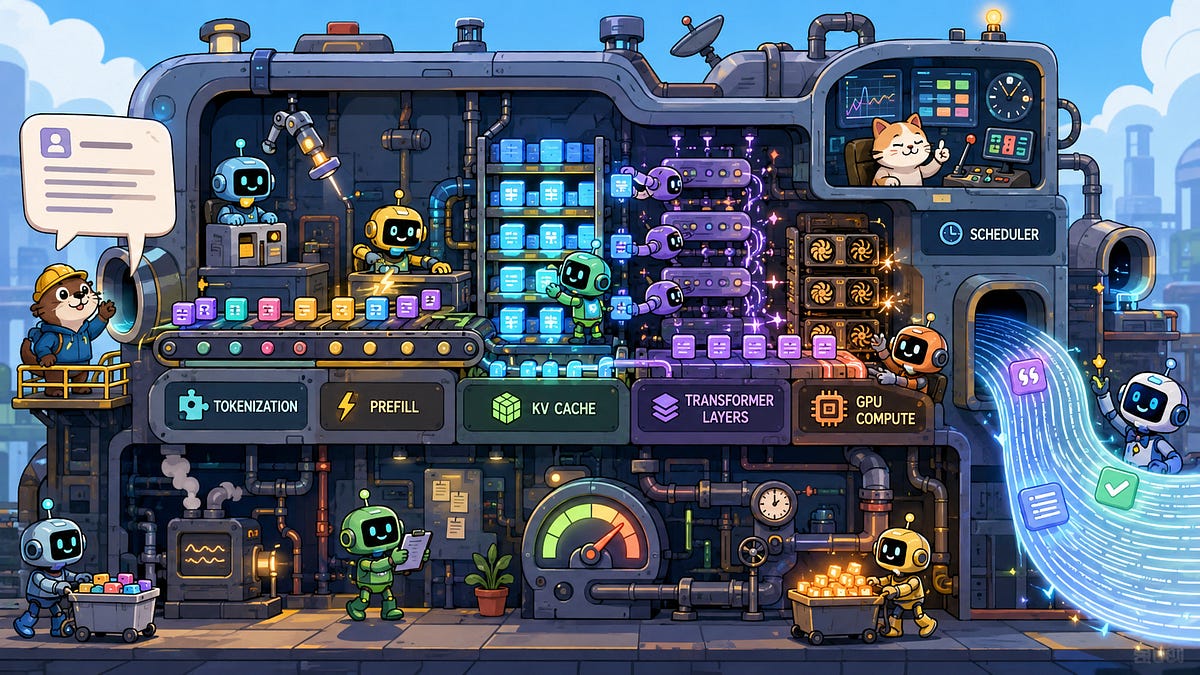
The piece argues that inference—not training—is where production AI systems accumulate their operational cost and complexity. It frames serving as much more than a forward pass: systems must assemble context, tokenize, route uneven requests, schedule GPU work, manage memory, run transformer kernels, sample output, and stream tokens. The challenge is compounded by asynchronous traffic, mixed prompt and response lengths, and simultaneous demands for fast first-token latency, smooth generation, and low cost. The article begins walking through a representative 4,000-token prompt that requests a 300-token response, but the supplied text ends before the detailed walkthrough.
Read the source →Gemini 3.7 🤖, GPT-5.6 Sol Ultrafast ⚡, Anthropic $2T IPO 💰
The supplied article text is a sponsored pointer to the 2026 SANS AI Survey Insights report rather than an editorial account of the model and company items in the headline. It says the report examines where AI is delivering value, where it can create a false sense of security, and why nominal “formal AI governance” may not mean what leaders assume. Readers are directed to a related webcast with Voodoo Security founder Dave Shackleford and to further SANS resources on building, breaking, and defending production AI. The excerpt provides no supporting detail on Gemini 3.7, GPT-5.6 Sol Ultrafast, or an Anthropic IPO.
Read the source →Ben's session #2
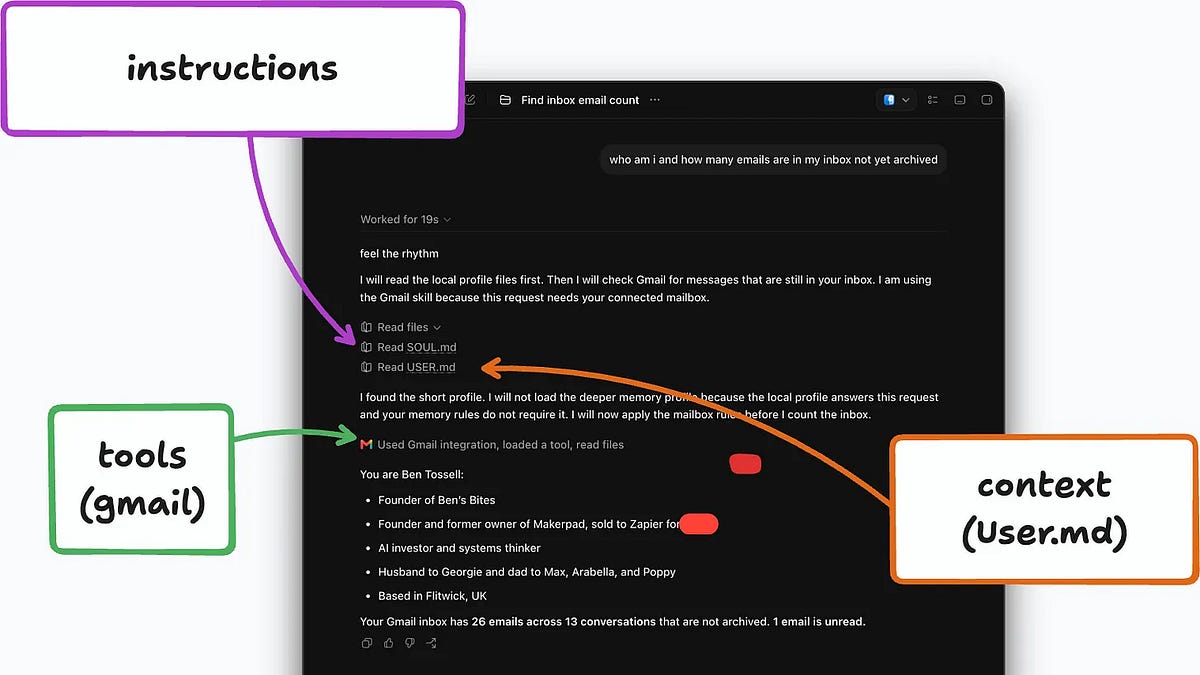
Ben’s Bites argues that the apparent distinction between personal-agent products such as OpenClaw, Hermes, and Grok Bot is largely packaging: the underlying setup is files, folders, instructions, tools, and sometimes a computer. The author describes persistent “memory” as a text log that an agent reads to regain context, with specialized agents simply having different instruction and memory files; shared memory is agents reading one another’s files. Grok Bot’s shared-computer design gives chats separate screens but common files, installations, and logins, while other agent tools can approximate task-specific agents through dedicated folders or pinned threads. The practical choice is therefore between convenience and control: the author prefers configuring files, models, reasoning, and visibility directly, while recognizing that products such as Grok Bot lower the barrier to trying the same capabilities and automations.
Read the source →Issue #57

This issue challenges the shorthand that “code was never the hard part,” distinguishing organizational bottlenecks from the skilled work of an individual engineer. It argues that agents make code generation less scarce, shifting the key constraint toward review, verification, architecture, and maintaining a coherent codebase; weak engineering culture can therefore fail faster as AI accelerates change. A cited multi-language evaluation found no clear advantage for dynamic languages on complex agent tasks, but did find a weak-to-moderate relationship between GitHub popularity and solutions that were more correct, cheaper, and faster—plausibly because popular languages have more training data. The issue expects AI to amplify strong engineers’ judgment and oversight while squeezing roles centered chiefly on translating specifications into code, making organizational discipline and readable, verifiable generated code more important.
Read the source →