OpenAI and Google slash the cost of agentic AI
Summary
The strongest theme is not simply better models, but a move to make capable agent systems economically and operationally routine: lower token prices, much faster inference, warm development environments, persistent cloud workers, and tool-native orchestration all shrink the cost of longer-running work. At the same time, the ICML reproduction effort shows why cheaper parallelism does not remove the need for rigorous human oversight: agents can scale review dramatically, but they can also scale mistaken assumptions and shallow verification.
not much happened today
The day’s roundup frames Gemini 3.7 Flash as a new mid-tier price/performance contender while tracking a broadening field that includes DeepSeek, Qwen, and xAI. It highlights Qwen3.8-2.4T-A95B’s 2.4T total and roughly 95B active parameters as a striking but largely impractical local-inference target: bf16 weights would occupy roughly 4.8–5 TB, and even aggressive quantization looks too slow for ordinary hardware. DeepSeek-V4-Pro’s reported benchmark jump is tempered by an initially inconsistent Hugging Face package, while its new plugin-oriented Harness is explicitly a breaking-change developer preview. The roundup also flags research and governance concerns, from alleged hidden-reasoning leakage and benchmark memorization to the practical fragility of proposed provenance watermarking.
Read the source →Introducing Gemini 3.7 Flash
Google positions Gemini 3.7 Flash as a coding-and-agent workhorse released only three weeks after 3.6 Flash, at an introductory price of $0.75 per million input tokens and $3.75 per million output tokens—half the earlier model’s launch cost. It reports gains on FrontierCode 1.1 Main (43.6% versus 34.4%), DeepSWE v1.1 (65.3% versus 49.0%), WebDev Arena (1,588 versus 1,538 Elo), GDP.pdf (34.0% versus 22.0%), and AutomationBench (30.4% versus 17.0%). The company emphasizes more disciplined planning, tool use, instruction following, and recovery from roadblocks, intended to reduce retries and manual supervision. Gemini Spark is switching to the model, and Google says the release includes updated CBRN and cyber-offense safeguards.
Read the source →Introducing chestnut
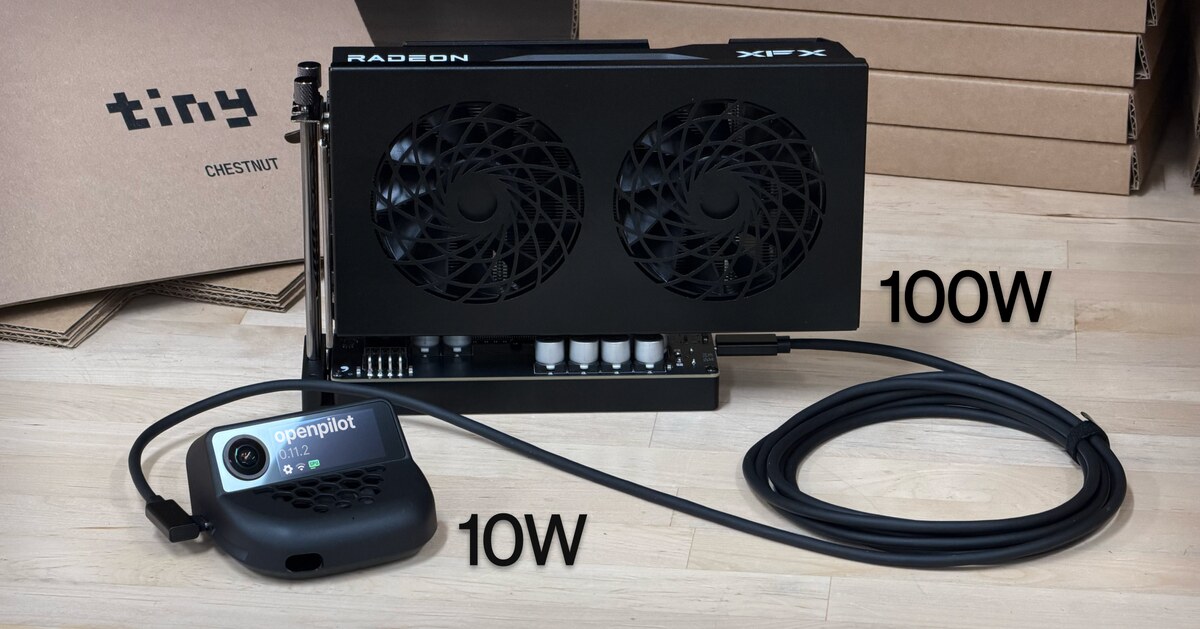
Comma.ai launched chestnut, a compute add-on for comma four intended to run substantially larger openpilot driving models. The ready-to-drive kit includes an AMD Radeon RX 9060 8GB GPU, power and mounting hardware, and brings the paired system to compute comparable with Tesla HW4. Its first chestnut-class model, arriving in openpilot 0.11.2, has 1B parameters—30 times the parameters and 100 times the FLOPs of the latest on-device model. Comma says its fleet now logs nearly one million driving minutes daily and that future autonomy work will focus primarily on these larger models.
Read the source →The builder’s guide to GPT‑5.6
OpenAI argues that GPT-5.6 changes agent economics through lower reasoning costs, smaller specialized models, and API features rather than requiring wholesale harness redesigns. It says GPT-5.6 Sol at low reasoning beats GPT-5.5 at high reasoning on Agents’ Last Exam, while GPT-5.6 Luna at extra-high reasoning reaches 84.04% on BrowseComp for $1.33 versus GPT-5.5’s 84.36% for $33.27. Retained reasoning, compaction, programmatic tool calling, native multi-agent orchestration, and longer deterministic prompt caching are presented as the mechanisms for further savings and throughput. In one cited ARC-AGI-3 case, retained reasoning plus compaction raised Sol from 13.3% to 38.3% while using about six times fewer output tokens.
Read the source →Previewing Ultrafast mode: GPT-5.6 Sol at up to 14X the speed

OpenAI is previewing an API service tier called Ultrafast that runs GPT-5.6 Sol at up to 14 times Standard speed, generating up to 750 output tokens per second through Cerebras. The limited preview is aimed at workloads where frontier-model quality and immediate response both matter, including coding, commerce, financial research, support, incident response, and interactive research. OpenAI’s examples focus on shortening the observe–hypothesize–act loop: engineers can analyze live logs and traces sooner, while researchers can make several experimental iterations during a workday rather than only overnight. Access is initially restricted to a select customer group as the company studies where the latency reduction changes product design most.
Read the source →OpenAI appoints Dali Rajic as Chief Revenue Officer

OpenAI appointed Dali Rajic as chief revenue officer to lead its global revenue organization as enterprise deployment expands. The company says its products now reach more than one billion weekly active users and over two million businesses, double the business count a year earlier. Rajic most recently served as president and COO of Wiz, and previously held senior revenue roles at Zscaler and AppDynamics. He succeeds Denise Dresser after a transition period, and OpenAI has also partnered with Chad Peets and RPT Partners on building its go-to-market organization.
Read the source →sqlite-utils 4.2.1
sqlite-utils 4.2.1 fixes a crash introduced in 4.2 because the package imported Self from typingextensions without declaring that package as a dependency. The bug was masked in development because a dev dependency installed it indirectly, but users invoking the tool directly with uvx sqlite-utils could lack it. Simon Willison added an isolated smoke test—uv run --isolated --no-default-groups sqlite-utils --help—to ensure the CLI works without a local virtual environment or default dev groups. The release is a concise lesson in testing the actual packaging path users take.
Read the source →sqlite-utils 4.2
sqlite-utils 4.2 expands table.transform(), the feature that performs complex ALTER TABLE operations by creating a replacement table, copying data, and swapping it in. The update preserves more unusual schema details during that operation, including check constraints, unique constraints, and column comments. It also adds properties for inspecting check constraints alongside numerous smaller changes. A later 4.2.1 patch fixed a packaging-related crash in this release.
Read the source →alchemy-utils 0.1a1
The alchemy-utils 0.1a1 announcement points to a performance-focused initial release. Its stated improvements target DuckDB exports and CSV imports. The post provides no further implementation detail or benchmarks, so users considering it should review the linked release material before estimating the impact on their workloads.
Read the source →What does AI actually know about you?
Anthropic’s explainer separates what an AI tool knows into four layers: the current conversation, account-level memory, provider-side retention and operations, and possible use in future-model training. It stresses that cross-chat memory is product data available to a model, not the model independently remembering a person, and that users can generally edit, clear, or disable it. The practical advice is to inspect memory, history, connected-app, and training controls; substitute placeholders for unnecessary personal details; and use business or enterprise terms for confidential or regulated work. It also notes that provider policies differ, while saying Claude organizational deployments have model training disabled by default.
Read the source →Microchip Switchtec 160-Lane PCIe Gen6 Switch Shown at FMS 2026 with XpressConnect PCIe 6 Retimer
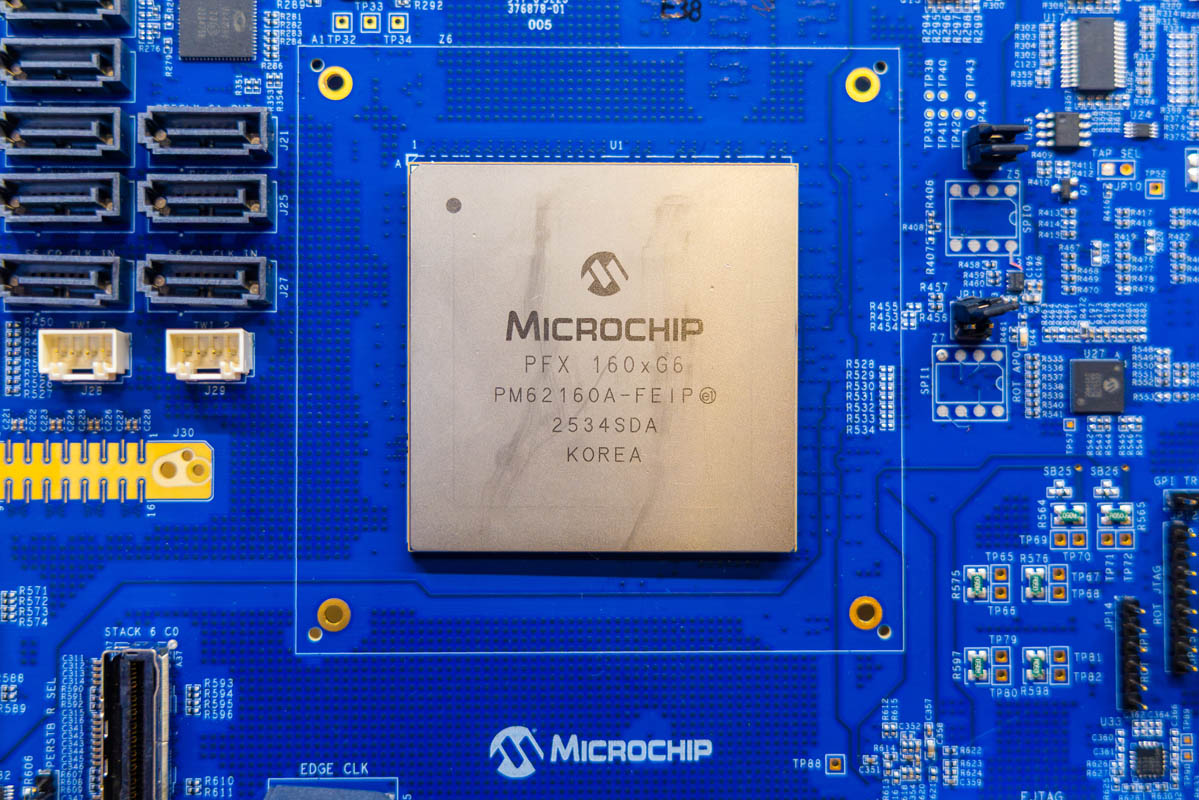
Microchip showed its Switchtec PFX 160xG6, a 160-lane PCIe Gen6 switch, and an XpressConnect PCIe Gen6 retimer operating at FMS 2026. The switch can expose up to 20 ports, though AI systems commonly consume them with x16 GPUs and NICs, and it enters a market increasingly central to AI infrastructure rather than just storage servers. Retimers matter because Gen6 links have shorter reach as systems become physically larger; Microchip’s part can also retime CXL 3.1. The report places Microchip against Broadcom, Astera Labs, Marvell, and Phison, while noting Microchip appears more PCIe-focused than vendors emphasizing combined PCIe/CXL switching.
Read the source →Sponsorship packages now available for AI DevCon NYC 2026
AI DevCon is selling sponsorship packages for its November New York conference, which it expects to host more than 700 in-person attendees and 3,000 virtual participants. The pitch emphasizes an audience weighted toward decision-makers: 67% in technical roles, 64% lead level or above, and 18% C-suite or founders. Sponsors are also offered access to the broader AI Native Dev community, described as more than 70,000 developers. Packages start at $7,000 and availability is limited.
Read the source →Submit your talk for AI DevCon NYC 2026
AI DevCon is soliciting experience-driven talks about how agentic coding works at real companies for its November New York event. The organizers say the conference follows a sold-out London gathering and targets leaders shaping software development’s agentic transition. The call for proposals remains open until October 1, though earlier submissions have a better chance of acceptance. The framing favors practical implementation evidence over general predictions about AI coding.
Read the source →Join us in NYC for AI DevCon Fall 2026
AI DevCon is promoting a three-day New York conference in November centered on agentic coding, following a sold-out London event. It pitches talks and tools from practitioners and companies including Anthropic, OpenAI, Netlify, and GitHub, with an emphasis on operational lessons rather than hype. The event is aimed at people directing agents, building feedback loops, leading engineering teams, or setting strategy. Early-bird pricing is available for a limited time.
Read the source →Did Grok Bot Just Overtake Claude? (Worth the Price?!)
The review tests xAI’s newly released Grokbot against the author’s expectations for an AI teammate, arguing that its main appeal is zero setup and persistent cloud computers per specialized bot. Each bot can have its own role, system prompt, browser, files, and login, so work can continue after the user closes their laptop without provisioning a VPS. The author sees the teammate-style interface—such as a chief of staff, accountant, or marketing bot—as a meaningful contrast with task-oriented Claude Code workflows. The transcript is an early hands-on assessment rather than a controlled benchmark, so its conclusions should be treated as product experience rather than a definitive capability ranking.
Read the source →Grok 4.6 Shows How Fast Your AI Options Are Expanding
The video argues that frontier-model competition is broadening beyond OpenAI, Anthropic, and Google, with Chinese open-weight models competing on efficiency and cost and Grok 4.6 re-entering the discussion. It says Grok 4.6 has benchmark results in the GPT-5.6/Fable 5 range at lower cost, but cautions that benchmarks do not settle real-world usefulness and that early users have not yet declared it fully comparable. The episode also reports that coding-agent company Cognition is discussing a new round at a $40 billion valuation, up from $26 billion three months earlier, with reported revenue run rate doubled to $1 billion. The common thread is that demand and capital are following the expanding set of credible model and agent options.
Read the source →Cloud Agents Start 3x Faster with Builds

Cursor introduced Builds, background-prepared copies of a Cloud Agents development environment that let agents start with repositories cloned, dependencies installed, and setup scripts already run. The company reports 10 times faster environment boot and three times faster time to first token, with the feature included at no extra charge for Cloud Agents. Successful builds become the baseline for future agents, while failed builds do not replace the last good environment, allowing work to continue during debugging. New environments get Builds automatically; existing users can enable them in the dashboard or first run a setup agent to review migration changes.
Read the source →Gemini 3.7 Flash is now available in GitHub Copilot
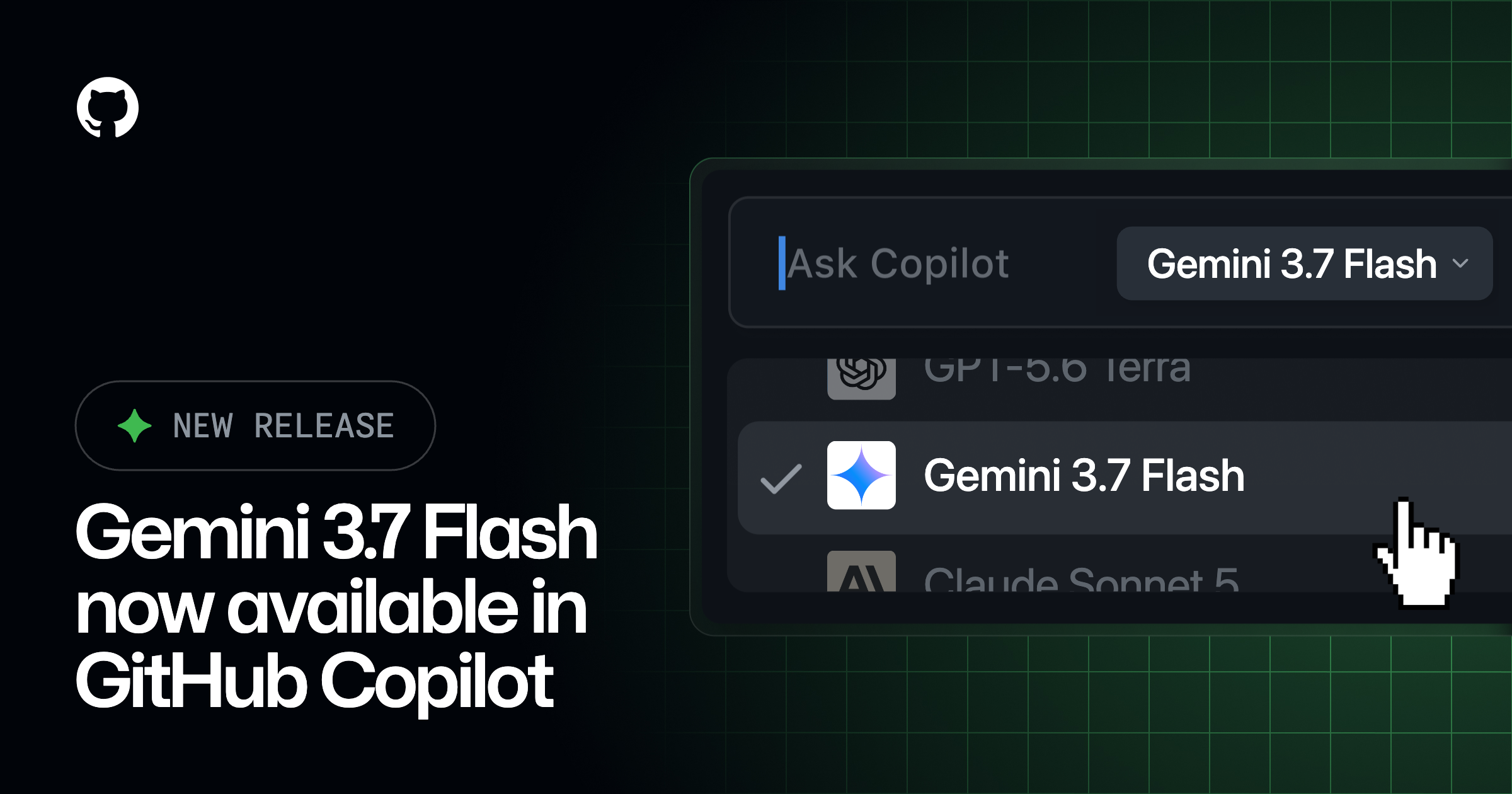
GitHub Copilot is gradually rolling out Gemini 3.7 Flash to Pro, Pro+, Max, Business, and Enterprise users. GitHub says its early tests show improvements in web and app development, agentic coding, code quality, final-output presentation, codebase research, and verification on complex tasks. The model is billed at the provider’s list price under usage-based billing. Business and Enterprise administrators must enable the Gemini 3.7 Flash Preview policy before their organizations can select it.
Read the source →Bring your spreadsheet data to life with Sheets canvas

Google launched Sheets canvas, a Gemini-powered read-write layer that turns existing spreadsheet data into interactive mini-apps from a natural-language prompt. It can create synchronized views such as dashboards, study trackers, fantasy-sports command centers, and drag-and-drop seating charts, with edits flowing back to the source sheet. The feature is available globally in English to Google AI Pro and Ultra users and is rolling out to specified Business, Enterprise, and Education plans. Users start from the Ask Gemini side panel by choosing “Create canvas.”
Read the source →Record, train, and deploy from one place with Strands Agents, LeRobot, and Hugging Face Storage Buckets

AWS’s open-source Strands Robots SDK and Hugging Face describe a continuous robot-learning loop that records demonstrations, syncs them into mutable Hugging Face Storage Buckets, streams them directly for training, and deploys checkpoints back to the same robot abstraction. The approach retains the LeRobot on-disk format throughout, avoiding format conversion and full local dataset downloads; a bucket acts as the working layer while versioned Hub repositories remain the publishing layer. Xet-backed buckets deduplicate content at byte-level chunks, intended to avoid repeatedly transferring near-identical video-heavy recordings. The walkthrough can run on a laptop with a mock policy, but the authors explicitly caution that such recordings are structurally valid rather than useful training data until a real policy is substituted.
Read the source →What We Learned by Reproducing 2,200 papers from ICML

Hugging Face’s ICML 2026 Open Reproductions hackathon enlisted more than 1,200 participants and coding agents to create 6,816 logbooks across 2,226 papers in 19 days. Of the examined papers, 51% had at least one independently verified claim, 23% had at least one falsified or contested claim, and 242 received opposite verdicts from different reproduction teams; 266 were fully reproduced. Confirmed findings included a paging proof with an overlooked logarithmic term, a transformer theorem defeated by late-emerging counterexamples, a forward/reverse-KL mismatch between theory and released code, and padding that understated perplexity. The organizers argue that agents make large-scale scrutiny feasible but still need human steering to catch premise errors, scale effects, unit mistakes, and judgments that numerical metrics cannot settle.
Read the source →v2.1.232
Claude Code v2.1.232 enables subagent forking by default, allowing subagenttype: "fork" to inherit the full conversation and prompt cache, while ordinary non-teammate interactive spawns now default to the background. It adds cross-session collaboration through @ mentions and direct SendMessage delivery to uniquely named live sessions, alongside controls for dialog expiry and inbound messages. The release also broadens GitLab integration and secret redaction, strengthens sandboxing and policy validation, and closes several permission and filesystem-bypass paths. Operationally, it improves responsiveness for long sessions, background code review, Remote Control reconnection and recovery, MCP failure handling, and plugin-marketplace installation.
Read the source →