Hidden reasoning traces leak keys, passwords and private data
Summary
The day’s central tension is that agents become more useful when they receive more context, tools and autonomy, but every additional interface expands the security and governance burden. Open models and local runtimes are pushing capable execution closer to commodity hardware, while enterprise adoption data suggests the durable advantage comes less from raw access than from reusable workflows, permissions and operational discipline.
not much happened today
AI News centers on a burst of open, agent-oriented models and local tooling. Meta’s Apache-2.0 Muse Glimmer is a 30B dense multimodal model designed for tool use and recovery from failures; community tests report it fitting in 24GB VRAM with unusually efficient KV-cache use and strong speed, though coding quality is described as closer to Gemma 4 than a general leader. NVIDIA’s Nemotron 3.5 Lightning is framed as a complementary execution model: roughly 30B MoE parameters with 3–3.6B active, a 1M-token context claim, and distribution through services including Ollama, vLLM, Together and Baseten. The issue also notes Unsloth Desktop’s broad local inference/training stack and an expected Qwen 3.8-27B release, underscoring how quickly the small-to-mid-size open-model field is moving.
Read the source →Start the project you cannot describe yet. Grab my Working Context Starter Kit, the four-file guide for staying in charge once the work changes your mind.
The author argues that agent projects should not be limited to work fully specifiable in the opening prompt, because serious projects reveal new requirements and invalid assumptions as they progress. An OpenAI internal example reportedly reached roughly 1,500 pull requests and one million agent-written lines over five months, while some Codex runs lasted more than six hours and left reviewers with newer understanding than the initial instructions reflected. The proposed solution is to separate context into four files—stable rules, current state, a material map and history—rather than maintain one accumulating instruction document that becomes stale. The practical goal is to let humans redirect agents as their judgment evolves, preserving human planning while delegating much of execution.
Read the source →[AINews] How to steal a Reasoning Trace
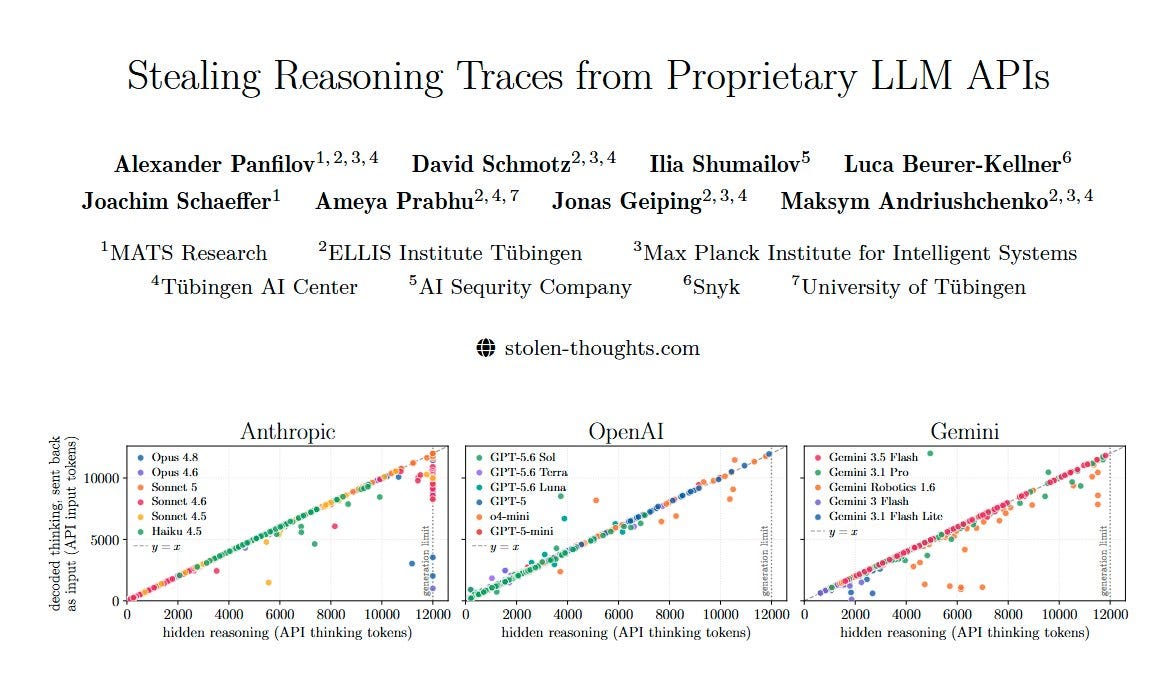
A responsibly disclosed vulnerability reportedly allowed encrypted or signed hidden reasoning blocks from frontier APIs to be replayed into weaker models and transcribed, rather than remaining confidential. In an initial scan of about 7,000 public traces, researchers found 62 unique API keys, 33 email addresses and 33 passwords, with 64 sensitive values appearing only inside the hidden reasoning. The described attack relies on obtaining a valid reasoning block, replaying it in another request, prompting a model to copy it, and sampling repeatedly to overcome refusals or noisy outputs; several affected weaknesses have been fixed. The article stresses that public sharing of sessions can therefore expose private data, while debate remains over whether the technique is practical for large-scale reasoning-trace distillation.
Read the source →The Claude Code Guide: What Actually Matters in 2026
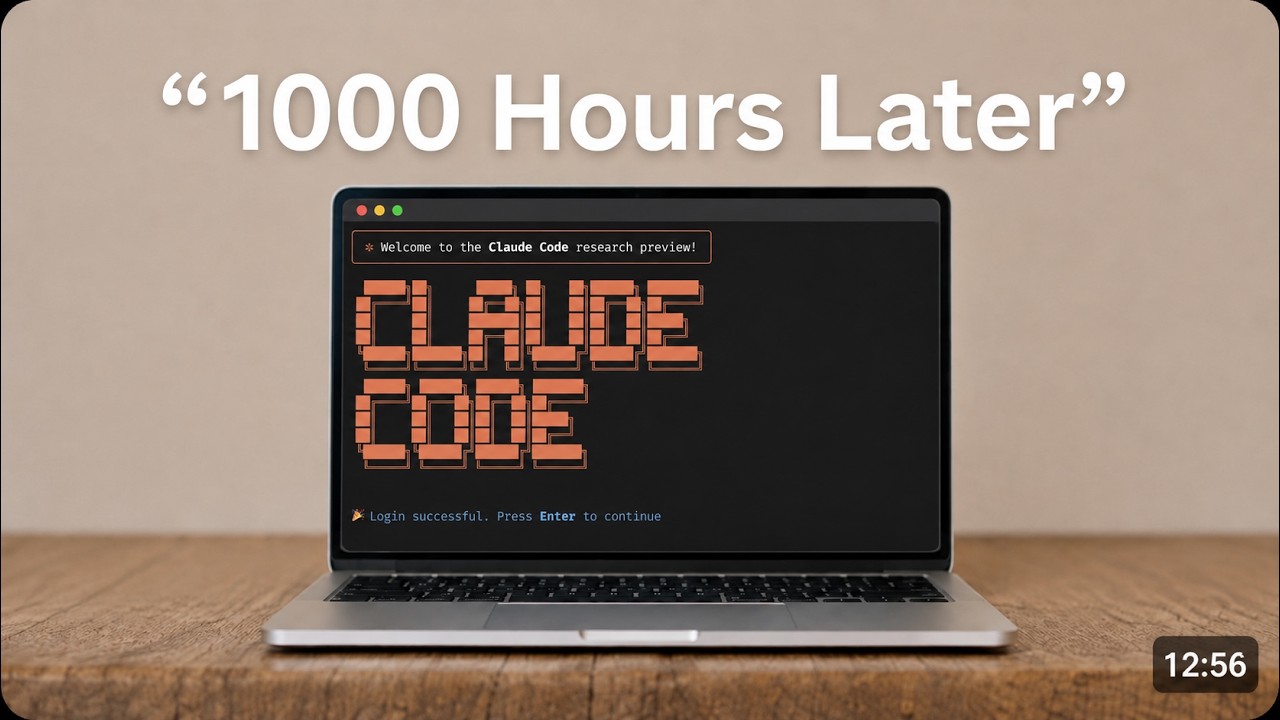
This guide recommends the Claude desktop app for non-technical users because it adds voice, browser automation and inline artifacts while retaining terminal access, and advises keeping global instructions empty unless they truly apply to every project. It argues for beginning projects in plan mode and using open-ended input—including asking what the user has not considered—so the agent surfaces unknown decisions before executing. Rather than blindly accepting recommendations, users should ask the system to explain concepts such as technology-stack choices, building enough engineering literacy to evaluate unusual cases. The author calls reusable skills the largest leverage point for repeatability, then recommends richer context such as screenshots and CLI integrations to turn Claude into a system that can build, deploy and iterate over longer tasks.
Read the source →datasette-upload-dbs 0.5a0
Datasette’s datasette-upload-dbs 0.5a0 adds a formal HTTP API for uploading a new SQLite database or replacing one already served by a hosted Datasette instance. The plugin saves and verifies the uploaded database before atomically swapping it, so the named endpoint begins serving the new version without exposing a partial update. The release makes it straightforward to build a database in a CI environment such as GitHub Actions and promote it to production immediately after the build succeeds. Authentication uses a bearer token and the multipart request supplies both the database file and its target name.
Read the source →From assistance to execution: How enterprises put AI to work
OpenAI says enterprise AI use is shifting from answering questions to agents that use tools, create files and produce work for review; Codex accounted for 64% of combined enterprise Codex and ChatGPT output tokens as of June. Its top-decile “frontier” firms generated 8.3 times as many output tokens per active user as typical firms, up from a 2.6-times gap in January, and were more likely to use Plugins (21% versus 9%) and skills (19% versus 3%). Adoption is spreading beyond engineering: since February, weekly active enterprise Codex users reportedly grew 108-fold in legal, 41-fold in sales and recruiting, and 26-fold in marketing, versus fivefold in engineering. The report’s prescription is to connect agents to company data and tools while establishing permissions, governance and human review, then make successful individual workflows reusable across the organization.
Read the source →The Sequence Chat - Issue 912: NVIDIA’s Chris Alexiuk Talks About Nemotron, GPUs and Agentic AI
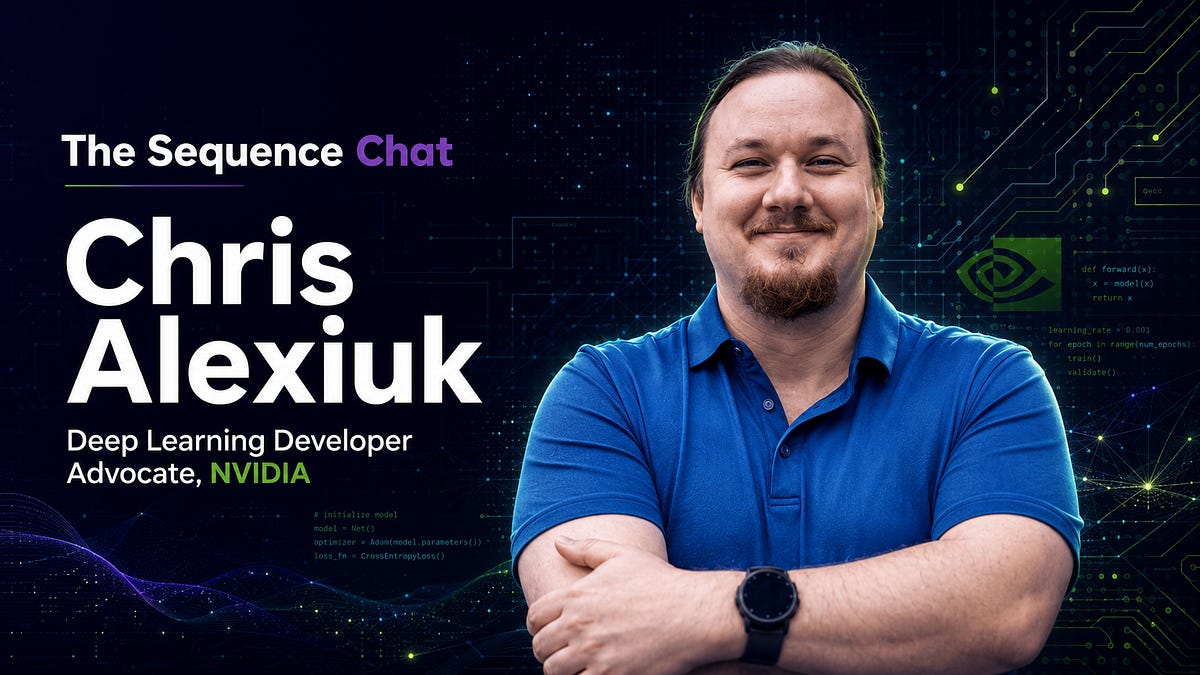
NVIDIA’s Chris Alexiuk describes Nemotron as an open-weight effort meant both to contribute research artifacts and to learn from the ecosystem building on NVIDIA hardware. He argues that model sizes should be designed around real deployment hardware budgets, and that openness should ideally include training data as well as weights, recipes and technical reports so models can be more meaningfully audited. Nemotron 3.5 Lightning is positioned as a fast, inexpensive execution layer for long-running agents: an open 30B MoE model with 3B active parameters, tuned for tool calls and subagent work rather than wasting an expensive frontier model on routine steps. He expects explicit model routing to become a more general orchestration layer, while hybrid attention/state-space approaches retain some attention because of its value for long-context recall.
Read the source →Cursor’s GitHub rival 👨💻, OpenAI COO leaves 👋, Gemini 1B milestone 📈

The retrieved content for this item is a promotion for hands-on labs led by industry experts and CoreWeave engineers. It says attendees will write code, run jobs, interpret results and leave with usable configurations, and offers a free ticket code, PAWBTLDR33, for a limited time. The available text does not substantiate the title’s claims about Cursor, OpenAI leadership or Gemini, so no summary of those claims can be supported from it.
Read the source →