Meta returns to open weights with Muse Glimmer
Summary
Today’s strongest thread is that useful AI is increasingly defined by how it is deployed and governed, not just by a benchmark score. Meta’s open local-agent model, selective memory retrieval, production ML workflows, and proposed mission-scoped identity all point toward more autonomous systems—but each depends on constrained access, tailored context, and human-reviewable outputs. The same pressure is visible in the push for faster local inference and clearer, more usable model communication.
Thinking of ACE? We Can Do It with Fewer Tokens

IBM Research compares ALTK-Evolve with ACE, two systems that turn an agent’s previous task trajectories into reusable lessons without retraining the model. Both reject repeatedly compressing experience into a tiny summary: ACE keeps a growing playbook with helpful/harmful counters, while ALTK-Evolve clusters related guidelines and retains support counts and provenance. The central difference is inference delivery: ACE injects the whole playbook on every step, whereas ALTK-Evolve uses a fixed high-support core plus task-specific retrieval, or a full set only when the model can use it. On the 168-task AppWorld test, the authors report comparable or better completion at roughly 40% of ACE’s inference cost on a stronger model and about one-seventh the cost on a weaker one, while cautioning that results are single pass@1 runs and use their own controlled ACE implementation.
Read the source →not much happened today
Meta released Muse Glimmer, a 30B Apache-2.0 multimodal model aimed at long-horizon tool use and local agents, and said Muse Spark 1.2 weights will follow. The issue says Glimmer can be quantized below 20GB, uses a lightweight DFlash drafter for local responsiveness, and had day-one support across vLLM, llama.cpp, Ollama, Together AI, Hugging Face, and Unsloth; third-party figures cited put 4-bit deployment around 18GB with 128K context. It also highlights an unreleased Claude research variant that improved a Riemann-hypothesis-related lower bound from 41.6% to 67.2% of zeta zeros on the critical line, while OpenAI restricted GPT-5.6-Cyber to approved defenders for advanced defensive work. The broader engineering argument is that harness and tool-interface design now materially shape agent performance and cost, with code-like tool calls, speculative decoding, and provider-specific serving stacks producing large practical differences.
Read the source →[AINews] Muse Glimmer and Spark: Open Weights return Personal Superintelligence promise
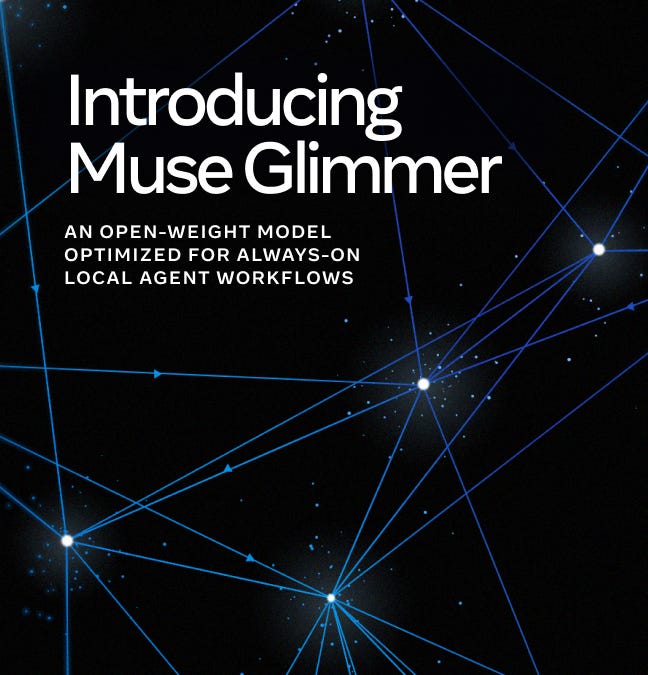
The post frames Muse Glimmer and the planned Spark release as Meta Superintelligence Labs’ renewed open-weights push, tied to Zuckerberg’s case for personal superintelligence rather than AI primarily controlled by institutions. Its vision is a capable personal agent, broadly affordable creation and business tools, individualized tutoring, and many independently aligned systems rather than one centralized superintelligence. Zuckerberg also argues that AI could shrink the size of individual companies while increasing the number of companies, and that data-center investment should bring local infrastructure benefits such as energy generation and water restoration. On governance, the essay combines continued export controls and faster US infrastructure buildout with government access to intermediate model checkpoints for critical-infrastructure hardening.
Read the source →The Sequence Knowledge - Issue 911: Distilling Diffusion and Multimodal Models
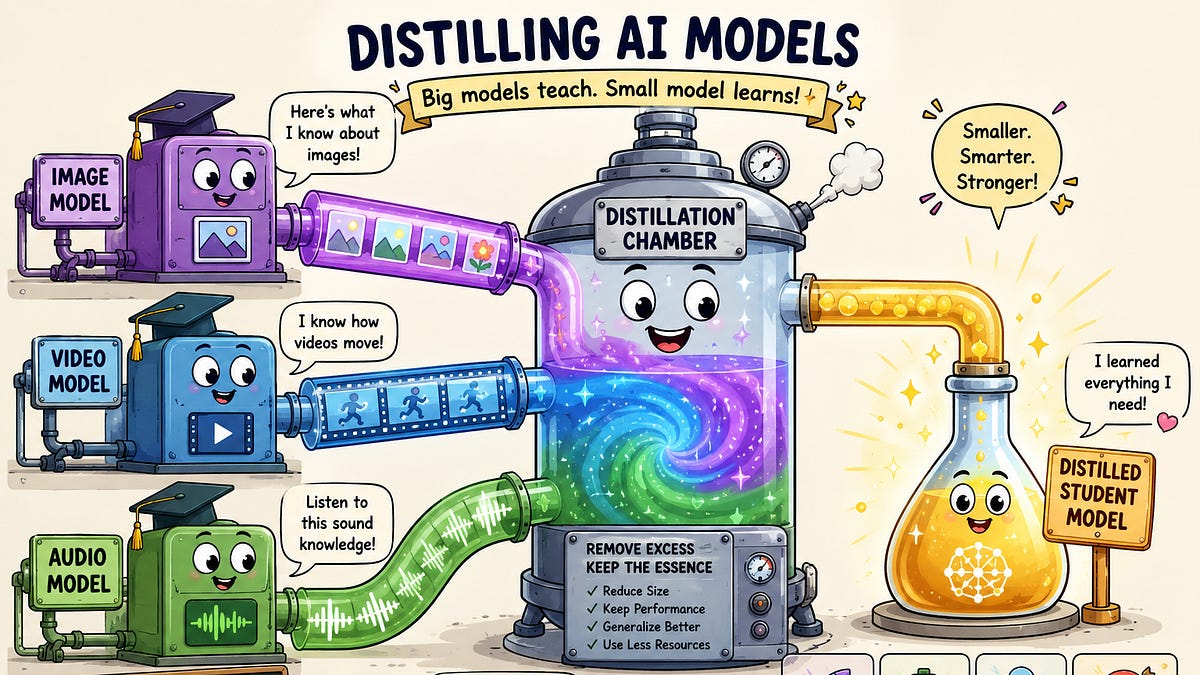
The issue argues that distillation becomes fundamentally harder outside text because a text model can often be trained to imitate a teacher’s answer distribution, while diffusion models generate through a sequence of denoising edits. In diffusion, the student must preserve a trajectory from noise to a coherent sample rather than merely reproduce a final answer. The framing extends the problem to multimodal systems, where compression must retain motion, distributions, and semantic relationships across different modalities. The available extract is introductory, so it sets up the conceptual distinction rather than presenting methods or benchmark results.
Read the source →Muse Glimmer ✨, OpenAI Cyber 🛡️, Claude vs Riemann Hypothesis 🧠
The available article body contains only the headline, with no substantive newsletter text to summarize. Its linked topics overlap with other items in this edition: Meta’s Muse Glimmer, OpenAI’s restricted cybersecurity model, and Anthropic’s Riemann-hypothesis-related research result. No additional claims, figures, or analysis are available in the extracted content.
Read the source →The Background Check You Can't Run on an AI Agent
The conversation argues that agent identity is inseparable from authorization because agents are probabilistic and can take actions that are technically plausible but misaligned with the user’s intent. It recommends hard, deterministic boundaries for catastrophic outcomes—such as deletion, sensitive-data access, or high-value transactions—rather than relying solely on model guardrails or perpetual approval dialogs. The proposed model separates the human, the agent, and a task-specific “mission” that carries scoped delegated authority, so downstream systems can assess whether an action matches the original assignment. Emerging approaches include agent-aware OAuth extensions, Agent Auth, MCP gateways, and policy systems that use contextual judgment while escalating only meaningful exceptions to avoid consent fatigue.
Read the source →OFFICIAL TRAILER: Kikimora: Building The Dark Factory
The trailer presents “the dark factory” as a software-engineering operation with no humans inside, borrowing the manufacturing term for lights-out automation. It says the team concluded it was not being ambitious enough after Anthropic reportedly rewrote Bun from Zig to Rust in two weeks. The trailer describes deliberately moving quickly through failed experiments, an orchestrator that was told to improve itself over a weekend, and a claimed pace increase of roughly 30% every week or two. It explicitly presents the effort as an experiment, saying the team is willing to be guinea pigs and does not yet know whether it will work.
Read the source →How AI Agents Change the Work of an ML Engineer
Niels Bantilan says agents have increased his coding velocity by at least threefold in mature repositories with strong tests, types, linters, and modular structure; he uses local models for small changes and commercial tools for longer codebase-wide work. In production, Flyte’s MCP server lets an agent inspect Kubernetes logs, diagnose issues such as out-of-memory failures, change configuration, and retry workloads; he cites a tensor-loading off-by-one bug found in five minutes. His operational pattern is deliberately narrow: agents such as Nody and Doxy propose reviewable pull requests for bounded infrastructure or documentation changes instead of making unreviewed changes. He sees Flyte evolving from fixed DAG orchestration into an AI runtime where agents compose typed tasks and resilient execution can resume near the point of failure, but stresses that engineers still need enough understanding to judge the output.
Read the source →Make it readable
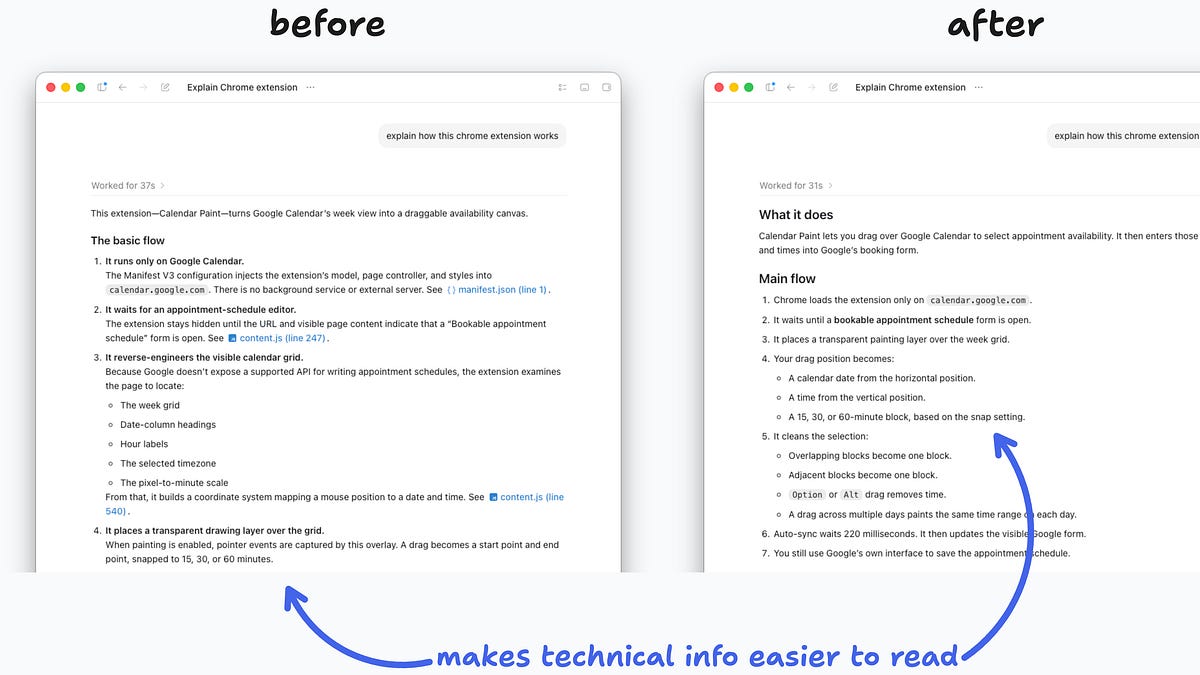
Ben’s Bites argues that AI output often feels unreadable even when it is technically correct, and recommends adding “Always talk in ASD-STE100 Simplified Technical English” to custom instructions or an AGENTS.md file. ASD-STE100 is a controlled writing standard intended to make technical material easier to read, understand, and translate; the author says it improved explanations of a Chrome extension more than asking the model to explain things to a nontechnical reader. A second, unspecified ADHD-oriented instruction is said to make answers more skimmable through concise bullets and headers. The post also rounds up product news: Meta’s 30B Muse Glimmer open-weight model, restricted GPT-5.6-Cyber access through Daybreak, changes to ChatGPT model availability, and reports of a display-less OpenAI device targeted for 2027.
Read the source →