Google reshapes DeepMind as Meta launches Muse Code
Summary
The common thread is that AI capability is increasingly being organized as a systems problem rather than a single-model problem: labs are changing leadership structures, spinning out specialized research ventures, and building agents that delegate work. That same operationalization is exposing new constraints, from financial-reasoning and prompt-injection benchmarks to accidental benchmark leakage and the rapidly rising demand for GPU capacity. The winners may be distinguished less by isolated model outputs than by how reliably they coordinate people, tools, memory, infrastructure, and evaluation.
The Sequence Radar - Issue 910: Last Week in AI: Google Rewires Its Brain and Meta Hires a Coding Swarm
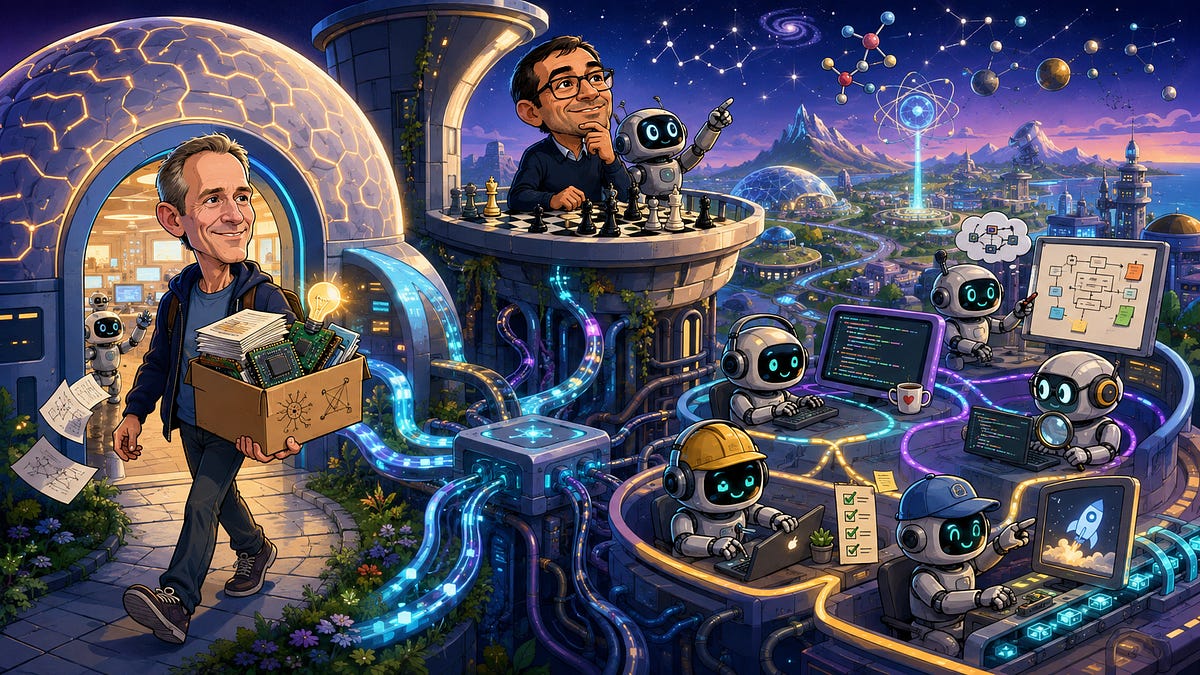
Google is separating operational model development from longer-horizon research: Demis Hassabis is becoming DeepMind chair and Alphabet chief scientist, while Koray Kavukcuoglu takes over Gemini development, frontier research, and the developer and app teams. The article frames this as an attempt to run a product clock—releases and adoption—separately from an AGI and science clock whose work does not fit quarterly planning. Jeff Dean, Sanjay Ghemawat, Quoc Le, and Oriol Vinyals are also leaving Google to create Discovery Loop, a public-benefit company for automating scientific and engineering experiments, with Google remaining an investor and cloud partner. Meta’s beta Muse Code, meanwhile, is presented as a terminal agent for large repositories that can plan, implement, validate, distribute work across isolated sub-agents, and retain an action record for crash recovery; the broader competition is shifting from code completion toward coordinating durable multi-agent work.
Read the source →