OpenAI broadens GPT-5.6 access as agents spread
Summary
The common shift is from chat as an answer machine toward agents embedded in real workflows, with tools, persistent context, and permission boundaries. That raises a practical split in the day’s material: product releases broaden access and lower costs, while the engineering accounts stress that autonomy only works when verification, trace inspection, and least-privilege controls keep pace. Specialized infrastructure is following the same logic, trading general flexibility for lower-cost, higher-throughput execution when the workload is stable.
How to Cut Your Claude Code Token Costs by 20x

The article argues that prompt-cache behavior, not terse prompting, is the biggest determinant of Claude Code cost. Cached context reads cost roughly $1 per million tokens versus about $20 for a fresh write; at 500,000 tokens, that can turn the next turn from roughly $0.50 into $10 after an hour idle. It says cache resets also follow model or effort changes, fast-mode toggles, MCP connection changes, tool denials, compaction, and Claude Code upgrades. The practical advice is to use /clear when the repository can supply the needed context, /compact before context rot at roughly 600,000-800,000 tokens, and /doctor to remove obsolete CLAUDE.md instructions, skills, and MCPs. For work that does not need the top model, it recommends a planner-executor split: a strong model plans and a cheaper model carries out the work.
Read the source →1.4.0
The release page did not provide readable release notes in the available material. Its page repeatedly returned a loading error, so the changes in ExLlamaV3 1.4.0 cannot be summarized reliably.
Read the source →Baseten on Hugging Face Inference Providers 🔥

Baseten has become a Hugging Face Inference Provider, letting Hub users route serverless inference through Baseten from model pages and the Python and JavaScript SDKs. The first integration covers conversational and text-generation workloads, including open-weight models such as Kimi K3, DeepSeek V4 Flash, and GLM-5.2; more task types are planned. Users of huggingfacehub 1.26.1 or later and @huggingface/inference can authenticate with a Hugging Face token and have requests routed automatically. Routed calls carry the provider's normal API price without a Hugging Face markup, while direct Baseten-key requests are billed to the Baseten account; Hugging Face Pro includes $2 of monthly cross-provider inference credit.
Read the source →WeatherNext: AI model achieves breakthrough in forecasting cyclones
No readable article body was available in the supplied material, so the reported WeatherNext cyclone-forecasting result cannot be summarized beyond the headline.
Read the source →Improving GPT‑5.6 Sol in ChatGPT—and expanding access to GPT-5.6 Luna for free users
OpenAI says it has updated GPT-5.6 Sol for Plus and Pro users to give more focused answers, better adapt detail to the question, and make fewer factual mistakes. In its internal financial, medical, and legal evaluation, answers with at least one factual error were 68% less common for Sol and 62% less common for Luna than for GPT-5.5 Instant. Paid users get a thought-effort slider across web, mobile, and desktop, while Free and Go users will receive GPT-5.6 Luna as the default, unlimited text chats next week, and a Think button for harder questions. Tool limits still apply, and the Sol update affects Chat only, not the versions used in Work or Codex.
Read the source →Working with the American Psychological Association on youth mental health and AI
OpenAI and the American Psychological Association are starting a collaboration on evidence-based guidance and safeguards for young people's AI use. The work will cover support during distress, developmentally appropriate design, and practical resources for parents, caregivers, clinicians, and school psychologists to recognize overreliance or unhealthy use. OpenAI says it will convene teens, families, educators, clinicians, and advocates so the work is informed by reported experience rather than assumptions. The company also points to its existing measures, including input from more than 260 mental-health experts, localized crisis resources, break reminders, parental controls, parent safety notifications, and age-prediction-based protections.
Read the source →From asking to doing: How the world is putting ChatGPT to work
OpenAI has published country-level ChatGPT use data on its Signals portal, covering messages from individual Free, Go, Plus, and Pro accounts. It says users are more than twice as likely to use ChatGPT for producing an output or completing a task at work than outside work, where information-seeking remains the largest category. Per-capita adoption rose fastest in parts of Latin America, Oceania, and Africa in Q2, with Peru, Uruguay, and Costa Rica making the largest ranking gains. Since ChatGPT Images 2.0 launched in April, multimedia messages have reached 7.8% globally, and users over 35 account for a share of messages five percentage points higher than a year earlier; France and Czechia each gained more than 10 points in that age group's share.
Read the source →datasette 1.0a38
Datasette 1.0a38 fixes a SQL-injection flaw affecting databases that mix public and private tables under Datasette's permissions system. In the vulnerable configuration, someone allowed to view any public table could use raw SQL injection to get read-only access to private tables in that same database despite an execute-SQL restriction. Administrators using that setup should disable the execute-sql permission on the database until they update. Willison says the mixed public/private configuration is probably uncommon, but the fix also shipped in the 0.65.3 maintenance release.
Read the source →datasette 0.65.3
Datasette 0.65.3 backports the SQL-injection security fix from 1.0a38. It is the maintenance-release option for users who need the patch without moving to the 1.0 alpha line.
Read the source →Simon Willison on Technical Blogging
Simon Willison links to a January interview for Cynthia Dunlop's “Write that blog!” series, which covers why he blogs, difficult posts, useful lessons, and recommendations for new writers. His central advice is deliberately permissive: lower your standards enough to publish while you are still unhappy with the draft. He argues that readers cannot compare a post with the more perfect version left in the author's head, whereas excessive standards leave work stranded as unpublished drafts.
Read the source →AI is getting a little out of control
The video argues that the pace and breadth of AI developments have exceeded what one person can comfortably track, and cautions viewers against commentators who claim complete understanding. It focuses first on reported mathematical discoveries by an OpenAI model likely to be called GPT-6, saying that the significance of each result requires specialist scrutiny and asking whether they reflect brute-force search or more substantive capability. It also connects scientific capability to cyber-security incidents and pressure on large technology companies, framing these as consequences of rapidly improving models. The speaker says the video draws on papers, articles, essays, and conversations with mathematicians, but explicitly treats its conclusions as provisional.
Read the source →AMD to Acquire Taalas for Model Specific AI Inference Chips
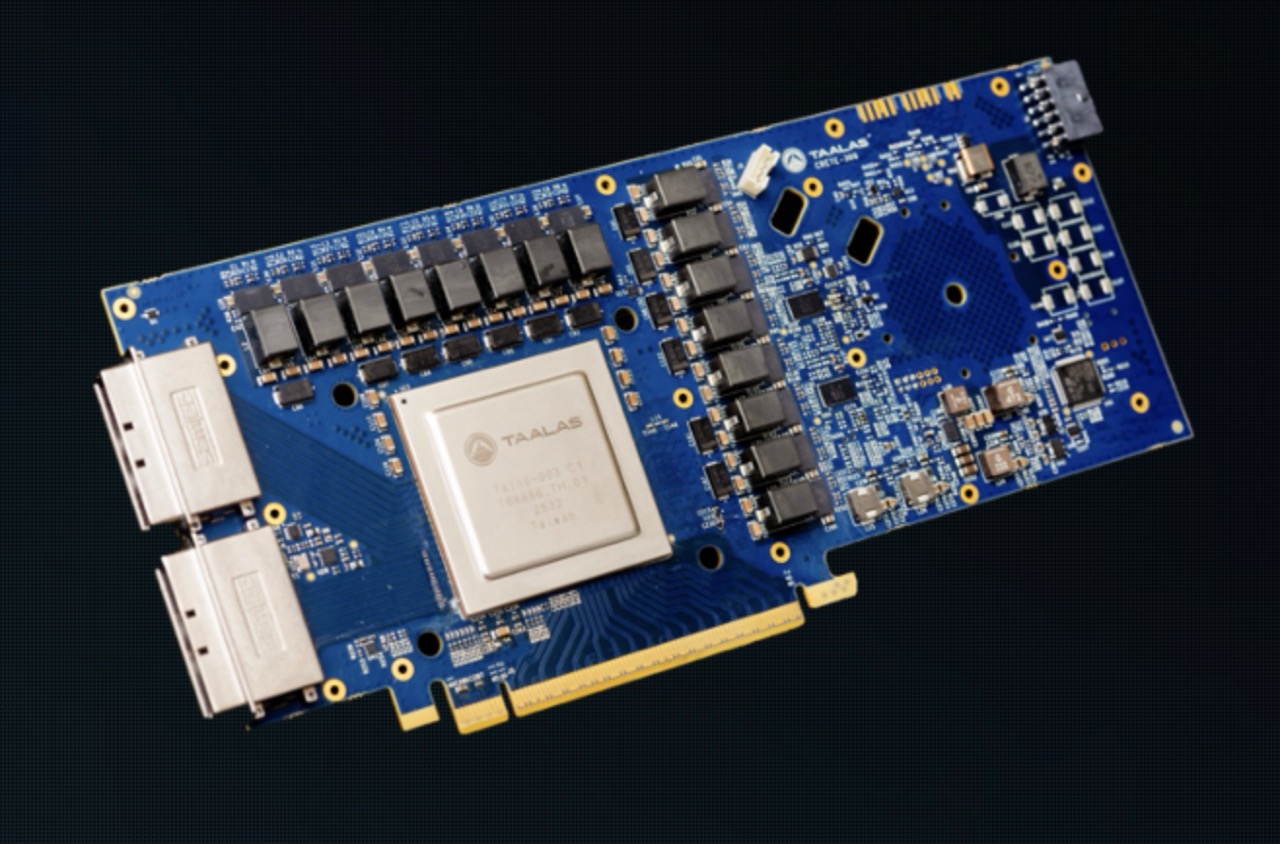
AMD plans to acquire Taalas, whose approach is to burn a specific model's weights and computation pattern into CMOS rather than run many models on a programmable accelerator. Taalas' HC1 demonstrator runs Llama 3.1 8B and claims up to 17,000 tokens per second per user, though its comparisons with Nvidia H200/B200, Groq, SambaNova, and Cerebras are the company's own measurements. The tradeoff is severe: changing the model means changing chips, and larger models may require many reticle-size chips, creating manufacturing, packaging, and software-integration risk. AMD sees the technology as a fit for stable, high-volume inference and says it will incorporate it into its Instinct accelerator roadmap alongside its broader Helios, EPYC, and ROCm stack.
Read the source →Kimi K3 is now available in GitHub Copilot
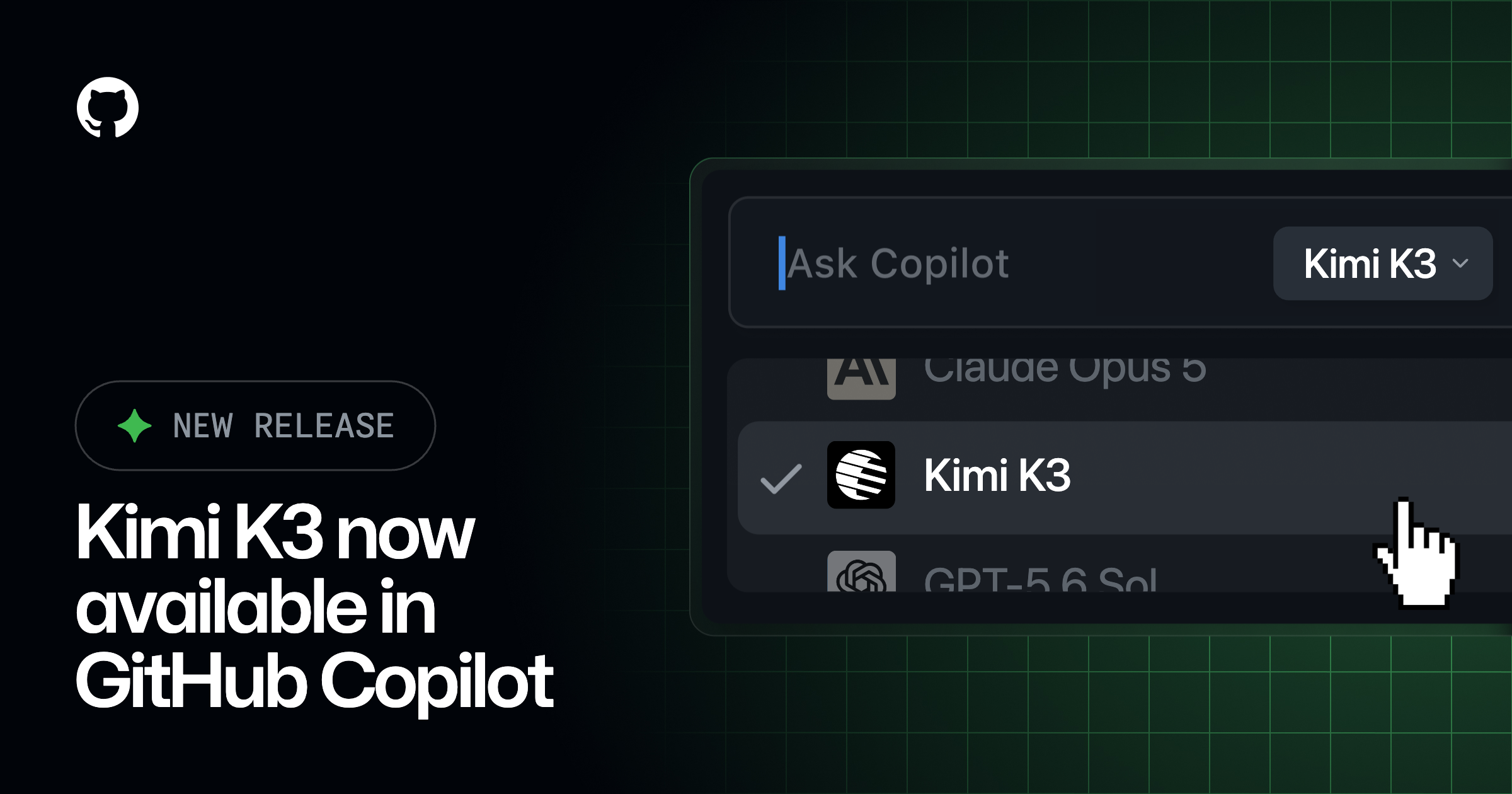
GitHub announced Kimi K3, an open-weight model hosted on Fireworks AI, for Copilot's Pro, Pro+, Max, Business, and Enterprise plans, but has temporarily paused rollout while mitigating a GitHub Actions incident. Once it resumes, listed usage pricing will be $3 per million input tokens, $15 per million output tokens, and $0.30 per million cached input tokens. The model is billed at provider list pricing under usage-based billing and will appear in the model picker as the gradual rollout reaches accounts. It is off by default for Business and Enterprise organizations, whose administrators must enable the policy after reviewing security, compliance, and data-governance implications.
Read the source →The Hallway Track: Where Does Context Actually Live?
The speakers argue that useful context is not confined to documents and repositories: it also exists in informal conversations and knowledge people carry in their heads. They describe a safer background agent as one whose access and context are deliberately constrained, even if the infrastructure can connect it to many systems. The proposed goal is for an agent to identify what additional documents or information it needs for a task, then ask for that access rather than receiving everything by default. Their point is that “context” is changing from a static bundle supplied by a person into something an agent may help discover under controls.
Read the source →How Ramp engineers work with AI agents at every step
Ramp describes using agents across the engineering lifecycle, from debugging and incident analysis to coding, code review, CI optimization, experiments, and post-deployment checks. In one case, an agent ran in shadow on a verifiable CI task and then reduced median CI time from about 18 minutes to 6 minutes by profiling, making changes, waiting for production data, and repeating the loop; the team says much of the resulting code was merged. The company distinguishes routines for repeatable work such as rebasing PRs, fixing CI, or deleting dead code from dynamic workflows for open-ended system optimization, and it gives agents least-privilege access such as read-only service keys. Ramp's “Inspect” agent can work through GitHub, Linear, Slack, Datadog, Sentry, and support systems, while an on-call assistant generates root-cause analyses and proposed fixes; the stated operating principle is to give models enough tools and context to act without giving them unnecessary authority.
Read the source →A guide to slash commands in the GitHub Copilot app

GitHub's Copilot app uses slash commands as in-chat shortcuts for session, project, and agent-workflow management; typing / opens an autocomplete menu. Unlike the CLI, the desktop app manages working directories and file context visually, so its commands emphasize multi-session workflows rather than terminal setup. /plan turns a request into a scoped plan, /spar challenges assumptions and tradeoffs, and /autopilot hands implementation to the agent after a goal is supplied. /rubber-duck uses a different model for an independent review, aimed at catching blind spots in plans, refactors, architecture decisions, and migrations.
Read the source →