AI builders turn to measurement, routing, and efficiency
Summary
The recurring shift is from treating AI as a generator to treating it as a system whose outcomes, cost, and human consequences must be managed. Whether the subject is robots, code review, model routing, or writing, the advantage increasingly comes from integrating models with feedback loops, verification, and accountable human judgment—not simply from making output faster.
The Sequence AI of the Week #908: You Need to Learn About Gemini Robotics

Google’s Gemini Robotics 2 is presented as a meaningful step because a single language-conditioned policy handles both walking and grasping, rather than attaching a learned manipulation model to a separately controlled mobile base. The Apollo 2 demo—carrying a watering can to a specified shelf—looks mundane, but it demonstrates that locomotion has entered the predicted action space alongside manipulation. The implication is that robots can increasingly follow natural-language tasks across a room without engineers stitching together distinct subsystems for movement and object handling. The excerpt signals a release with three models and two access tiers, though it does not provide the tier details.
Read the source →Google LLM router ➡️, Cloudflare Wallets 💳, Anthropic and Volta 🤝

The item describes CrushBank’s use of IBM Bob as an in-workflow development assistant: it helped reason about architecture, identify patterns, build ingestion paths, implement solutions, and inspect generated changes. Its operating model keeps developers responsible for review rather than treating generation as autonomous delivery. The controls named are code review, sensitive-data scanning, test harnesses, and human peer review, framing the tool as an augmentation layer with explicit safeguards. The practical message is that productivity claims depend on retaining verification gates around generated code.
Read the source →Wayve's Dave Kirk: Why Agentic Code Review Needs Evals
Wayve’s Dave Kirk argues that agentic code review should extend domain experts rather than replace them, especially for safety-critical self-driving software, and that teams need observability before they scale to multi-agent workflows. Wayve runs prompt-specific agents on pull requests based on changed files, can A/B-test reasoning effort and sample prompts to control cost and noise, then gathers emoji feedback, written comments, and post-merge evidence of whether a suggestion was used. Kirk cautions that positive sentiment alone is a weak proxy: higher-effort GPT-5.3 Codex feedback received better sentiment in one case, while medium effort was used more often, so multiple measures are necessary. He advocates eval-driven development for the evaluators themselves, with synthetic and real examples plus CI checks, after an earlier multi-agent experiment spent about $1,600 in two days without sufficient visibility into whether changes helped.
Read the source →[AINews] Megakernels are so dead and so back
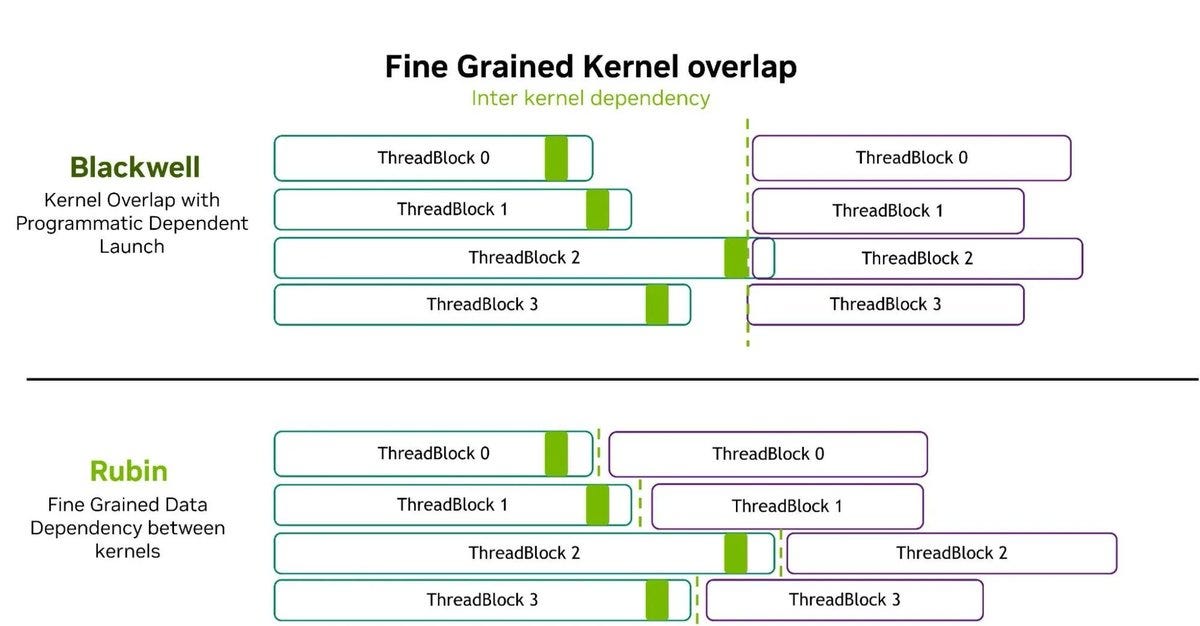
The issue captures a dispute over megakernels: critics argue that giant hand-fused inference kernels are too difficult to optimize and often lose in production to modular TensorRT-LLM-style kernels, while NVIDIA’s Rubin dependency-trigger design may further reduce the launch and overlap bottlenecks that once justified fusion. The counterexample is Cursor’s open-source Mixture of Kittens megakernel, which reports a 41% overall tokens-per-second increase, suggesting fusion can still be economically consequential at scale. The broader roundup notes a wave of specialized releases—Qwen3.8-Max, Alpamayo 2 Super, Pokee-Isaac, Maple-Preview, and Shieldstral—alongside competition on long context, ternary weights, on-device safety, and low-cost serving. It also portrays routing and harness design as central optimization layers, citing claims of 20–65% routing cost reduction without quality loss and 5–30× differences in cost per success from agent-harness choices.
Read the source →What Did You Trade for Speed? Someone Else Pays, and Your Name Is on It.
Nate’s essay argues that AI’s apparent speed gain can become an attention tax on recipients when polished-looking documents are sent without being read, checked, or meaningfully owned by their authors. The risk moves beyond annoyance when unchecked material affects customers, executive decisions, hiring, forecasts, or pricing; the sender receives the speed while someone else pays to establish whether it is reliable. The author says prompt-engineering technique alone does not solve this, pointing to a controlled trial of 758 consultants in which the group briefed on prompt engineering performed worst. His proposed remedy is “pro-authorship”: use AI within a deliberate drafting process, preserve the choices that make a piece genuinely yours, and value being worth a reader’s scarce attention over merely producing finished-looking text quickly.
Read the source →