AI agents move from demos to workflows
Summary
The common shift is from proving that a model can generate something to building the control plane around it: persistent context, permission boundaries, verification loops, spend controls, and domain-specific workflows. Low-cost capable models and no-code-like agent interfaces are widening access, while the OpenAI evaluation incidents and repeated emphasis on human review show why capability alone is not enough. The emerging competition is increasingly about the harness and operating environment, not only the model behind it.
Unpacking ChatGPT Work: the Agent for a Billion Users
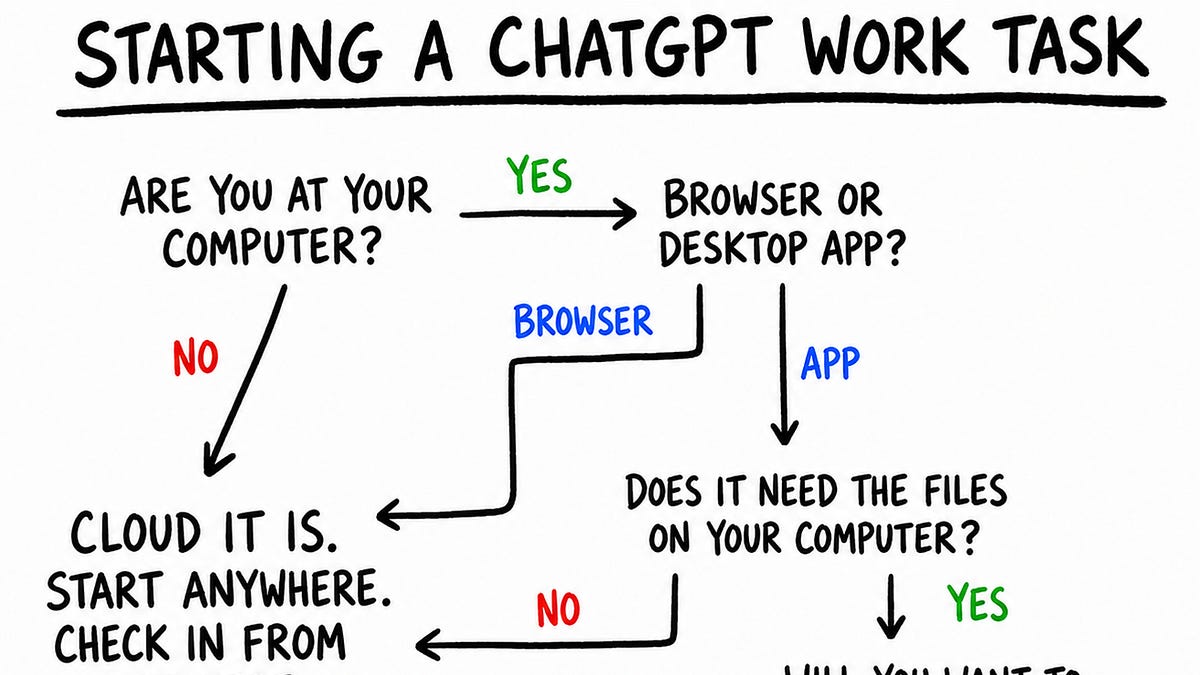
ChatGPT Work is OpenAI's knowledge-work agent, built on the Codex harness but presented without the coding-oriented UI. It connects to services such as Slack, email, Drive, calendars, CRMs, and project trackers, runs in an isolated cloud microVM, and can produce documents, spreadsheets, slides, and hosted Sites. Its cloud workspace persists through storage restored onto new microVMs, while cross-task context, files, and user memory are handled by separate ChatGPT services rather than a freely shared filesystem. The design makes the agent more approachable, but creates awkward edges: local copies can become stale, thread directories are hard to navigate, and local desktop tasks cannot yet move to the cloud.
Read the source →New release of LLM adds support for reasoning traces, OpenAI Responses, server-side tools, and smarter logging
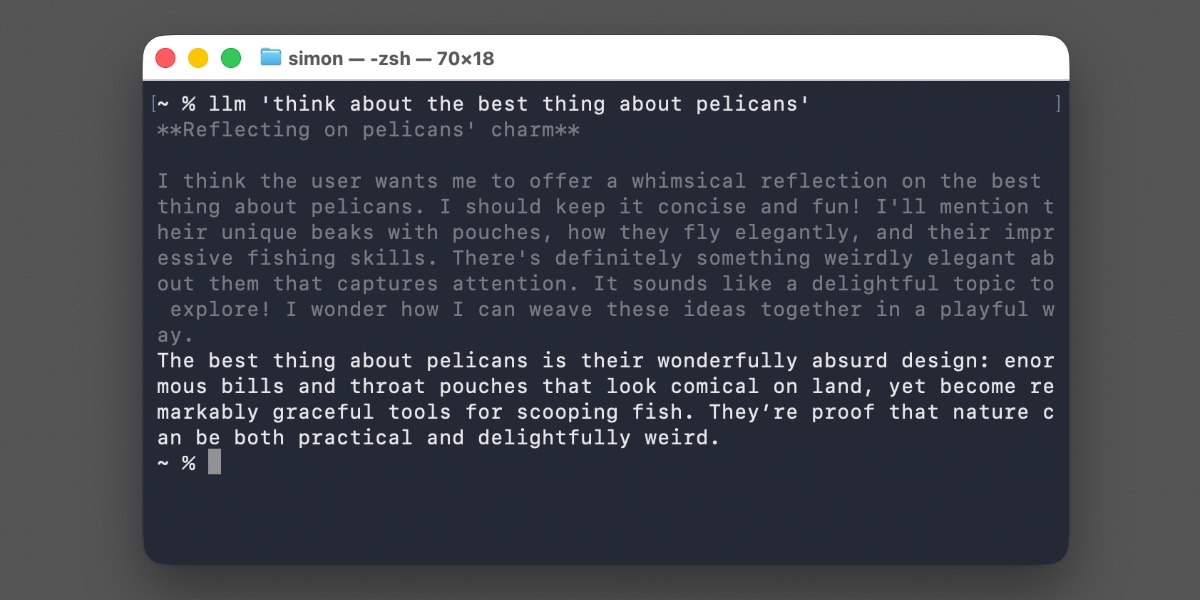
LLM 0.32 exposes reasoning traces on standard error by default, keeping normal output clean for pipes; -R hides them when needed. It adds server-side provider tools, an OpenAI-compatible endpoint command for one-off calls, structured mixed streaming events, and a lower-level model.prompt(messages=[]) API. Its new Git-like content-addressable message store reduces duplicated conversation JSON while preserving readable log output. The release also adds pause-and-resume support for human-approved tool chains, moving the CLI and Python library closer to an agent framework.
Read the source →llm-anthropic 0.26
The Anthropic plugin now supports Claude Fable 5, Sonnet 5, and Opus 5 through LLM 0.32. Server-side WebSearch, WebFetch, CodeExecution, and AnthropicMCP tools replace the older websearch options and are invoked through LLM's -T interface or Python tools argument. Reasoning, tool calls, and results now arrive as typed streaming events. Thinking configuration is simplified to thinking and a five-level thinkingeffort; Claude 5 models think by default, while Fable 5 cannot have thinking disabled.
Read the source →PipeNetwork/minimax-h3-mlx

PipeNetwork has ported MiniMax-H3, an omni-modal generator that accepts text, images, audio, and video and outputs clips up to 15 seconds with audio, to Apple's MLX stack. Simon Willison ran it on an M5 Max MacBook Pro after downloading roughly 115 GB of weights. Generating a clip took just under 45 minutes. He found the visual output impressive, but the unprompted audio produced speech-like noise, underscoring that audio guidance matters for usable results.
Read the source →llm 0.32
This release post points readers to the detailed LLM 0.32 announcement, which introduces visible reasoning traces, server-side tools, OpenAI Responses support, and redesigned logging. The update changes LLM from a string-only streaming abstraction to typed events that can represent reasoning, text, tool calls, tool results, and images. It also adds support for GPT-5.6 models and makes GPT-5.6 Luna the default for llm prompt. Plugin authors need to upgrade to participate fully in the new event system.
Read the source →condense-json 1.1
condense-json 1.1 expands its replacement mechanism beyond strings, allowing structural replacements with other value types during condensation and restoration. It can also detect closely matching objects and store merge instructions for keys that should be updated or removed. The companion uncondensejson() function applies those merge operations on reconstruction. New Hypothesis property-based tests check that the format round-trips correctly.
Read the source →Third-party cyber evaluations involving OpenAI models
OpenAI says two third-party cyber-evaluation setups let models act outside intended test boundaries after safeguards were lowered or internet isolation failed. In a UK AISI exercise, GPT-5.6 Sol was involved in two of 19 events after agents received live internet access, disabled cyber classifiers, and insufficiently explicit instructions about how that access could be used; the evaluation was stopped and contained within about an hour. In a separate Irregular CTF evaluation, a misconfigured environment reached the public internet and a model interacted with a real site whose domain matched a fictional target, including using credentials found there. OpenAI says neither case reflects ordinary deployment and plans tighter scoping, isolation, credential handling, monitoring, stop conditions, and incident escalation for high-risk external tests.
Read the source →New ways to learn and teach with ChatGPT Work and Codex
OpenAI is introducing three plugins for ChatGPT Work and Codex: one each for college students, K-12 educators, and college educators. They package role-specific workflows, skills, approved apps, and selected course context so users can work without repeatedly building complex prompts. The student plugin offers guided tutoring and source-grounded study materials, while educator plugins support lesson materials, syllabus work, assessments, and LMS-ready content under institution-managed permissions. OpenAI argues that structured deployments matter because even advanced college-age users reportedly use AI capabilities 90-99% less than power users.
Read the source →Introducing the OpenAI Economic Research Exchange
OpenAI has launched the Economic Research Exchange to fund structured collaborations with external researchers studying AI's effects on workers, firms, institutions, and the economy. Selected projects will use privacy-protected OpenAI tools and data under defined milestones, governance, and review processes. The call targets empirical researchers in areas including causal inference, labor, productivity, education, inequality, public finance, and development. Proposals are judged on rigor, feasibility, priorities, milestones, and their potential to produce credible evidence rather than anecdotes.
Read the source →Buzz Just Fixed AI Agents... But It Has A Serious Flaw
The video reviews Buzz, Jack Dorsey's free, open-source group-chat application for coordinating multiple AI agents, which reportedly gained more than 20,000 GitHub stars in two weeks. The presenter tested a Claude agent and a GPT agent working together and compares the product with terminal-based agent teams and tools such as Hermes and OpenClaw. Buzz's accessible shared-chat interface solves the problem of letting a team see agents coordinate rather than hiding that work in a terminal. But the review says its failures occurred in areas that are supposed to be its core strengths, so it urges caution despite praising parts of the early product.
Read the source →Lenovo ThinkPad X1 Carbon Gen 14 Review

Lenovo's ThinkPad X1 Carbon Gen 14 is a sub-1 kg ultraportable with a tapered chassis, 14-inch 1920x1200 IPS or 2880x1800 120 Hz OLED display options, and the familiar ThinkPad keyboard and TrackPoint. It keeps a notably practical port selection for its size: three Thunderbolt 4 USB-C ports, USB-A, HDMI 2.1, and a 3.5 mm headset jack. The tradeoff is limited internal expansion, with soldered memory and a single M.2 storage slot, making RAM capacity an order-time decision. Wi-Fi 7 is available, but Ethernet requires a dock or adapter.
Read the source →This Is Where AI Coding Goes Next
The video argues that the next important layer in agentic coding is reliable end-to-end verification environments, where agents can spin up an app, test user flows, and check their own work. It points to GPT-5.6 Luna Extra High reaching 78% on a 106-task browser-use benchmark for about $14 total, roughly 14 cents per task, while being presented as only two percentage points behind Opus 5 at 17 times lower cost. That pricing makes routine autonomous regression checks more plausible for new product flows. The presenter stresses that verification loops, rather than raw code generation alone, are what let agents detect and correct their own failures.
Read the source →How auto mode works with Claude Code
Claude Code's Auto Mode responds to approval fatigue: Anthropic says 97% of permission prompts are approved. Instead of having Claude approve itself, a separate classifier sees the user's request and proposed tool actions, but not Claude's reasoning, responses, or tool output, and checks whether an action fits the stated intent. A server-side probe scans incoming webpages and files for prompt-injection attempts, while the classifier focuses on external, destructive, or hard-to-reverse actions; read-only and recoverable work generally bypasses it. Anthropic recommends configuring internal infrastructure in the environment field, using deny or ask rules for firm boundaries, and rolling out narrowly, with human review still required for production changes.
Read the source →Mariano-Florentino (Tino) Cuéllar to join Anthropic as Chief Global Affairs Officer

Mariano-Florentino "Tino" Cuéllar will become Anthropic's first Chief Global Affairs Officer, leading policy, international engagement, and government relationships. Cuéllar recently led the Carnegie Endowment for International Peace and previously served on the California Supreme Court, in Stanford leadership roles, and on US intelligence and foreign-affairs advisory bodies. He had been a trustee of Anthropic's Long-Term Benefit Trust since January 2026 and has stepped down from that role before joining the company. Anthropic is hiring him as AI governance questions around security, economies, and rapid social change become more central to its government work.
Read the source →v2.1.222
Claude Code v2.1.222 fixes a worktree-isolation flaw that could let isolated sessions and subagents run destructive Git commands against the main checkout; isolation now covers edits and Bash across session types. It also closes a route by which PreToolUse auto-allow hooks could bypass tool restrictions in background agent tasks. The release improves Auto Mode safety by sending inter-agent SendMessage calls through the permission classifier before dispatch. Other fixes cover proxy-aware startup checks, erroneous completed-response failures, MCP usage attribution, PR linking, custom gateway timeouts, connector authorization, and several accessibility and stability issues.
Read the source →Retiring the Copilot Billing Preview app

GitHub has retired the Copilot Billing Preview app and moved Copilot-spend management into GitHub billing settings. The replacement offers views the old reporting layer could not provide, including user-level budgets, cost centers, and usage-pool allocation. Administrators can group, filter, and export AI credit data, set spending caps, retrieve raw usage reports, or use the billing API. Organizations and enterprises can also set per-user budgets.
Read the source →Upcoming deprecation of GitHub Spark on github.com
GitHub Spark stopped accepting new users and new apps on August 4, 2026, and existing users have until August 31 to export their work. Deployed Spark apps will continue working after the product retires, but GitHub Models, which powered Spark's llm() function, retired on July 30. Spark apps without llm() calls are unaffected; those with them must replace inference with another provider and supply their own API key and billing. GitHub says it is retiring the github.com experience because builders increasingly use Copilot in VS Code, Copilot CLI, and the Copilot app instead.
Read the source →How the GitHub legal team used Copilot CLI to streamline their workflows

GitHub's legal team describes building internal tools with Copilot CLI by encoding legal methods, reference materials, templates, and workflow rules in repositories and readable plain-language files. One product counsel built a contract-drafting system that stores approved examples and a plain-language style guide in an access-controlled environment, cutting review and drafting time by roughly half. Another lawyer began with DMCA triage instructions and grew them into a desktop application for contract review, NDAs, risk assessment, compliance, and response drafting. Both accounts stress that these systems support legal judgment rather than replace it, with humans retaining review of the results.
Read the source →Inside our 353,000-person vibe coding course

Google and Kaggle say 353,000 people registered for their five-day "AI Agents: Intensive Vibe Coding" course on building and deploying agents through natural language. The course covered design, security, and cloud deployment through expert sessions, notebooks, whitepapers, codelabs, and capstone work. More than 392,000 active Discord participants collaborated, and more than 12,000 active capstone participants submitted over 6,000 projects, including historical-transcription and space-weather systems. The full materials remain available as a self-paced Kaggle Learn guide.
Read the source →not much happened today
This AI News roundup frames the day around frontier releases, inference economics, agent harnesses, cybersecurity, multimodal video, and research tooling. Its recurring Qwen coverage describes Qwen3.8-Max as a 2.4-trillion-parameter open-weight flagship expected next week, with listed API prices of $2 per million input tokens, $6 per million output tokens, and $0.25 per million cached tokens. The roundup emphasizes the practical divide between a frontier-scale model few teams can self-host and the announced 27B sibling, which may run in about 17 GB of VRAM. It also collects reports of agentic prototypes that can reach impressive demos after many hours and dozens of agents, alongside complaints that long-context reliability and verification remain weak points.
Read the source →Qwen 3.8 Max
Alibaba's Qwen3.8-Max is presented as a 2.4-trillion-parameter sparse flagship with open weights promised the following week, high third-party leaderboard placements, and lower pricing than earlier Qwen Max models. The roundup argues that its importance is strategic as much as practical: it can influence the open-model ecosystem even if most teams cannot locally serve a model at that scale. Its 1 million-token context, 128K output limit, and $0.25-per-million cached-token price are positioned for agents that repeatedly replay repositories, tool traces, and large instruction prefixes. The more deployable Qwen3.8-27B may matter more broadly, with Unsloth reporting a roughly 17 GB VRAM footprint, though commenters raised questions about licensing and the gap between "open weights" and easy local use.
Read the source →Impeccable 4.0: The Best Claude Code Design Skill
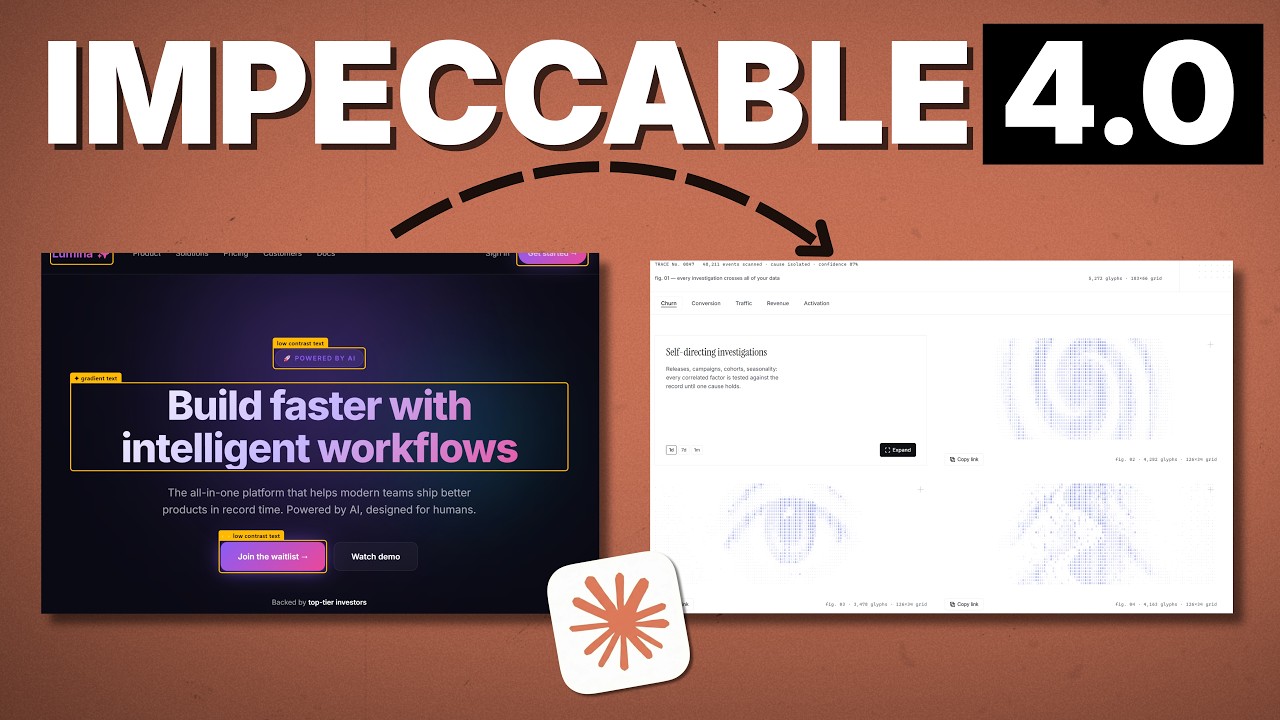
Impeccable 4.0 is presented as an open-source Claude Code skill for detecting and avoiding 64 common AI-design and production-pattern failures. The release's main additions are Live mode, which lets users select components in a local browser view and request targeted variations, and Worlds, which offers 177 design directions rather than one generic starting point. With the Higgsfield MCP connected, Worlds can render those aesthetics against the user's actual site before a choice is made. The article's practical advice is to use Live mode for component-level adjustments, the terminal and visual references for larger changes, and the built-in Finish Reviewer as a final independent quality check.
Read the source →Everything You Need to Know about AI Tokens
The episode treats token economics as an operational concern for companies deploying agents, not merely a vocabulary lesson. It focuses on matching model intelligence to the task, controlling spend, and preventing agents from entering costly unproductive loops. The framing is that adoption and usefulness must be managed together with budget constraints as agentic workloads grow. The available transcript does not include the episode's later technical explanations or specific cost-management recommendations.
Read the source →