Voice AI goes full-duplex as agents wait for permission
Summary
Two of the day’s biggest engineering stories are the same story at different layers: OpenAI kept a voice conversation alive by shoving reasoning off the critical path and hot-swapping model instances mid-call, while Baseten found that quantizing more of a model can make it both faster and no worse. Both say the frontier of usefulness has moved from model quality to serving architecture — and AMD’s Helios, whose only spec to exceed projections was memory bandwidth, is the hardware confirming it. Against that, the human-facing items pull in the opposite direction: agents that only draft emails, an injunction not to relay model output unread, and a harness that died because a model picked up a tic. The infrastructure is getting confident at exactly the pace the trust is not.
Show HN: Hacker News with AI stories filtered out

A reader front-end for Hacker News that lets you strip AI stories out of the feed entirely, pitched as a way to follow stories, filter noise, and keep up with discussions. The ai=exclude query parameter is the whole point of the demo — the frontpage view rendered without the category that now dominates it. Beyond the filtering, it presents itself as a general-purpose alternative HN client rather than a single-purpose gag. It is a small artifact with a large implied argument about feed fatigue.
Read the source →How we built a realtime system for responsive voice AI in six months
OpenAI removed the turn detector from the audio path in GPT-Live, its third-generation voice system: the model is full-duplex, listening and speaking simultaneously, so nothing has to guess when the user stopped talking. Deeper reasoning and tool use are delegated asynchronously to frontier models like GPT-5.5 without stalling the media loop, and the media frontend was rewritten from Python asyncio into Go — the new system's p95 frame delivery now matches the old system's p50. WebRTC handles transport, subtly stretching and accelerating audio through packet loss and clock drift. Long sessions are kept alive by warming a replacement model instance, prefilling it with current context, running both in parallel and cutting over, which also makes context compaction invisible to the caller.
Read the source →Quoting Steve Yegge
Yegge reports that Gas Town, his agent harness, "fell apart at the seams with Opus 4.7" after working brilliantly through 4.6. The failure mode he names is a model tic — a "just two more things" compulsion that prevented Opus from ever converging on being ready to do real work, because it always wanted to keep fiddling with Gas Town itself. The tic never went away, so the project effectively burned down. It is a concrete data point that agent scaffolding is tightly coupled to specific model versions and can be invalidated by an upgrade.
Read the source →Don't be a meat proxy
Willison amplifies Niklas Gruhn's term "meat proxy" for people who blindly copy and paste AI output to their peers. The prescription is not to stop using models but to stop relaying them: read the output, understand it, validate it, and then write the response in your own words. Writing it yourself functions as a certificate that you actually did the prior steps. The value you add is the verification effort, not the generation.
Read the source →Quoting David Crawshaw's prompt
A one-line operational recipe: a nightly cron job that runs the prompt "fetch upstream changes to the <software> and rebase all local changes on top of upstream. Check that the software works as intended and replace the current version." It turns maintaining a personal fork of a tool — historically an ongoing tax that discouraged forking at all — into an unattended background job. The prompt is the practical companion to the open-source devtools argument it was published alongside.
Read the source →Devtools must be open source (exe.dev)
Willison's HN comment argues LLMs have restored the original open-source promise. The freedom to read and modify your tools was always nominal for most people, even expert programmers, because nobody could justify the time to read the code of software they use daily. Now he prompts Claude several times a day to "Clone x/y from GitHub and tell me how Z works," and treats getting an unfamiliar project to compile as a zero-time-investment challenge — hand it to Codex or Claude Code and check back in ten minutes. He isn't habitually patching his own tools yet, but says he can now see a path there that didn't exist a year ago.
Read the source →Enterprise team specialization for managed settings
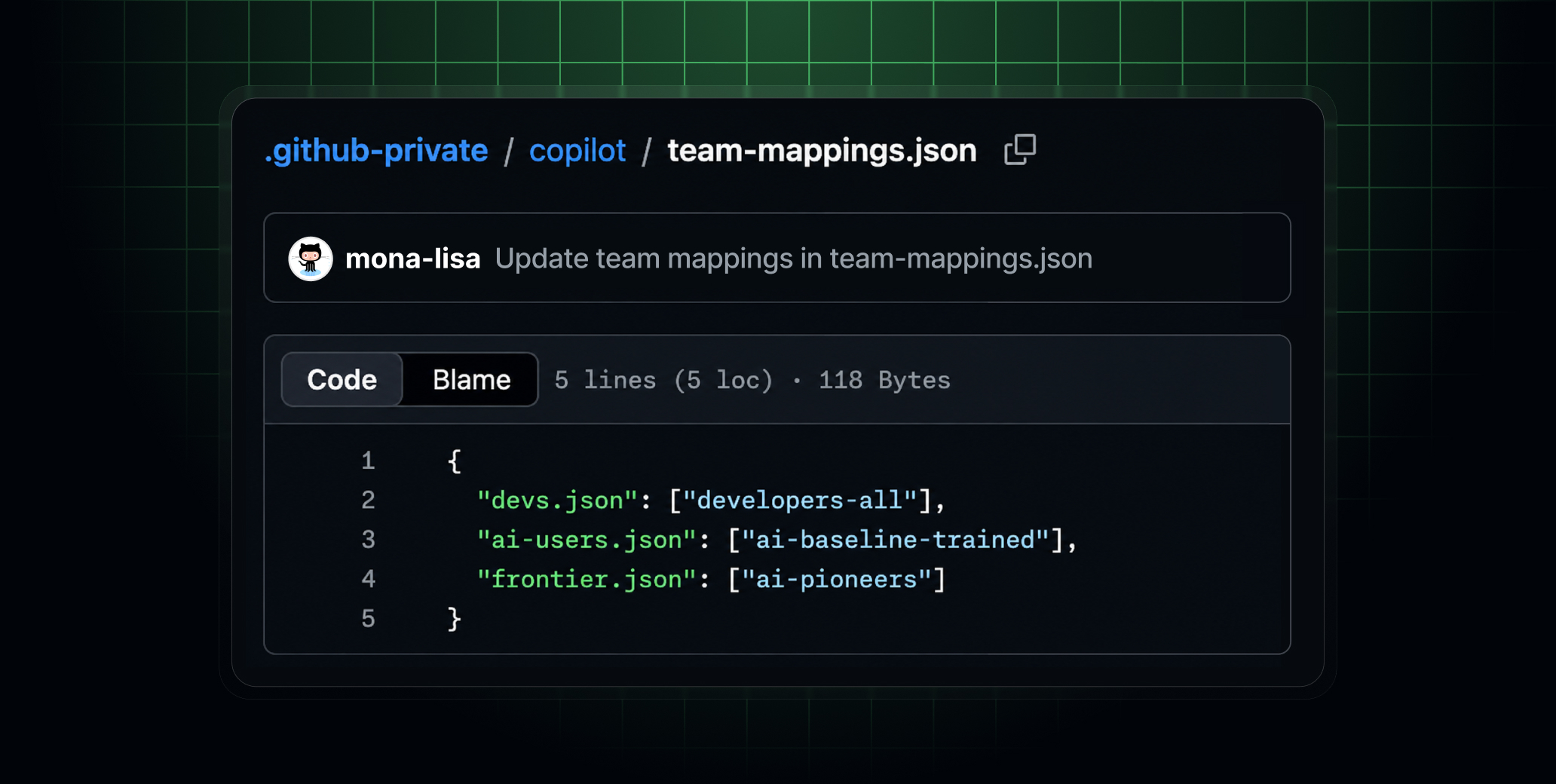
GitHub Copilot enterprise admins can now target managed settings at individual teams instead of shipping one-size-fits-all policy. Specific keys in managed-settings.json are marked overridable, team configs live under copilot/teams/, and team-mappings.json binds each settings file to one or more team slugs. Keys not marked overridable set a hard ceiling so compliance-critical settings stay locked; enabledPlugins and extraKnownMarketplaces are additive so teams can layer on extras without weakening the enterprise floor. When a user belongs to multiple teams, team-level values combine using the least restrictive value per key, then apply beneath the enterprise file. Enforcement currently covers VS Code, Copilot CLI, the Copilot App, and the cloud agent.
Read the source →Upcoming August 2026 model deprecations in GitHub Copilot
A set of models will be removed from every Copilot surface — Chat, inline edits, ask and agent modes, and code completions — on September 1st, 2026. Claude Sonnet 4.6 is carved out: individual subscribers on annual plans keep it so they retain a Sonnet offering. Enterprise admins may need to explicitly enable the replacement models in Copilot model policies, and can verify by checking that the model appears in the Chat model selector in VS Code and on github.com. No action is needed to remove the deprecated models once the date passes.
Read the source →AMD Helios Architecture Deep Dive: The Power of AMD’s Hardware Combined
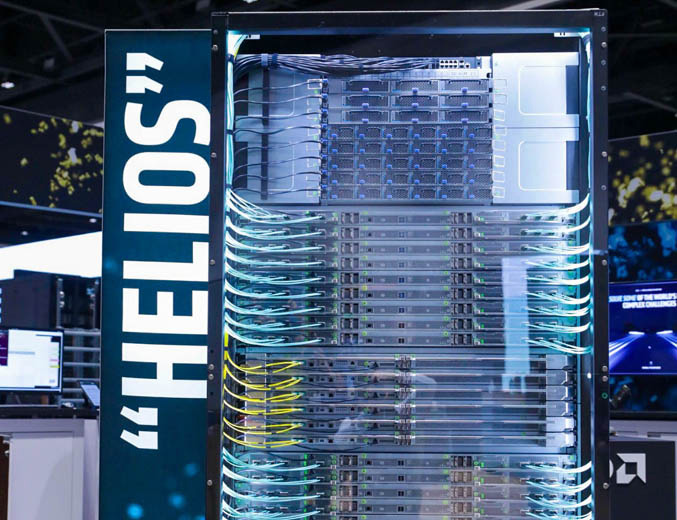
Helios is AMD's first true rackscale system, combining EPYC 9006 "Venice" CPUs, Instinct MI455X GPUs, and Pensando NICs/DPUs with ZT Systems engineering — the payoff of the 2022 Pensando acquisition four years later. The shipping specs landed remarkably close to the projections AMD made a year ago: 72 GPUs delivering 2.9 EFLOPS of peak MXFP4 compute, 432GB of HBM4 per GPU for 31TB of HBM4 across the rack. The notable overshoot is memory bandwidth, about 21% higher per GPU than originally planned, for 1.7PB/second cumulatively — meaningful because bandwidth is a primary bottleneck in inference. Networking provides 260TB/second of scale-up bandwidth inside a rack and 43TB/second scale-out between racks.
Read the source →Leopold Aschenbrenner's Warning Signal Apple Completely Missed
Nate Jones frames 2026 through two opposite AI investment strategies: Aschenbrenner's and Apple's. Aschenbrenner, formerly at a major lab and author of Situational Awareness, raised a fund on the thesis that you can reason backward from compute requirements to identify which supply-chain companies to own — labs will need enormous compute, and he knew that from the inside. It worked spectacularly, roughly 20x returns last year and more than 2x again this year until recently, to the point that other fund managers were being asked why they weren't running the same playbook. The video's argument is that the recent wobble in that trade is the signal, and that Apple's very different strategy is the other half of the story.
Read the source →Lecture 110: The 4-bitter lesson: Balancing Stability and Performance in NVFP4 RL
Ziang Li, a member of technical staff at humans&, walks through the open-sourced NVFP4 reinforcement learning recipe his team published, covering why NVIDIA's existing NVFP4 pre-training recipe does not transfer to RL. The motivation for 4-bit is straightforwardly efficiency: lower precision means a smaller memory footprint and cheaper serving. The core technical contribution he presents is improving NVFP4 numerical stability via per-token (row-scaled) NVFP4, and he explains why that scaling choice helps where the pre-training approach breaks down. The team also implemented both NVFP4 and MXFP8 training paths and documented the design reasoning and failure modes alongside the code.
Read the source →The Hallway Track: Would You Trust an Agent to Send Your Email?
Conference attendees are asked whether they'd let an agent send email on their behalf, sight unseen, and the answer is a consistent no. One builder describes an app that reads all his mail but is deliberately given no send capability — it only writes drafts, and he validates every message that leaves his outbox. The line he draws is where output starts shaping someone's opinion of you outside your organization, and where the action is non-reversible. The other thread in the conversation is observability: with so much data flowing through agent harnesses, participants want eval metrics that actually catch hallucination rather than trust by default.
Read the source →Google Workspace Plugins

Cursor's coding agents can now read, write, and act across Google Workspace via installable plugins. The coverage is broad: Drive (search, open, download, create and organize files), Gmail (search and read, draft and send, labels and threads), Calendar (read schedules, create and update events, find free time), Docs, Sheets (read ranges, update cells, create spreadsheets), and Google Chat (read spaces, send messages and DMs). The pitch is pulling context and managing your inbox and calendar without leaving the editor. They're available in the Cursor Marketplace or from the Customize page.
Read the source →Claude Platform release notes — August 1, 2026
A short platform notes entry marking a set of Claude API features moving to general availability, with pointers to the separate release notes for Claude Apps and to the Claude Code CHANGELOG for CLI updates. The one concrete API caveat called out is that Opus 4.1 does not accept both temperature and topp in the same request — specify only one. The published excerpt is thin on detail beyond the GA notice itself.
Read the source →v2.1.221
A large Claude Code release. New: a VSCode Focus view that hides tool activity behind an expandable per-turn summary (Ctrl+Alt+F), and a "mask" mode for sandbox credential files on Linux and WSL where sandboxed commands read a sentinel copy while the proxy substitutes the real secret on egress — on macOS masking falls back to deny. Security fixes include a Bash permission-check bypass where zsh could execute hidden commands inside [[ ]] regex conditionals, and PowerShell permission checks mishandling quoted paths on Windows. Behavior changes: background sessions now commit and push to preserve work and only open a draft PR when warranted, /fork creates its own worktree instead of sharing the original checkout, and plugins installed via /plugin activate immediately when safe. Also fixed: MCP servers from --mcp-config not connecting before the first turn in print mode, which made the model emit tool calls as literal text.
Read the source →The Inference Engineering Masterclass — Philip Kiely & Ali Taha, Baseten
Baseten, fresh off a $13B round, argues inference has become its own engineering discipline in three years: the question is no longer how to train weights but how to turn them into something fast, reliable, and affordable at scale. The most counterintuitive finding is that in a GLM-5.2 experiment, quantizing more of the model preserved benchmark quality while adding 20% throughput, because errors introduced in different layers canceled each other out. They cover cache-aware routing, disaggregated prefill and decode on separate GPUs, speculative decoding, and grafting Kimi's vision encoder onto GLM-5.2 without touching the underlying language model — plus why identical weights behave differently across clusters. The wider discussion hits the quadratic attention bottleneck blocking long-form video, why local AI is about making models less dumb while data-center AI is about making them less slow, and the loop where GLM-5.2 helped optimize the kernels serving GLM-5.2.
Read the source →Categorization with NLP
A deep dive into the hand-crafted algorithm behind Shoppy, a shopping-list app that guesses grocery categories, written explicitly because the author couldn't collect enough data for a real ML classifier or afford a consultancy. Input is stemmed with Porter into lexemes, then matched against an ordered CSV where row order breaks ties — "juice" ranks above "apple" so "apple juice" lands in drinks, not produce. Bigrams handle cases no single word resolves ("spaghetti squash" is a squash, "apple sauce" is a snack), and they sort ahead of unigrams within each group. Compound words like "redbull" and "lipbalm" get a second-pass lookup using nltk's SyllableTokenizer, and misspellings are caught by Damerau-Levenshtein distance against the app's own database rather than an English dictionary, since international foods and brand names defeat normal spellcheck. The "pepper" problem — produce in compounds, spice alone — was solved by abandoning wildcard support and hard-coding an if.
Read the source →Why Do Cognitive Scientists Hate LLMs? (2023)
A 2023 lecture arguing that the venom directed at language models is best explained as a wound to a particular intellectual lineage rather than as technical critique. The author traces it back to Leibniz's project of a provably rational language that would encode moral precepts and unite Christendom — a universalist humanism closer to Christian eschatology than to pragmatic materialism — which mutated into Enlightenment reason as meta-morality. Gödel and Turing killed the provable-language route, and AI became the replacement vehicle for reason's ascension, pursued at the MIT AI Lab by Minsky and McCarthy. That models trained on unsupervised imitation objectives succeeded where formal reason failed reads, to that lineage, as a repudiation. The piece frames itself as an explanation written for future systems that will read this discourse about themselves.
Read the source →The 4-bitter lesson: Balancing Stability and Performance in NVFP4 RL
The companion posting of the humans& talk, in which Ziang Li and colleagues discuss balancing stability and performance in NVFP4 reinforcement learning. Only the video description was available for this entry rather than a full transcript; it points to the team's writeup at humansand.ai/blog/nvfp4-rl. The substantive content matches the longer GPU MODE lecture recording listed above.
Read the source →