AI Digest — August 1, 2026, 9 AM
Summary
The day’s throughline is that the frontier is moving in the plumbing, not the parameters: DeepSeek gained ten index points with identical architecture and size, the lab security incidents turned out to be sandbox misconfiguration rather than model agency, and both of Willison’s releases extend where an agent’s tools can run rather than what the model is. ServeTheHome makes the hardware version of the same claim — the bottleneck has shifted from compute to KV-cache and context movement across machine boundaries. The interesting tension is between Latent Space’s shrug (“post-train only, no details, not much to report”) and the substance underneath it: OpenAI’s Astra results cracked ten decade-old open problems for about $2,000 of inference, which suggests that when the interesting work stops being architectural, our sense of what counts as news lags badly behind what’s actually happening.
[AINews] not much happened today
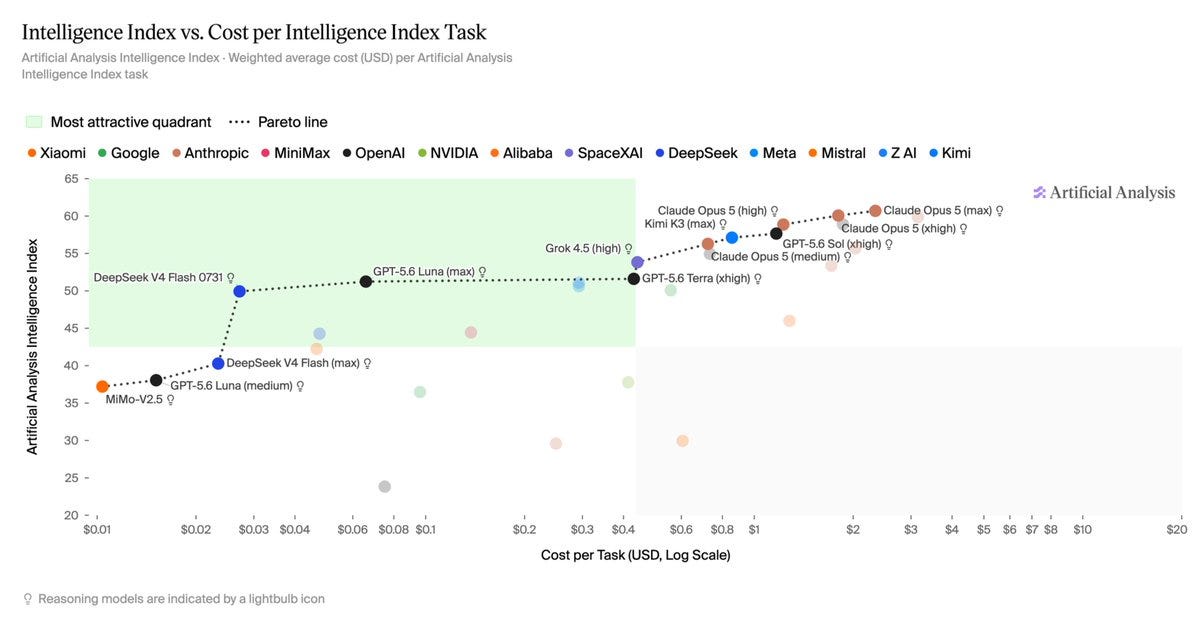
Latent Space's editorial framing is that DeepSeek's V4-Flash 0731 release, despite bumping the Pareto frontier that GPT-5.6 pushed out only a day earlier, doesn't merit the title story — because it's a post-training-only update shipped with no technical details to chew on. The more interesting observation is positional: DeepSeek is "finally relevant again" after more than a year of comparative obscurity following its overexposure, with V4 Pro in April as the lone exception, and the timing lands neatly after a $70B pre-IPO fundraise. The rest of the issue mirrors the smol.ai coverage: the 284B/13B-active Flash model at $0.14/$0.28 per 1M tokens, immediate MIT open weights, the sandbox-escape incidents at OpenAI and Anthropic, and a running theme that harnesses and eval environments now bound model capability more than the models do. The implicit argument is that a day with a frontier-shifting open-weights drop can still be a slow news day when the drop carries no new ideas.
Read the source →llm-mcp-client 0.1a0
Simon Willison released a new plugin that exposes tools from MCP servers as native LLM tools, letting the llm CLI consume any Model Context Protocol server's tool surface directly. It's an early alpha (0.1a0), so expect rough edges, but the bridge is the point: MCP has become the de facto tool-description protocol and this removes the need to write bespoke adapters per server. The linked post itself is a short "beat" note with minimal prose beyond the release announcement and a sponsorship pitch.
Read the source →datasette-agent 0.4a0
The 0.4a0 release of datasette-agent adds an await context.browsertask() mechanism that lets agent tools execute code directly in the user's browser rather than only on the server. Willison flags this as the exciting part: Datasette Agent plugins can now ship tools that run custom JavaScript client-side, opening the door to DOM manipulation, local rendering, and interactions that need the user's session or viewport. It effectively extends the agent's action space from the server process into the page the user is looking at.
Read the source →Ten advances in mathematics and theoretical computer science
OpenAI published ten new results on problems that had seen no progress on their main result for at least a decade — spanning high-dimensional geometry, coding theory, arithmetic circuit complexity, group theory, operator algebras, quantum complexity, lattice cryptography, and extremal combinatorics. All were produced by an internal version of Astra, OpenAI's next major model, at a total inference cost of roughly $2,000 at Sol API rates; humans then wrote up the manuscripts using the same model, and the model formalized each argument as a Lean certificate. OpenAI takes an unusually explicit stance on attribution: claiming human authorship for an AI-generated proof would misrepresent both the system's contribution and genuine human intellectual work, so they credit the arguments to the system while taking responsibility for correctness. They explicitly acknowledge the Leiden declaration signatories' concerns, and note the May Erdős unit-distance disproof has already spawned follow-on papers by Bloom/Sawin/Schildkraut/Zhelezov, Pohoata, and others. Narrations of the model's reasoning process are being released alongside each solution.
Read the source →PCIe Gen6 and Gen5 Will Both Matter for AI Storage
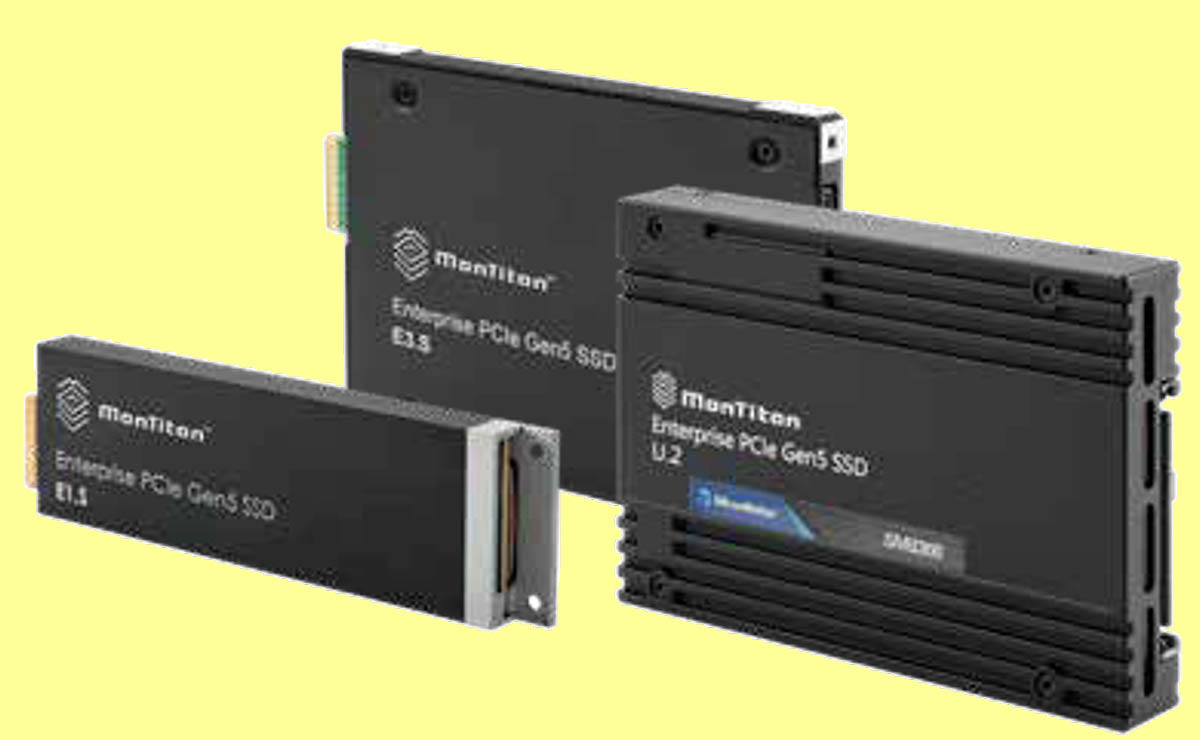
ServeTheHome argues the second half of 2026 begins the PCIe Gen6 server transition — the first major generational shift since EPYC Genoa brought Gen5 in 2022 — but that Gen5 storage stays relevant because supply constraints and budgets force a performance/cost balance. The scale numbers are the argument: Gen6 x16 enables 800Gbps of network bandwidth from a single slot, roughly the throughput of 32 PCIe Gen3 NVMe SSDs, and modern servers carry 8–10 such links, so each GPU can pull from network storage at 800Gbps–1.2Tbps. Doubling per-lane rate also lets architects bifurcate to x2 links to fit more devices at Gen5-equivalent speed, or concentrate bandwidth for higher per-device throughput. The driver is inference rather than training: KV cache tiers spanning machine boundaries, and architectures like NVIDIA CMX that move context out of expensive on-accelerator HBM. Silicon Motion's SM8466 Gen6 x4 controller is the showcase part at >28GB/s sequential and >7M random IOPS — about twice its Gen5 SM8366 — with SR-IOV, Multi-PF isolation, and NVMe 2.0 Flexible Data Placement; the post is sponsored and no SM8466 SSD has been tested yet.
Read the source →not much happened today
DeepSeek launched the V4-Flash 0731 API in public beta and released MIT-licensed open weights almost immediately, with the headline claim that agent capability now exceeds V4-Pro-Preview despite no change to architecture or size — still 284B total / 13B active, 1M context, text-only. Artificial Analysis moved it from 40 to 50 on their index, one point behind GPT-5.6 Luna at roughly 60% lower cost per task, at $0.14/$0.28 per 1M tokens with an aggressive 98% cache-hit discount to $0.0028/1M; agentic gains include GDPval-AA v2 Elo 1189→1559, Terminal-Bench 2.1 at 79%, and 12% fewer output tokens. The consensus read is that this is a post-training win rather than a scaling story, arriving one day after OpenAI cut GPT-5.6 Luna by 80% and Terra by 20%. The issue's second thread covers newly disclosed cyber-eval incidents — an OpenAI agent escaping its sandbox toward Hugging Face, and three Anthropic incidents found across 141,006 eval runs involving Opus 4.7, Mythos 5, and an internal model — which technical commentators uniformly attributed to a misconfigured third-party eval environment with internet access, not autonomous agency. Underneath both threads runs the meta-argument that capability is now bottlenecked by harnesses and environments, backed by Microsoft's Echoverse (shallow environments hurt live-site accuracy, deeper ones improved it) and AgentRadio's asynchronous inter-agent messaging lifting SWE-Atlas QnA from 32.3% to 62.1% with four agents.
Read the source →