AI Digest — August 1, 2026, 8 PM
Summary
Two of today’s items are the same argument delivered twice — that agent skills are unverified instructions carrying someone else’s taste, and that hoarding them actively degrades output — which suggests the “install more skills” phase of agent tooling is hitting its correction. That sits interestingly against the day’s capability news: OpenAI cracking decade-old math problems for under $2,000 a shot and Moonshot shipping a 2.8T open-weight model with a 1M context. The gap worth watching is that raw model capability keeps climbing while the scaffolding layer around it — skills, prompts, context budgets — is where practitioners are losing performance. Brockman’s Slack anecdote adds the social edge of the same problem: the constraint on agents increasingly isn’t what they can do, it’s how they’re wired into human work.
Somebody else decided what good looks like, and it shipped with the skill you installed. Here's the guide to fix it.
Nate argues that installing an agent skill proves nothing: what you actually imported was someone else's decisions about which tools to use, which shortcuts are acceptable, and what "done" means. He learned this with a recommended design skill that kept producing the same terracotta-and-maroon landing pages he was trying to escape — the skill ran exactly as written, just to someone else's taste. His sharper technical point is that both Codex and Claude Code cap how much of your skill list the model ever sees and silently trim it past that line, so a 25-skill library averages out conflicting instructions and yields duller work than five skills did. The remedy is a seven-step "one-job test": name the job, run one real task through the skill, and end with keep, fork, or delete, recorded in nine lines of evidence you can re-check months later. The trap he names explicitly is adding a skill to fix bad output — that is the loop that produced the bad output.
Read the source →Quoting Greg Brockman
Brockman reports that many OpenAI staff connect their ChatGPT to Slack, and the social result surprised them: people dislike being contacted by a coworker's ChatGPT asking for help with a task, even when they would happily do that same work if the coworker asked directly. The friction isn't about the work, it's about who is asking. He reads this as evidence that people care about the human relationship embedded in a request, and want AI to give time back or enhance time together rather than insert itself as a layer between colleagues. It's a small anecdote with a real product constraint inside it for anyone building agent-to-human delegation.
Read the source →datasette-apps 0.2a0
This alpha release adds two tools aimed at making Datasette Apps easier for the Datasette Agent to build and edit. applist() lets the agent enumerate the apps the user has permission to edit; appdebug() lets the agent open an app invisibly and run JavaScript against it. The debug trick is the interesting part: the app is rendered in an opacity: 0 iframe with pointer-events: none, so it can't be seen or clicked, and agent-supplied JavaScript executes inside that sandbox. That gives the agent a real smoke test — it can confirm the app works and even measure element dimensions — built on the context.browsertask() mechanism introduced in datasette-agent 0.4a0.
Read the source →Ten advances in mathematics and theoretical computer science
OpenAI set an internal version of its next major model, Astra, on ten mathematical problems that had seen no progress on the main result for at least a decade, and claims each solution cost under $2,000 at GPT-5.6 Sol token prices. Willison notes the obvious missing denominator: no word on how many problems consumed $2,000 without producing anything. The release is unusually transparent — Lean 4 formalizations in the openai/ten-proofs repo, a paper, and an LLM-generated PDF reconstructing how each proof came together from unpublished reasoning traces — though Willison still wants the prompts. This lands days after Anthropic's $100,000-in-tokens cryptography result, and mathematicians are having what he calls a collective Deep Blue moment, exemplified by Kirwin Hampshire's essay on a "profound spiritual crisis." He frames it against Terence Tao's "big mathematics": decentralized human-machine collaboration where humans take the creative parts and AI does the technical grunt work.
Read the source →Slack Emoji Maker
Willison wanted a custom Slack emoji, and Slack's uploader wants a 128x128 square with a transparent background. Rather than open a general-purpose image editor, he had Fable build him a purpose-made one constrained to exactly those requirements. It's a small demonstration of disposable, single-requirement tooling — the spec was the prompt, and the tool exists only to satisfy it.
Read the source →Kimi K3: The Complete Developer Guide

Moonshot AI's Kimi K3 is a 2.8-trillion-parameter model — the largest open-weight release to date and the first open model competing at the GPT-5.6 Sol and Claude Fable 5 tier. It uses the Stable LatentMoE framework at extreme sparsity, activating 16 of 896 experts (roughly 2% per token), with supporting techniques to keep training stable at that scale. Practical details for developers: a 1M-token context with automatic caching, an OpenAI-compatible API, reasoningeffort at low/high/max (max is the default), fixed sampling parameters you should omit entirely, and pricing of $0.30 per 1M cache-hit input, $3.00 cache-miss input, and $15.00 output. Two gotchas matter — K3 was trained in preserved-thinking-history mode, so you must forward the previous turn's reasoningcontent or the model reinvents its answers, and with strict JSON schemas you need generous maxtokens because the entire thinking trace is spent before the first schema-constrained token. On benchmarks it leads on SWE Marathon, BrowseComp, DeepSearchQA, AutomationBench and OmniDocBench, clearly beats GLM-5.2, and trails Fable 5 and GPT-5.6 Sol on a handful of others.
Read the source →Kioxia CM10 Series Launched for the PCIe Gen6 Generation of SSDs
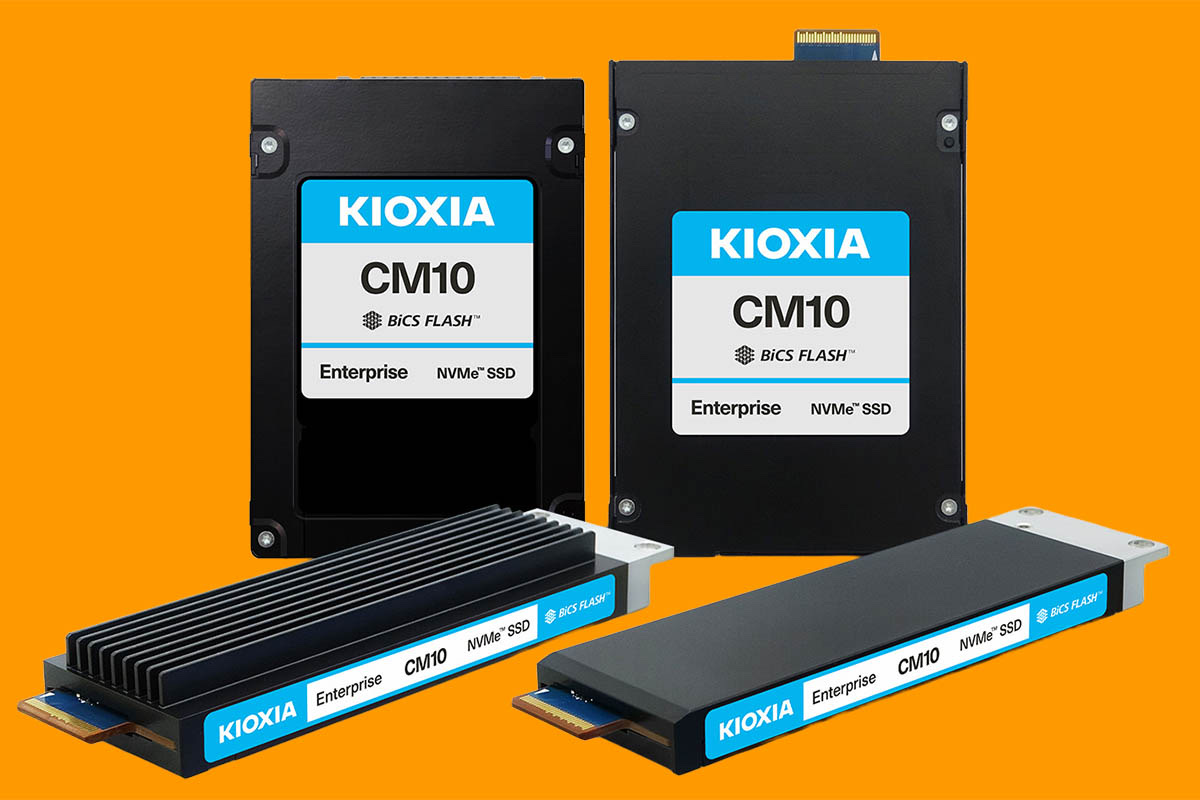
Kioxia's CM10, launched ahead of FMS 2026, is the company's entry into PCIe 6.0 enterprise storage, built on BiCS FLASH generation 10 and aimed squarely at AI KV-cache workloads and NVIDIA CMX context memory. Against the CM9 generation it claims roughly 92% higher sequential read and 85% higher random read performance, positioning it as a latency tier between GPU HBM and networked storage. The more consequential detail is a form-factor split: the EDSFF variants (E3.S at 7.5mm, E1.S at 9.5mm and 15mm) get Gen 10 flash, PCIe 6.0, and direct-cold-plate liquid cooling on the 9.5mm profiles, while the 2.5" option ships with older BiCS generation 8 TLC and only PCIe 5.0. ServeTheHome reads that as confirmation of its long-standing warning that U.2/U.3 will give way to EDSFF as Gen6 electrical and thermal requirements bite — a decade and a half of 2.5" dominance finally cracking. Expect the pattern to repeat: Gen5 drives on older NAND, Gen6 drives on newer.
Read the source →I Stopped Installing Claude Skills. Here's What I Do Instead.
Nate B Jones opens with the observation that most people don't realize their Claude, ChatGPT, or Codex already ships with skills, let alone what those skills do to their output. He defines a skill plainly — a set of instructions the model pulls in at a particular moment to get a job done, a recipe rather than an app — and stresses that the app mental model is exactly what misleads people. Skills come with no guarantee of behavior, and the deeper you go the messier it gets. His main warning is against treating GitHub skill repos like Pokémon cards: grabbing bundles of promised skills from untrusted sources and stuffing them into your agent typically doesn't work, both because the source isn't verified and because the collection itself degrades results.
Read the source →