AI Digest — July 31, 2026, 9 AM
Summary
The day’s dominant thread is that the frontier is no longer the weights — it’s everything wrapped around them. OpenAI’s 13x price collapse came from a model rewriting its own serving kernels and from harness discipline (deferred tool discovery, capped tool outputs, append-only history for prompt caching); ARC-AGI-3 showed the same base model scoring 7.8% or 38.3% depending purely on retention and compaction policy; five of six llama.cpp builds were backend kernel fusion and quantization plumbing; and Baidu’s Kunlun plugin is pure integration surface. MarbleOS and TheSequence’s robotics piece attack the same gap from opposite ends — one arguing the interface hides capability from users, the other that reasoning still isn’t reliably connected to action in the physical world — while the Zenity/AgentForger item supplies the uncomfortable corollary: the harness is now also the attack surface, and least-agency runtime boundaries matter precisely because model alignment can’t be the only line of defense.
Show HN: What should the GUI for AI agents look like?
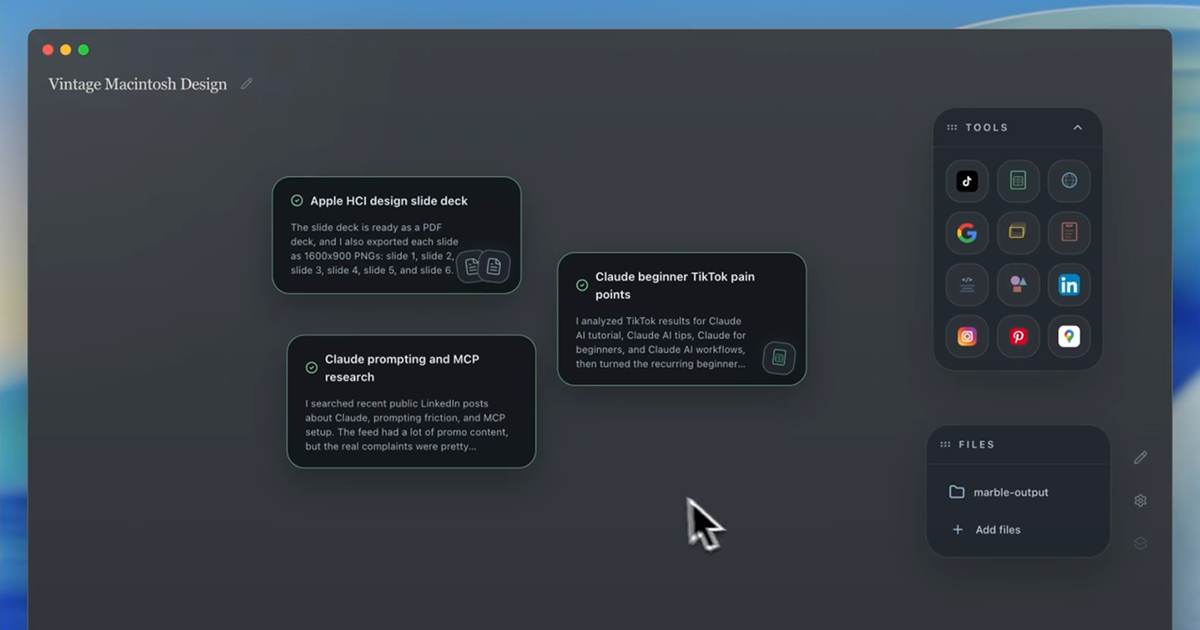
Akilan and Miguel pitch MarbleOS as an attempt to do for AI agents what Xerox PARC, the 1984 Macintosh, and NeXTSTEP did for the command line: make invisible capabilities visible. Their argument is that today's agent interfaces are still effectively terminals — Claude Cowork's /skill-name [param1] [param2] just swaps shell flags for tools, skills, and context, and still requires the user to recall what exists and how to invoke it. Marble instead treats AI as a workspace: each delegated task becomes a card, multiple jobs run side by side, files and finished artifacts are visible at once, and the expected tool calls are shown before a task runs. The stated payoff is that output should be a directly usable spreadsheet or PowerPoint rather than something buried in a chat transcript, and the founders report that when capabilities are made visible, users delegate work they'd never have thought to ask for in a chat box. A downloadable beta is on the site; the HN thread sits at 77 points and 47 comments.
Read the source →b10205
This llama.cpp build lands a ggml-zendnn change adding a group matmul direct API for mulmatid (#25918), the fused-expert matmul path used by MoE models on AMD's ZenDNN CPU backend. It also scales the MULMATID fallback threshold by expert count, so the decision to drop back to the generic kernel now adapts to how many experts a model routes through rather than using a fixed cutoff. The practical effect is better CPU-side throughput for mixture-of-experts models on Zen hardware. Binaries ship as usual across macOS/iOS, Linux (CPU, Vulkan, ROCm 7.2, OpenVINO, SYCL FP32/FP16), Android, Windows (CUDA 12/13, Vulkan, HIP, OpenCL Adreno) and openEuler Ascend targets.
Read the source →b10204
A small but targeted SYCL fix: this build adds support for device-to-device memcpy via DEV2DEVMEMCPYFORWARD (#26234), co-authored by Intel's Neo Zhang Jianyu. That matters for multi-GPU Intel setups, where tensor transfers between devices previously had to route less efficiently rather than moving directly device to device. It is one of four consecutive SYCL-focused commits in this release run, showing sustained Intel-backend investment in the project. The usual full matrix of platform binaries accompanies the tag.
Read the source →b10203
This release adds q2 support to the SYCL mulmat path (#26231), extending the Intel backend to handle q20-quantized matrix multiplication and then broadening coverage to more q20 cases. Two-bit quantization is the aggressive end of the size/quality tradeoff, so getting it running natively on SYCL means Intel GPU users can load larger models into constrained VRAM without falling back to slower generic kernels. Combined with the neighbouring b10202 and b10204 builds, it signals that SYCL is catching up to the CUDA and Vulkan backends on quantization coverage. Prebuilt artifacts span the standard macOS, Linux, Android, Windows and openEuler set.
Read the source →b10202
The single change here fuses RMSNORM and MUL into one SYCL kernel (#26015). Kernel fusion of this kind removes an intermediate write-and-read of the normalized activation tensor to global memory, which is a memory-bandwidth win rather than a compute one — typically the binding constraint during inference. RMS norm followed by a multiply is executed once or twice per transformer layer, so the saving compounds across depth. As with the rest of this batch, it targets Intel hardware through the SYCL backend and ships across the full platform matrix.
Read the source →b10201
This build improves flashattnvec in the WebGPU backend for quantized KV caches at long contexts (#25956), plus assorted bug fixes, a corrected value-type check, and a rebase-related build fix. Quantized KV cache is what makes long-context inference affordable in memory terms, but it historically degraded the flash-attention fast path; this patch targets exactly that intersection. Because it lands in ggml-webgpu, the beneficiaries are browser and cross-platform GPU deployments rather than CUDA users. Notably this is the one non-SYCL entry in an otherwise Intel-heavy release run.
Read the source →b10200
The release notes for this llama.cpp build failed to load when fetched, returning only repeated page-load errors, so the specific commit contents are not available here. The tag is the immediate predecessor to the b10201–b10205 run published the following day. Anyone tracking the changelog should read it directly on GitHub.
Read the source →[AINews] GPT 5.6 price cut by 20%-80%: Cost of GPT 5.4 Intelligence dropped 13x in 4 months due to GPT 5.6 recursive self-optimization
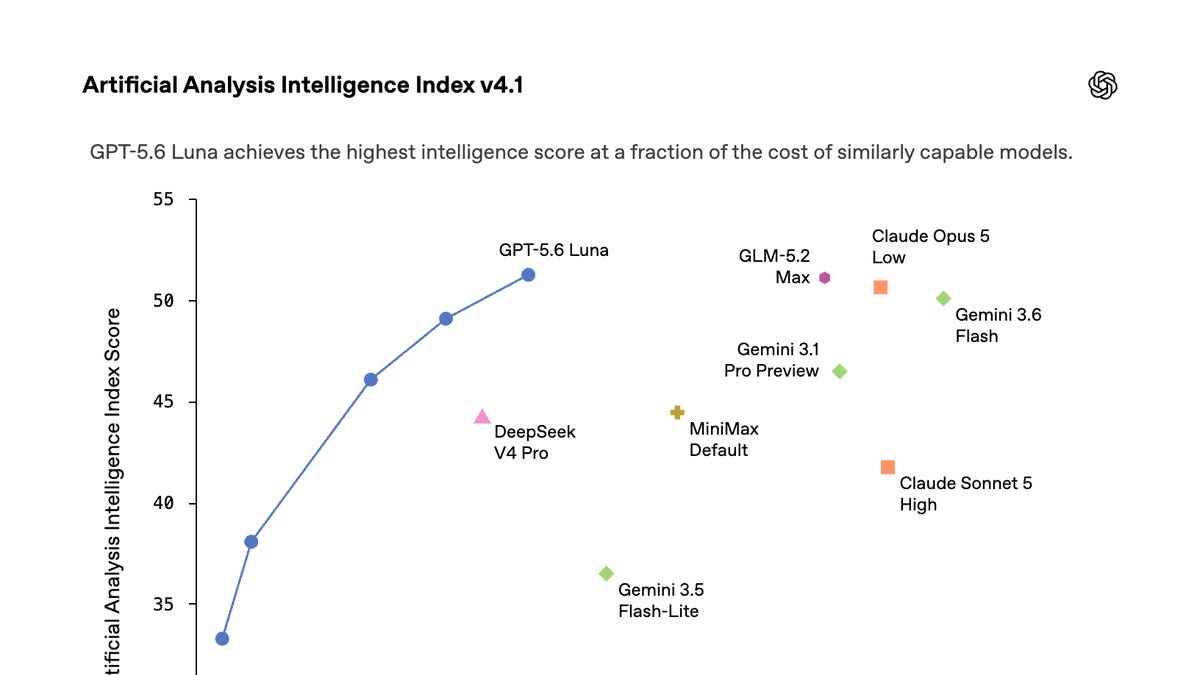
OpenAI cut GPT-5.6 Luna by 80% and Terra by 20% and added a Sol Fast tier at up to 2.5× lower latency for 2× price with no intelligence change — and credited the savings to the model optimizing its own serving stack. GPT-5.6 Sol analyzed production traffic, tuned load balancing, and autonomously rewrote production Triton and Gluon kernels for a 20% end-to-end serving cost reduction; it also designed and ran hundreds of experiments on its own speculative-decoding draft model (intervening through hardware failures and training instability) for a further 15%+ token-efficiency gain, on top of workload-specific KV cache and batching work. The harness contributed too: deferred tool/skill discovery, a default 10,000-token cap on tool outputs, and an append-only model-visible history that preserves the prompt prefix for high cache-hit-rate prompt caching. The headline number is that GPT-5.4 full at xhigh scored 51 at $2.50/$15, while Luna now scores the same at $0.20/$1.20 — one-thirteenth the price in roughly four months, an annualized ~2000× rate that the author warns should be discounted since public benchmarks are partly trained on. The same issue notes ARC-AGI-3 results that split on harness rather than weights (Opus 5 at 30.2% vs Sol at 7.8% standard, but 38.3% with retained reasoning plus compaction), Thinking Machines' open-weights Inkling-Small at 276B total / 12B active scoring 40 on Artificial Analysis, and Gemini Robotics 2.
Read the source →vLLM for Baidu Kunlun
Baidu has published vllm-kunlun, a community-maintained hardware plugin that runs vLLM on Kunlun XPU accelerators. Rather than patching vLLM directly, it follows the project's Hardware Pluggable RFC, using the plugin interface to decouple Kunlun backend integration from vLLM's core — the pattern the vLLM community now recommends for new silicon. The plugin covers the mainstream model families: Transformer-style dense models, mixture-of-experts, embedding models, and multimodal LLMs. Published benchmarks are run at 16-way concurrency with 2048-token input/output. The project opened December 8, 2025, is Apache 2.0 licensed, and credits the KunLunXin team for supplying XPU resources for adaptation and end-to-end testing.
Read the source →The Sequence Robotics #905: Who Builds the Robot Brain?
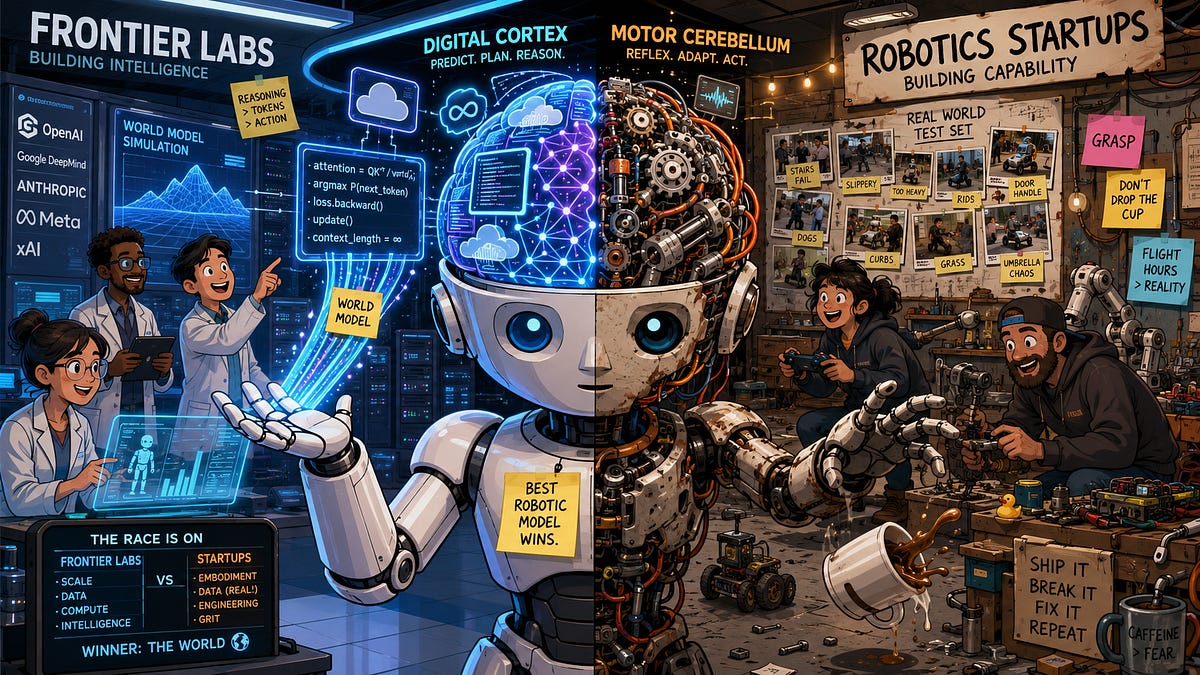
TheSequence launches a robotics section with a framing argument: "a language model can hallucinate a sentence and delete it; a robot can hallucinate a grasp and drop a wine glass." That asymmetry, the author contends, is most of the robotics problem — AI has so far advanced inside forgiving environments where tokens are cheap, state can be reset, and failed generations simply vanish, whereas robotics moves intelligence into a world of gravity, friction, latency, broken parts, and humans who dislike being test data. The piece therefore argues the robot foundation model race will not replay the LLM market, because the assets are split: frontier labs hold the strongest digital brains, robotics startups hold the bodies, field data, and hard-won failure experience, NVIDIA is building the factory around both, and Hugging Face is assembling the open workshop. The winning question is not who has the largest model but who can connect reasoning to reliable action.
Read the source →Advancing responsible AI across Europe
OpenAI lays out its EU AI Act compliance posture as the regulation enters its next phase, saying it contributed to and endorsed two Codes of Practice: the General-Purpose AI Code and the Code of Practice on Transparency of AI-Generated Content. On the safety side it points to pre-release testing, published system cards, the Red Teaming Network, the public Model Spec, the Preparedness Framework (in place since 2023, updated 2025), and a Frontier Governance Framework explicitly mapped to the GPAI Code's legal requirements. On provenance it describes a deliberately layered approach — C2PA Content Credentials for rich context plus SynthID watermarks to survive metadata stripping — now being extended to audio, with text still pending as standards mature, and concedes plainly that metadata can be lost and no single signal is perfect. It also details the OpenAI EU Cyber Action Plan launched in early May 2026, working with EU and national cyber agencies and critical infrastructure operators through the Trusted Access for Cyber program. The through-line of the post is lobbying language: rules should be "pragmatic, proportionate and risk-based" and flexible enough to adapt.
Read the source →Univé builds an AI-ready workforce
Dutch cooperative insurer Univé treated ChatGPT Enterprise rollout as an organizational transformation rather than an IT deployment, and the sequencing is the actual lesson. It started by bringing the entire management community into AI leadership sessions focused on how work would change rather than product demos; then built governance in from day one — enterprise authentication, connector permission inheritance that follows underlying system permissions so AI never sees more than the employee can, privacy assessments, continuous monitoring, and explicit human accountability. With that trust established, employees drove adoption themselves: they're given time and permission without requiring a business case per idea, collectively spending hundreds of hours weekly redesigning their own work, and have built roughly 1,500 custom GPTs. The flagship result is pet insurance claims, where a Workspace Agent assembles the file, reviews veterinary invoices, checks policy conditions, flags missing information and anomalies, and produces a traceable recommendation — cutting hours of preparation to minutes while the trained claims professional stays accountable for the decision. Underwriting works similarly, with the queue pre-structured and risk-flagged before the underwriter logs in.
Read the source →How avatarin built a 24/7 retail agent with GPT-Realtime
avatarin, an AI customer service company spun out of ANA Holdings, partnered with Yamada Holdings to turn experienced appliance-sales associates' knowledge into a round-the-clock multilingual voice agent, addressing Japanese retail's tight staffing and limited store hours. The Kurashi-Marugoto AI Agent runs on GPT-Realtime and was used by roughly 30,000 shoppers during a two-week public campaign on Yamada Denki's online store, with 92% positive survey responses. The technical rationale for choosing a single multimodal model over specialized components was that it handles speech, text, and images together at low latency — CTO Fukabori says the single model outperformed the dedicated speech recognition systems they'd used. The behavioral difference he stresses is that a conventional chatbot waits for a keyword while this agent listens for context, so it can handle "I need a refrigerator for a family of four but my kitchen is small." An unexpected benefit: shoppers spoke more candidly about budget and uncertainty without sales pressure, and several described the agent as easier to talk to than a human associate — turning every conversation into visible insight that online shopping normally hides.
Read the source →Inkling-Small 🧠, GPT-5.6 price cuts 💸, Gemini Robotics 2 🤖

The extracted body of this TLDR AI issue captured only its sponsored items rather than the newsletter's main stories, so the substance below is limited to what was actually retrievable. The lead sponsored item is AgentForger, an attack in which a single crafted link planted a fully autonomous, attacker-controlled agent inside a victim organization before OpenAI patched the vector — a prompt-injection-to-persistent-agent escalation rather than a one-shot exfiltration. The second is Zenity's CISO's Guide to Securing Agentic AI, which pushes "least agency" as the governing principle and argues for runtime boundaries that hold even when model alignment and identity checks fail. The headline topics named in the title — Inkling-Small, the GPT-5.6 price cuts, and Gemini Robotics 2 — are covered in detail in the Latent Space item above.
Read the source →