AI Digest — July 29, 2026, 9 AM
Summary
A cost-efficiency thread runs through the day: Nate’s deep-dive and the TLDR/CData item both zero in on caching reused context to slash token spend once workflows stabilize, while the Laguna story attacks efficiency from the model side — showing a 118B model outperforming trillion-parameter rivals, so you pay for far fewer parameters per unit of capability. Alongside efficiency, transparency emerges as a shared value: Poolside published every eval trajectory, Nate documents which changes he actually measured versus still assumes, and both resist treating a raw number (token count or parameter count) as a scoreboard. The panel connects this to organizational reality — enterprises like Saxo Bank pushing agentic development across hundreds of developers — underscoring that the day’s real question is how to run AI cheaply, verifiably, and at scale.
Your tenth message costs far more than your first. Grab the guide + the Token Saver skill: clean tasks, evidence selection, settled steps as code, accepted answers reused.

Nate cracked open his own token-burn tracker after a long Codex session and found 3.77 billion tokens across 143 threads and 28,877 local records — but the alarming part was that 3.59 billion (95.73%) of input was "reused" context rather than new prompts. His point is that the tenth message carries everything before it: prior exchanges, standing instructions, tool definitions, files, screenshots, browser results, command output, and rejected answers, so you type less but pay more. He stresses that reused ≠ useless — continuity (the decision from 20 minutes ago, the file already changed, the approved paragraph) is what makes agents work, and eligible repeated material can earn a provider cache discount. His experiment sets an aggressive target: cut reported reused input by 90% without increasing mistakes, retries, or review time, delivered via 15 measured changes, 9 no-install habits, and a "Token Saver" skill for Codex and Claude Code.
Read the source →The Sequence AI of the Week #903: Laguna, the 118 Billion Parameters that Walks Into a Trillion-Parameter Bar
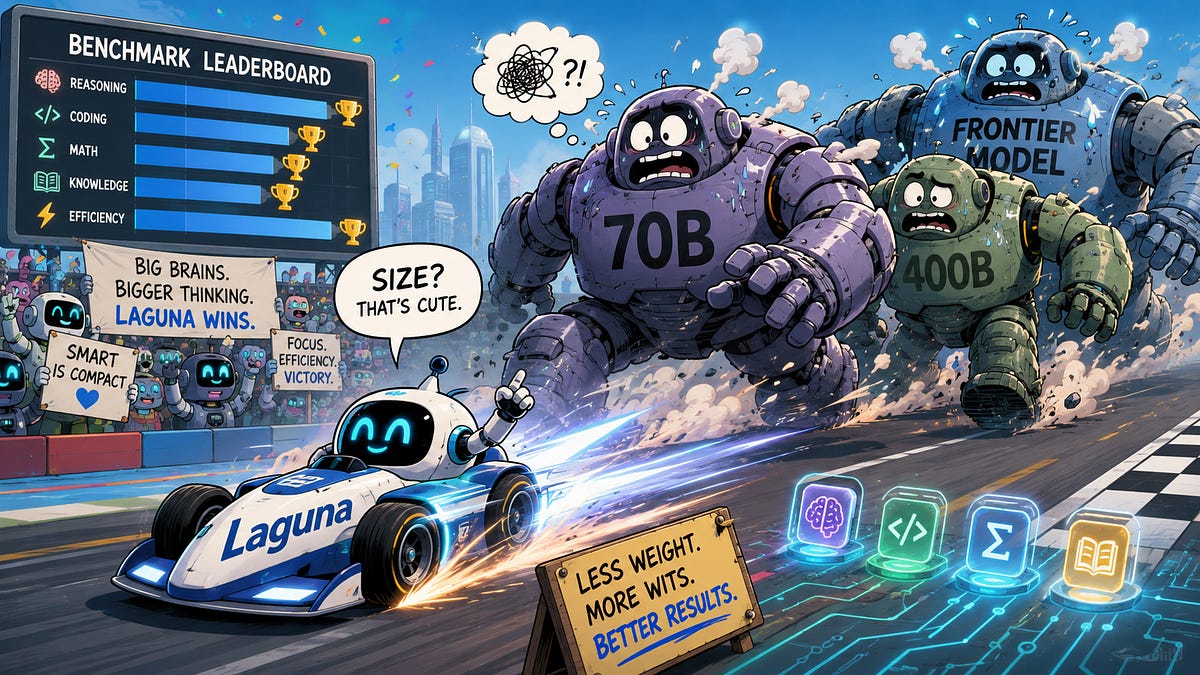
Plotting open-weight models by disclosed parameter count against Terminal-Bench 2.1 score gives the expected "bigger is better" cloud — except Poolside's Laguna S 2.1, at just 118B parameters, sits far above the trend line with a 70.2% score. It beats DeepSeek-V4-Pro-Max (1.6T params, 64.0), Inkling (975B, 63.8), and Nemotron 3 Ultra (550B, 56.4), all while being a fraction of their size. On the harder, less-saturated DeepSWE benchmark the gap becomes stark: Laguna scores 40.4 versus DeepSeek-V4-Pro-Max's 9.0 — a roughly 13x parameter deficit paired with a 4x score advantage. Because that result normally signals a broken eval, Poolside preemptively published every trajectory from every trial in the final evaluation set so readers can inspect exactly what the model did, a transparency choice the author reads as central to the release's design.
Read the source →AI slowdown pact ⏸️, Personal superintelligence access 🌍, Grok Build Mode 🛠️

This issue highlights CData Connect AI, which lets Claude discover connections on its own, inspect data and data models, and reason across multiple sources to answer questions nobody pre-specified — an open-ended, agentic querying approach rather than fixed pipelines. The complementary pitch is that once those workflows harden and access patterns stabilize, an optimization layer takes over to cache results, so repeated queries run at a fraction of the original token cost. The framing is explicitly skeptic-facing, inviting readers to run the benchmark themselves to calculate their own savings. The net theme is open-ended reasoning first, then caching-driven cost reduction once patterns settle.
Read the source →Stephane Jourdan, Simon Rohrer & Pini Reznik - From Pipelines to Prompts: Surviving the Shift to AI
This panel gathers three practitioners to discuss surviving the shift from traditional pipelines to AI-driven, agentic development. Simon Rohrer is head of enterprise architecture and ways of working at Saxo Bank in Denmark, where he runs the AI center of excellence and is rolling out agentic development across roughly 700 developers, and co-authored John Smart's book "Sooner Safer Happier." Pini Reznik is co-founder of Reync, a consultancy helping enterprises adopt AI for software development, infrastructure, and building large platforms (his prior company, Container Solutions, grew substantially). Stephane Jourdan is CTO and co-founder of a startup focused on context for production agents, with 15 years building startups for managing production systems, one of which was acquired by Snyk. The available transcript is truncated before the substantive discussion begins, so the panel's specific conclusions are not captured here.
Read the source →