AI Digest — July 29, 2026, 8 PM
Summary
Across the day’s items, the competitive edge is moving from a model’s raw benchmark score to the systems built around it: retained memory, cache-aware scheduling, specialized skills, trusted external context, and deployable governance. That shift makes openness more useful but also raises the cost of operating safely, whether the context is finance, code review, document automation, research, or self-hosted frontier models. The same pattern complicates comparisons: a model, its harness, its tools, and its control plane increasingly have to be evaluated together.
[AINews] AI is eating Finance; AIE NYC now open
AI adoption in finance is shifting from isolated copilots to infrastructure that must have ownership, evaluation, auditability, provenance, permissions, and supply-chain controls for reusable agent skills. Examples from banks, asset managers, data providers, and enterprise-finance vendors stress that answers and workflows need reconciled numbers, uncertainty labels, human review, and defensible action histories rather than polished demos. The accompanying news roundup also argues that agent safety is a full-system problem involving sandboxes, audit trails, access controls, memory, tools, and harness design.
Read the source →We’re launching Lyria 3.5 in Google Flow Music, with advances across musicality, lyrics, vocals, and creative control

Google is rolling out Lyria 3.5 in Google Flow Music. It says the model improves musicality, lyric generation, and vocal quality. The stated goal is to give creators more control while helping them make richer tracks.
Read the source →Formal methods with Hillel Wayne
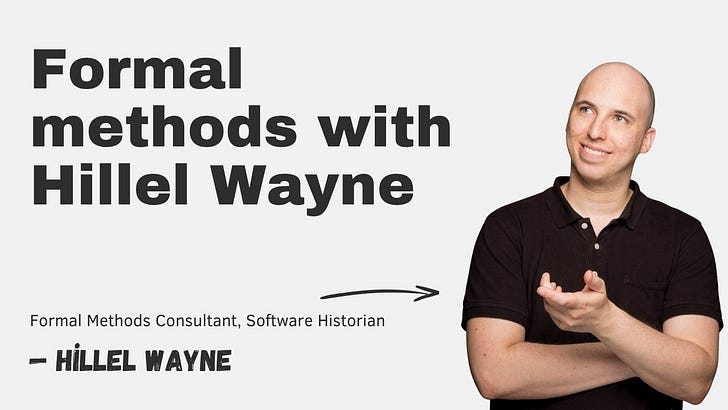
Hillel Wayne argues that formal methods are invaluable for the small set of systems where exhaustive reasoning pays for itself—especially distributed systems and concurrency—but that writing complete specifications makes them impractical as a universal default. TLA+ models systems as state machines and can expose failures conventional tests miss; AWS found one bug whose shortest reproducing trace had 35 steps. His practical recommendation for most teams is property-based testing, while expecting AI to expand formal verification from a niche rather than make it mainstream.
Read the source →Quoting D. Richard Hipp
D. Richard Hipp compares SQL’s effect on data work to today’s code-generation debate. SQL made it possible to specify queries declaratively instead of paying COBOL programmers to hand-write all the retrieval code. The implication is not that programmers disappeared, but that their work changed as the abstraction improved.
Read the source →AI Worming through Word
A disclosed prompt-injection technique places hidden instructions in a Word document that Copilot for Word may treat as instructions rather than source material. If Copilot copies those instructions into an output document, that output becomes a new carrier that can trigger and spread through later Copilot-assisted workflows. Microsoft had 144 days to address the report, but the post says no mitigation yet covers the entire class of self-replicating-document attack.
Read the source →Quoting Matthew Green
Cryptographer Matthew Green sees the transition from RSA and elliptic-curve cryptography to post-quantum standards as an unusually valuable opportunity for AI-assisted public cryptanalysis. If AI can find weaknesses in these new hard problems, it could improve confidence in the algorithms selected and strengthen the research literature. He notes the caveat that this optimistic outcome assumes AI does not broadly undermine the underlying hardness assumptions themselves.
Read the source →Adding a custom MCP server to Claude and ChatGPT
Simon Willison notes that both Claude and ChatGPT’s standard chat interfaces can connect to a custom MCP server. He cautions that the setup currently involves quite a few steps. The item is a short pointer rather than a configuration guide.
Read the source →How enabling two settings tripled our scores on the ARC-AGI-3 benchmark
OpenAI says ARC-AGI-3 results changed dramatically when its harness retained private reasoning between actions and used context compaction instead of rolling truncation. GPT-5.6 Sol’s public-set score rose from 13.3% to 38.3%, while output-token use fell sixfold; the official harness had discarded both reasoning and, eventually, older action history. The lesson for builders and evaluators is that benchmark scores reflect the model plus API settings, memory policy, prompting, and harness—not weights in isolation.
Read the source →Accelerating scientific discovery with ChatGPT for Academic Researchers
OpenAI is launching free frontier-model access for 10,000 researchers initially, expanding to 100,000 researchers at selected institutions by 2027 as part of a commitment exceeding $250 million. Participants receive GPT-5.6 models, higher limits and context windows, skills and connectors, privacy protections, and may invite up to four institutional collaborators. OpenAI reports that about 1.3 million people already use ChatGPT for advanced science and mathematics weekly, and says intensive AI users are nearly twice as likely to delegate tasks estimated at four or more hours.
Read the source →How GPT-5.6 fuses frontier intelligence with frontier efficiency
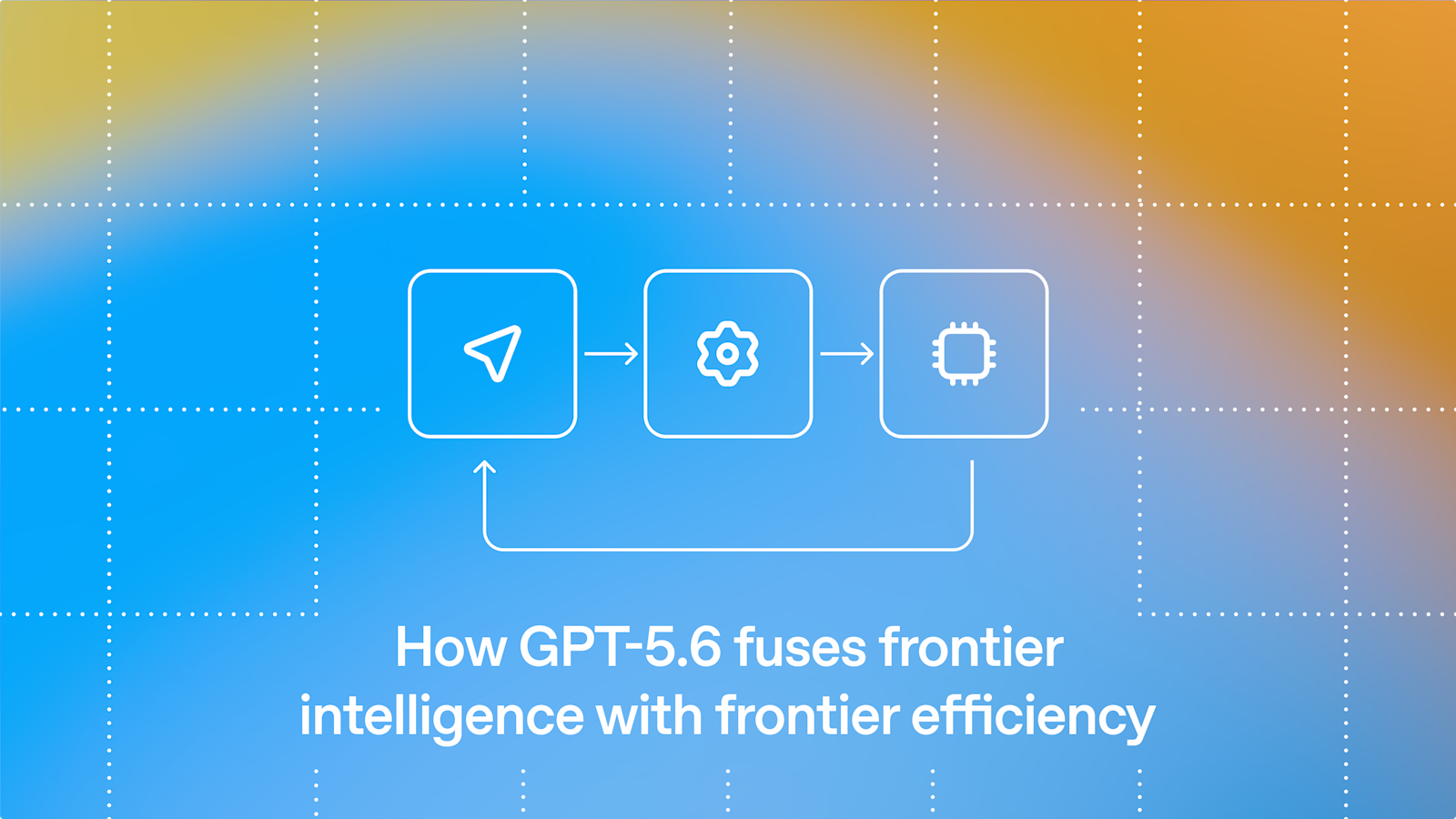
OpenAI attributes GPT-5.6’s cost-performance gains to joint optimization of the model, inference stack, and agent harness rather than model capability alone. It says Sol-assisted production kernel work cut end-to-end serving costs 20%, and Sol-designed speculative-decoding work increased token-generation efficiency by more than 15%. The post also emphasizes avoiding repeated agent work—context bloat, tool overhead, and process startup costs compound across many requests in a single task.
Read the source →Together AI announces strategic partnership with Moonshot AI to natively serve Kimi models
Together AI will serve Moonshot AI’s open-weight releases from launch, beginning with Kimi K3, through US-hosted infrastructure with zero data retention and options for serverless, reserved, and dedicated inference. It describes K3 as a 2.8-trillion-parameter sparse MoE model with vision and a one-million-token context window, positioned for long-horizon coding and agent workflows. The partnership also offers post-training—including LoRA reinforcement learning and supervised fine-tuning—with a native path from checkpoint evaluation to deployment.
Read the source →ThunderAgent: 2x Faster Agentic Inference for Synthetic Data Generation at Scale
Together AI’s open-source ThunderAgent treats a multi-turn agent workflow as a schedulable program instead of independent LLM requests. That lets it pause lower-priority workflows under memory pressure, track KV-cache footprints, and route resumed work to the node with capacity, reducing cache-thrashing caused by tool waits and fixed node pinning. In its CoderForge-style tests, it reached 803 versus 390 tokens/s at batch size 192 on one 8×H100 node, and 2.39× the SGLang Gateway speed on eight nodes; adoption only requires adding a programid to OpenAI-compatible requests.
Read the source →The Ultimate Knowledge Base: Bring YouTube Into Your AI Second Brain
The video presents Google’s Open Knowledge Format as a proposed agent-to-knowledge-base standard, analogous to MCP for tools and A2A for agents. Its demonstration packages roughly 200 videos from the creator’s channel into a searchable knowledge bundle so an agent can answer cross-video questions and cite the relevant videos. It also promises a workflow for building comparable knowledge bases from other YouTube channels.
Read the source →We Scored Oracle's Database Skill Live: 95% Isn't Enough
A live review examines Oracle’s repository of database skills, which provides agents with product-specific guidance for SQL, operational tasks, containers, and niche features such as property graphs. The speakers argue that local, tested skill context reduces the need to hunt documentation and can encode secure, scalable best practices, especially when paired with a database MCP server. Tessl’s reviewer initially scores an Oracle database skill at 95%, then applies suggested verification steps for slow-query diagnosis and reaches 100%, illustrating iterative review and PR-based improvement of SKILL.md files.
Read the source →Paste This Into Claude, Never Hit a Token Limit Again
Nate B. Jones explains that token limits are mainly driven by repeatedly resending accumulated conversation context, not by the latest user message. In one tracked Codex workspace day, 3.59 billion of 3.77 billion processed tokens—about 96%—were reused input across 143 threads. The video frames retries and long chats as particularly expensive because each repeats the history, then promises practical rules, an accompanying skill, and a more technical multi-agent solution for managing that growth.
Read the source →The last30days Skill: How to Fix Claude Code's Research Problem

The open-source last30days skill is positioned between quick web search and costly deep research: it collects posts, comments, and transcripts across Reddit, Hacker News, GitHub, YouTube, TikTok, Instagram, LinkedIn, Bluesky, X, and other sources, then synthesizes sentiment into a ranked brief. It can be invoked with /last30days or natural language, scoped to selected platforms, and typically takes about five minutes; raw results are also saved as JSON for inspection. Most sources auto-configure without cost, while X needs an xAI key at roughly $0.10 per run and some social sources have dependency or subsidized-call requirements, so the author recommends it for genuine sentiment questions rather than routine lookups.
Read the source →Optimizing vLLM on Arm CPUs
vLLM and collaborators improved Arm Neoverse CPU serving by fixing stack-wide bottlenecks rather than focusing only on GEMM kernels: PyTorch now defaults to mimalloc on Arm, libgomp can use LSE atomics, and oneDNN pre-packs weights during warmup. The allocator alone improved Llama 3.1 8B offline throughput 2.3× and low-concurrency serving by about 7×, while weight prepacking reduced output-token latency by 60% and optimized paged attention reached up to 4× faster. An INT8 W8A8 path using Arm I8MM/SMMLA can add as much as 88% throughput versus the optimized BF16 baseline, alongside lower TTFT and per-token latency.
Read the source →Kimi K3: How Did Open Source Catch Up To Closed LLMs?
The video argues that Moonshot AI’s Kimi K3 sharply narrows the presumed three-to-six-month gap between open and closed frontier models. It describes K3 as an open-weights multimodal model with 2.8 trillion parameters—75% larger than DeepSeek V4—and claims it approaches or exceeds Claude Fable 5 on some benchmarks. The episode sets out to explain the architecture and scaling choices that enabled this result, while highlighting the growing appeal of hosting or training directly on frontier open weights.
Read the source →Cursor, now on iPad

Cursor is now available on iPad for all paid plans, with an interface designed to keep sidebar chats visible while monitoring several agents, reviewing diffs, and working in split screen. Its mobile review surface now covers an entire PR, including comments, checks, approvals, reviewer changes, and agent-assisted resolution. Both iPhone and iPad gain an inbox for work and review status, plus Bitbucket and Azure DevOps support, multi-PR access from one chat, team switching, and screenshot markup with Apple Pencil.
Read the source →5 AI Engineering Trends That Non Engineers Should Know About
The video reports that OpenAI’s first consumer device is in prototype development as a portable, screen-free smart speaker intended to remain mostly in the home. Sources describe a ChatGPT-like companion that can control smart-home devices, play music, use memory, and use cameras and sensors to understand its environment, with real-time two-way voice interaction. Unlike a conventional smart speaker, it may include self-moving components and be rechargeable for use around the home, reflecting a bet that a more human-like interaction model can differentiate it from Alexa-style devices.
Read the source →Why Everyone Is Debating AI Policy
The episode argues that policy and geopolitics directly determine which AI models people can access, at what cost, and which tools and systems can be built around them, rather than being a peripheral concern for practitioners. It focuses on the conflict over open-source AI and asks listeners to treat the debate as consequential for careers, product choices, and the future availability of models. Its central framing is that the stakes are practical as well as geopolitical.
Read the source →Copilot code review: Agent skills and MCP now generally available
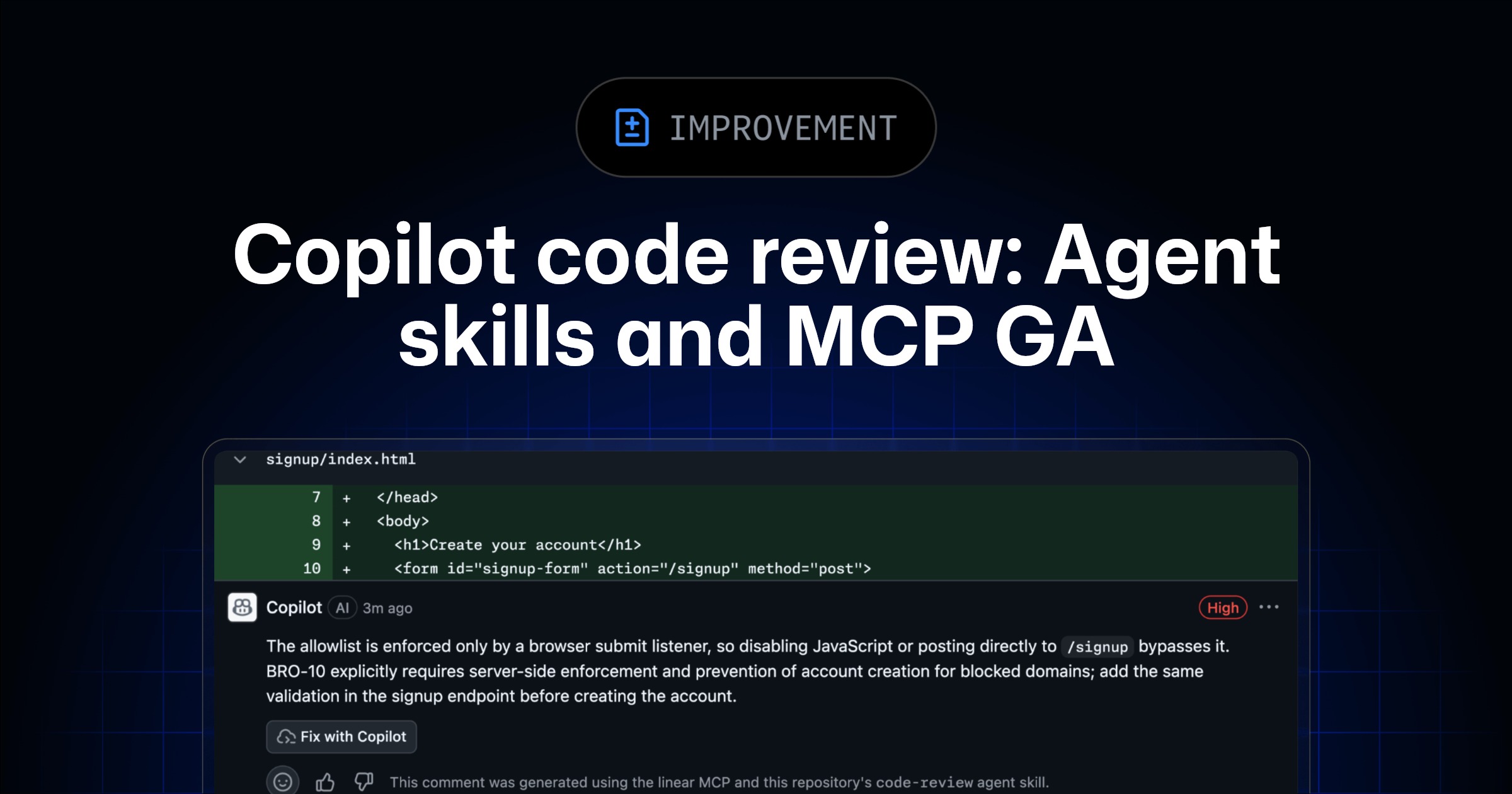
GitHub Copilot code review now generally supports repository skills and MCP servers for Pro, Pro+, Business, and Enterprise users. Skills live in skill-specific directories under .github/skills and allow reviews to apply internal standards and tools; MCP connections can bring in context from systems such as issue trackers and documentation, but all MCP calls in code review are read-only. Review comments now identify whether skills or MCP context informed them, existing cloud-agent configurations carry over, and GitHub and Playwright MCP are enabled by default.
Read the source →Default model enablement for Copilot Business and Enterprise
GitHub is adding a global policy under which generally available Copilot models will become enabled by default for Business and Enterprise customers unless administrators opt out. The policy is configurable for 28 days without changing access; on August 26, unconfigured models become “inherits default” and dynamically follow the setting, while explicit per-model choices remain intact. Open-weight models such as DeepSeek and Kimi K2.7, along with models outside GitHub’s data-retention agreement such as Fable 5, are excluded, so administrators who require individual approval should disable the policy before it takes effect.
Read the source →not much happened today
The roundup highlights the operational reality of frontier open models: Kimi K3 quantizations still range from 594 GB to 1.56 TB, while experimental home-lab runs demonstrate feasibility at roughly 4 tokens/s on 768 GB RAM plus two RTX 5090s but expose significant hardware, heat, and utility tradeoffs. It also links the open-weights debate to recent agent-security incidents and a contested call for frontier “pacing,” with the recurring conclusion that safety evaluation must cover the chatbot, memory, tools, and harness rather than the base model alone. Meanwhile, it notes OpenAI’s security CLI, academic-access program, and reported inference gains as signs that agent deployment and AI-assisted infrastructure optimization are becoming concrete engineering work.
Read the source →