AI Digest — July 27, 2026, 9 AM
Summary
The dominant thread today is that agentic performance now hinges on cost-per-accepted-result and verification, not raw model quality — Nate’s stitched-quotation failure, Together AI’s Kimi-vs-Sol routing (where a test suite is what turns model disagreement into free accuracy), Google’s efficiency-priced Flash line, and vLLM’s SLA-first tuning all treat a cheap or fast model as useful only when a checker catches its bad output. Against that optimism about capability (MirrorCode’s week-long tasks solved in hours), IndyDevDan supplies the countercurrent: the more of your proprietary knowledge you feed these systems to get good results, the more you risk handing your “alpha” to a vendor that competes with you. Meanwhile OpenAI’s task-crossover data and NVIDIA’s surgical simulator show the same expansion playing out in practice — AI letting people (and policies) take on work well outside their original boundaries.
Stop guessing whether a cheaper model can do the job. Grab the bakeoff guide: the validator, the manifest, the score sheet, and the fixtures.
Nate argues that the "should we use Chinese models" debate is framed wrong: the decision is not about a country but about a specific job, endpoint, and verification check, and serious AI users should test DeepSeek, Qwen, GLM, Kimi, and MiniMax selectively rather than declaring the whole stack usable or unusable. His central cautionary tale comes from a 34-task run of his "Ringer" multi-agent system, where one worker reported 213 verified quotations but 13 turned out to be stitched together — illustrating that a cheaper model's token price is misleading because it can double your review time. He stresses that the real cost metric is what an accepted result costs, not the sticker price per token. The post ships a bakeoff kit (validator, manifest, score sheet, two fixtures to prove your checker rejects bad work), and he notes the run that taught him all this cost roughly $8.
Read the source →Introducing Gemini 3.6 Flash, 3.5 Flash-Lite, and 3.5 Flash Cyber

Google DeepMind is releasing efficiency-focused Flash models aimed at production agents. Gemini 3.6 Flash consumes 17% fewer output tokens than 3.5 Flash on the Artificial Analysis Index while improving coding and knowledge work, and it drops in price to $1.50/1M input and $7.50/1M output tokens, lowering the overall cost per agentic task. The new 3.5 Flash-Lite is the fastest in the series at 350 output tokens/s, priced at $0.30/1M input and $2.50/1M output, and now ships computer use as a built-in tool for agentic workloads. The post also confirms Gemini 3.5 Pro is testing with partners and that DeepMind has begun its "most ambitious pre-training run yet" for Gemini 4.
Read the source →Kimi K3 vs GPT-5.6 Sol on DeepSWE: Cost, Coding, and Routing
Together AI analyzed all 904 graded rollouts (113 tasks, four trials each) on the DeepSWE software-engineering benchmark and found the two models are complementary rather than one being simply better. GPT-5.6 Sol wins single-shot (72.7% pass@1 vs 68.5%) and is steadier — 84.5% reliability, solving 61 tasks four-for-four — while open-weight Kimi K3 wins pass@4 (89.4% vs 85.8%), casts a wider net (89.4% coverage), and costs 64% less per completed task ($4.65 vs $8.37 a rollout). Because they disagree on 18 tasks and fail in different ways (correlation just 0.46), routing beats either alone: run Kimi K3 first and escalate to Sol only when your test suite rejects the result, reaching ~85.6% and clearing ~70% of the queue before Sol is invoked. The hard ceiling for the pair is 95.6% — five tasks are solved by neither, so beyond that you need a third model, not a better router.
Read the source →How AI is expanding what people do at work
OpenAI's Economic Research team launched a "Work at the Frontier" series analyzing more than 800,000 U.S. ChatGPT messages, finding that 16.8% of work-related messages — and 43.5% of occupation-specific (non-generic) messages — concern tasks associated with a different occupation. They call this "task crossover": a salesperson exploring a dataset that once went to an analyst, a marketer troubleshooting a website without a developer, a small-business owner drafting copy or reviewing a contract. Financial calculation and technology troubleshooting appear among the top three outside tasks for all seven other occupation groups, and marketing and engineering tasks travel farthest into other fields. The directions differ by role: designers borrow heavily from other occupations (35.2% of their messages) while design work rarely appears elsewhere, whereas engineering supplies tasks broadly but borrows less (18.5%).
Read the source →Simon Obstbaum & Rob Willoughby - Why evals are hard and how we're solving it - AI Native DevCon Jun
The available transcript is almost entirely conference stage logistics — a host promoting the "Grenola" skill for browsing recorded talks at tessal.io, reminding attendees about extra afternoon workshop slots, and introducing Simon Obstbaum and Rob Willoughby to the stage. The substantive talk on why evals are hard and how the speakers are solving it is cut off before its content begins, so the actual argument and findings are not captured in the provided material.
Read the source →Is Anthropic STEALING Your Data? (While You PAY FOR IT)
IndyDevDan poses the question of whether Anthropic competes with its own customers by absorbing the proprietary knowledge users must feed its models to get good results. He anchors the argument in two executive quotes: Satya Nadella's warning that you "pay for intelligence twice" — once in money and again in the proprietary knowledge you reveal — and Palantir's Alex Karp saying technical customers want control over their compute, models, data, and "alpha," with assurance the means of production isn't transferred elsewhere. He cites Microsoft banning "Fable 5" over a 30-day ZDR data-retention policy as evidence enterprises take this seriously. His framing is that language models and agents are far more extractive than Google Search because what's handed over isn't just a query but the intelligence of the business itself.
Read the source →From Day 0 to Production SLAs: Serving GLM-5.2 on 24 NVIDIA B300 GPUs with vLLM
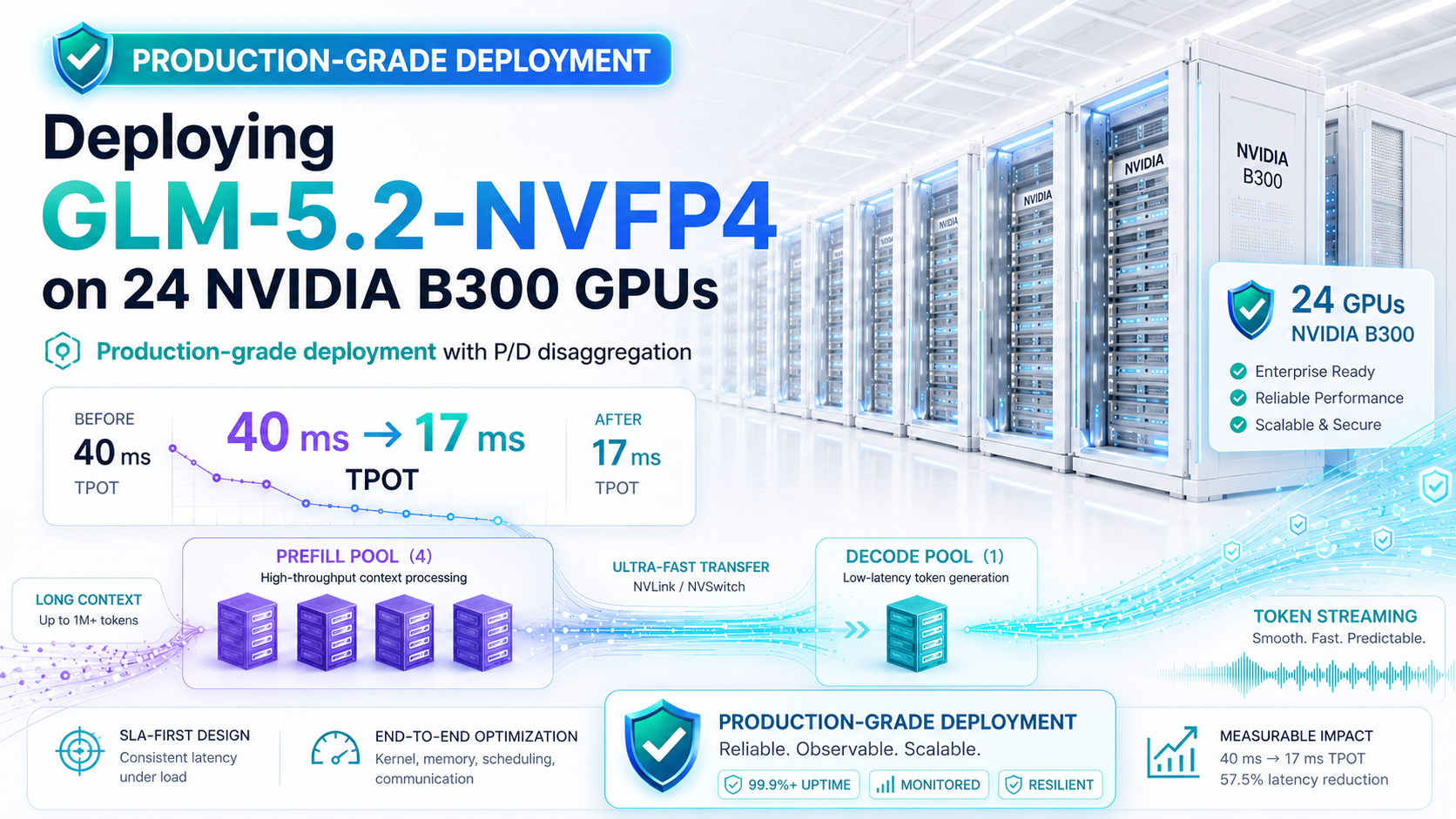
vLLM documents cutting GLM-5.2-NVFP4 decode latency from ~40 ms to 17 ms mean TPOT on 24 B300 GPUs, using a disaggregated 4-Prefill + 1-Decode topology to hit production SLAs of TTFT ≤ 2.5s and TPOT ≤ 20ms. Disaggregation is the enabling move: it removes prefill work from the decode critical path so TPOT depends only on decode batch composition rather than incoming prompt-length distribution. A key fix addressed the interaction between P/D disaggregation and MTP speculative decoding — newly transferred requests compute only one token on their first decode step, creating mixed batches that fall off the fast CUDA-Graph path, so they pad shapes with dummy speculative tokens to 1+N to match existing requests. Notably, they chose a parallelism strategy that is not the highest raw throughput, because a config that improves throughput 30% but violates the TPOT SLA is useless; measured concurrency settled around 700 requests at 8K context, 300 at 16K, and 25 at 256K.
Read the source →How to Get the Most from AI This Summer
The AI Daily Brief walks through Ethan Mollick's updated "opinionated guide to which AI to use to do stuff," emphasizing how much has changed: using AI no longer means just chatting with a model but running agentic systems that can do many hours of human-equivalent work by combining a model's reasoning with tools that plan and act. Mollick splits advice into two buckets — for low-stakes answers (a recipe, drafting a letter) almost any frontier model will do, while more demanding work benefits from agentic setups that effectively give the AI a computer to use. The episode also previews AIDB's new "choose your own adventure" training program at summeradventure.ai for expanding AI skills through practical projects. The overall thrust is action-oriented and practical, nudging listeners to experiment with and rethink their workflows.
Read the source →NVIDIA Cosmos-H-Dreams: Bringing Real-Time Generative Simulation to Surgical Robotics

NVIDIA introduces Cosmos-H-Dreams, a real-time, action-conditioned generative simulator for surgical robotics that distills its bidirectional Cosmos-H-Surgical-Simulator teacher into a causal, few-step student model served through the FlashDreams streaming-inference library, running interactively on a single RTX PRO 6000 GPU. The system takes an initial RGB frame plus a live stream of robot kinematics and autoregressively generates the next chunk of frames, letting a person or a learned policy operate in a closed loop — addressing the difficulty of modeling deformable tissue, sutures, needles, smoke, and occlusions that conventional simulators struggle with. Crucially, the teacher is fine-tuned on the JHU dVRK tabletop mixture including failures and out-of-distribution episodes (needle drops, missed throws, failed knot ties), because a simulator meant to evaluate policies must reproduce the consequences of bad actions, not just ideal demos. Training progressively grows the temporal horizon from 12 to 72 frames for stable long rollouts, and NVIDIA demonstrated versatility by integrating it with CMR Surgical's Versius controller.
Read the source →Import AI 466: The bitter lesson for robotics, AIs complete week-long programming tasks; and OpenAI's accidental AI hacker

Import AI leads with MirrorCode, a new benchmark from Epoch and METR testing long-horizon programming by having AI systems fully reimplement software programs using only CLI access — no source code or web. The results are striking: Opus 4.7 solved one task in 14 hours for $251 in inference that METR and Epoch estimate would take a human 2–17 weeks, and across all 25 target programs, 17 had at least one perfect-scoring run with four more scoring over 99%. Both Claude Opus 4.7 and GPT-5.5 successfully reimplemented programs like gotree (a phylogenetic-tree tool) across multiple languages at $100–400, and Opus reimplemented Apple's 61k-line pkl configuration language. The authors note leading models from a year ago would have scored ~30% and were limited to simple utilities, underscoring rapid improvement, though the benchmark may prove a little too easy.
Read the source →